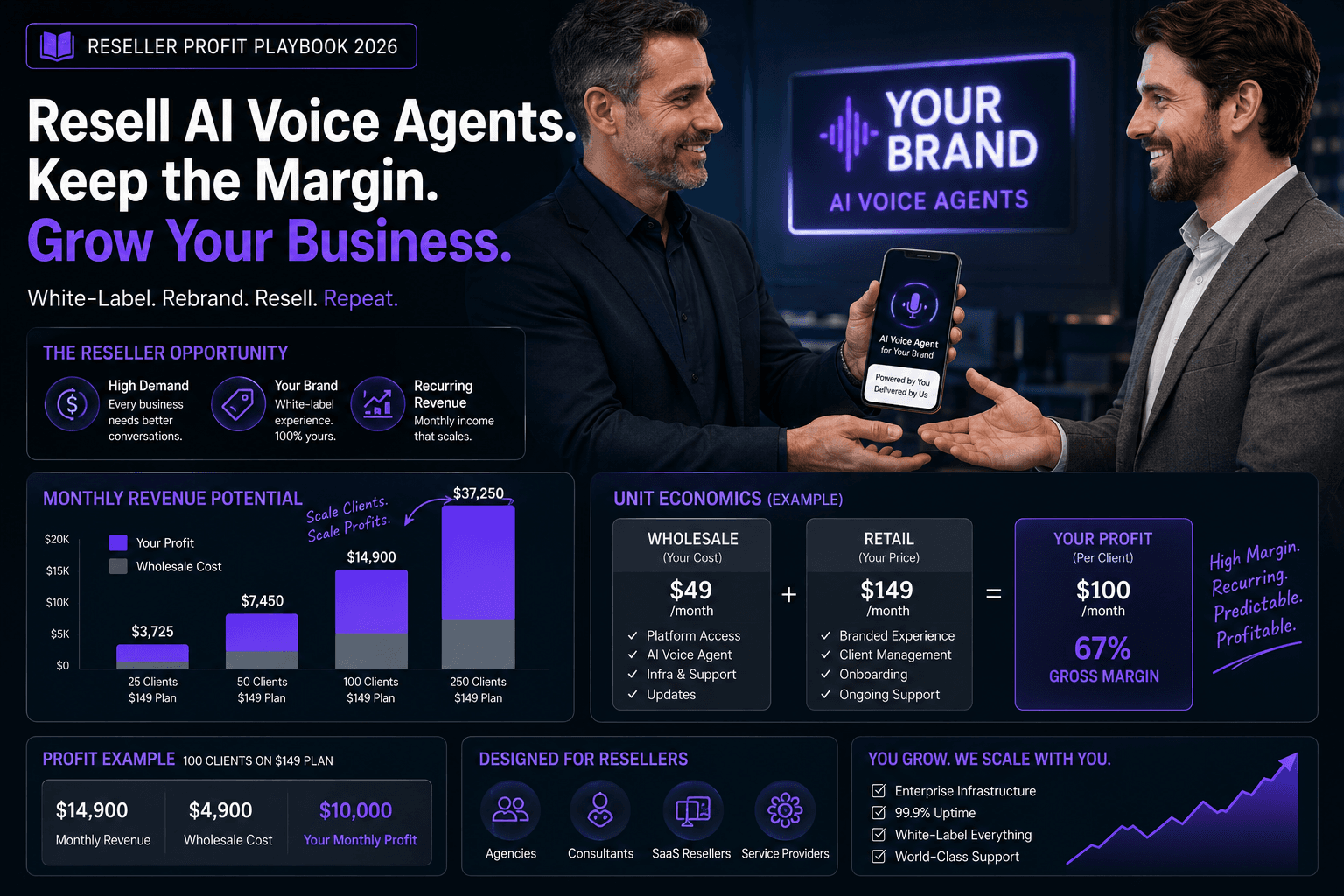
White-Label AI Voice Agent Pricing and Margins in 2026
Three-tier packaging, real price points by vertical, the per-minute cost stack, and where margin leaks out of a reseller business.
Utkarsh Mohan•Jul 27, 2026
White-label AI services let agencies resell voice agents, AI receptionists, and appointment reminders under their own brand. This 2026 guide covers which AI solutions to package, the margin math behind reselling AI voice agents, and how to launch a recurring-revenue AI agency fast with Ringlyn's white-label platform.
Divyesh Savaliya
Published: Jul 20, 2026

White-label AI services are AI-powered products — voice agents, AI receptionists, automated appointment reminders, lead-qualification callers, and more — that a platform provider builds and operates, but that you resell to your own clients entirely under your own brand. The end client never sees the underlying vendor. They see your logo on the dashboard, your domain in the browser bar, your name on the invoice, and your team as the point of contact. In practice, white-label AI means you get to sell a sophisticated, production-grade AI product without hiring a machine-learning team, provisioning telephony infrastructure, or maintaining a single line of orchestration code. The platform handles the hard engineering; you handle the client relationship, the pricing, and the brand. This is the same model that powered the last decade of agency growth in web hosting, email marketing, and CRM reselling — now applied to the fastest-growing category in software: applied AI.
The distinction that matters for agencies is between reselling and white-labeling. A plain reseller passes through someone else's branded product and earns a referral cut, but the client always knows they are buying a third-party tool. A true white label AI solution removes every trace of the vendor: brand removal across the interface, a custom domain, a rebranded client dashboard, and billing that runs through your own payment processor so the money lands in your account first. That difference is what transforms a thin commission into a durable, high-margin business. When the product is yours in the eyes of the client, you own the pricing power, the upsell path, the retention, and the enterprise value of a recurring revenue book. Agencies exploring this model should look closely at how a platform's agency and white-label program is structured, because the depth of rebranding directly determines how much margin and defensibility you can build.
The timing for launching a white-label AI agency in 2026 is unusually favorable, and it comes down to a rare alignment of demand, supply, and tooling maturity. On the demand side, small and mid-sized businesses have spent the past two years watching AI voice agents answer phones, book appointments, and follow up on leads flawlessly — and they now expect these capabilities but overwhelmingly lack the technical staff to deploy them. A dentist, a med spa, an HVAC contractor, or a real estate brokerage does not want to configure large language models and telephony webhooks; they want a partner who shows up, sets it up, and sends one monthly invoice. That partner is you. On the supply side, the underlying AI voice technology has crossed the quality threshold where a well-configured agent is genuinely hard to distinguish from a trained human receptionist, which means the product finally sells itself in a live demo.
What was missing until recently was the third leg: mature white label AI software that lets a non-technical agency operator launch a branded product in days rather than months. Historically, an agency wanting to offer AI voice services had to either build on raw APIs — hiring engineers, managing infrastructure, and shipping a fragile custom dashboard — or accept a co-branded reseller arrangement that capped both margins and brand ownership. In 2026 that gap has closed. Turnkey white-label platforms now bundle brand removal, custom domains, multi-tenant client management, and Stripe rebilling into a single fixed-cost plan, so the entire cost of goods for your AI service is predictable and flat while your revenue scales with every client you sign. That combination — surging demand, product quality that closes deals, and tooling that removes the engineering barrier — is exactly why 2026 is the window to start an AI agency before the category becomes crowded.
Before designing an offer it is worth knowing where the market has actually settled, because the range is wide and the extremes are misleading. Published 2026 benchmarks across the white-label voice AI category put agency gross margins at 50% to 75% in typical operation, rising to 70% to 90% for agencies with disciplined implementation and support practices. The gap between those two bands is almost entirely operational — it is not a function of which platform you picked.
On the revenue side, agencies commonly bill clients $297 to $997 per month while paying $99 to $299 per month in platform fees under subscription arrangements. Underlying voice minutes cost the provider somewhere between $0.07 and $0.31 per minute depending on the stack. Platform pricing across the category spans an enormous range, from around $29 a month at the entry level to $2,000 or more for full white-label and reseller tiers.
| Metric | Market range | What moves you to the top of the range |
|---|---|---|
| Agency gross margin | 50% – 75% typical; 70% – 90% strong | Bounded support, standardised onboarding, no free custom work |
| Client price per month | $297 – $997 | High-value verticals; outcome-based positioning rather than software pricing |
| Platform cost per month | $99 – $299 subscription | Falls toward zero per client under a fixed licence |
| Voice minutes (provider cost) | $0.07 – $0.31 per minute | Budget TTS and a lean stack sit at the low end |
| Referral commission (if you do not white-label) | 20% – 40% of invoice | This is the ceiling if you never own the client relationship |
| Setup fee | $500 – $1,500 one-time | Charged on every account; shortens payback materially |
2026 white-label voice AI market benchmarks — where agency pricing and margins actually sit
The single most instructive number in that table is the referral commission. If you operate as a referral partner rather than a white-label owner, 20% to 40% is your permanent ceiling — you do the selling and keep a minority of a relationship you originated. An agency billing directly on a wholesale platform cost earns roughly two and a half times the revenue from the identical client. That multiple is the entire argument for white-labeling rather than referring.
The most successful white-label AI agencies do not sell a single feature — they sell outcomes, packaged as recognizable services a business owner already understands and already pays humans to perform. The strongest anchor product is the AI voice agent: an always-on caller that handles inbound and outbound phone conversations, qualifies leads, answers questions, and routes or books as needed. Around that anchor you can build a full menu of adjacent services, each of which maps to an existing budget line in your client's business. The key is to translate technical capabilities into services with names your clients already use, so the sale becomes a straightforward comparison against what they spend today on staff, missed calls, and no-shows.
An AI receptionist answers every inbound call 24/7, captures caller details, answers frequently asked questions, and books appointments directly into the client's calendar — eliminating missed calls, which for service businesses are missed revenue. Appointment reminders and confirmations place automated outbound calls that dramatically cut no-show rates, a service that pays for itself in a single recovered appointment for most clinics and salons. Lead qualification and speed-to-lead callers ring new inbound leads within seconds, qualify them against your client's criteria, and hand off warm prospects — a capability that transforms cold web forms into booked calls. Layer in after-hours and overflow coverage, review and reactivation campaigns that call dormant customers, and CRM-synced follow-up sequences, and you have a service catalog that justifies a premium monthly retainer per client.
| Service You Offer | What It Replaces for the Client | Typical Client Price / Month |
|---|---|---|
| AI Voice Agent (inbound + outbound) | Front-desk staff, missed-call revenue | $300 – $900 |
| 24/7 AI Receptionist | Answering service, after-hours voicemail | $250 – $600 |
| Appointment Reminders & Confirmations | Manual reminder calls, no-show losses | $150 – $400 |
| Lead Qualification / Speed-to-Lead Caller | SDR time, slow form follow-up | $400 – $1,200 |
| Review & Reactivation Campaigns | Manual outreach, dormant-customer loss | $200 – $500 |
| Full Managed AI Bundle (all of the above) | Multiple staff roles + point solutions | $800 – $2,500 |
White-label AI services you can package and resell, with typical client-facing pricing
The strategic advantage of packaging multiple services is that your per-client revenue climbs while your underlying platform cost stays flat. A client who starts with a single AI receptionist at $300 per month is a natural upsell into appointment reminders, then lead qualification, then a full managed bundle — each addition increasing your revenue per account without increasing your fixed cost of goods. This is the compounding dynamic that makes a white-label AI agency so much more valuable than a project-based service business: you are building a recurring revenue book with expanding account value and near-zero marginal cost per new service.
Learning how to resell AI voice agents profitably comes down to controlling four things: the brand, the domain, the dashboard, and the billing relationship. If any one of these still shows the underlying vendor, you are a reseller earning a commission, not an agency owning a product. First, brand removal must be complete — no vendor logo, no vendor name, no "powered by" footer anywhere the client can see. Second, your clients should access the platform through a custom domain such as app.youragency.com, so every login reinforces that this is your product. Third, the client dashboard itself should carry your branding, so when a client logs in to review call transcripts, analytics, and agent settings, they experience your company, not a third party's.
The fourth and most important lever is billing ownership through Stripe rebilling. When you control the payment relationship, you set your own prices, collect payment into your own account, and manage the client as your customer — the platform simply charges you its flat white-label fee behind the scenes. This is what converts a per-seat pass-through into a genuine margin business: the client pays you $600 a month, your platform cost is a fixed monthly plan regardless of how many clients you serve, and the spread is yours. Agencies that also want infrastructure control for larger or compliance-sensitive clients can explore self-hosted deployment options for full data residency and control, but for the vast majority of agencies a managed white-label plan with Stripe rebilling is the fastest and most profitable path to market.
The economics of white-label AI reselling are what make the model so compelling, and they hinge on a single structural fact: your platform cost is fixed while your revenue scales linearly with clients. Consider a Ringlyn White-Label plan at $2,497 per month as your fixed cost of goods. If you charge each client an average of $600 per month for a bundled AI voice service, your break-even is just five clients. Every client beyond that contributes almost pure margin, because the marginal cost of serving one more client on a flat-fee platform is effectively zero. This is the inverse of a staffing or project business, where every new client requires more human hours — here, client ten and client fifty cost you essentially the same platform fee as client five.
| Clients | Monthly Revenue | Platform Cost | Gross Profit | Gross Margin |
|---|---|---|---|---|
| 5 (break-even) | $3,000 | $2,497 | $503 | 17% |
| 10 | $6,000 | $2,497 | $3,503 | 58% |
| 20 | $12,000 | $2,497 | $9,503 | 79% |
| 40 | $24,000 | $2,497 | $21,503 | 90% |
| 75 | $45,000 | $2,497 | $42,503 | 94% |
Illustrative margin math on a fixed-cost white-label plan at $2,497/mo, average client price $600/mo
The table makes the compounding obvious: at 20 clients you are running a roughly 79 percent gross margin business, and at 40 clients you are approaching 90 percent — figures that rival the best SaaS companies while requiring none of the R&D. This is precisely why AI voice agents rank among the AI voice agents platforms with high margins for resellers: the cost structure is flat, the product commands a premium because it replaces human labor, and retention is strong because once an AI agent is embedded in a client's phone and calendar workflow, ripping it out is genuinely disruptive. Add expansion revenue from upselling additional services into each account, and the lifetime value of every client you sign grows well beyond the initial retainer. The result is a business with predictable recurring revenue, high margins, and real enterprise value — the kind of asset that can be scaled, systematized, and eventually sold.
“We were a five-person marketing agency running Facebook ads for local service businesses on thin, project-based margins. When we added white-label AI voice agents as a productized retainer, everything changed. Within four months we had signed eighteen clients at an average of $650 per month, our platform cost stayed flat, and for the first time we had predictable recurring revenue that did not depend on billing hours. The AI service also made our ad clients stickier — once the agent was answering their phones and booking their calendar, they stopped shopping around.”
— Illustrative scenario based on common agency adoption patterns
Configure a demo agent for your target vertical and hear it handle a real call flow — the live demo is what closes these deals, and it takes an afternoon to build.
Not all white-label AI platforms are built for reseller economics, and choosing the wrong one can quietly erode the margins that make the model worthwhile. The first thing to scrutinize is the pricing structure. A flat-fee white-label plan — where you pay one predictable monthly amount regardless of client count — is dramatically better for a scaling agency than a per-seat or per-minute markup model, because it decouples your cost from your revenue and lets margin expand with every client. Platforms that charge you variable per-minute rates on top of a base fee reintroduce cost uncertainty and cap your upside, which is the opposite of what you want when you are trying to build a high-margin recurring book. Ringlyn's White-Label plan at $2,497 per month exemplifies the flat-fee approach: your cost of goods is fixed, so your margin math is clean and your pricing power is entirely yours.
Beyond pricing, evaluate the depth of rebranding, the quality of the underlying product, and the operational support you receive as a partner. Confirm that brand removal is complete, that custom domains and a white-labeled dashboard are included, and that Stripe rebilling is native so you are not stitching together billing yourself. On product quality, insist on premium voice synthesis, low latency, native CRM integrations, and reliable telephony — because the client-facing quality of the AI is ultimately your brand's reputation on the line. Finally, weigh the support and enablement the platform offers its white-label partners, since your ability to onboard clients quickly and resolve issues confidently depends on the platform standing behind you. The table below summarizes what separates a platform built for reseller margins from one that merely offers a logo swap.
| Criterion | Margin-Friendly (Look For) | Margin-Eroding (Avoid) |
|---|---|---|
| Pricing model | Flat monthly fee, unlimited clients | Per-seat or per-minute markup on top |
| Brand removal | Complete — no vendor marks anywhere | Partial or 'powered by' footer remains |
| Custom domain | Included, client-facing | Shared vendor domain only |
| Client dashboard | Fully rebranded to your agency | Vendor-branded interface |
| Billing | Native Stripe rebilling, you set prices | Vendor collects, you get a commission |
| Product quality | Premium voices, low latency, CRM-native | Robotic voice, high latency, webhook-only |
What to look for when choosing white-label AI software for high reseller margins
Ringlyn's White-Label plan was purpose-built to let agencies launch a branded AI voice product in days rather than months, which is the single biggest advantage when you are racing to capture the 2026 demand window. At $2,497 per month, the plan includes complete brand removal from every client-facing touchpoint, custom domain support so clients access the platform through your own URL, a fully white-labeled client dashboard that you present as your proprietary product, and native Stripe rebilling so you define your own pricing tiers and collect recurring revenue directly. Because the plan is a flat monthly fee, your cost of goods stays fixed as you add clients — the exact structure that produces the 80-plus percent gross margins outlined earlier in this guide.
Underneath the branding, your clients get a genuinely enterprise-grade product: ElevenLabs and Gemini voices for natural, human-like conversation, low-latency real-time orchestration, native CRM integrations with HubSpot, Salesforce, and GoHighLevel, call recordings and full transcripts, sentiment analysis, and advanced analytics — all presented under your brand. This matters because your agency's reputation rides on the quality of the AI, and Ringlyn's managed voice quality means you are never explaining away a robotic-sounding agent or a dropped call. A no-code agent builder lets you configure each client's conversation flows, booking logic, and call-routing rules without engineering, so onboarding a new client is a same-day task. In practice, an agency can sign up for the White-Label plan, point a custom domain, brand the dashboard, connect Stripe, and launch a fully branded AI voice product for its first client within a single week.
The agencies that struggle in this space rarely fail because of the technology — they fail because of avoidable positioning and operational mistakes. The most common error is selling features instead of outcomes. Business owners do not care about large language models or telephony orchestration; they care about never missing a call, cutting no-shows, and booking more appointments. Frame every service around the outcome and the dollar value it protects or creates, and the sale becomes a simple comparison against what the client already spends on staff and lost revenue. A close second is underpricing. Because the platform cost is low and the product feels like software, new agencies instinctively charge software-like prices of $50 to $100 a month, leaving enormous margin on the table. You are replacing a human role that costs thousands per month — price against that value, not against your cost.
Other frequent missteps include skipping standardized onboarding, which turns every new client into a custom project and caps how many you can serve; choosing a variable-cost platform that reintroduces margin uncertainty just as you start to scale; and neglecting the client relationship after go-live, which invites churn in a category where proactive account management drives both retention and upsell. The agencies that win treat white-label AI as a productized, repeatable service: a fixed menu, standardized onboarding, value-based pricing, and structured check-ins that surface expansion opportunities. Get those fundamentals right and the flat-cost, high-margin economics of white-label AI do the rest.
Two further mistakes deserve their own mention because they are less obvious and more expensive. The first is selling into too many verticals at once. An agency serving dentists, plumbers, law firms, and gyms simultaneously has four different scripts, four sets of integrations, four vocabularies, and no referenceable case study in any of them. Pick one vertical, get to ten clients inside it, and your sales cycle collapses because every prospect knows someone already using you.
The second is giving away custom integration work to close a deal. It feels like a small concession in the room. It is a permanent maintenance liability that you now own, unpaid, for the life of the account — and when the client's CRM changes its API next year, that unpaid work becomes unpaid emergency work. Price integrations as one-time projects from the first conversation, even when you are hungry for the logo.
The path from launch to a durable, high-margin recurring-revenue business is genuinely achievable within a quarter when you pair a flat-cost white-label platform with disciplined, outcome-based selling. The demand is present, the product quality closes deals, and the tooling has removed the engineering barrier that once made this model inaccessible to non-technical operators. What remains is execution — and the agencies that move now, while the category is still early, will build the client relationships and recurring revenue books that become genuinely hard for later entrants to displace.
Complete brand removal, custom domain, white-labeled dashboard, and Stripe rebilling — everything you need to resell AI voice agents at high margins.
White-label AI services are AI-powered products — such as voice agents, AI receptionists, and automated appointment reminders — that a platform provider builds and operates, but that you resell to your own clients entirely under your own brand. The end client sees your logo, your domain, your dashboard, and your invoice, with no trace of the underlying vendor. This lets agencies sell a production-grade AI product without hiring engineers or maintaining infrastructure. A true white label AI solution includes complete brand removal, a custom domain, a rebranded client dashboard, and billing through your own payment processor, which is what separates a genuine white-label business from a thin reseller commission.
To resell AI voice agents profitably you need to control four things: the brand, the domain, the client dashboard, and the billing relationship. Choose a white-label platform that offers complete brand removal, point a custom domain such as app.youragency.com at the platform, configure the client dashboard with your logo and colors, and connect Stripe rebilling so you set your own prices and collect payments into your own account. The platform charges you a flat fee behind the scenes while your clients pay you directly, and the spread is your margin. Ringlyn's White-Label plan bundles all four capabilities so you can launch a fully branded AI voice product within a week.
The economics are compelling because your platform cost is fixed while revenue scales with clients. On a flat white-label plan at $2,497 per month, charging an average of $600 per client, you break even at about five clients. At 20 clients you run roughly a 79 percent gross margin, and at 40 clients you approach 90 percent — figures that rival top SaaS companies. Because the marginal cost of serving one more client on a flat-fee platform is effectively zero, every client beyond break-even contributes almost pure margin. Upselling additional services into each account increases per-client value further, building a high-margin recurring-revenue book with real enterprise value.
The AI voice agent platforms with the highest margins for resellers are those with a flat monthly white-label fee rather than per-seat or per-minute markups, because a fixed cost of goods lets your margin expand with every client you add. Look for complete brand removal, custom domains, a fully rebranded client dashboard, native Stripe rebilling so you own pricing, and premium product quality — natural voices, low latency, and native CRM integrations — since the AI's quality is your brand's reputation. Ringlyn's White-Label plan at $2,497 per month is structured this way: a flat fee with unlimited clients, which produces 80-plus percent gross margins at scale while keeping your cost of goods predictable.
The strongest anchor product is the AI voice agent, which handles inbound and outbound calls, qualifies leads, and books appointments. Around it, package services your clients already understand: a 24/7 AI receptionist that eliminates missed calls, automated appointment reminders and confirmations that cut no-shows, lead-qualification and speed-to-lead callers that ring new leads within seconds, after-hours overflow coverage, and review or reactivation campaigns that call dormant customers. Bundling multiple services raises your per-client revenue while your platform cost stays flat, and each service maps to an existing budget line the client already pays humans to cover — which makes the sale a straightforward value comparison.
You do not need a technical background to start an AI agency, because modern white-label AI software handles all the engineering. Start by choosing a flat-fee white-label platform with complete brand removal, a custom domain, a rebranded dashboard, and Stripe rebilling. Set up and brand the platform in your first two weeks, build one polished demo agent for a target vertical, and define two or three value-based service tiers. Then sell into your warm network and local market — a live demo of the AI answering a call closes deals fast. Standardize your onboarding so each client goes live in a day, and focus on retention and upsells. With a no-code agent builder, the entire operation runs without writing code.
Reselling means passing through someone else's branded product for a referral cut — the client always knows they are buying a third-party tool, so you have little pricing power or defensibility. White-label AI software removes every trace of the vendor: brand removal across the interface, a custom domain, a rebranded client dashboard, and billing through your own payment processor. When the product is yours in the client's eyes, you own the pricing, the upsell path, the retention, and the enterprise value of the recurring revenue book. That ownership is what turns a thin commission into a durable, high-margin agency business.
With a purpose-built white-label platform you can launch a fully branded AI voice product within a week. On Ringlyn's White-Label plan, the steps are straightforward: sign up, point a custom domain at the platform, brand the client dashboard with your logo and colors, connect Stripe rebilling to set your prices, and configure your first client's conversation flows in the no-code agent builder. Because brand removal, custom domains, the white-labeled dashboard, and rebilling are all included in the plan, there is no engineering work required — most agencies go from signup to their first live branded client within a single week.
Published 2026 benchmarks put typical agency gross margins at 50 to 75 percent, rising to 70 to 90 percent for agencies with disciplined implementation and support practices. The difference between those bands is operational rather than technological — it comes down to whether you bound your support commitments, standardise onboarding, and refuse to give away custom integration work. Agencies commonly bill clients $297 to $997 per month against platform costs of $99 to $299 per month on subscription arrangements, with underlying voice minutes costing $0.07 to $0.31 depending on the stack.
White-label, in almost every case, once you are past the validation stage. Referral partners earn 20 to 40 percent recurring commission, and that is a permanent ceiling — you do the selling but never own the client relationship, the pricing, or the renewal. An agency billing directly against a wholesale platform cost earns roughly two and a half times the revenue from an identical client. Referral arrangements are a reasonable way to test whether you can sell the product at all, but they are a poor foundation for a business because the asset you are building belongs to someone else.
One vertical, until you have roughly ten clients in it. An agency serving dentists, plumbers, law firms, and gyms at the same time maintains four different scripts, four sets of integrations, and four vocabularies, with no referenceable case study in any of them. Concentrating means your demo agent is already built for the next prospect, your objection handling is rehearsed, and — most importantly — prospects start knowing someone who already uses you. Referral density inside a single vertical shortens the sales cycle more than any other single factor.
On a flat-fee platform arrangement your platform cost does not move, but your underlying minute costs do, and an unmonitored outbound campaign can turn a profitable account into a loss-making one. Protect against this with a published overage threshold set well above normal usage — high enough that most clients never encounter it, low enough that an unexpected 20,000-minute campaign does not silently consume your margin. Publish the threshold in the contract rather than hiding it, because a cap that appears for the first time on an invoice reads as a penalty.
Start on a subscription while you are validating that you can close clients consistently, then move to a licence once you have a repeatable sale. Below roughly eight to ten clients a subscription is cheaper because you have not committed capital. Above that, a fixed licence wins and the advantage compounds, because your platform cost stops scaling with your success. The agency licence covers branded resale, while a self-hosted licence suits organisations that need the platform on their own infrastructure for data residency or compliance reasons.
Three-tier packaging, real price points by vertical, the per-minute cost stack, and where margin leaks out of a reseller business.
Vertical selection, the missed-call audit, a demo that closes in one call, and the eight objections you will hear.

Ownership, cost curve, compliance, and operational load — the decision framework for which licence route fits.