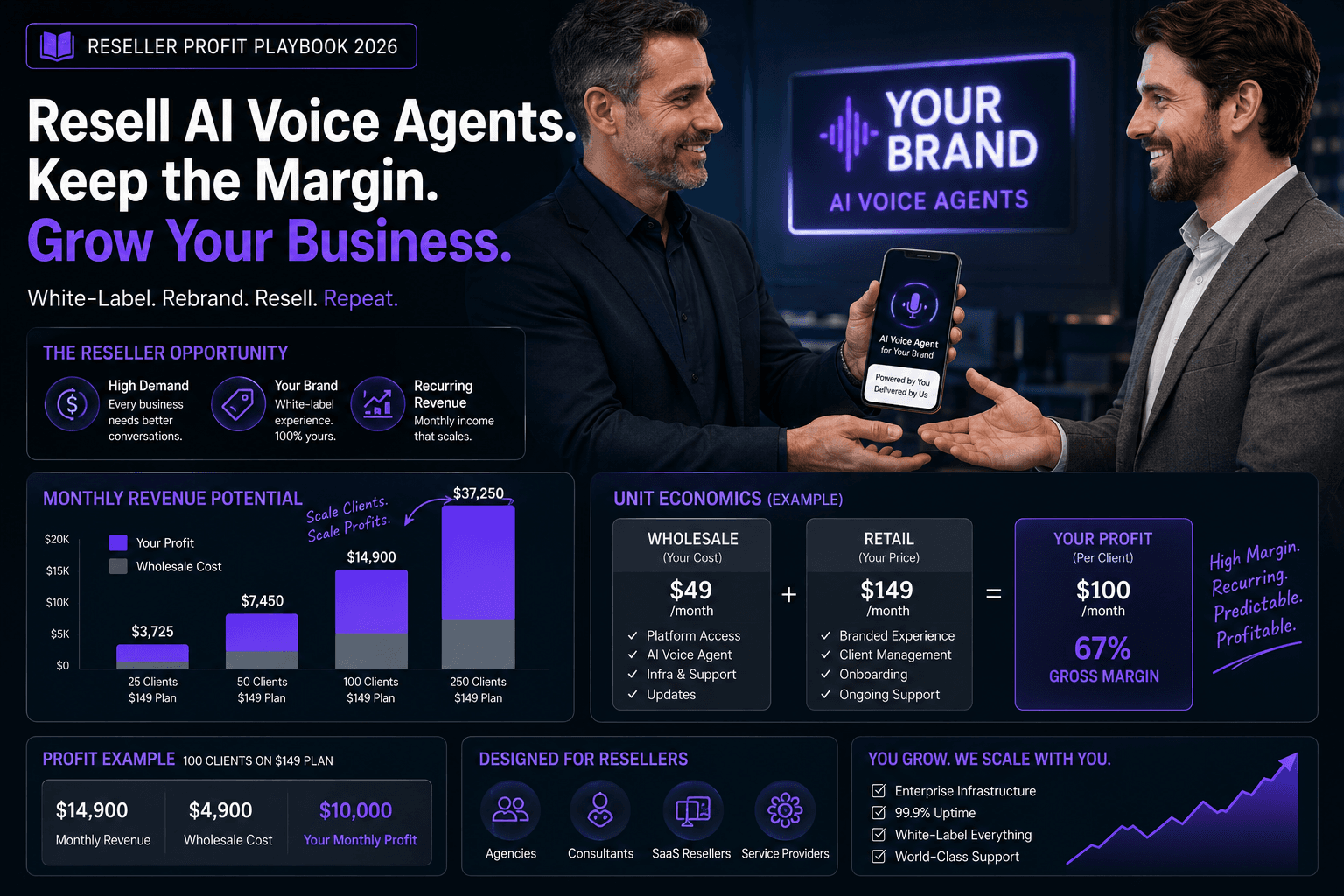
White-Label AI Voice Agent Pricing and Margins in 2026
What to charge, what it costs you to serve, and where the margin sits once the licence question is settled.
Utkarsh Mohan•Jul 27, 2026
Two very different ways to stop renting a voice AI platform: buy the source code and resell it under your own brand, or deploy it on your own infrastructure and run it for yourself. This is the decision framework — ownership, cost curve, compliance posture, resale rights, and the operational load each one puts on your team.
Utkarsh Mohan
Published: Jul 27, 2026

Most people arrive at the white label voice AI conversation from one of two frustrations. Either they are reselling somebody else's platform at a thin margin and have realised their clients can Google the vendor in ten seconds, or they are paying per-minute SaaS fees on call volume they generated themselves and watching the invoice grow every quarter. Both frustrations point at the same underlying problem — you do not own the thing your business depends on — but they lead to two genuinely different solutions.
The two destinations are the agency source-code licence and the self-hosted licence, and this guide exists because people routinely buy the wrong one. They are not tiers of the same product — they solve different problems, and the more expensive one is not the more capable one for every buyer. If you have not yet worked out what you would charge clients, the pricing and margins guide is the better place to start, because the revenue model determines which licence is even worth considering.
Strip away the feature comparisons and every enquiry reduces to a single question: who is the end customer? If the answer is "businesses that pay me for this service," you are building a product company and you need resale rights and source-code control. If the answer is "my own organisation," you are buying infrastructure and you need deployment control and a cost structure that does not punish volume. Almost every wrong licence purchase comes from answering that question vaguely — "well, maybe both eventually" — and then buying for the hypothetical rather than the actual.
It is worth being blunt about the second-order consequence. A self-hosted licence does not include the right to resell, and an agency licence is overkill if you only ever intend to answer your own phones. The gap between $2,500 and $15,000 looks large in isolation and becomes trivial the moment you sign your third client — or completely wasted if you never sign one. Decide what business you are in first, then pick the licence.
An agency source-code licence is a one-time purchase of the complete production codebase for the voice AI platform, together with the right to rebrand it, modify it, deploy it, and sell it to unlimited clients. This is materially different from what most vendors call a white-label program. You are not being granted access to a rebrandable dashboard that still runs on the vendor's servers; you receive the code itself, and what you do with it afterwards is genuinely your business.
The trade-off is responsibility. Once the code is yours, the roadmap is yours too. Nobody is going to ship your clients a new feature on a Tuesday morning unless you or your team ship it. For an agency with a developer on staff — or a willingness to hire one — that is the point. For an agency that wants software to arrive fully-formed and maintained by someone else, it is a burden dressed up as a benefit.
A self-hosted licence lets you deploy and run the platform inside your own server or cloud account for your own business. The application, admin console, database, call records, transcripts, and recordings all live in your environment behind your domain and your security controls. Telephony and the speech and language models are connected using your own provider accounts and API keys, so usage is billed to you directly at cost rather than marked up through a platform.
What it does not include is source-code access or the right to resell. You are buying the ability to run the software, not the software itself. That distinction matters enormously if your plan involves clients, and matters not at all if your plan involves a clinic group, a dealership network, a law firm, or an internal contact centre that simply wants its call data to stay put.
It is worth putting the third option on the table too, because most of the market is selling it. A reseller program gives you a discount code, a rebranded login, and a revenue share — and it is genuinely the right answer for someone testing whether they can sell voice AI at all before committing capital. It is the wrong answer once you have proven you can.
| Dimension | Agency Source-Code Licence | Self-Hosted Licence | Typical Reseller Program |
|---|---|---|---|
| Typical upfront cost | $15,000 one-time | $2,500 one-time (+$500/yr support) | Low or zero |
| Ongoing platform fee | None | Annual updates and support only | Per-seat, per-minute, or 20–30% revenue share |
| Source-code access | Yes — full production codebase | No | No |
| Right to resell to clients | Yes, unlimited clients | No | Yes, within the vendor's terms |
| Where call data lives | Wherever you deploy it | Your infrastructure | Vendor's infrastructure |
| Branding depth | Complete — nothing traces back | Complete for your own use | Surface-level; vendor usually discoverable |
| Roadmap control | Yours — modify anything | None, but you control the version you run | None |
| Margin as you scale | Expands — fixed cost, growing revenue | Expands — fixed cost, growing usage | Compresses — cost grows with usage |
| Time to live | Days | 1–2 business days for a standard deployment | Days |
| Risk if vendor changes terms | None — the code is yours | Low — your instance keeps running | High — pricing and policy can change |
The three routes to a branded voice AI offer, compared on the dimensions that actually determine outcomes
Per-minute SaaS pricing is designed to feel cheap at the point of decision and expensive at the point of success. That is not a criticism of the model — it lowers the barrier to entry, which is genuinely useful — but you should understand what you are signing up for. The fee scales with your call volume, which means it scales with how well your business is doing rather than with the cost of serving you. Every marketing campaign that works, every client you onboard, every seasonal surge makes the invoice larger.
A licence inverts that. The platform cost becomes fixed and only genuine variable costs — telephony minutes and model inference — scale with usage. The practical consequence is that the two models cross over at a volume threshold, and above that threshold the gap widens every month rather than staying constant.
| Monthly call volume | Typical per-minute SaaS spend | Licensed / self-hosted | Practical read |
|---|---|---|---|
| ~2,000 minutes | Roughly $300–$600 per month | Fixed licence plus usage at cost | Break-even lands somewhere between month six and month twelve |
| ~10,000 minutes | Roughly $1,500–$3,000 per month | Same fixed licence plus usage at cost | Break-even typically inside the first quarter |
| ~50,000 minutes | $7,500+ per month and climbing | Same fixed licence plus usage at cost | The recurring fee has become a tax on growth |
| 10 reseller clients at $500/mo | 20–30% of $5,000 = $1,000–$1,500/mo to the vendor | $0 to the vendor after the licence | The licence pays for itself in roughly three months |
Why the crossover point matters more than the sticker price — figures vary with provider mix and average call length
The reseller row is the one worth staring at. If you sign ten clients at $500 a month and your vendor takes a quarter of it, you are handing over $15,000 a year — the entire cost of an agency licence — every single year, forever, for a product you still do not own and cannot modify.
Security reviews rarely fail on encryption. Everyone encrypts. They fail on the two questions that follow: where does the data physically reside, and who else can reach it? A multi-tenant SaaS answer to those questions involves a sub-processor list, a shared infrastructure diagram, and a request that the reviewer trust the vendor's controls. A self-hosted answer is a region name and an account ID.
For agencies this cuts both ways and it is worth planning for. If you intend to sell into healthcare, legal, or financial services, at some point a client's compliance team will insist the call data never leave a controlled environment. With source code in hand you can deploy a dedicated instance for that client. On a reseller program, that conversation ends the deal.
"White label" is used loosely enough to be nearly meaningless, so it pays to be specific about the layers. At the shallowest level you get a logo upload and a custom subdomain, while the login page still loads assets from the vendor's CDN, the transactional emails still send from the vendor's domain, and the terms of service still name the vendor. A curious client with fifteen minutes and a browser inspector finds all of it.
Genuine white labelling means the application runs on your domain with your certificate, emails send from your mail infrastructure, invoices carry your business name, the documentation is yours, and there is no outbound call to a vendor telemetry endpoint that a network tab would reveal. With a source-code licence this is achievable by definition, because there is no vendor infrastructure left in the path. With a reseller program it is achievable only to the extent the vendor has engineered for it — which is worth testing, not assuming, before you sign.
“We were reselling another voice AI tool at a 25% margin and our clients could Google the vendor in ten seconds. Licensing the source code changed the business — it's our product now, our pricing, and the recurring revenue actually belongs to us.”
— Founder, growth agency running a branded voice AI product
This is the section most comparison articles skip, and it is the one that determines whether the purchase works out. Owning software means operating software. The honest version of that commitment differs quite a lot between the two licences.
| Responsibility | Agency source-code licence | Self-hosted licence |
|---|---|---|
| Initial deployment | Your team, or vendor-assisted setup | Vendor deploys it, or your team self-deploys with the package |
| Infrastructure and uptime | Yours — hosting, scaling, monitoring, backups | Yours, but a single-instance footprint is modest |
| Platform updates | Yours to merge and ship on your own cadence | Delivered through the annual support subscription |
| Client support | Yours entirely — you are the vendor now | N/A — you are the end user |
| Feature development | Yours, which is the point — build what competitors cannot copy | None; you run the version you are given |
| Telephony and model accounts | Yours, per client or pooled | Yours |
| Realistic team requirement | At least one developer, or a retained dev partner | A sysadmin-level contact; vendor can cover deployment |
The operational reality of each licence — the deciding factor for most teams once the commercial case is clear
If reading that table produced a quiet sense of dread about the agency column, that is useful information rather than a disqualification. Plenty of successful resellers retain a development partner rather than hiring in-house. What does not work is buying a source-code licence with the assumption that source code is a decorative asset you will never need to touch.
The decision is less permanent than it feels. The most common sequence we see is a business starting on the managed platform to validate the offer with real clients and real call volume, then moving to a licence once the numbers justify it. That order is deliberately conservative and it is the right one — validating demand is cheap on SaaS and expensive on a licence.
Moving from self-hosted to an agency licence is also straightforward when a business that started by automating its own phones realises it could sell the same capability to peers in its industry. That happens often enough to be a pattern: a dental group that built a great AI receptionist for twelve locations discovers that every other practice in the state wants one, and the licence upgrade converts an internal cost centre into a product line. What is worth avoiding is the reverse — buying the larger licence speculatively, before you have signed anyone, on the theory that you will grow into it.
The fifth question — whether the instance keeps running if you stop paying — separates a licence from a subscription wearing a licence costume. A real licence leaves your deployment running and simply stops delivering updates and support. Anything that can be remotely disabled is a subscription with a large upfront payment attached.
Answer three questions honestly. First: will businesses other than your own pay you for this? If yes, you need resale rights, which means the agency licence — nothing else in the market gives you a product you actually own. Second: will a client or regulator ever require that call data stay inside a specific environment? If yes, you need deployment control, which both licences provide and no multi-tenant SaaS does. Third: do you have, or will you retain, someone technical? If no, take the vendor-managed deployment option and factor a development partner into your plan before you sign rather than after.
If you answered yes to the first question, the agency licence is the route and the payback maths is simple: ten clients at roughly $500 a month covers a $15,000 licence in about three months, and everything after that compounds because your platform cost has stopped growing. If you answered no to the first and yes to the second, self-hosted is the route and the payback depends on your call volume — which is exactly the number worth modelling on a call rather than guessing from an article.
Tell us what you want to build and we'll give you a straight recommendation on a short call — including the volume maths for your actual call load, not a generic estimate.
An agency source-code licence is for building a business that sells voice AI. It includes the full production source code, the right to rebrand and resell to unlimited clients, and complete freedom to modify the platform, typically for a one-time $15,000. A self-hosted licence is for running the platform for your own organisation on your own infrastructure, typically $2,500 one-time plus an annual support subscription; it gives you data ownership and deployment control but no source-code access and no resale rights. The simplest test is who the end customer is: if clients pay you for the service, you need the agency licence; if it is your own business answering its own phones, self-hosted is the right fit.
Only at the start, and only if you stay small. Reseller programs usually cost little or nothing upfront but take 20 to 30 percent of what you bill, or price per minute so your cost grows with your clients' call volume. Ten clients at $500 a month on a 25 percent revenue share means handing over roughly $15,000 a year — the full cost of an agency licence — every year, indefinitely, for a product you still do not own. A reseller program is a sensible way to validate that you can sell voice AI at all; it is an expensive way to run a proven business.
The common benchmark is around three months. Ten clients on a mid-tier package at roughly $500 per month produces $5,000 in monthly recurring revenue against a $15,000 one-time licence. Setup fees of $500 to $1,500 per client shorten that further. Because the platform cost is fixed rather than usage-based, every client added after break-even contributes close to full margin instead of a shrinking percentage.
No — the self-hosted licence covers running the platform for your own business and does not include resale rights or source-code access. If you want to deploy branded instances for paying clients, including dedicated deployments for clients with strict compliance requirements, you need the agency source-code licence. That licence permits both: you can host client tenants centrally and stand up isolated deployments for the clients who demand them.
With a genuine licence, your deployed instance keeps running. You simply stop receiving updates and support, and the platform is not remotely disabled. This is one of the sharpest tests for distinguishing a real licence from a subscription with a large upfront payment attached — ask the vendor directly, and get the answer in writing before you sign.
Substantially, because security reviews rarely fail on encryption — they fail on where data physically lives and who else can reach it. Self-hosting lets you deploy in a required region and point at the specific account when asked, keeps protected health information inside controls and BAAs you already maintain, and turns GDPR deletion or export requests into database queries rather than vendor tickets. Recording consent rules and retention windows follow your policy, and your existing SSO, private networking, key management, and monitoring cover the deployment like any other internal system.
For a self-hosted deployment, a sysadmin-level contact is usually enough, and the vendor can handle the initial deployment as part of the package. For an agency licence you realistically need at least one developer or a retained development partner, because owning the source code means owning the roadmap — nobody else will ship features to your clients. That is the point of the licence rather than a hidden cost, but it should be planned for before purchase rather than discovered afterwards.
If you have not yet sold voice AI to anyone, prove the model first on the standard platform or a reseller arrangement, close three clients, and then licence. Validating demand is cheap on a subscription and expensive on a licence. The reverse migration — starting on SaaS and moving to a licence once volume or client count justifies it — is a common and sensible path, and moving from self-hosted to an agency licence later is equally straightforward if an internal deployment turns into a product opportunity.
Work it from your own numbers rather than a rule of thumb. Hosted platforms typically charge $0.05 to $0.13 per minute in orchestration fees on top of underlying costs of roughly $0.06 to $0.19, so an organisation running 40,000 minutes a month is paying somewhere between $2,000 and $5,000 monthly in orchestration alone. Against a $2,500 one-time licence plus infrastructure and support, the crossover typically lands somewhere between 10,000 and 20,000 monthly minutes. Below that, hosted is genuinely cheaper once you account for the engineering time self-hosting consumes.
The licence fee covers the software, not the running of it. You still pay for telephony minutes, speech-to-text, the language model, and text-to-speech, which together run $0.06 to $0.19 per minute regardless of licensing. Self-hosted deployments add infrastructure — compute, database, storage, monitoring — plus whatever your annual support subscription costs. Agency licensees add the developer time required to own a roadmap. What disappears under a licence is the orchestration fee and any per-client or revenue-share charge, and at scale that is the largest line.
Yes, and it is a recognisable pattern rather than an edge case. A business that deployed the platform to answer its own phones discovers that peers in the same industry want the same thing, and the upgrade converts an internal cost centre into a product line. A dental group running twelve locations is the classic example. Discuss the upgrade path with the vendor before the initial purchase so the credit treatment is agreed in writing rather than negotiated later from a weaker position.
Ask four questions and require written answers. Does my deployment continue running if I stop paying for support? Do I receive actual source code, or access to a rebrandable hosted product? Are there per-client, per-seat, or per-minute charges payable to you after purchase? And can I modify the code without voiding support entirely? A genuine licence answers yes, source code, no, and yes with caveats. A subscription dressed up as a licence will be evasive on the first question in particular, which is why it is the most useful one to lead with.
What to charge, what it costs you to serve, and where the margin sits once the licence question is settled.
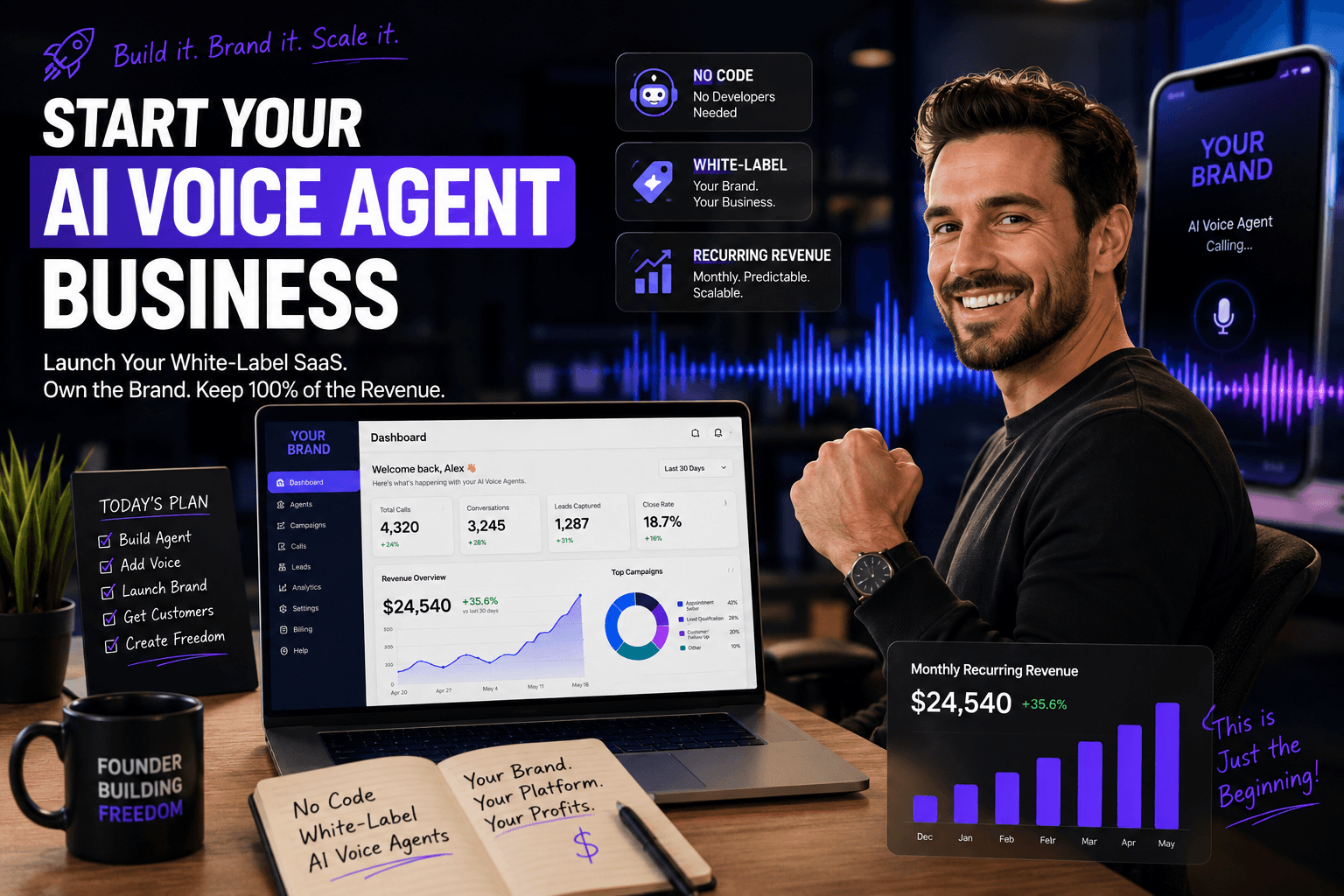
Vertical selection, the missed-call audit, and a demo that closes in a single call.

Which services to package, the 2026 market benchmarks, and how to launch a branded agency offer.