
White Label AI Voice Agents for Marketing Agencies: From Solo Reseller to $1M ARR
The 2026 playbook for marketing agencies adding $50k–$150k in recurring revenue reselling white-label AI voice agents under their own brand.
Utkarsh Mohan•May 12, 2026
How much can you really make reselling white-label AI voice agents in 2026? This is the complete playbook on reseller program mechanics — what a true white-label program includes, reseller vs. affiliate vs. referral vs. OEM models, wholesale-vs-retail margin math, onboarding and enablement, SLAs and compliance for resold deployments, and how Ringlyn AI's reseller program lets you own the voice AI business under your brand.
Utkarsh Mohan
Published: Jun 2, 2026
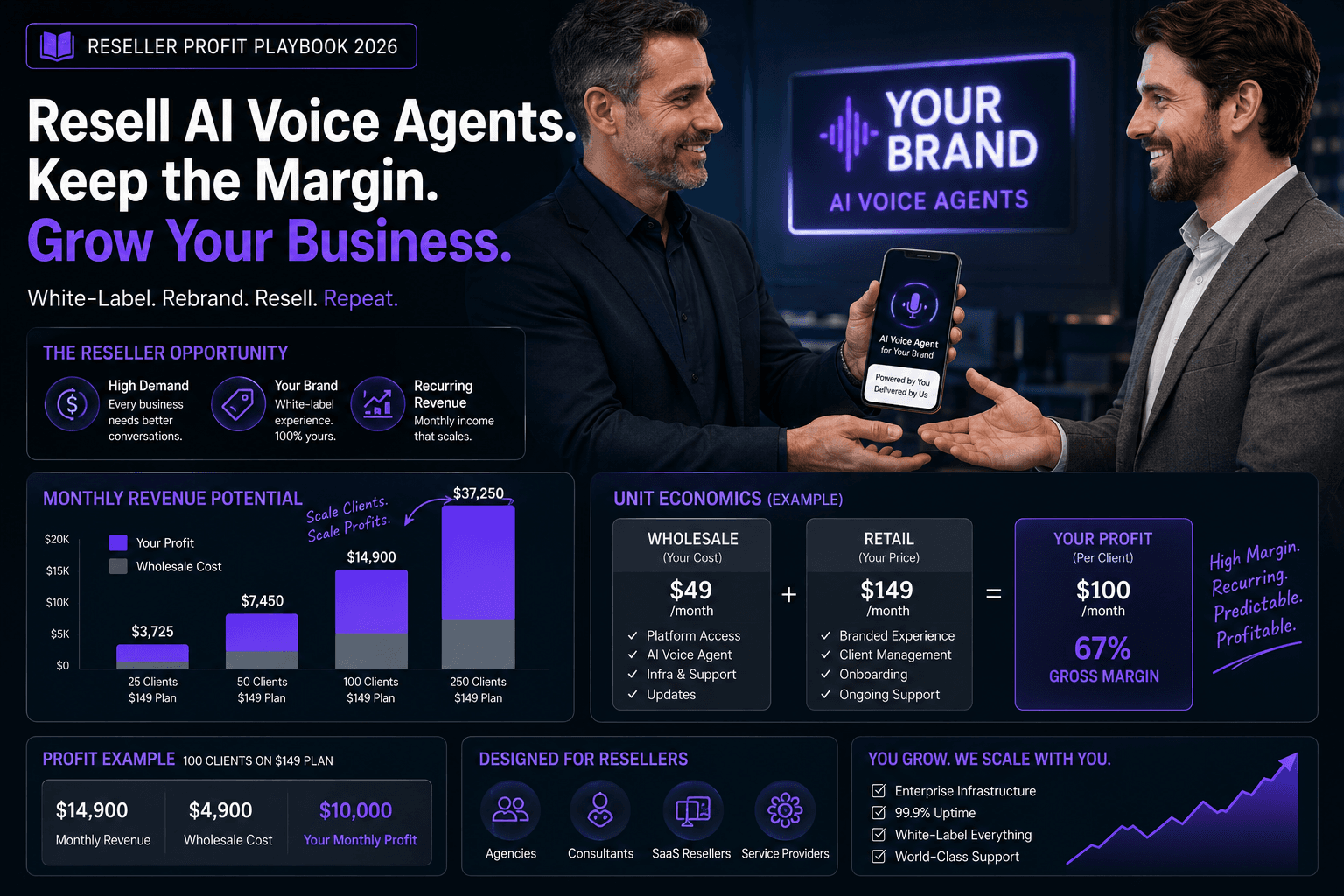
A white label AI voice agent reseller program is one of the highest-margin businesses you can start in 2026 — but only if you understand the unit economics before you sign anything. The model is deceptively simple: you buy access to a voice AI platform at a wholesale rate, brand it as your own, and resell it to businesses at retail. The spread is your profit, and because your costs are largely fixed while your revenue scales with each client, the margin compounds in your favor as you grow.
This playbook strips away the hype and shows you the actual numbers: how the profit model works, what each client really earns you, when you break even, how margin behaves at 10, 50, and 100 clients, and exactly what to demand from a reseller program before you commit. We'll use Ringlyn AI's white-label reseller program as the worked example, because its flat, all-inclusive pricing makes the math clean — but the framework applies to evaluating any program.
A white-label reseller program lets you sell a vendor's AI voice agent technology as your own product. The vendor builds and maintains the platform — the AI models, the telephony, the voice synthesis, the dashboards, the uptime. You provide the brand, the sales, the client relationship, and the support. Your clients sign up with you, pay you, and see only your branding. The vendor is invisible to them.
This is fundamentally different from selling services with your own labor. In a services business, every dollar of revenue requires hours of delivery. In a white-label reseller business, the product runs itself once configured — so revenue and effort decouple. That decoupling is the entire reason the margins are so attractive, and why software distribution has always been one of the best business models in existence.
Before you weigh the economics, you need to know what you are actually buying. A genuine white-label reseller program is far more than a logo swap — it is a complete operating system for running a branded voice AI business. The strongest programs (Ringlyn AI's included) bundle the following building blocks so you never have to assemble infrastructure, billing, or branding yourself.
The foundation of true white-label is a client dashboard that lives entirely under your brand. That means a custom domain via CNAME (app.yourbrand.com, never a vendor subdomain), your logo, colors, favicon and typography across every screen, and branded transactional emails so clients never receive a message referencing the underlying vendor. If the vendor's name appears anywhere your clients can see it, the program is a reskin, not a white-label.
Your product is audible, not just visual. A real program lets you choose or add premium neural voices and name your AI agents whatever you want, so the experience callers hear is yours too. Multilingual support widens your addressable market — a reseller serving multilingual regions or international clients can offer agents in dozens of languages without bolting on a separate text-to-speech provider.
Multi-tenancy is what lets one operator serve dozens of clients. Each client lives in an isolated sub-account with their own agents, phone numbers, knowledge base, call history, and analytics, while you manage all of them from a single parent dashboard. Data isolation between tenants is a hard requirement for trust and for compliance in regulated verticals. Ringlyn AI provides unlimited sub-accounts under one flat plan, with no per-seat charges to erode your margin.
You set retail prices and bill clients under your own brand. Most owners connect Stripe and run standard recurring subscriptions with their markup baked into the price; invoices, receipts, and payment emails carry your brand, not the vendor's. With a flat wholesale cost, your markup is simply retail minus a fixed number — clean, predictable, and easy to model. The vendor bills you once a month; you bill your clients on your own terms.
A turnkey program includes telephony — local and international numbers under your brand in 100+ countries — so you never manage a separate Twilio account or voice contract. Native CRM and calendar integrations (the tools your clients already use) round out the stack so agents can book appointments, log calls, and update records out of the box.
Finally, the program should enable you to sell. That means a dedicated partner support channel (your clients only ever talk to you), a live demo environment for your sales calls, pre-built industry templates that slash onboarding time, and sales collateral or co-marketing assets you can rebrand. These enablement pieces are what shorten the distance between signing up and landing your first paying client.
| Building Block | What It Delivers | Why It Protects Your Margin / Brand |
|---|---|---|
| Rebrandable dashboard + CNAME domain | Client app on your own domain, fully themed | Real ownership, not a reskin — your brand equity, not the vendor's |
| Custom voices & agent names | Branded, multilingual audible experience | The product sounds like yours; widens your market |
| Multi-tenant sub-accounts | Isolated client accounts, one parent view | One operator serves dozens of clients; compliance-ready isolation |
| Your-pricing billing (Stripe) | You set retail prices and invoice clients | Markup fully in your control; flat cost = predictable margin |
| Built-in telephony + integrations | Numbers in 100+ countries, CRM/calendar | No separate Twilio/voice contracts eating margin |
| Partner support & enablement | Demo env, templates, co-marketing, support channel | Faster time-to-first-revenue; vendor stays invisible |
The building blocks of a true white-label AI voice agent reseller program
"Partner program" is an umbrella over four very different relationships, each with its own economics, level of ownership, and amount of work. Choosing the wrong one caps your upside before you start, so it pays to understand exactly what each model gives you — and what it costs you.
A referral partner simply introduces a prospect and earns a finder's fee or a slice of the first invoice; a affiliate earns a tracked commission (often 15–30%, sometimes recurring) on customers who sign up through their link. In both, the customer signs up with the vendor, sees the vendor's brand, and pays the vendor. These are excellent for monetizing an audience with almost no operational work, but you are renting the vendor's customers — you never own the relationship, the pricing, or a sellable asset.
A reseller (or agency) partner buys access at a wholesale rate, brands the product as their own, sets retail pricing, and owns the entire client relationship. The vendor is invisible. This is the model that builds a real business — recurring revenue, client relationships, and brand equity that you can grow and eventually sell. It carries the most upside (65–85% gross margins) and asks the most of you: sales, onboarding, and support. Ringlyn AI's program is a true reseller/agency model with unlimited sub-accounts.
An OEM (embedded) partner integrates the vendor's voice AI into their own software or SaaS product via API, so it becomes a feature of their platform rather than a standalone resold dashboard. This suits product companies and developers who already have a customer base and a UI of their own. It offers the deepest ownership and customization but requires engineering, and you take on the multi-tenant, billing, and client-experience layers yourself. For non-technical operators, the turnkey reseller model is almost always the better fit.
| Dimension | Reseller / Agency | Affiliate / Referral | OEM / Embedded |
|---|---|---|---|
| Whose brand does the client see? | Yours — full white-label | The vendor's | Yours (inside your product) |
| Who owns the client relationship? | You | The vendor | You |
| Typical economics | 65–85% gross margin | 15–30% commission | Wholesale API cost + your markup |
| Pricing control | You set retail prices | Vendor sets prices | You set prices |
| Technical work required | None — no-code/turnkey | None | High — you build the integration |
| Builds a sellable asset? | Yes — strongest | No | Yes (part of your product) |
| Best for | Agencies & entrepreneurs owning the business | Audiences monetizing with low effort | SaaS/product companies with existing users |
If your goal is to own the voice agent business — build an asset with recurring revenue, client relationships, and brand equity — the reseller/agency model is the path. Affiliate income is real but capped; OEM is powerful but technical. This playbook focuses on the reseller path, because it is where most owners want to be and where the economics are most attractive.
The profit model has three layers, and understanding each is what separates resellers who make 80% margins from those who barely break even:
The spread between retail and (wholesale + variable cost) is your gross profit per client. The key structural advantage: your wholesale cost is fixed at the platform level, not charged per client. So once you cover that flat cost, nearly every additional dollar of client revenue drops to the bottom line. This is why the margin curve bends upward as you grow.
| Retail Price / Client | Effective Wholesale Cost / Client* | Markup | Gross Profit / Client |
|---|---|---|---|
| $197/mo (basic) | $83/mo | ~2.4x | $114/mo |
| $297/mo (standard) | $83/mo | ~3.6x | $214/mo |
| $497/mo (pro) | $83/mo | ~6.0x | $414/mo |
| $997/mo (managed) | $83/mo | ~12x | $914/mo |
Markup worked example at 30 clients (*effective wholesale = $2,497 flat platform cost ÷ 30 clients; falls further as you add clients). Illustrative — your real pricing and client count will vary.
Notice the column that does the work: your effective wholesale cost per client shrinks every time you add a client, because the flat $2,497 is divided across more accounts. At 30 clients it's about $83 each; at 60 clients it halves to ~$42. The same retail price therefore earns a richer markup the more you scale — the mathematical engine behind the compounding margins shown later in this playbook.
Let's make it concrete using a $297/month average client price (a typical SMB AI receptionist rate) against Ringlyn AI's flat $2,497/month WhiteLabel platform cost:
| Clients | Monthly Revenue | Platform Cost | Gross Profit | Gross Margin |
|---|---|---|---|---|
| 9 (break-even) | $2,673 | $2,497 | $176 | 7% |
| 20 | $5,940 | $2,497 | $3,443 | 58% |
| 35 | $10,395 | $2,497 | $7,898 | 76% |
| 50 | $14,850 | $2,497 | $12,353 | 83% |
| 100 | $29,700 | $2,497 | $27,203 | 92% |
White-label AI voice agent reseller unit economics at $297/month per client (before variable labor)
Notice the shape of the curve. Break-even sits around 9 clients. By 20 clients you're already at a healthy 58% margin. By 50 you're past 80%. After accounting for $20–$50/client in variable labor, net margins land in the 65–80% range at steady state — far above the 40–55% gross margins typical of creative or labor-based agency services. The fixed-cost structure is doing the heavy lifting.
“The single most important number in a white-label reseller business is your break-even client count. Everything before it funds the platform; everything after it funds your life. With a flat platform cost, that number is small and fixed — which is what makes the model so forgiving for new owners.”
— Ringlyn AI Partner Program
Most service businesses get harder to run as they grow — more clients means proportionally more staff, more overhead, and thinner margins. A white-label voice AI reseller business behaves the opposite way, for two reasons:
The practical result: a single operator with one part-time configuration specialist can comfortably run 50–80 clients. At 50 clients averaging $500/month, that's $300K/year in recurring revenue against a fixed platform cost and modest labor — and the business becomes a sellable asset, with recurring-revenue service businesses commanding meaningful multiples at exit.
Ringlyn AI's WhiteLabel plan: flat $2,497/month, unlimited client sub-accounts, full branding. Your margin starts at client 9.
Ringlyn AI's white-label reseller program is built for owners who want clean economics and full brand control. Here's what's included at the flat platform price:
A program's enablement is the difference between landing your first paying client in week two versus month four. The infrastructure may be turnkey, but your go-to-market still has to be built — and the best programs hand you most of it. Here is what strong enablement looks like and how to use it.
Because the product is no-code, your ramp is measured in days, not months. Expect onboarding sessions or documentation covering agent configuration, knowledge-base setup, integrations, and the multi-tenant dashboard. The goal is to make you competent enough to configure a useful agent for a prospect's specific industry and to run a confident live demo — that is the core skill the whole business rests on.
Look for rebrandable sales collateral — one-pagers, ROI calculators, pitch decks, case-study templates, and email sequences — that you can put your logo on and use immediately. Co-marketing assets (landing-page copy, ad creative, demo scripts) compress the time it takes to build a credible offer. You should never be starting your marketing from a blank page.
A live demo environment is your single most powerful sales tool. The ability to call a prospect's industry-specific demo agent — and let them call it — converts skepticism into signatures faster than any deck. Build one polished flagship demo agent per vertical you target, mirroring the booking flow and CRM stack your prospects already use, and lead every sales conversation with it.
The reason a single operator can run 50–80 clients is operational leverage from the multi-tenant dashboard. Once you pass a handful of clients, the way you provision, monitor, and support accounts determines whether growth feels effortless or crushing.
The practical result: adding a client adds revenue without adding proportional labor. That is the structural advantage a white-label voice AI business has over a human-staffed answering service, where every new client means more headcount and thinner margins.
In a resold model, your client's experience of reliability and support is a pass-through of your vendor's — plus whatever you layer on top. You cannot credibly promise an uptime guarantee or responsive support to your clients if the platform underneath you doesn't offer one to you. Two things deserve attention here: the SLA, and the support topology.
Your client's SLA equals your vendor's uptime commitment plus your own responsiveness. Before you promise "99.9% uptime" or "same-day support" to a client, confirm the vendor backs it. Ask for the platform's uptime track record, status-page transparency, and the partner support channel's response targets — these set the ceiling on what you can offer.
The correct support topology in a white-label program is two-tier: your clients only ever contact you, and you have a dedicated partner channel to the vendor for anything you can't resolve. This keeps the vendor invisible and your brand intact. If clients can reach the vendor directly — or see the vendor's branding in support docs — the white-label promise is broken. Most front-line tickets (configuration, how-tos) you handle yourself; only true platform issues escalate to the vendor.
| Support Layer | Who Handles It | Typical Examples | Stays Invisible to Client? |
|---|---|---|---|
| Tier 1 — Client-facing | You (the reseller) | How-to questions, agent tweaks, onboarding | N/A — this is your brand |
| Tier 2 — Partner channel | The vendor (for you) | Platform bugs, outages, feature questions | Yes — vendor never contacts your client |
| Tier 3 — Infrastructure | The vendor (silently) | Telephony, AI models, uptime, security | Yes — entirely behind the scenes |
How support tiers work in a true white-label reseller program — the vendor stays invisible to your clients
When you resell voice AI under your brand, you inherit your clients' compliance expectations — because to them, you are the vendor. If you plan to serve healthcare, finance, legal, or any business handling sensitive data, the platform underneath you must support the compliance posture those clients require. The key question resellers get wrong: who is responsible for what?
Responsibility is shared. The platform is responsible for the technical controls — encryption in transit and at rest, data isolation between tenants, audited security (SOC 2), and HIPAA-aligned handling with a Business Associate Agreement (BAA) that can flow through to your sub-accounts. You, the reseller, are responsible for how you configure and operate it: obtaining consent for outbound calls, respecting calling hours and DNC lists, AI-disclosure where required, and setting per-client data retention appropriately. Choose a platform whose certifications match the most demanding vertical you intend to sell into — it's far easier to sell down-market from a compliant platform than to retrofit compliance later. Ringlyn AI is HIPAA and SOC 2 capable for resold deployments.
The fine print of a reseller agreement shapes your freedom to grow and your ability to leave. Two programs with identical features can feel completely different depending on their terms. Scrutinize these clauses before you sign.
| Term | Reseller-Friendly | Watch Out For | Ringlyn AI |
|---|---|---|---|
| Minimum clients | None — start with one | 5–10 clients required in a window, forcing discounts | No minimums |
| Contract length | Monthly, cancel with notice | Annual lock-in with penalties | Monthly terms |
| Exclusivity | Non-exclusive — you choose your market | Territory or vertical exclusivity that traps you | Non-exclusive |
| Pricing model | Flat platform fee | Per-minute that erodes margin at scale | Flat $2,497/mo, unlimited sub-accounts |
| Data portability | Export rights with reasonable notice | No export clause — you're locked in | Export rights |
| Client ownership | You own the relationship & billing | Vendor can contact/bill your clients | You own the client |
Contract terms to evaluate in any white-label voice AI reseller program
The pattern to demand: no minimums, monthly terms, non-exclusive, flat pricing, and data export rights. These keep you in control — free to grow at your own pace, free to serve any market, and never trapped if you decide to switch. A program confident in its product doesn't need to lock you in with minimums and long contracts.
A reseller business is light on operations but real on sales. Here's an honest accounting of what the work looks like:
| Function | Time Required | Skill Needed | Can Outsource? |
|---|---|---|---|
| Selling & demos | The bulk of your time early on | Sales / relationship building | Eventually (hire a closer) |
| Client onboarding | 1–3 hrs per client (drops with templates) | No-code config, attention to detail | Yes (config specialist) |
| Ongoing support | A few hrs/month per client | Product familiarity | Yes |
| Reporting | Automatable | None (set up once) | Automated |
| Platform/infra | Zero — vendor handles it | None | N/A (vendor owns it) |
Where your time actually goes in a white-label voice AI reseller business
The takeaway: this is a sales-led business with a self-running product, not a technical business. You don't need engineers. You need to be willing to sell, to learn your clients' industries well enough to configure useful agents, and to deliver a clean onboarding experience. Everything technical — the part most people fear — is the vendor's job.
Because the platform cost is fixed, your ROI timeline is driven almost entirely by how fast you acquire clients. Here's a realistic trajectory for a focused operator:
Most disciplined operators recover their startup investment within 1–3 months of landing their first paying clients, then move into compounding profit. The variable that determines your speed isn't the technology — it's how aggressively and consistently you sell into a focused niche.
Pricing is where reseller margins are won or lost. The discipline: price on the value the agent creates for the client, never on your wholesale cost. The client compares you to a human employee and to lost revenue — both far larger than your platform cost.
| Package | Client Price | Includes | Best For |
|---|---|---|---|
| Receptionist Basic | $197–$297/mo | Inbound AI receptionist, call logging, basic CRM, standard voice | Home services, salons, small retail |
| Receptionist Pro | $397–$597/mo | Inbound + outbound, advanced CRM, premium voice, analytics, monthly review | Real estate, dental/medical, B2B services |
| Growth Engine | $797–$1,497/mo | Pro + managed outbound campaigns, dedicated reporting | High-ticket: roofing, solar, legal, finance |
White-label voice AI reseller packaging — price on outcomes, not features
A roofing company doesn't care about your tech stack — it cares that it books 8 more estimates a month. At an average job value of $2,500, that's $20,000 in revenue potential, which makes a $597/month price an obvious yes. Anchor every conversation on the client's outcome, and premium pricing stops feeling expensive. (If your underlying platform charges per-minute, model your costs carefully — see our breakdown of AI voice agent per-minute pricing — because usage-based wholesale costs can quietly compress the margins shown above.)
Not all 'white-label' programs are equal — many are cosmetic logo swaps with hidden per-minute fees that crush margins at scale. Before you commit to any program, get clear answers to these questions:
Once you've chosen a program, the path from sign-up to recurring revenue is well-trodden. Follow this sequence and you'll clear break-even in your first quarter rather than spinning on setup.
Every business has risks; the smart move is to know them and contract around them. For a white-label reseller business, the main risks are vendor dependency, margin compression, and data portability:
For the right operator, a white-label AI voice agent reseller program is one of the most attractive businesses available in 2026. The demand is proven, the technology works, the margins are exceptional, and the fixed-cost structure means profitability compounds as you grow. You get the economics of a software business without the cost or risk of building software.
The deciding factor is not the technology — it's you. If you're willing to sell consistently into a focused niche and deliver a clean client experience, the numbers in this playbook are achievable. Pick a program with flat pricing, true CNAME branding, no minimums, and data portability — and you can own a recurring-revenue voice AI business under your own brand. The window is open now, while most businesses still don't know how to buy this technology directly.
Ringlyn AI's white-label reseller program: flat pricing, full branding, unlimited clients, no minimums. Margin that compounds with every client.
Gross margins at steady state run 65–85%. With a flat $2,497/month platform cost and $297/month average client pricing, you break even around 9 clients, reach ~58% margin at 20 clients, and exceed 80% margin at 50 clients. A focused operator with 50 clients averaging $500/month generates roughly $300K/year in recurring revenue against a fixed platform cost and modest labor.
An affiliate or referral program pays you a 15–30% commission to send clients to the vendor — clients sign up with the vendor and see their brand. A true white-label reseller program means YOU are the brand: clients sign up with you, pay you, and see only your branding while the vendor stays invisible. White-label margins (65–85%) far exceed affiliate commissions, and you own the client relationship and a sellable business asset.
With per-minute wholesale pricing, your costs rise as clients use the service more — compressing your margin exactly when usage (and your value) is highest. A flat platform cost like Ringlyn AI's $2,497/month for unlimited sub-accounts keeps your cost fixed while revenue scales linearly, so nearly every dollar past break-even is profit. This is what makes margins compound at scale.
Break-even is typically around 9 clients. Most disciplined operators recover their startup investment within 1–3 months of landing their first paying clients, then move into compounding profit. The pace depends almost entirely on how aggressively you sell into a focused niche, since the technology and infrastructure are handled by the vendor.
No. The vendor handles all the technical work — AI models, telephony, voice synthesis, uptime, and product updates. Your role is sales, packaging, no-code client onboarding, and relationship management. This is a sales-led business with a self-running product, not an engineering business. A single operator with one part-time configuration specialist can run 50–80 clients.
Five things: (1) flat platform pricing, not per-minute that erodes margins; (2) true CNAME white-label so the client dashboard is on your domain; (3) no minimum-client commitments and monthly terms; (4) you — not the vendor — as the client's support contact; and (5) data export rights so you're never locked in. Ringlyn AI's program is structured to meet all five.
Your main fixed cost is the platform license — Ringlyn AI's WhiteLabel plan is a flat $2,497/month for unlimited client sub-accounts, with telephony, voices, and analytics bundled, so there's no separate Twilio or voice bill. Beyond that, budget modestly for a domain, a Stripe account (pay-as-you-go), and your own time selling. There's no per-seat fee and no minimum-client commitment, so the realistic startup cost is roughly one to two months of the platform fee while you land your first clients — most disciplined operators recover that within 1–3 months of going live.
A referral partner introduces a prospect for a finder's fee; an affiliate earns a tracked 15–30% commission on sign-ups through their link — in both, the customer signs up with the vendor and sees the vendor's brand. A reseller (or agency) partner buys wholesale, brands the product as their own, sets retail pricing, and owns the client relationship, earning 65–85% gross margins. An OEM (embedded) partner integrates the vendor's voice AI into their own software via API. The reseller/agency model is the one that builds a real, sellable business with the highest margins, which is why this playbook focuses on it.
For owning a branded business with predictable economics, look for true CNAME white-label, flat (not per-minute) pricing, built-in telephony, unlimited multi-tenant sub-accounts, no minimums, and data portability. Ringlyn AI's program meets all of these at a flat $2,497/month for unlimited sub-accounts and is HIPAA/SOC 2 capable for regulated verticals. Developer-first platforms (Vapi, Retell AI, Bolna AI) suit teams building custom software, while ecosystem options like GoHighLevel fit agencies already on that stack. Compare programs at 50 clients, not 5, since that's where flat pricing wins decisively.
Yes. Most resellers connect Stripe and charge clients directly under their own brand, with invoices and receipts carrying your logo, not the vendor's. With a flat-cost platform, you run standard recurring Stripe subscriptions and your markup is simply retail price minus your fixed platform cost — clean and predictable. The vendor bills you once a month for the platform; you bill each client on your own terms. If your underlying cost were per-minute, you'd want Stripe's metered billing so retail charges scale with usage, but a flat wholesale cost keeps billing simple.
The 2026 playbook for marketing agencies adding $50k–$150k in recurring revenue reselling white-label AI voice agents under their own brand.
The no-code blueprint to launch your own branded AI calling company on Ringlyn AI's white-label platform — your brand, your pricing, recurring revenue.

The definitive playbook for building, branding, and selling white-label AI voice agents — platform selection, branding, pricing, onboarding, and Ringlyn AI's program.
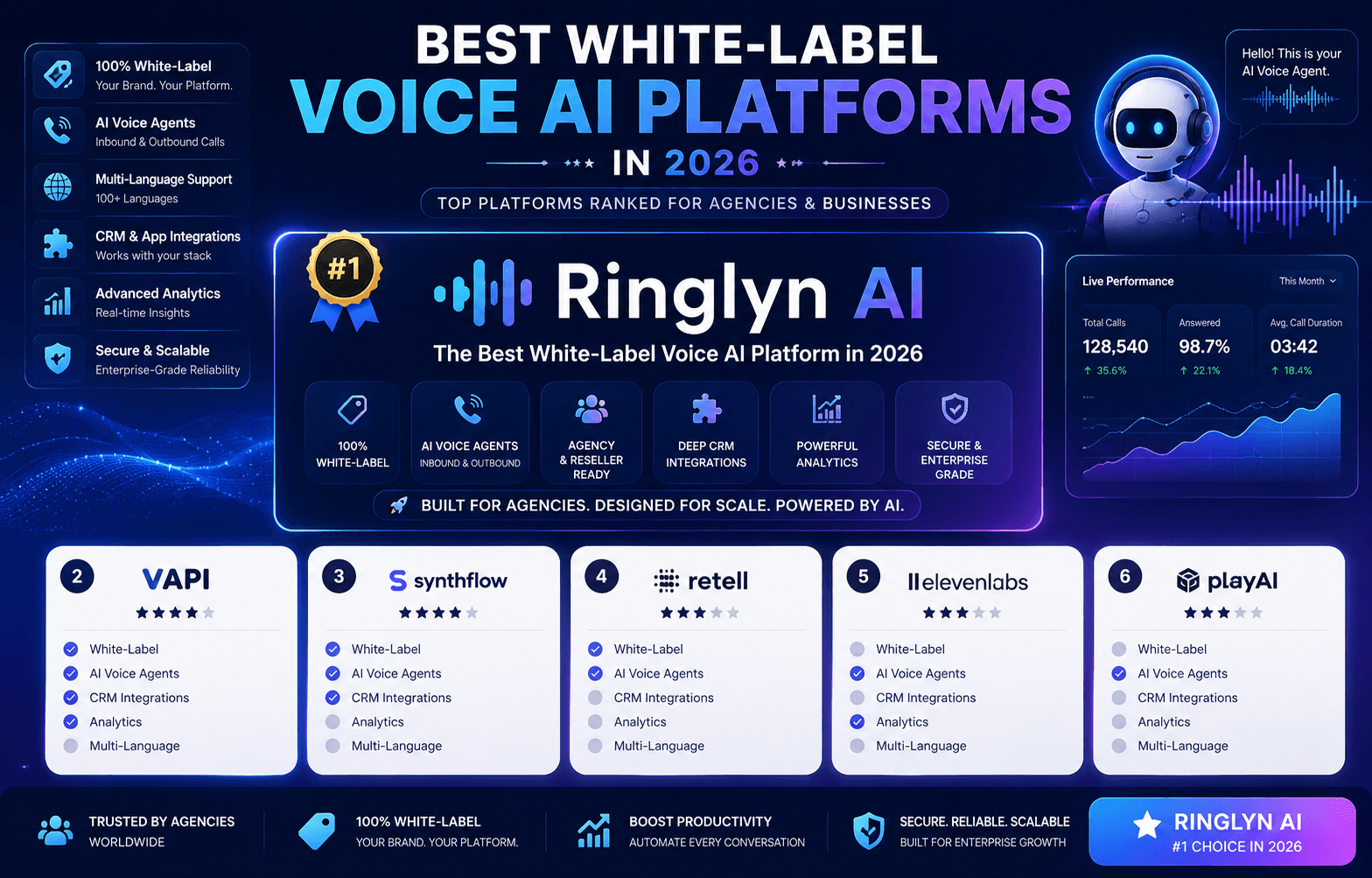
Platform-by-platform deep-dives on Ringlyn AI, Vapi, Retell AI, Synthflow, Bland AI, Bolna AI, Air AI, and GoHighLevel — branding depth, pricing, multi-tenancy, and compliance.