
Agency Source-Code Licence vs Self-Hosted Deployment
Two ways to stop renting a voice AI platform — the ownership, cost curve, and compliance differences between them.
Utkarsh Mohan•Jul 27, 2026
The pricing model is what makes or breaks a white-label voice AI business — not the technology. This is the full breakdown: three-tier packaging, real price points by vertical, cost-per-minute maths, setup fees, where margin leaks, and how to defend your price when a prospect compares you to a $49 SaaS.
Utkarsh Mohan
Published: Jul 27, 2026
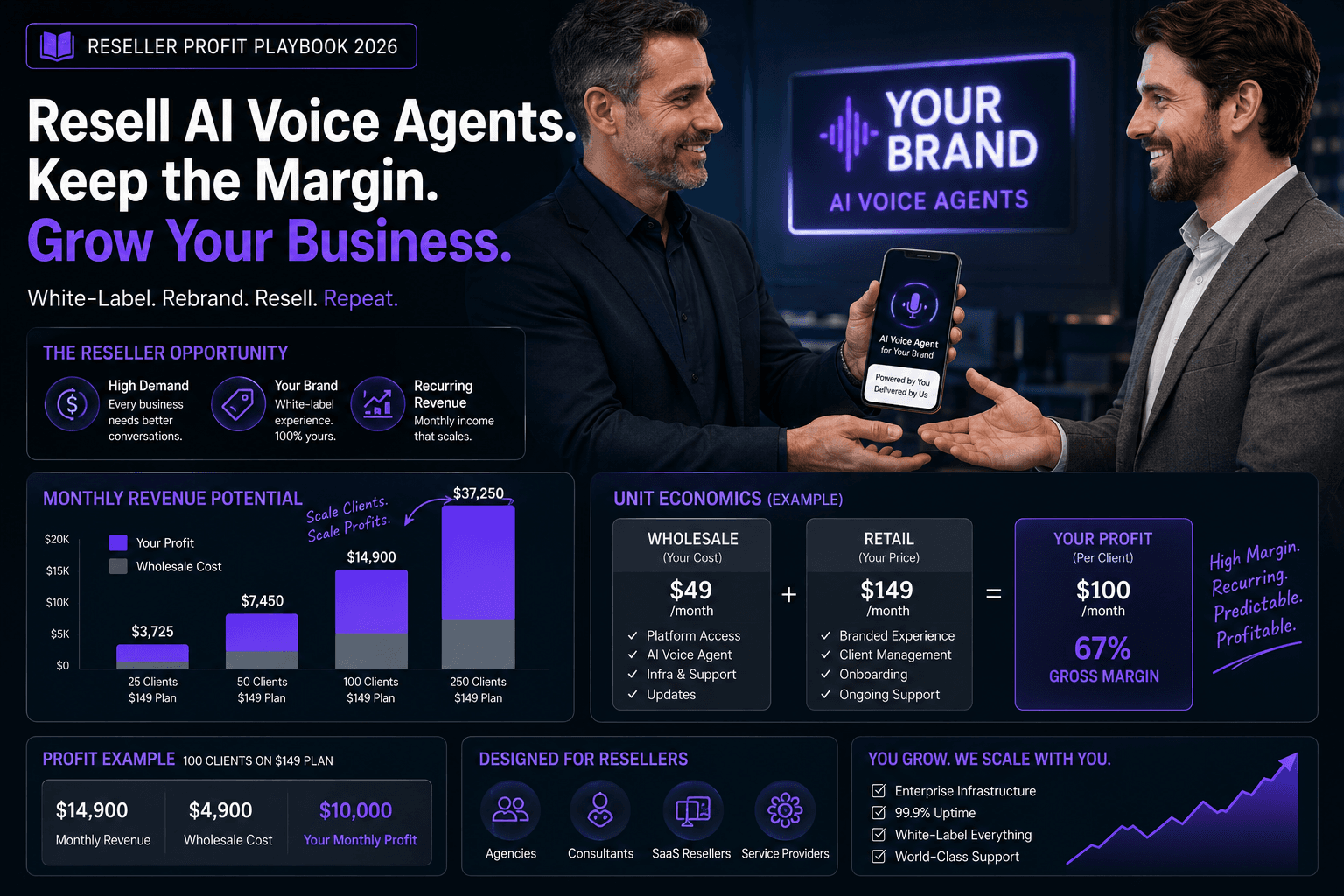
There is a specific failure pattern in white label AI voice agent businesses that has nothing to do with the technology. The reseller licences a good platform, builds a competent agent, closes their first client at $199 a month because it felt safe, and then discovers that $199 does not cover the account management the client expects, the integration work the client asked for, or the two hours a month spent tuning scripts. They have built a business that gets less profitable with every client they add. Pricing is not the last decision in a white-label business. It is close to the first.
The mistake is anchoring on your cost instead of on the alternative your client is actually comparing you to. If your licence and infrastructure work out to roughly $40 a month per client, a $199 price feels like a healthy multiple. But your client is not comparing you to your infrastructure bill — they have never seen it. They are comparing you to a part-time receptionist at $2,000 a month, an after-hours answering service at $600 a month, or the twelve leads they lost to voicemail last week. Price against that number, and $700 a month reads as obviously cheap. Price against your own cost, and you have quietly capped your business at a fraction of what the market would have paid.
The second mistake compounds the first: pricing the same for everyone. A solo chiropractor and a nine-location dealer group have wildly different willingness to pay for the same underlying agent, because the value of a captured call differs by an order of magnitude between them. A single price list forces you to choose which of those two clients you are leaving money on — and it is almost always the larger one.
Before setting a price you need an honest cost-to-serve. With a licensed platform your fixed platform cost is already sunk, so the marginal cost of an additional client is narrower than most people assume — but it is not zero, and the human components are the ones people forget.
| Cost component | Typical monthly cost per client | Notes |
|---|---|---|
| Telephony (numbers + minutes) | $10–$60 | Number rental is trivial; minutes dominate. Scales directly with call volume. |
| Speech and language model usage | $15–$90 | Depends on minutes, model choice, and whether you run transcription on every call. |
| Infrastructure share | $3–$15 | Compute, database, and storage amortised across your tenant base — falls as you add clients. |
| Platform licence (amortised) | Falls toward $0 | One-time cost spread across every client; the more clients, the lower per head. |
| Support and account management | $40–$200 | The real variable. One hour of your team's time per month is often the largest single line. |
| Script tuning and iteration | $0–$120 | Heaviest in the first 60 days, then drops sharply if you set expectations well. |
| Realistic all-in cost to serve | $70–$400 | Wide range driven almost entirely by call volume and how much hand-holding you promised. |
Marginal cost to serve one white-label voice agent client — the human time, not the software, is what varies
Two things fall out of that table. First, at a $700 price point against a $150 cost to serve, you are running a 78% gross margin, which is a genuinely good software business. Second, the fastest way to destroy that margin is unlimited support, and the fastest way to protect it is packaging support explicitly into the tier rather than giving it away by default.
It is worth sitting with the shape of that cost table for a moment, because it is the opposite of what most people expect. The software is nearly free at the margin. The human is expensive. That means the lever that moves your profitability is not negotiating a better rate on minutes — it is deciding how much of your own time each account is allowed to consume. A reseller with forty clients at $650 and disciplined support runs a better business than one with forty clients at $900 who answers every email personally.
Every quoted per-minute rate in this market hides a stack of four components, and vendors differ in how many of them they include in the headline number. Understanding the stack is what lets you tell the difference between a genuinely cheap platform and one that quotes orchestration only and bills the rest separately.
| Component | Typical cost per minute | What drives it |
|---|---|---|
| Telephony (inbound/outbound) | $0.0085 – $0.0140 | Carrier rates; roughly fixed, minor regional variation |
| Speech to text | $0.0025 – $0.0160 | Provider and accuracy tier; streaming costs more than batch |
| Language model | $0.0030 – $0.0150 | Model choice and how much conversation history you resend each turn |
| Text to speech | $0.0110 – $0.0800 | The widest range in the stack — budget voices near a cent, premium neural voices up to eight |
| Platform orchestration fee | $0.0500 – $0.1300 | Charged by hosted platforms on top of everything above |
| Realistic all-in | $0.11 – $0.32 | Lower end on budget voices and a lean stack; upper end on premium voice plus a hosted orchestration fee |
The four technical components behind any voice AI per-minute rate, plus the orchestration fee hosted platforms add on top
Two observations that matter commercially. First, text to speech is the single largest swing factor — premium neural voices run around $0.036 to $0.08 a minute against roughly $0.011 for budget alternatives. That is a real quality difference your clients will hear, and it is usually worth paying for, but you should know you are choosing it rather than discovering it on an invoice.
Second, the orchestration fee is often larger than all four technical components combined. A platform charging $0.05 to $0.13 a minute for orchestration alone, on top of a stack that costs $0.06 to $0.19, is where a hosted per-minute model quietly becomes expensive at volume. This is precisely why the licence question below is a pricing question rather than a procurement one.
Translate it into account terms. A client running 1,500 minutes a month costs you somewhere between $165 and $480 in raw platform spend at hosted rates. Against a $700 monthly price, the upper end of that range leaves you very little once support time is counted. Against a fixed licence where the orchestration fee does not exist, the same account costs $90 to $285 and the margin holds comfortably.
Almost every successful reseller converges on three tiers, and the reason is structural rather than aesthetic. The bottom tier exists to be easy to say yes to, the middle tier is where you actually want everyone, and the top tier exists partly to sell to multi-site clients and partly to make the middle tier look reasonable.
| Tier | Monthly price | What's included | Who buys it |
|---|---|---|---|
| Essential | $250–$400 | After-hours and overflow answering, message capture, SMS confirmation, monthly call report | Solo practitioners and small trades replacing voicemail, not a person |
| Core | $500–$900 | 24/7 answering, appointment booking and reminders, caller qualification, warm transfer, CRM sync | The majority of accounts — this is where you want your average client |
| Premium | $1,000–$2,500 | Multi-location routing, outbound follow-up campaigns, multilingual reception, custom integrations, named account manager | Franchises, dealer groups, multi-site practices, and anyone with a real contact centre |
| Setup (one-time) | $500–$1,500 | Script and persona build, number provisioning or porting, calendar and CRM integration, staff training | Every client, without exception |
The three-tier white-label pricing structure most resellers land on, with the setup fee that materially shortens payback
Note what separates the tiers: capability, not usage. Tiering on minutes teaches your client to think about minutes, which is the last thing you want — it turns a business outcome into a metered commodity and invites them to compare your per-minute rate to a platform's. Tiering on capability keeps the conversation on what the agent does for them.
Willingness to pay tracks the value of a single captured call almost linearly. A missed call at a nail salon costs maybe $60 of revenue. A missed call at a personal-injury law firm can cost five figures. Your pricing should reflect that gap, and prospects in high-value verticals will not blink at numbers that would horrify a low-ticket business.
| Vertical | Value of one captured call | Realistic monthly price | Why it lands there |
|---|---|---|---|
| Personal-injury and family law | $2,000–$25,000+ per case | $900–$2,500 | One recovered intake call pays for a year of service |
| Dental and orthodontics | $300–$5,000 per patient | $600–$1,200 | High lifetime value, heavy after-hours enquiry volume |
| Auto dealerships and service | $400–$3,000 per RO or unit | $800–$2,000 | Service BDC volume is enormous and mostly unanswered |
| Med spas and cosmetic clinics | $500–$6,000 per client | $700–$1,500 | High ticket, appointment-driven, strong booking attribution |
| HVAC, plumbing, roofing | $300–$12,000 per job | $500–$1,200 | Emergency calls at night convert at a premium |
| Veterinary clinics | $150–$1,200 per visit | $400–$800 | Constant phone load, chronically understaffed front desk |
| Salons, spas, fitness studios | $50–$400 per booking | $250–$500 | Volume business; Essential tier is the natural entry point |
| Property management | $200–$2,000 per lease or repair | $500–$1,000 | After-hours maintenance triage has clear, measurable value |
White-label voice agent pricing by vertical — anchor on the value of a captured call, not on your software cost
Also read: White-Label AI Receptionist — the branded answering service resellers sell to local businesses
Resellers skip setup fees because they feel like friction in the close. They are, in fact, the single most useful line item in the whole model, and for three reasons that have nothing to do with the revenue.
If a prospect genuinely balks, discount the first month rather than the setup fee. You keep the filter and the cash-flow benefit, and you have given away $700 once instead of permanently teaching the market that your onboarding is free.
Flat-rate monthly pricing with a generous included-minutes allowance is the right default for almost every reseller, and it is worth understanding why the alternatives underperform. Per-minute billing makes your revenue unpredictable, makes your client anxious about using the product you want them to use, and invites a direct price comparison with platform vendors whose per-minute rate will always look lower than yours because it excludes everything you add. Per-seat pricing simply does not map to how a voice agent is used — the agent is not a seat, and clients find the metaphor confusing.
| Billing model | Revenue predictability | Client behaviour it encourages | Recommended? |
|---|---|---|---|
| Flat monthly with included minutes | High | Uses the product freely; focuses on outcomes | Yes — the default for most resellers |
| Pure per-minute | Low | Rations usage; scrutinises every call | No — commoditises your offer |
| Per-seat | Medium | Confusion; a voice agent is not a seat | No |
| Flat plus overage above a fair cap | High | Normal usage, protects you from outliers | Yes — the practical refinement of flat-rate |
| Performance-based (per booking) | Low to medium | Strong alignment, but attribution disputes | Occasionally, as an upsell layer only |
Billing models for white-label voice agents, ranked by what they do to your revenue and your client's behaviour
The refinement worth adopting is a flat rate with a fair overage threshold set well above normal usage — high enough that ninety percent of clients never see it, low enough that a client running an unexpected outbound campaign does not silently destroy your margin. Publish the threshold rather than hiding it; being transparent about the cap is what stops it feeling like a penalty when it is triggered.
“The month we stopped saying yes to every script change and started billing for anything beyond the quarterly revision allowance, our support hours halved and not a single client left. We had been paying for our own politeness.”
— Managing director, agency running a branded AI receptionist product
This is the decision that determines whether the margins described above are yours or partly the vendor's, and it deserves more scrutiny than it usually gets. Broadly there are three commercial structures available to a reseller, and the gap between them widens every month you grow.
| Structure | What you pay | Margin at 30 clients | Who owns the client relationship |
|---|---|---|---|
| Referral partner | Nothing; you earn 20–40% commission | 20–40% of $19,500 = $3,900–$7,800 to you | The vendor. They bill, they support, they can raise the price |
| Reseller / revenue share | 20–30% of every invoice, forever | Roughly $14,000 after the vendor's cut | Shared. You are exposed to their pricing decisions |
| Platform licence | One-time fee, then fixed | Roughly $19,500 less cost to serve | Entirely yours, including the billing relationship |
Three commercial structures for reselling voice AI, compared at a 30-client book billing $650 a month
The referral model looks attractive at three clients and indefensible at thirty. You are doing the selling, the client thinks of the vendor as their supplier, and you are earning a fraction of a relationship you originated. It is a fine way to test a market and a poor way to build a business.
Revenue share is the more common trap because it feels reasonable. Twenty to thirty percent of an invoice sounds modest when the invoice is $650. At thirty clients it is roughly $58,000 a year leaving your business, and it grows exactly as fast as you do — the better your sales year, the larger the cheque. There is also a strategic exposure that people underrate: your cost base is set by someone else, and if they reprice, your margin moves without your consent.
A licence inverts this. You pay once, your platform cost is fixed thereafter, and every client you add lands almost entirely on the bottom line. At the scale in the model above, the difference is around $58,000 a year in retained gross profit, and the gap compounds. The two routes are the agency source-code licence, which is the branded resale option, and the self-hosted licence for organisations that need the platform on their own infrastructure for compliance or data residency reasons.
The honest counter-argument: a licence is capital up front, and if you do not reach eight to ten clients it is the more expensive choice. Start on a subscription while you validate the market, and move to a licence once you have proven you can close consistently. There is no prize for buying a licence before you have a repeatable sale.
Build an agent, run it against a real client scenario, and see what your cost to serve actually looks like at your call volumes — then decide whether a subscription or a licence fits.
Sooner or later a prospect says some version of: "I found a platform online for $49 a month, why are you charging $700?" This is not really a price objection. It is a request for you to explain what you do that the $49 tool does not, and the answer is available and concrete — you just have to say it out loud instead of getting defensive.
The strongest close on this objection is to reframe the comparison entirely: "You're right that the software is cheap. So is a set of clippers, and people still pay for a haircut. What you're buying from us is that the phone gets answered properly every time and somebody owns that outcome." If a prospect still wants the $49 tool after that, they were never your client — and it is far cheaper to discover that in the sales conversation than in month three.
The cheapest revenue in a white-label business comes from accounts you already have, because the trust and the integration work are already paid for. The pattern that works is to sell the inbound receptionist first, prove it, then expand.
| Upsell | Typical uplift | When to introduce it |
|---|---|---|
| Outbound follow-up and reminder campaigns | +$200–$600/month | Once inbound has visibly reduced missed calls, usually month three |
| Multilingual reception | +$100–$300/month | Immediately, in any market with a bilingual customer base |
| Additional locations or departments | +$150–$400 per location | As the client expands; the marginal cost to you is near zero |
| Custom CRM or PMS integration | $1,500–$5,000 one-time | When the client asks — never bundle it into the monthly |
| Advanced reporting and call-quality review | +$150–$400/month | For clients who are measuring ROI seriously |
| Lead-qualification scoring and routing rules | +$200–$500/month | For sales-led clients where call handling drives pipeline |
Upsell ladder for existing white-label accounts — expansion revenue is materially cheaper than new logos
It is worth writing the model down, because the shape of it is genuinely encouraging and most people never do the arithmetic. Assume an average of $650 monthly per client, a $900 average setup fee, a cost to serve of roughly $150, and a one-time platform licence of $15,000.
| Stage | Clients | Monthly recurring revenue | Approx. monthly gross profit | Cumulative position |
|---|---|---|---|---|
| Month 1–2 | 3 | $1,950 | $1,500 | Setup fees cover early costs; licence not yet recovered |
| Month 3–4 | 8 | $5,200 | $4,000 | Licence roughly recovered — the business is now net positive |
| Month 6 | 15 | $9,750 | $7,500 | Support load requires a part-time coordinator |
| Month 12 | 30 | $19,500 | $15,000 | Expansion revenue starts outpacing new logos |
| Month 18 | 46 | $29,900 | $23,000 | A real software business with fixed platform cost |
An illustrative growth model for a white-label voice AI reseller at a $650 average monthly price point
The important structural feature is what the platform cost column would look like if it existed: flat. Under a revenue-share reseller program, month eighteen would be handing roughly $7,500 a month to the vendor — $90,000 a year — and that number would keep growing. Under a licence, it stays at zero. That single difference is why the pricing conversation and the licensing conversation are really the same conversation.
Three cautions on that model, because it is illustrative rather than promised. It assumes you close roughly two to three clients a month sustained, which is achievable but not automatic and depends entirely on having a repeatable sale rather than a lucky network. It assumes churn near zero, which is unrealistic — budget for 1% to 2% monthly once you are past twenty accounts, and note that churn concentrates in the first ninety days, which is an onboarding problem rather than a pricing one. And it assumes your cost to serve stays near $150, which only holds if you enforce the support boundaries described above.
The step most people miss is the coordinator hire around fifteen clients. Somewhere in that range you stop being able to personally handle onboarding and support alongside selling, and the choice is to stop selling or to hire. A part-time coordinator at $2,000 to $3,000 a month is the correct answer and it barely dents the model — but if you have priced at $300 a month instead of $650, that hire is unaffordable and your growth stops at fifteen accounts. This is the concrete, practical reason underpricing kills these businesses.
Pricing structure and contract structure do different jobs. Price determines how much you make per account; terms determine how long you keep it. Twelve-month terms with monthly billing are the practical middle ground — long enough that onboarding investment is recovered, short enough that a prospect will sign without legal review. A ninety-day out clause costs you almost nothing in practice and removes the largest objection in the room.
The strongest anti-churn mechanism is not contractual at all: it is the monthly report. A branded summary showing calls answered, after-hours leads captured, and appointments booked converts an invisible service into a visible one. Voice AI has an odd failure mode where the better it works, the less the client thinks about it — until the renewal, when they wonder what they are paying for. The report is the answer to that question, delivered before it gets asked.
Book a call and we'll walk through the tiers, cost-to-serve, and margin structure for the specific verticals you sell into — plus which licence route makes those numbers work.
Most resellers use three capability-based tiers. Essential — after-hours and overflow answering with message capture — sells at $250 to $400 per month. Core, adding full 24/7 answering, appointment booking, caller qualification, warm transfer, and CRM sync, sells at $500 to $900 and is where the majority of accounts settle. Premium, covering multi-location routing, outbound campaigns, multilingual reception, and a named account manager, runs $1,000 to $2,500 for franchises, dealer groups, and multi-site practices. Add a one-time setup fee of $500 to $1,500 on every account. Anchor these prices against the staffing cost you replace, not against your own software cost.
A well-priced account should hold 60 to 85 percent gross margin. Marginal cost to serve one client typically lands between $70 and $400 per month — telephony $10 to $60, model usage $15 to $90, infrastructure share $3 to $15, and support and account management $40 to $200, which is the largest and most variable line. At a $700 price against a $150 cost to serve you are running roughly 78 percent. If you are below 50 percent, you are almost certainly pricing against your software cost rather than against the alternative your client is comparing you to.
Flat monthly pricing with a generous included-minutes allowance and a published overage threshold is the right default. Pure per-minute billing makes revenue unpredictable, teaches the client to ration usage of a product you want them using, and invites a direct comparison with platform vendors whose headline per-minute rate will always look lower because it excludes everything you add. Per-seat pricing does not map to how a voice agent works and confuses buyers. Set the overage cap high enough that ninety percent of clients never reach it, and publish it so it does not feel like a penalty.
Yes, for three reasons beyond the revenue. They pay for genuine onboarding labour — script building, number porting, calendar and CRM integration, testing, staff training — which otherwise makes your first three months on every account unprofitable. They filter prospects: a client unwilling to invest $750 in proper setup tends to churn in month two while consuming support. And they collapse payback, since a $1,000 setup fee on a $700 account recovers your onboarding cost before the first renewal. If a prospect pushes back, discount the first month rather than the setup fee.
Treat it as a request to explain the difference rather than a price objection. The $49 tool is a toolkit; you deliver a working outcome. Someone has to write the scripts, handle edge cases, port the number, connect the calendar and CRM, test against real callers, and notice when the agent mishandles a new question type — on the cheap plan that someone is the client, and they will not do it. The $49 price is also metered above a small allowance, so at real volume it is not $49; run that arithmetic with them using their actual minutes. Above all, you are accountable at 2am and the platform is not.
Willingness to pay tracks the value of a single captured call. Personal-injury and family law support $900 to $2,500 per month because one recovered intake call can be worth five figures. Auto dealerships and service departments support $800 to $2,000 given service BDC volume. Med spas and cosmetic clinics land at $700 to $1,500, dental at $600 to $1,200, home services at $500 to $1,200, veterinary at $400 to $800, and salons or studios at $250 to $500 where the Essential tier is the natural entry point. Ask a prospect what one new client is worth before you quote.
At a $650 average monthly price, roughly eight clients recovers a $15,000 one-time licence within three to four months, and setup fees shorten that further. From there the model compounds because your platform cost is fixed: thirty clients produces around $19,500 in monthly recurring revenue with roughly $15,000 of monthly gross profit. Under a revenue-share reseller program instead, that same book would be handing 20 to 30 percent — around $5,000 a month, growing — to the vendor indefinitely.
Six things, in rough order of damage: unbounded support commitments that cost an hour a month per account and appear nowhere in your pricing; endless script tweaking beyond the first sixty days; custom integrations given away to close a deal, each of which becomes a permanent maintenance liability; unmonitored outbound campaigns that blow through flat-rate assumptions; discounting the price instead of narrowing the scope, since a discount is permanent while a smaller package is not; and annual plans discounted without a rationale. Bound support per tier, include a fixed number of quarterly script revisions, price integrations as one-time projects, and publish an overage threshold.
The all-in cost lands between $0.11 and $0.32 per minute depending on your stack. It breaks into four components plus an orchestration fee: telephony at $0.0085 to $0.0140, speech to text at $0.0025 to $0.0160, the language model at $0.0030 to $0.0150, and text to speech at $0.0110 to $0.0800. Text to speech is the widest swing — premium neural voices cost several times what budget alternatives do, and the quality difference is audible. Hosted platforms then add $0.05 to $0.13 per minute in orchestration fees, which is frequently larger than all four technical components combined.
It depends almost entirely on scale. Below eight to ten clients, a subscription or revenue share is cheaper because you have not committed capital. Above that, a licence wins and the gap compounds. At a thirty-client book billing $650 a month, a 20 to 30 percent revenue share hands roughly $58,000 a year to the vendor, growing every time you sell. A licence fixes your platform cost permanently. There is also a strategic difference: under revenue share your cost base is set by someone else and can be repriced without your agreement. Validate the market on a subscription, then licence once you have a repeatable sale.
Budget 1 to 2 percent monthly once you are past roughly twenty accounts, and expect it to concentrate heavily in the first ninety days. Early churn is almost always an onboarding failure rather than a pricing or product failure — the client never got the agent properly configured, never saw a report, and quietly concluded it was not working. A setup fee reduces this by filtering out prospects who were not committed, and a branded monthly report reduces it further by making an invisible service visible before renewal comes up.
Around fifteen clients you can no longer personally handle onboarding and support while continuing to sell, and the choice becomes hiring or stalling. A part-time coordinator costs $2,000 to $3,000 a month, which is comfortably absorbed at a $650 average price point and roughly 75 percent gross margin. At a $300 average price that hire is unaffordable and growth stops at fifteen accounts. This is the most concrete reason underpricing kills these businesses — it is not that you make less per client, it is that you cannot buy the capacity to add more.
Publish the Essential tier and a starting-from figure for Core, then qualify Premium on a call. Publishing the entry point filters out prospects with no budget before they consume a demo slot, which is worth more than the negotiating leverage you give up. Withholding all pricing raises friction for small clients who simply want to know whether you are in their range, and those are exactly the accounts where the sales cost has to stay low. Keep Premium unpublished because multi-location pricing genuinely varies with scope and a fixed number there will either undersell large accounts or frighten mid-sized ones.
Two ways to stop renting a voice AI platform — the ownership, cost curve, and compliance differences between them.

The go-to-market playbook: vertical selection, the missed-call audit, a demo that closes in one call, and objection handling.

Which AI services to package, the margin math behind reselling them, and how to launch a branded agency offer.