If you want to own a voice AI business in 2026 — branded as your own, sold under your pricing — the platform you choose is the single most consequential decision you'll make. It determines your gross margins, how completely you can own your brand, how fast you can onboard clients, and whether your costs stay predictable as you scale. Pick well and the business compounds in your favor. Pick a platform with cosmetic branding and per-minute pricing, and your margins erode exactly as you grow.
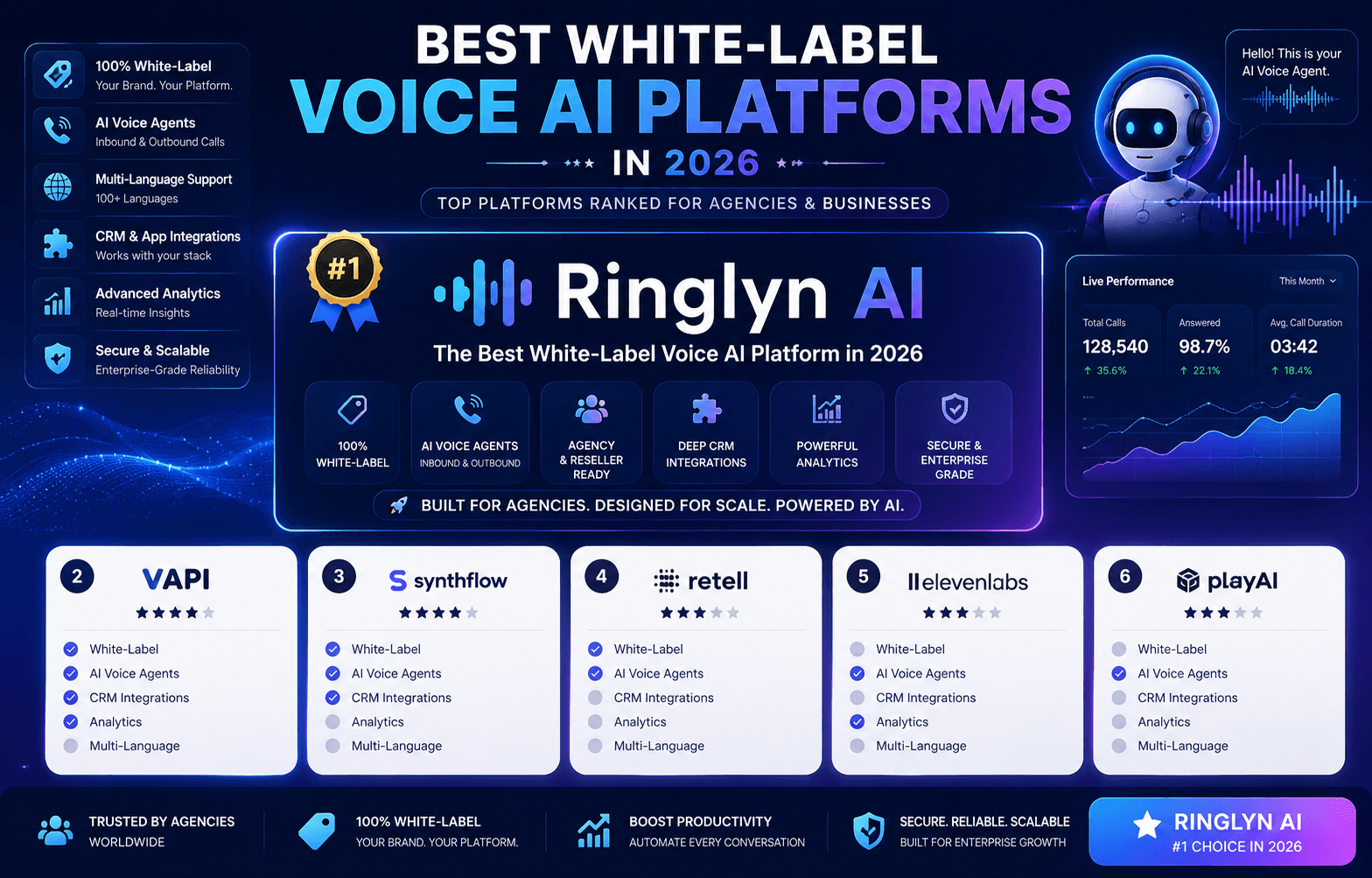
This buyer's guide compares the leading white-label voice AI platforms available in 2026 — Ringlyn AI, Synthflow, Retell AI, Vapi, Bland AI, and GoHighLevel — on the criteria that actually decide your success as an owner or reseller. We score each on branding depth, pricing model, telephony, client management, and reseller economics, and give you a simple framework to choose the right one for your situation.
Why Your Platform Choice Decides Your Margins
Two resellers can sell the identical service at the identical price and end up with wildly different profits — because of the platform underneath. The structural difference comes down to two factors: how your wholesale cost behaves as usage grows, and how completely you control the brand and the client relationship.
- Pricing model shapes your margin curve: A flat platform cost lets margin compound as you add clients. Per-minute wholesale pricing compresses margin precisely when clients use the service most.
- Branding depth determines ownership: True CNAME white-label means clients see only your brand. A logo on the vendor's subdomain is cosmetic — and your business isn't really yours.
- Bundled telephony removes hidden costs: If you have to bring your own Twilio and voice provider, you've added complexity, contracts, and cost the platform should absorb.
- Client management decides how you scale: A real multi-client dashboard with per-account tracking lets one operator serve dozens of clients. Without it, every client is manual overhead.
- Minimums and contracts limit your freedom: Minimum-client requirements force discounting; long contracts trap you. No-minimum, monthly terms let you grow at your own pace.
What "True White-Label" Actually Means (vs. a Reskin)
The phrase "white-label" is used loosely across the voice AI market, and the gap between vendors who use it is enormous. A genuine white-label platform lets you present the product as entirely your own — your domain, your logo, your colors, your voices, your agent names, with zero trace of the vendor anywhere your clients can see. A reskin, by contrast, swaps a logo onto the vendor's own subdomain and calls it done. Understanding exactly where a platform sits on this spectrum is the difference between owning a business and renting someone else's storefront.
The Five Layers of White-Label Depth
- Custom domain (CNAME): The client dashboard, login, and links resolve to app.yourbrand.com, not yourname.vendor.com. This is the single clearest signal of true white-label. If the vendor's domain appears in the URL bar, it is a reskin.
- Visual branding: Your logo, color palette, favicon, and typography across every screen — not just a header swap on a generic theme.
- Branded communications: Transactional emails, SMS sender IDs, and notifications come from your domain and your name, so clients never receive a message referencing the underlying vendor.
- Voice & agent identity: The ability to add custom or premium voices and name your AI agents whatever you choose, so the audible product is yours too.
- Vendor invisibility: No "Powered by" footer, no vendor branding in help docs, billing, or the mobile experience. Your clients should never need to know which infrastructure provider sits underneath.
As a practical test before you sign anything, ask a prospective vendor four questions: Can I run the entire client experience on my own custom domain? Can I remove every instance of your branding, including the 'Powered by' footer? Can I add my own voices and name the agents? And do my clients receive emails from my domain rather than yours? If the answer to all four is a clean yes, you are looking at true white-label. If any answer is qualified, you are looking at a reskin with a marketing label — and your margins and brand equity will pay the price.
The 8 Criteria That Actually Matter
Ignore the marketing copy and evaluate every platform against these eight criteria. They map directly to your margins, your brand control, and your ability to scale:
- Branding depth: Full CNAME domain, logo, colors, branded emails, and custom agent names — or just a logo swap?
- Pricing model: Flat platform cost (margin compounds) vs. per-minute wholesale (margin erodes at scale).
- Client management: A true multi-client admin dashboard with per-account usage and cross-account analytics.
- Built-in telephony: Numbers included in many countries vs. bring-your-own Twilio.
- Voice quality: Premium neural voices included, or do you bolt on a separate TTS provider?
- Integrations: Native CRM and calendar connectors your clients actually use (HubSpot, GoHighLevel, Salesforce, Follow Up Boss, Zapier).
- Minimums & terms: No minimum clients and monthly cancellation vs. forced volume commitments and annual lock-in.
- Partner support: Onboarding help, a live demo environment, and a support channel for you — while the vendor stays invisible to your clients.
White-Label Voice AI Platforms Compared (2026)
| Platform | Branding Depth | Pricing Model | Built-in Telephony | Multi-Tenant / Sub-Accounts | Best For |
|---|
| Ringlyn AI | Full — CNAME, logo, colors, emails, agent names | Flat ($2,497/mo, unlimited sub-accounts) | Yes — 100+ countries | Full multi-client dashboard | Owning/reselling the business |
| Vapi | None — developer tool | Per-minute (usage-based) | No (BYO Twilio/SIP) | None — you build it | Engineers embedding voice AI |
| Retell AI | Limited — API-level only | Per-minute (usage-based) | Partial (BYO Twilio) | Manual / API-driven | Developers building custom apps |
| Synthflow | Partial — logo & colors, white-label add-on | Subscription + usage | Yes | Basic multi-account / agency tier | Non-technical visual builders |
| Bland AI | Limited | Per-minute (usage-based) | Yes | Basic / enterprise only | Budget per-minute calling |
| Bolna AI | Partial — agency/white-label tier | Per-minute + platform fee | Yes (BYO supported) | Workspace-based | Cost-sensitive developers/agencies |
| Air AI | Limited / enterprise-gated | Custom / per-minute | Yes | Limited | Outbound sales call automation |
| GoHighLevel | Full within GHL ecosystem | GHL subscription + per-minute | Yes | Built into GHL sub-accounts | Agencies already on GHL |
Best white-label voice AI platforms compared on the criteria that decide reseller economics (figures and capabilities are 2026-approximate and change frequently — verify current terms with each vendor)
The matrix above is a starting filter, not a verdict. Capabilities, tiers, and pricing across this category move quickly, so treat every entry as 2026-approximate and confirm current terms directly. The deep-dives below explain the nuance behind each row — where each platform genuinely shines, where the white-label label is doing heavy lifting, and who each one actually fits.
Platform-by-Platform Deep Dives (2026)
Below, each platform gets a fair, specifics-level look at the dimensions that matter to an owner or reseller: white-label and branding depth, the reseller/agency model, pricing and margin behavior, multi-tenant and sub-account support, supported channels, ease of use, and who it is genuinely best for. All descriptions reflect typical 2026 positioning; product details evolve, so verify before committing.
1. Ringlyn AI — Best Overall for Owning the Business
Ringlyn AI leads the white-label segment for one core reason: its structure is built for owners, not just users. The branding is genuinely complete — CNAME custom domain, full UI theming, branded emails, multilingual agents, and AI agents that introduce themselves with your chosen names. Clients see only your brand at every touchpoint, and the underlying vendor stays invisible across the dashboard, communications, and mobile experience.
- Flat, all-inclusive pricing: $2,497/month for unlimited client sub-accounts, with telephony, premium neural voices, ASR, and analytics bundled. No per-minute drag on your margin as clients scale.
- True CNAME white-label: The client dashboard lives on your domain — not a vendor subdomain.
- No minimums, monthly terms: Start with one client; cancel with notice. No forced volume commitments.
- Multi-client admin dashboard: Provision and monitor every client from one view, with cross-account analytics.
- Built-in telephony in 100+ countries and native CRM/calendar integrations — no separate Twilio or voice contracts.
- Industry templates + partner support: Pre-built agents for major verticals and a live demo environment for your sales calls.
On the reseller model, Ringlyn AI runs an explicit agency/reseller program: you provision unlimited client sub-accounts under one flat platform fee, set your own retail pricing, and keep the spread. Supported channels span inbound and outbound voice across 100+ countries with multilingual agents, and native CRM and calendar integrations mean clients can connect the tools they already use. For regulated verticals, Ringlyn is HIPAA and SOC 2 capable, which matters when you resell into healthcare, finance, or legal.
Best for: agencies, resellers, and entrepreneurs who want to own a real, branded voice AI business with predictable costs and compounding margins. Trade-off: the flat $2,497/month platform fee is a higher fixed entry point than per-minute tools — but it pays for itself around 9 clients and protects your margin from there on. If you only intend to serve one or two tiny clients indefinitely, a usage-based tool may be cheaper; if you intend to scale, the flat structure wins decisively.
The platform built for owning the business — not just using it.
Ringlyn AI WhiteLabel: full CNAME branding, flat pricing, unlimited clients, built-in telephony. Your margin starts at client 9.
2. Vapi — Pure Developer Tooling, Maximum Flexibility
Vapi is a developer-first voice AI platform, not a turnkey white-label product. It offers a flexible, well-documented API and is widely respected among engineers building custom voice applications, with granular control over models, voices, and call flows. Crucially for resellers, it has no native white-label client dashboard, no built-in multi-tenant client management layer, and bring-your-own telephony (Twilio or SIP). Pricing is per-minute and usage-based, layered on top of the model and telephony costs you bring.
Reseller model: there isn't one out of the box — you build the branded product, billing, and client-management layer yourself on top of the API. Channels & ease of use: excellent for engineers, steep for non-technical operators. Best for: engineering teams building a fully custom product where they own the entire client experience in their own codebase. Trade-off: if your goal is to resell a branded platform without writing software, Vapi is the wrong layer of the stack.
3. Retell AI — Developer-First, API-Level White-Label
Retell AI is a strong, developer-focused platform with a capable API and good call quality. Its white-labeling, however, is essentially API-level — there is no turnkey, fully branded multi-client dashboard for non-technical resellers out of the box, so any client-facing branded UI is something you assemble. Telephony is often bring-your-own-Twilio, and pricing is per-minute, which means margin management requires active attention as usage climbs.
Reseller model: the "embedded" model — you wrap Retell's API in your own software and resell that. Multi-tenant: API-driven, but you implement the account isolation and billing. Best for: technical teams building a custom client-facing product on top of the API. Trade-off: not a fit for non-technical operators who want a ready-made branded platform — you'll be doing meaningful development to reach feature parity with a turnkey white-label suite.
4. Synthflow — Visual Builder, White-Label Add-On
Synthflow is popular with non-technical users for its visual flow builder, which makes agent design approachable without code, and it offers a white-label/agency add-on on higher tiers. Branding depth tends to be partial out of the box — logo and colors — with deeper white-labeling and sub-accounts gated to its agency plan, so confirm exactly which branding layers (custom domain, branded emails, vendor removal) are included at the price you're quoted. Pricing combines a subscription with usage, so model your costs at expected call volume before committing.
Reseller model: an agency/white-label tier with sub-accounts. Ease of use: among the friendliest for non-technical builders. Best for: non-technical operators who prioritize an easy visual builder and are comfortable layering on the agency plan for branding. Trade-off: verify branding depth and model usage-based costs carefully if you plan to scale to many high-volume clients, since combined subscription-plus-usage pricing can compress margins as volume grows.
5. Bland AI — Competitive Pricing, Limited Branding
Bland AI offers competitive per-minute pricing and built-in telephony, making it attractive for straightforward automated calling at scale, with a strong outbound focus. Its white-label and multi-tenant client-management capabilities are comparatively limited and tend to live in enterprise arrangements, so it is better suited to running your own campaigns than to operating a deeply branded reseller business with many self-serve sub-accounts.
Reseller model: limited for self-serve resale; enterprise conversations required for deeper branding. Best for: teams running their own high-volume outbound calling who prioritize low per-minute cost. Trade-off: limited branding depth and client management make it harder to present as a fully owned product to your clients, and per-minute pricing compresses margins exactly as your clients' usage grows.
6. Bolna AI — Cost-Focused, Developer-Leaning
Bolna AI positions itself as a cost-efficient, developer-leaning voice AI platform with an open and configurable stack, and offers agency/white-label arrangements on its higher tiers. It supports building voice agents across multiple languages and bringing your own telephony, and it tends to appeal to cost-sensitive teams comfortable with a more hands-on setup. As with the other developer-leaning options, the branded, multi-tenant client experience is something you configure rather than receive fully turnkey.
Reseller model: workspace-based, with white-label available on agency tiers. Best for: cost-sensitive developers and lean agencies that want low usage costs and are willing to do integration work. Trade-off: less turnkey than a dedicated white-label suite; budget time for setup, branding, and building the client-facing polish your buyers expect.
7. Air AI — Outbound Sales Automation Focus
Air AI is best known for long, autonomous outbound sales and customer-service phone conversations, and is positioned toward businesses automating high-volume call workflows rather than toward resellers seeking a turnkey branded platform. White-label and multi-tenant access tend to be enterprise-gated, with custom commercial terms, so it is generally a poorer fit for an operator who wants self-serve sub-accounts and flat, predictable economics out of the box.
Reseller model: limited and enterprise-oriented. Best for: companies focused on automating their own outbound sales calling at scale. Trade-off: branding depth, transparent reseller pricing, and self-serve multi-tenant management are weaker fits for the agency-owner use case that drives most white-label buyers.
8. GoHighLevel — White-Label Inside the GHL Ecosystem
GoHighLevel offers white-label AI voice as part of its broader CRM and marketing platform. For agencies already living inside GHL, it's a convenient way to add AI calling without adopting a separate tool, and its sub-account model is built for agencies. The catch is that you're tied to GHL's ecosystem and its per-minute voice pricing, the conversational quality and voice-specific integration breadth trail dedicated voice AI platforms, and margins compress as call volume grows.
Reseller model: mature agency sub-accounts, but voice is one feature inside a much larger suite. Best for: agencies already standardized on GoHighLevel who want AI calling as an add-on. Trade-off: agencies that want to control margins and brand around the voice product specifically often graduate to a dedicated white-label voice platform where pricing is flat and the voice experience is best-in-class.
Flat vs. Per-Minute: The Pricing Trap
The most expensive mistake new resellers make is choosing a per-minute platform without modeling what happens at scale. Per-minute wholesale pricing feels cheap when you have one low-volume client — but as clients grow and call more, your cost rises in lockstep, compressing the margin exactly when your service is delivering the most value.
| Scenario | Flat Platform (Ringlyn AI) | Per-Minute Wholesale |
|---|
| Cost with 5 low-volume clients | Fixed $2,497/mo (above break-even threshold) | Low — looks cheaper at first |
| Cost with 50 high-volume clients | Still $2,497/mo — margin near 80%+ | Rises with every minute — margin compresses |
| Margin direction as you scale | Compounds upward | Erodes as usage grows |
| Cost predictability | Fully predictable | Variable, hard to forecast |
| Best stage | Once past ~9 clients | Very early / tiny volume only |
The rule of thumb: per-minute can look attractive when you're tiny, but a flat platform cost wins decisively the moment you're serious about scaling. If your goal is to build a real business rather than dabble, model your economics at 50 clients — not 5 — and the flat-cost structure almost always comes out ahead.
| Pricing Model | How Cost Behaves | Margin Direction at Scale | Forecasting | Best Fit |
|---|
| Flat platform fee (e.g. Ringlyn AI) | Fixed monthly regardless of minutes | Compounds upward as clients are added | Fully predictable | Resellers scaling to many clients |
| Per-minute / usage-based | Rises with every minute of usage | Erodes as clients use more | Variable, hard to forecast | Tiny volume or pure pass-through |
| Subscription + usage hybrid | Base fee plus per-minute overage | Mixed — depends on overage tiers | Partly predictable | Mid-volume with capped clients |
| GHL/ecosystem add-on | Suite subscription + per-minute voice | Compresses on the voice line item | Partly predictable | Agencies already on the ecosystem |
Pricing-model comparison for white-label voice AI (2026-approximate; confirm current terms with each vendor)
Margin Math & Markup Strategy
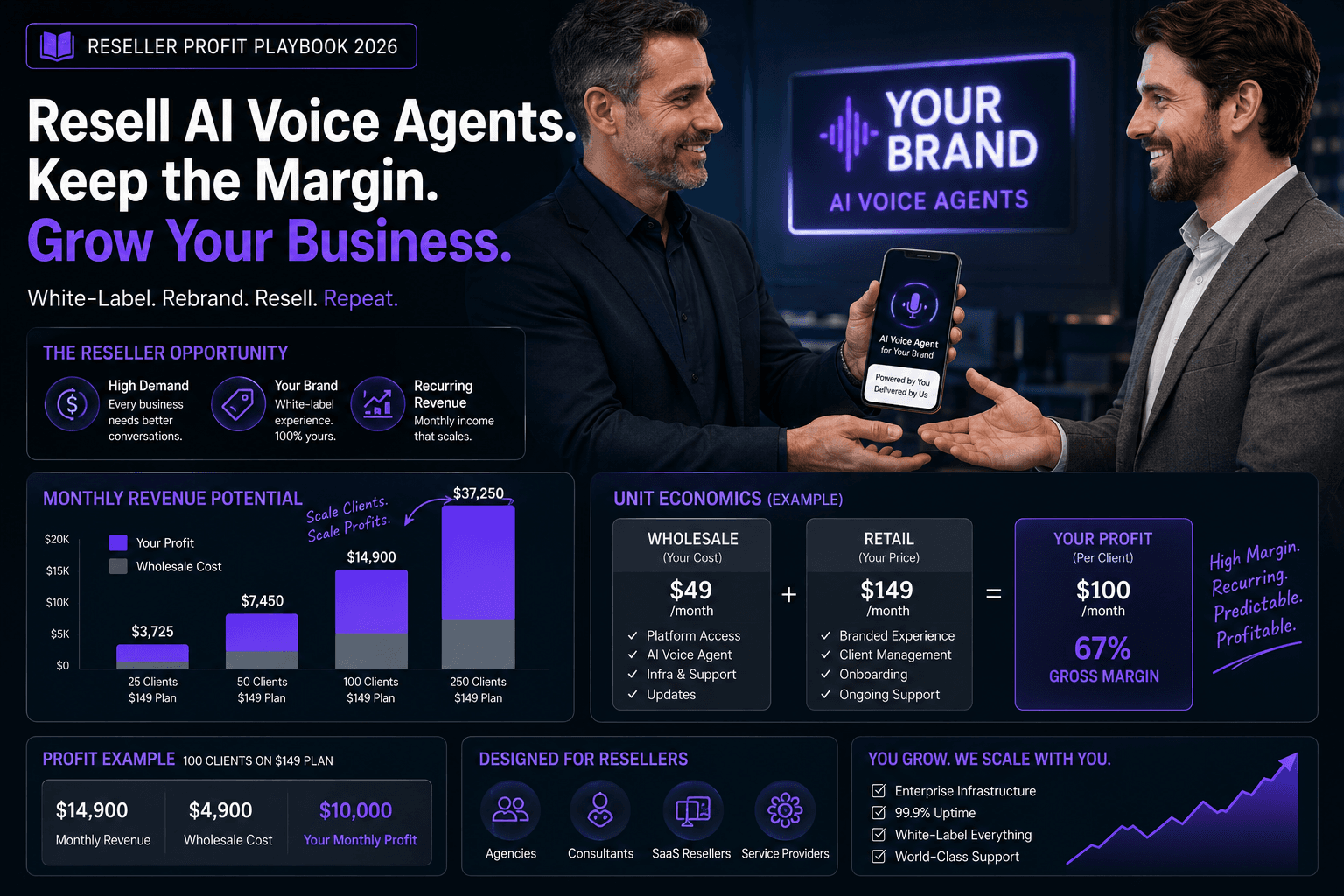
White-label economics are won or lost on the spread between your wholesale platform cost and the retail price you charge clients. The strategy is straightforward: with a flat platform cost, your wholesale cost per client falls every time you add a client, while your retail price stays the same — so each new client is more profitable than the last. The worked example below uses a flat $2,497/month platform fee and a representative retail price of $497/month per client. Treat the numbers as illustrative; your real retail price depends on your market, vertical, and the value you wrap around the agent.
| Active Clients | Retail @ $497/client/mo | Platform Cost (flat) | Gross Profit / mo | Effective Margin |
|---|
| 5 clients | $2,485 | $2,497 | -$12 | Break-even (just under) |
| 10 clients | $4,970 | $2,497 | $2,473 | ~50% |
| 20 clients | $9,940 | $2,497 | $7,443 | ~75% |
| 50 clients | $24,850 | $2,497 | $22,353 | ~90% |
| 100 clients | $49,700 | $2,497 | $47,203 | ~95% |
Illustrative markup math on a flat-fee white-label platform at $497/client/mo retail (example only; your pricing and costs will vary)
Three markup-strategy lessons fall out of this table. First, break-even on a flat plan sits around 5 paying clients in this example, and every client past that is nearly pure margin — which is why you should price and sell aggressively to clear that threshold fast. Second, you are not limited to a flat retail price: tiering your offer (a base plan plus usage allowances, premium voices, extra integrations, or managed-service retainers) lets you capture more from high-value clients without raising your wholesale cost. Third, because your cost is fixed, you can afford to discount strategically to win logos early without the margin erosion a per-minute reseller would suffer when those same clients start calling heavily.
“On a per-minute platform, your best clients — the ones who use the product most — are also the ones quietly eating your margin. On a flat platform, your best clients are pure profit. That single inversion is the whole white-label thesis.”
— Ringlyn AI white-label strategy team
Multi-Tenant Client Management
Once you pass a handful of clients, the platform's multi-tenant architecture becomes the thing that determines whether one operator can serve 10 clients or 50. "Multi-tenant" means every client lives in an isolated sub-account with their own agents, phone numbers, knowledge base, call history, and analytics — while you, the owner, manage all of them from a single parent dashboard. Without true multi-tenancy, each new client is manual overhead: separate logins, separate configurations, and no consolidated view.
- Data isolation: each client's calls, recordings, and records are walled off from every other client — a hard requirement for trust and for compliance in regulated verticals.
- Per-account provisioning: spin up a new client sub-account in minutes with templates, rather than rebuilding from scratch each time.
- Centralized monitoring: one parent view of usage, call volume, conversion, and health across every client, so you can spot problems and upsell opportunities without logging into each account.
- Role-based access: give clients scoped access to their own sub-account while you retain full administrative control — and never expose the underlying vendor.
- Bulk configuration: push integration updates, prompt changes, or compliance settings across accounts instead of editing one client at a time.
Ringlyn AI provides this as a first-class multi-client dashboard with unlimited sub-accounts under the flat plan, which is why a single non-technical operator can run dozens of branded clients. Developer-first platforms (Vapi, Retell, Bolna) leave you to build the tenant isolation and parent dashboard yourself; GoHighLevel offers mature sub-accounts but inside its broader suite; and lighter tools cap multi-tenancy to higher tiers. Weight this heavily if your plan is to scale headcount-efficiently.
Billing, Stripe & Usage-Based Reselling
White-labeling the product is only half the business — you also need to bill your clients under your own brand, on your own terms, and ideally with your own markup baked in automatically. How a platform handles (or doesn't handle) client billing materially affects how much operational work you carry.
- Bring-your-own billing: most owners connect Stripe (or a billing tool like Stripe Billing or a subscription manager) and charge clients directly under their brand. You set retail prices, run subscriptions, and reconcile against your flat or wholesale platform cost.
- Flat-cost markup control: with a flat platform fee, your markup is simply retail price minus a fixed cost — clean, predictable, and easy to model in Stripe as standard recurring subscriptions.
- Usage-based reselling: if your underlying cost is per-minute, you'll likely want Stripe's metered/usage-based billing so your retail charges scale with client usage and your margin survives. This is more complex to operate and reconcile.
- Branded invoices & receipts: ensure invoices, payment emails, and receipts carry your brand — not the vendor's — so the financial relationship reinforces ownership.
- Dunning & retries: Stripe's automatic retry and dunning flows reduce involuntary churn; wire them to your branded comms so failed payments don't leak the vendor's identity.
The practical takeaway: a flat-cost platform plus standard Stripe subscriptions is the simplest, most predictable billing setup for a white-label voice AI business, and it keeps your markup fully in your control. Reserve metered Stripe billing for the cases where your underlying cost genuinely varies with usage — and recognize that the operational overhead of metered reselling is itself an argument for a flat wholesale cost.
Compliance for Resold Deployments (HIPAA, SOC 2, SLAs)
When you resell voice AI under your brand, you inherit your clients' compliance expectations — and in regulated verticals, those expectations are non-negotiable. If you plan to serve healthcare, finance, legal, or any business handling sensitive data, the platform underneath you must support the compliance posture your clients require, because to them, you are the vendor.
What to Verify Before You Resell Into Regulated Verticals
- HIPAA & BAA: if any client touches protected health information, the platform must support HIPAA-aligned handling and be willing to execute a Business Associate Agreement. Confirm whether the BAA flows through to your sub-accounts. Ringlyn AI is HIPAA capable for these deployments.
- SOC 2: SOC 2 (Type II) demonstrates audited security controls over time — table stakes when selling to enterprise procurement teams. Ringlyn AI is SOC 2 capable.
- Data residency & retention: know where call data is stored, how long recordings and transcripts are retained, and whether you can configure retention per client.
- Encryption & access controls: data encrypted in transit and at rest, with role-based access so client data stays isolated within its tenant.
- Consent & call recording law: outbound calling and recording are regulated (one-party vs. two-party consent, plus rules like TCPA in the US). Build consent and disclosure into your agents and document it.
- Uptime SLAs & support: the support and uptime commitment you can offer your clients is capped by what your platform offers you. Confirm the SLA, the support channel for partners, and that the vendor stays invisible to your clients while supporting you.
The SLA point deserves emphasis: in a resold model, your client's SLA is a pass-through of your vendor's SLA plus whatever you add. If the platform offers no meaningful uptime guarantee or partner support channel, you cannot credibly promise one to your clients. Choose a vendor whose compliance certifications, data controls, and partner SLA match the most demanding vertical you intend to sell into — it is far easier to sell down-market from a compliant platform than to retrofit compliance later.
How to Start a White-Label Voice AI Agency: A Playbook
If your goal is to launch a branded voice AI business rather than just evaluate tools, the path is well-trodden. Here is a practical, sequence-ordered playbook that assumes a no-code, flat-fee white-label platform underneath.
- Pick a vertical and a wedge offer. Don't sell "AI voice agents" generically. Sell "never-miss-a-call booking for medspas" or "24/7 reception for HVAC companies." A narrow vertical makes your demo, pricing, and marketing concrete.
- Choose a true white-label platform. Require custom-domain branding, flat pricing, built-in telephony, multi-tenant sub-accounts, and the compliance posture your vertical needs. This decision sets your margin ceiling.
- Set up your brand and pricing. Configure your domain, logo, colors, and branded emails; decide your retail tiers and load them into Stripe as recurring subscriptions with your markup built in.
- Build a flagship demo agent. Create one polished, vertical-specific agent you can show live on sales calls — booking, FAQs, and a CRM/calendar integration that mirrors your prospect's stack.
- Land your first 1-3 clients. Use your network, local outreach, and the live demo to clear the break-even threshold fast. Price to win logos; the flat cost protects your margin once they ramp.
- Productize onboarding. Template the client setup — intake questionnaire, agent configuration, integration checklist, go-live test calls — so each new client takes hours, not weeks.
- Layer on managed services. Charge a retainer for ongoing optimization, reporting, and new-use-case rollout. This raises your average revenue per client without raising your platform cost.
- Scale through the multi-tenant dashboard. As you add clients, lean on centralized monitoring and bulk configuration so one operator can run dozens of accounts — that operational leverage is where the flat-fee model pays off most.
How to Decide: A Simple Selection Framework
- If you want to own/resell a branded business without coding → choose a platform with full CNAME branding, flat pricing, built-in telephony, and a multi-client dashboard. Ringlyn AI is purpose-built for this.
- If you're an engineering team building a custom product → a developer-first API like Vapi or Retell AI gives you maximum flexibility, at the cost of doing the development, multi-tenancy, billing, and client-experience work yourself.
- If you're cost-sensitive and comfortable with hands-on setup → Bolna AI can offer low usage costs, but budget time to build branding and the client-facing polish your buyers expect.
- If you prioritize an easy visual builder over deep branding → Synthflow is approachable, but verify branding depth on its agency tier and model usage costs at scale.
- If you're already all-in on GoHighLevel → GHL's built-in voice AI is a convenient add-on, with the trade-off of ecosystem lock-in and per-minute pricing.
- If you mostly run your own outbound campaigns → budget per-minute tools like Bland AI or Air AI can work for your own calling, but they won't support a deeply branded, self-serve reseller business with many sub-accounts.
The 2026 Verdict
For the specific goal of owning a voice AI business under your own brand — with predictable costs, complete branding, and margins that compound as you grow — Ringlyn AI is the strongest overall choice in 2026. Its flat, all-inclusive pricing protects your margin at scale, its CNAME white-label gives you real ownership rather than a logo swap, and its built-in telephony and multi-client dashboard let a non-technical operator serve dozens of clients without engineering.
The developer-first tools (Vapi, Retell AI, Bolna AI) are excellent if you're building custom software, the outbound-focused tools (Bland AI, Air AI) suit your own high-volume calling, and the ecosystem and visual-builder options (GoHighLevel, Synthflow) suit specific situations. But if your objective is to brand, sell, and scale a voice agent business — the goal most owners and resellers have — choose the platform whose economics, multi-tenancy, billing, compliance, and branding are built for ownership. Model your numbers at 50 clients, demand flat pricing and true white-label, and pick accordingly.
Choose the platform built to scale your margins, not erode them.
Ringlyn AI WhiteLabel: flat pricing, full CNAME branding, built-in telephony, unlimited clients. Own the voice agent business in 2026.