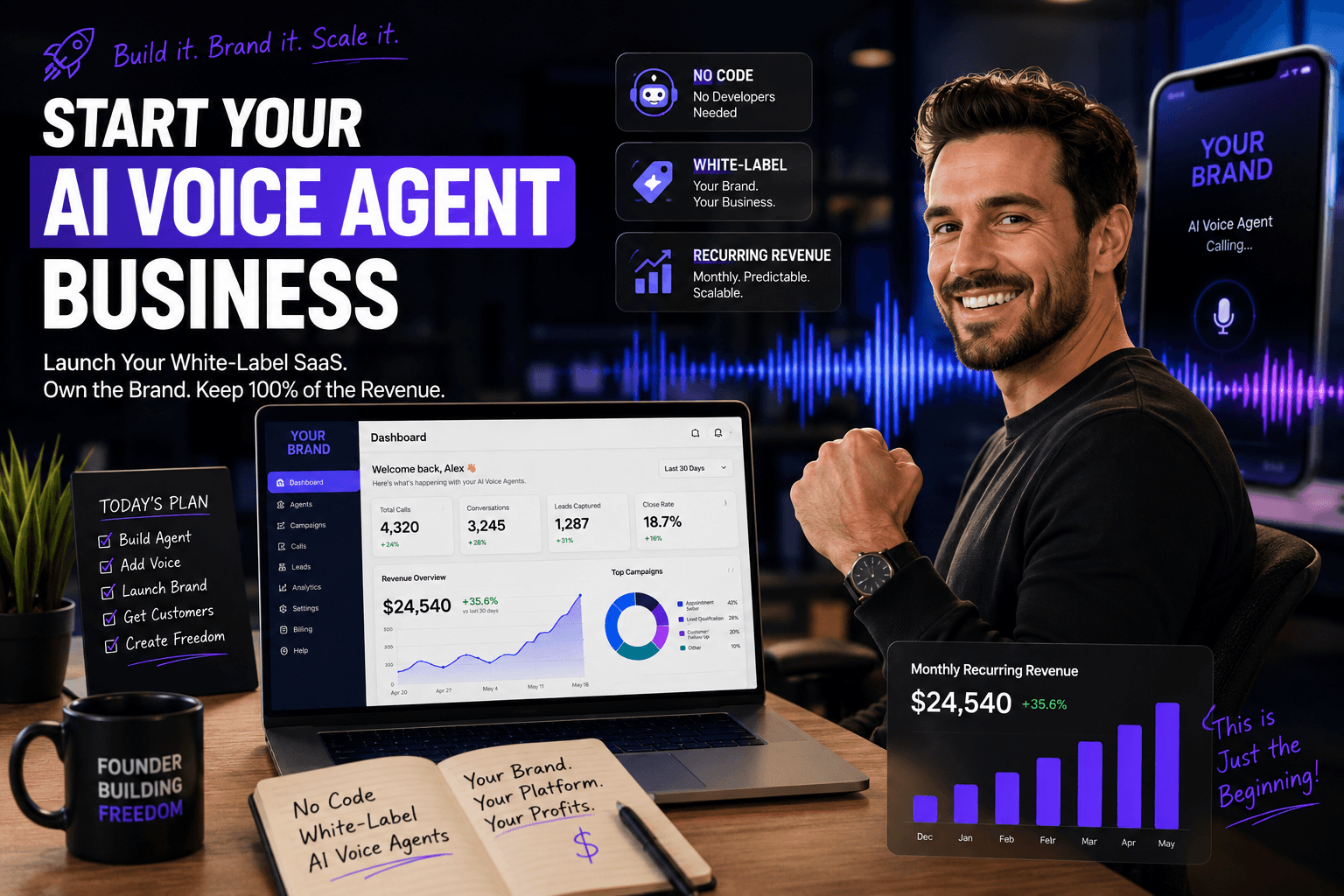
In 2026, you can start your own AI voice agent business without writing a single line of code, hiring an ML team, or spending a dollar on cloud infrastructure. Every business with a phone number is now a potential customer for AI calling — answering missed calls, booking appointments, qualifying leads, and following up 24/7 — and most of them have no idea how to buy or deploy the technology. That gap is the opportunity. The people who close it are not the engineers who built the AI; they're the operators who package it, brand it, and sell it to the businesses who need it.
This is exactly what a white-label voice AI business is. You license a production-grade platform like Ringlyn AI, put your own brand on it, set your own prices, and sell AI phone agents to local businesses, niche industries, or your existing network — as your product. The platform vendor stays invisible. You own the client relationship, the recurring revenue, and the brand. This guide is the complete, no-fluff blueprint for launching that business in 2026 — from your first client to six figures of recurring revenue.
Why Owning a Voice AI Business Is the 2026 Opportunity
Three things have to be true for a business opportunity to be worth pursuing: the demand has to be real, the technology has to work, and the barrier to entry has to be low enough that you can actually start. For AI voice agents in 2026, all three are finally true at the same time.
- Demand is mainstream: Searches for 'AI receptionist' and 'AI voice agent' are up several hundred percent year-over-year. Small businesses lose 20–30% of inbound calls to voicemail — and every missed call is lost revenue they feel immediately.
- The technology crossed the trust threshold: Modern neural voices, real-time speech recognition, and large language models make AI calls natural enough that callers often can't tell. This was not true 18 months ago.
- The barrier to entry collapsed: White-label platforms now hand you the entire stack — AI, telephony, voice synthesis, dashboards, billing — under your brand. You provide the sales, packaging, and relationship.
- It's recurring revenue, not project work: Unlike a website build or an ad campaign, an AI agent runs every day and bills every month. You configure it once and it keeps paying you.
- Switching costs are high: Once a client's phone numbers, knowledge base, call flows, and CRM are wired in, leaving is painful — so clients stay.
“The winners in any technology wave are rarely the people who invented it — they're the distributors who put it in front of the businesses that need it, in language those businesses understand. Voice AI in 2026 is a distribution game, and the distribution layer is wide open.”
— Ringlyn AI Partner Program
The 5 Business Models: Which One Should You Pick?
"Starting an AI voice agent business" is not one business — it's at least five, each with a different effort profile, margin structure, and ceiling. Most successful owners eventually blend two or three, but you should launch with one so your offer, your demo, and your pricing stay sharp. Here's how the models compare before we go deep on each.
| Business Model | How You Make Money | Effort to Run | Margin Profile | Best For |
|---|
| Done-for-you agency | Setup fee + monthly retainer per client | Medium-high (you build & manage) | 60–80% | Hands-on operators, ex-agency owners |
| White-label SaaS reseller | Monthly subscription, you own the brand | Medium (config + support) | 65–85% | Owners who want recurring SaaS-style revenue |
| Niche vertical specialist | Productized package for one industry | Medium (templated setup) | 70–85% | Anyone with industry knowledge or contacts |
| Pay-per-appointment / lead-gen | Per booked appointment or qualified lead | High (you carry usage risk) | 40–70% | Confident closers, performance marketers |
| Usage markup / wholesale | Buy minutes wholesale, resell at a markup | Low (mostly billing) | 30–60% | Existing SaaS/agency adding a line item |
The five core ways to make money with an AI voice agent business in 2026
1. The Done-For-You Agency
You act as a hands-on service provider: you design the call flows, write the prompts, load the knowledge base, connect the CRM, and manage the agent on the client's behalf. Clients love it because they do nothing — you love it because it commands the highest retainers and the stickiest relationships. You typically charge a one-time setup fee ($500–$2,500) plus a monthly retainer ($300–$1,500). This is the fastest path to revenue if you're comfortable being the expert in the room.
2. The White-Label SaaS Reseller
Instead of selling your time, you sell a branded product. You license a platform like Ringlyn AI, put your logo and domain on it, and clients subscribe to your software. Because the vendor stays invisible and your platform cost is flat, this model behaves like a real SaaS business: predictable recurring revenue and margins that widen as you scale. It's the model this guide leans into most heavily — it has the best long-term economics for a non-technical owner.
3. The Niche Vertical Specialist
Here you pick one industry — real estate, dental, home services, restaurants, law — and become "the AI receptionist company" for it. You productize a single offer, reuse the same agent template for every client, and let referrals compound inside the vertical. It's not really a separate model so much as a focusing strategy you layer on top of the agency or reseller model, and it's the single biggest accelerant for new owners. We dedicate a full section to niche selection below.
4. Pay-Per-Appointment & Lead-Gen
Rather than a flat retainer, you charge per outcome — say $25–$75 per booked appointment or qualified lead. Clients love the zero-risk framing, and a well-tuned outbound agent can make this extremely lucrative. The catch: you carry the usage cost and the performance risk, so margins are thinner and more variable. Start with retainer clients first, prove your numbers, then offer performance pricing to clients who hesitate on a flat fee.
5. Usage Markup / Wholesale Reselling
The lightest-touch model: you buy voice minutes or platform usage at a wholesale rate and resell at a markup, often as an add-on inside an existing agency or SaaS product. Effort is minimal — mostly billing and light support — but so is differentiation, which keeps margins lower. It's a great add-on revenue line, less so as a standalone business. If you already serve clients in another capacity, this is the easiest way to test demand before committing to a full agency.
“If you're starting from zero, pick the white-label SaaS reseller model with a single-vertical focus. It gives you recurring revenue, a brand you own, flat and predictable costs, and a productized offer you can sell again and again. The other models become upsells once you have clients.”
— Ringlyn AI Partner Program
What You're Actually Selling (and Who Buys It)
You are not selling 'AI.' You're selling outcomes that a business owner already wants and already pays for — just delivered cheaper, faster, and around the clock. The clearest way to think about it: you're replacing or augmenting an expensive, unreliable, part-time human function with a tireless AI one.
| What You Sell | The Problem It Solves | Who Buys It |
|---|
| AI Receptionist | Missed calls go to voicemail; customers hang up and call a competitor | Dentists, salons, home services, clinics, law firms |
| AI Appointment Setter | Front desk is overwhelmed; no-shows pile up | Medical/dental practices, med spas, auto service |
| AI Lead Qualifier | Sales reps waste hours on unqualified leads | Real estate teams, solar, insurance, mortgage |
| AI Outbound Caller | Old leads go cold; follow-up never happens | Roofing, financial advisors, agencies, B2B sales |
| After-Hours AI Answering | Calls after 5pm and on weekends are lost revenue | Property management, HVAC, plumbing, legal intake |
What a white-label AI voice agent business actually sells — by outcome and buyer
The buyer almost never asks 'what AI model are you using?' They ask 'how many appointments will this book me?' and 'what does it cost vs. hiring someone?' Your job as the business owner is to translate the technology into those answers — which is exactly why a non-technical operator can win here. You're a packager and a problem-solver, not an engineer.
White-Label vs. Building It Yourself: The Real Math
Some people see this opportunity and think they should build their own platform from scratch — wire together a speech-to-text engine, an LLM, a text-to-speech provider, and a telephony provider like Twilio. It's technically possible. It's also a trap for anyone whose goal is to own a business rather than run an engineering project. Here's the honest comparison:
| Factor | Build It Yourself | White-Label (Ringlyn AI) |
|---|
| Time to first client | 6–12 months | 1–4 weeks |
| Upfront cost | $80K–$300K+ in dev | Monthly platform license |
| Engineering team needed | Yes (2–4 people) | None |
| Telephony, TTS, ASR contracts | You negotiate each one | All included, one bill |
| Ongoing maintenance | You own every bug & outage | Vendor handles uptime & R&D |
| Your focus | Infrastructure | Sales, clients, growth |
| Time to profit | 12–24 months | 1–3 months |
Building a voice AI platform vs. white-labeling one — for a business owner, not an engineer
The math is decisive for almost everyone. Building from scratch only makes sense if your goal is to become a platform vendor competing with Ringlyn, Bland AI, Retell AI, Vapi, Synthflow, and the rest — a venture-scale software company. If your goal is to own a profitable AI calling business serving real clients, white-label is faster, cheaper, and dramatically less risky. You skip straight to the part that makes money: selling and serving customers. (If you're still curious about the technical side, our guide to building an AI voice agent walks through what the platform handles for you.)
Skip the 12-month build. Launch your AI voice business this month.
Ringlyn AI's white-label platform gives you the full stack — AI, telephony, voices, dashboard, billing — under your brand.
How a White-Label AI Voice Agent Business Works
The model is simple once you see the flow of money and branding. You sit between the platform and the client. The platform charges you a wholesale rate; you charge your client a retail rate; the difference is your margin. The client only ever sees your brand.
- You license the platform: Activate Ringlyn AI's WhiteLabel plan and configure your branding — logo, colors, custom domain (e.g. app.yourbrand.com), and your AI agents' names and voices.
- You package an offer: Decide what you sell (e.g. 'AI Receptionist for Dental Practices — $497/month') and to whom.
- You sell to a client: A local business signs up with you, pays you, and sees your brand on the dashboard and in their billing.
- You configure their agent: Set up call flows, upload their FAQ and business info into the knowledge base, connect their CRM and calendar, and assign a phone number — all in a no-code dashboard.
- The agent runs 24/7: It answers calls, books appointments, qualifies leads, and logs everything to the client's CRM. You collect recurring revenue every month.
- The platform stays invisible: Ringlyn handles the AI, telephony, uptime, and product updates behind the scenes. Your client never knows it exists.
What Ringlyn AI Gives You to Own the Business
Ringlyn AI's WhiteLabel program is built so that one person — or a small team — can run a real AI voice agent business without technical staff. Everything a business owner needs to brand, sell, deliver, and bill is included:
- Full brand ownership: Your logo, colors, custom login domain, and email templates. Clients see only your brand — never Ringlyn's.
- Unlimited client sub-accounts: Add as many clients as you can sell from a single agency dashboard, each with its own agents, numbers, and usage tracking.
- Built-in telephony: Local and international phone numbers in 100+ countries, included — no separate Twilio account to manage.
- Premium neural voices: Natural, human-sounding voices across multiple languages so your agents don't sound like a robot from 2019.
- No-code agent builder: Configure prompts, call flows, knowledge bases, and routing through a visual dashboard — no engineering required.
- Knowledge base + CRM integrations: Upload each client's documents for accurate answers, and connect HubSpot, GoHighLevel, Salesforce, Follow Up Boss, Zapier, and more.
- Your own pricing: Set whatever you charge clients. You buy wholesale; you sell retail; you keep the margin.
- Industry templates: Pre-built agents for real estate, healthcare, home services, hospitality, legal, and more — go live in hours, not days.
- Partner support: Onboarding help, sales enablement, and a demo environment so you can show prospects a live AI call on the spot.
Startup Costs & Budget: What You Actually Need to Begin
One of the most attractive things about this business is how little it costs to start compared with almost any other software-driven company. There's no inventory, no office, no engineering payroll, and no cloud bill that balloons with usage. Your real startup budget is a platform license, a few light tools, and some time. Here's a realistic breakdown for a solo founder launching lean.
| Cost Item | Lean Start | Comfortable Start | Notes |
|---|
| White-label platform license | $2,497/mo | $2,497/mo | Ringlyn WhiteLabel — unlimited client sub-accounts, flat |
| Domain + custom branding | $15–$50 | $50–$200 | One-time / annual; logo via a freelancer if needed |
| Demo phone number | Included | Included | Bundled in the platform — no separate Twilio bill |
| Website / landing page | $0–$30/mo | $50–$150/mo | Carrd or a one-page site; webflow if you want polish |
| CRM / outreach tools | $0–$50/mo | $100–$300/mo | Free tiers work early; scale tools as clients grow |
| Marketing / ads (optional) | $0 | $300–$1,000/mo | Cold outreach is free; ads optional once you have proof |
| Total month one | ≈ $2,550 | ≈ $3,500–$4,500 | Then near-flat as you add clients on the same license |
Realistic startup budget for a solo white-label AI voice agent business in 2026
Why Your Costs Stay Flat as You Grow
The single most important number above is the flat $2,497/month platform license. Because it covers unlimited client sub-accounts, your largest cost doesn't move whether you serve 3 clients or 30. That's the opposite of a labor business, where every new client means another hire. It's also why most owners reach break-even around 9 clients and then watch margin climb with each additional account — the topic of the pricing section below.
The One Thing Worth Spending On Early
If you spend on anything beyond the license in month one, make it a polished live demo agent — a great voice, a tight greeting, and a real number prospects can call. The demo is your single best sales asset, and a few hours of careful tuning (or a small freelancer fee for a logo and landing page that make you look credible) pays back faster than any ad spend. Everything else can wait until you have your first paying client funding it.
Step-by-Step: Launch Your Voice AI Business in 30 Days
- Days 1–3 — Set up your brand: Activate the WhiteLabel plan. Upload your logo and colors, connect your custom domain, and name your AI agents. Your platform now looks like your company.
- Days 4–7 — Build your flagship agent: Pick one use case and one industry. Build a polished demo agent — system prompt, voice, greeting, knowledge base, and a real phone number people can call.
- Days 8–10 — Use it on yourself: Point the demo agent at your own business line (or a dedicated demo line). Call it from your phone. Refine until it handles real scenarios smoothly. This is your sales weapon.
- Days 11–14 — Create your offer: Write a one-page offer, a simple ROI calculator (cost vs. a human + value of recovered calls), and record a 3-minute demo video of a live call.
- Days 15–21 — Pitch warm leads: Approach 5–10 businesses you already know in your chosen niche. Let them call your demo agent. Offer a 14–30 day pilot.
- Days 22–28 — Onboard first clients: Configure each client's agent — their info in the knowledge base, their CRM, their calendar, their number. Run test calls together, then flip to live.
- Days 29–30 — Capture proof: Pull early data (calls handled, appointments booked, calls recovered) and turn your best client into a case study. That case study sells the next ten clients.
Pick a Niche: The Verticals That Buy Fastest
New owners who try to sell 'AI for everyone' struggle. Owners who pick one niche and become 'the AI receptionist company for [industry]' grow fast. A niche makes your marketing sharper, your demo more relevant, and your referrals more powerful. The best starting verticals share three traits: high call volume, expensive or unreliable human coverage, and clear ROI per booked appointment.
| Niche | Why It Converts | Typical Monthly Price |
|---|
| Dental & medical practices | High no-show cost, overloaded front desk, recall campaigns | $300–$1,000 |
| Home services (HVAC, plumbing, roofing) | Missed calls = lost jobs; after-hours demand | $300–$1,200 |
| Real estate teams | Speed-to-lead is everything; ISAs are expensive | $500–$2,500 |
| Med spas & salons | Booking-driven revenue, high call volume | $300–$900 |
| Law firms | After-hours intake leads are gold; staff is costly | $500–$2,000 |
| Solar & home improvement | High-ticket deals justify premium pricing | $700–$2,000 |
Best starting niches for a new white-label AI voice agent business
Pricing Your Service for Maximum Margin
The golden rule: price on the value you create for the client, not on what the platform costs you. Your client compares your price to (a) the cost of a human doing the same job, and (b) the revenue they lose without you. Both numbers are far higher than your platform cost — so anchor there.
The Three-Part Pricing Structure
The most profitable owners don't rely on a single monthly fee. They stack three revenue components so each client is worth more and churn-proofing is built in:
- One-time setup fee ($500–$2,500): Charged up front to configure the agent, load the knowledge base, and integrate the CRM. It covers your onboarding effort and weeds out tire-kickers.
- Monthly retainer ($297–$1,497): Your core recurring revenue for hosting, managing, and supporting the agent. This is the number that compounds.
- Usage markup (optional): If a client runs heavy outbound volume, add a per-minute or per-appointment markup on top so high-usage clients pay for the value they extract.
Anchor Your Price High (Then Make It Feel Cheap)
- Anchor against a human: A part-time receptionist costs $2,500–$4,000/month and works 40 hours, not 168. Your AI agent at $497/month covers every hour, every day. The savings sell themselves.
- Anchor against lost revenue: If a business misses 40 calls a month and each booked job is worth $300, even recovering half is $6,000/month. Charging $497 is a rounding error to them.
- Use simple tiers: Basic ($197–$297, inbound receptionist), Pro ($397–$597, inbound + outbound + CRM + analytics), Growth ($797–$1,497, managed outbound campaigns for high-ticket clients).
- Keep your costs predictable: Ringlyn's WhiteLabel plan is a flat $2,497/month for unlimited sub-accounts — so every client you add past break-even is mostly profit.
The Margin Math: A Worked Example
Numbers make this concrete. The table below models a solo owner on Ringlyn's flat $2,497/month platform license, charging an average $500/month retainer. Watch what happens to margin as clients are added — the platform cost never moves, so almost every new dollar of revenue past break-even is profit.
| Clients | Monthly Revenue (avg $500) | Platform Cost | Gross Profit | Gross Margin |
|---|
| 5 clients | $2,500 | $2,497 | $3 | ~0% (pre-break-even) |
| 10 clients | $5,000 | $2,497 | $2,503 | ~50% |
| 20 clients | $10,000 | $2,497 | $7,503 | ~75% |
| 35 clients | $17,500 | $2,497 | $15,003 | ~86% |
| 50 clients | $25,000 | $2,497 | $22,503 | ~90% |
Illustrative margin math on a flat platform cost — figures are examples, not income guarantees
Run the unit economics: at a flat $2,497/month platform cost, you break even around 9–10 clients at $500 each. At 20 clients you're past 75% margin; at 50 clients you're near 90%. Because your platform cost is fixed and your revenue scales linearly, every new client makes the business more profitable — the defining advantage of a software-distribution business over a labor-based one. These figures are illustrative; your actual results depend on your pricing, niche, and retention.
LTV, Churn & Why Retention Is the Whole Game
Recurring-revenue businesses live or die on lifetime value (LTV). A client paying $500/month who stays 24 months is worth $12,000 — plus their setup fee. Keep churn low (under ~3–5% monthly) and your revenue compounds; let it creep above 8–10% and you'll spend all your selling effort just replacing lost clients. The good news: voice agents are sticky by nature — once a client's numbers, knowledge base, call flows, and CRM are wired in, switching is painful. Branded monthly performance reports and proactive support push churn even lower. For a deeper look at per-minute and usage-based costs that affect your markup, see our AI voice agent pricing guide.
Sales & Marketing: Getting Your First 10 Clients
The first 10 clients are the hardest and the most important — they fund the business and produce the proof you need to scale. The strategy is simple: use channels where trust already exists, and let a live demo do the heavy lifting. Below are the four plays that consistently land early clients.
Cold Outreach That Actually Books Meetings
Cold outreach works when it leads with a specific, quantified pain rather than a generic pitch. Email or call local businesses in your niche and open with the missed-call problem: "I noticed [Practice] forwards after-hours calls to voicemail — most dental practices lose 20–30% of new-patient calls that way. Mind if I show you a 60-second example of an AI receptionist catching those?" Keep it short, reference their industry specifically, and make the only ask a 15-minute demo. You can even have your own AI agent run the first round of outreach calls — a powerful proof point in itself.
The Live Demo: Your Single Best Closer
- Let the demo close: Nothing sells AI voice like hearing it. Have prospects call your live demo agent during the meeting — it's more persuasive than any slide deck.
- Lead with a missed call: Ask a prospect to recall the last time they missed a customer call. Quantify it. Then show the AI catching that exact scenario.
- Make it their scenario: Configure the demo agent with their business name and a realistic call (a new-patient booking, an after-hours emergency). Hearing the AI handle their situation removes all doubt.
- Offer a no-risk pilot: A 14–30 day pilot removes friction. Pilot-to-paid conversion is typically very high because the ROI shows up fast.
Case Studies, Referrals & Partnerships
- Turn your first win into a case study: Pull real numbers (calls recovered, appointments booked, revenue saved) from your first client and package them into a one-page story. It sells the next ten.
- Go niche-deep: Once you land one dentist, the next dentist is easier — same script, same demo, same case study. Referrals compound inside a vertical.
- Build partnerships: Marketing agencies, web designers, CRM consultants, and bookkeepers all serve your target clients but don't offer voice AI. Offer them a referral cut and they become a steady lead source.
- Post local proof: Share before/after numbers on LinkedIn and in local business groups. Concrete results attract inbound interest with zero ad spend.
Why Niching Down Multiplies Every Channel
Every play above gets sharper when you focus on one vertical. Your cold outreach references the exact pain that industry feels; your demo speaks their language; your case study comes from a business just like the prospect's; and your referrals travel through tight-knit industry networks. A generalist sending "AI for any business" messages converts a fraction as well as "the AI receptionist company for HVAC contractors." Pick the lane, own it, then expand.
Operations, SLAs & Retention: Keeping Clients for Years
Selling the client is half the business; keeping them is the half that builds wealth. Smooth operations are what turn a one-month pilot into a three-year client. Here's how to run delivery so clients stay, refer, and upgrade.
Onboarding & Client Management
A polished first two weeks sets the tone for the entire relationship. Use a standard intake form to collect the client's FAQs, hours, services, calendar, and CRM details in one pass, then configure their agent from a reusable niche template. Run test calls with the client before going live so they hear it working and feel ownership. Multi-tenant platforms like Ringlyn let you manage every client from a single agency dashboard, each with their own sub-account, numbers, and usage tracking — so onboarding a new client is a checklist, not a project.
SLAs & Support That Justify Your Retainer
- Set clear expectations: Define response times for change requests and issues in writing. Even a simple "we respond within one business day" SLA makes you look professional and prevents friction.
- Lean on the platform's uptime: The vendor handles infrastructure reliability and updates, so your effective SLA is backed by enterprise-grade uptime you didn't have to build.
- Be proactive, not reactive: Review each agent's transcripts periodically, tune prompts, and flag improvements before the client notices a problem. Proactive tweaks are the cheapest retention tool there is.
- Offer compliance assurance: For regulated clients (healthcare, legal, finance), lead with HIPAA/SOC 2-capable infrastructure and built-in consent, calling-hours, and AI-disclosure controls.
Branded Reporting Is Your Anti-Churn Weapon
The fastest way to lose a client is to let them forget what they're paying for. The fix is a branded monthly report — calls handled, appointments booked, after-hours calls recovered, estimated revenue saved — delivered automatically under your logo. It turns an invisible service into visible ROI every single month, reinforces your value, and creates the perfect moment to suggest an upgrade. Clients who see their numbers rarely cancel.
Scaling to Six Figures of Recurring Revenue
Going from 10 clients to 50+ is an operations game, not a heroics game. The owners who scale build systems so that adding a client takes hours, not days:
- Template everything: Reusable agent templates, prompts, and knowledge-base structures per niche turn each new client into a fill-in-the-blanks setup.
- Standardize onboarding: An intake form and a checklist cut setup time from 4 hours to under 90 minutes per client.
- Hire one specialist: Around 10–15 clients, a part-time configuration specialist can manage 30–50 accounts, freeing you to sell.
- Automate reporting: Send branded monthly performance reports automatically. Clients love seeing the numbers — it reinforces your value and prevents churn.
- Build upsell paths: Start clients on inbound, then add outbound campaigns, after-hours coverage, and extra numbers. Revenue per client should climb 30–50% within six months.
- Turn clients into a channel: A referral incentive makes happy clients your cheapest acquisition channel.
At 50 clients averaging $500/month, that's $25,000/month — $300K/year — in recurring revenue, against a fixed platform cost and one part-time hire. The business is sellable, too: recurring-revenue service businesses with high retention command real multiples when you decide to exit. (Figures are illustrative, not guarantees — your results depend on niche, pricing, and retention.)
Your 30 / 60 / 90-Day Launch Plan
Pulling it all together, here's a phased plan that takes you from zero to a small portfolio of paying clients in 90 days. Treat the milestones as targets, not promises — but owners who follow a structured plan like this consistently outpace those who improvise.
| Phase | Primary Focus | Key Actions | Target Milestone |
|---|
| Days 1–30: Build & Validate | Brand, demo, first conversations | Set up white-label brand; build a flagship demo agent; pick one niche; pitch 5–10 warm leads; offer pilots | 1–3 pilot clients live |
| Days 31–60: Prove & Sell | Convert pilots, create proof | Onboard paying clients; capture your first case study; start cold outreach in your niche; refine your offer and pricing | 5–8 paying clients, first case study |
| Days 61–90: Systemize & Scale | Repeatable delivery, steady pipeline | Templatize onboarding; automate branded reports; build referral and partnership channels; consider a part-time configurator | 10–20 clients, near break-even-plus |
A 30/60/90-day launch roadmap for a white-label AI voice agent business (targets, not guarantees)
Common Mistakes New Owners Make (and How to Avoid Them)
- Selling to everyone: Generalists struggle. Pick one niche, dominate it, then expand.
- Competing on price: Racing to the bottom kills margin. Compete on results, responsiveness, and a polished branded experience.
- Skipping the demo: Trying to sell with words instead of a live call. Always let them hear it.
- Over-promising: Position AI as handling routine calls and freeing humans for complex ones — not as flawless magic. Set expectations and you keep clients.
- Neglecting onboarding: A sloppy first week causes churn. A great first week creates a reference customer.
- Ignoring compliance: For outbound calling, respect consent, calling hours, DNC lists, and AI-disclosure rules. Build these in by default — Ringlyn includes the controls.
Is This Business Right for You?
A white-label AI voice agent business is an excellent fit if you're comfortable selling and serving clients, you have or can build relationships with local or niche businesses, and you want recurring revenue without managing infrastructure. You do not need to be technical — the platform handles that. You do need to be willing to learn your clients' industries well enough to configure agents that genuinely help them.
If that's you, 2026 is the rare moment where the demand is proven, the technology is ready, and the barrier to entry is a monthly software license instead of a million-dollar build. The businesses that need AI calling are out there right now, missing calls and losing revenue. Someone is going to brand this technology and sell it to them. With a white-label platform, that someone can be you — starting this month.
Own your AI voice agent business — your brand, your clients, your margin.
Ringlyn AI's WhiteLabel platform gives you everything to launch and scale. No code. No infrastructure. Start with one client.