
AI Voice Agent for Law Firms: Automate Legal Intake 24/7
Legal intake, conflict screening, and after-hours triage — where language coverage changes the intake design.
Utkarsh Mohan•Mar 31, 2026
A multilingual answering service powered by AI voice agents lets your business answer calls in Spanish, French, Mandarin, Hindi, Arabic, Portuguese, Tagalog, Vietnamese, and 30+ more languages, 24/7, with automatic language detection and native-sounding voices. Learn how AI multilingual phone support compares to bilingual human staff, traditional answering services, and interpreter lines on cost, coverage, and speed, which industries benefit most, how language-access compliance fits in, and why expanding your serviceable market no longer requires recruiting rare bilingual agents.
Utkarsh Mohan
Published: Mar 16, 2026

When a prospective customer calls your business and is met with a language barrier, the call almost always ends the same way: a quiet hang-up, a lost opportunity, and a customer who books with a competitor who could speak to them. For decades the only fixes were expensive and clunky, such as recruiting scarce bilingual staff, routing callers into understaffed language queues, or patching in a third-party interpreter who relays the conversation back and forth while every ounce of warmth drains out of it. An AI-powered multilingual answering service changes the economics entirely. A single system greets, understands, and assists every caller natively in their preferred language, 24 hours a day, without translation modules to bolt on or routing rules to configure.
The industries where this matters most are the ones with high-value, time-sensitive inbound calls and a client base that does not uniformly speak English — law firms handling intake, medical and dental practices, home services dispatch, and property management. Agencies that serve those verticals often package language coverage as a paid upgrade rather than a default, which is one of the cleaner upsells available in a branded receptionist offering.
The United States is more linguistically diverse than most businesses build for. More than 68 million U.S. residents speak a language other than English at home, and roughly 25 million have limited English proficiency, meaning they are far more comfortable conducting important conversations, such as booking a medical appointment, disputing a bill, or scheduling an emergency repair, in their first language. Globally the picture is even starker: English is a minority language, and any company selling across borders is leaving demand on the table the moment its phone line speaks only one tongue.
The business case rests on three pillars. The first is market reach: every additional language you support phone-natively expands the population that can actually transact with you, often inside your existing service area rather than overseas. The second is trust and conversion: surveys of multilingual consumers consistently find that a large majority prefer to buy and seek support in their native language, and many will choose a vendor that speaks their language over one that does not, even at a higher price. The third is retention and lifetime value: customers served comfortably in their own language report higher satisfaction, resolve issues faster, and churn less. A multilingual answering service is not a courtesy feature; it is a growth lever that compounds across acquisition, conversion, and retention.
An AI multilingual answering service is a conversational voice agent that answers inbound (and places outbound) phone calls, understands natural speech in many languages, and takes real actions, such as booking appointments, answering FAQs, capturing leads, and routing urgent calls, without a human on the line. Unlike an IVR phone tree that forces callers to 'press 2 for Spanish,' a modern agent listens to the first few words a caller speaks, identifies the language automatically, and continues the entire conversation in that language with a natural, native-sounding voice. It cross-references your business knowledge base, performs the requested task in your CRM or calendar, and escalates anything outside its scope to a human.
The capability rests on three layers working together in real time: multilingual automatic speech recognition that transcribes what the caller says, large language models that understand intent and decide what to do, and neural text-to-speech that speaks the response back with appropriate accent, pacing, and warmth. Because all three run in the cloud with sub-second latency, the experience feels like talking to a fluent, knowledgeable receptionist who happens to speak the caller's language, available at any hour and on unlimited simultaneous calls.
The single biggest difference between an AI multilingual answering service and every legacy approach is that the caller never has to declare their language. The system does the work invisibly, in real time, and adjusts on the fly as the conversation unfolds.
The moment a caller begins speaking, multilingual acoustic and language models analyze the audio stream and identify the spoken language, usually within the first sentence and often within the first few words. There is no 'press 1 for English' menu to navigate and no specialized queue to wait in. The agent simply continues the greeting and the rest of the call in the detected language. For businesses that already know a caller's preferred language from their CRM record, the agent can also start the call in that language proactively, recognizing returning customers and greeting them the way they expect.
Real conversations are not monolingual. A caller may open in English, then slip into rapid Spanish to explain an emotional or complicated point, then drift back, a pattern known as code-switching or, colloquially, 'Spanglish.' Because the agent re-evaluates language continuously rather than locking in at the start, it follows these shifts naturally, matching the caller's comfort moment to moment. A household where a bilingual adult hands the phone to a Mandarin-only grandparent is handled the same way: the agent simply continues in whichever language it now hears. This is the heart of a true real time language translation answering service, and it is something rigid IVR menus and even many human agents struggle to do gracefully.
Languages are not monolithic. Spanish from Mexico, the Caribbean, and Spain differ in vocabulary, pronunciation, and idiom; Arabic spans Modern Standard plus many regional dialects; Chinese splits into mutually unintelligible spoken varieties such as Mandarin and Cantonese. A well-built multilingual agent is trained across these variations, so it understands a wide range of accents and can speak back in a regionally appropriate voice. When a caller uses a regional idiom, the agent interprets the intended meaning rather than a literal word-for-word reading, which is what separates genuine multilingual support from a translation widget.
There are two technical strategies for multilingual calls, and the best platforms blend them. In a native-language approach, the agent reasons and responds directly in the caller's language, which preserves nuance and feels most natural. In a real-time translation approach, the caller's speech is translated to a pivot language (often English), processed against your knowledge base, and the answer translated back before being spoken, which lets you support a long tail of languages without maintaining separate content for each. Ringlyn AI leans on native-language understanding for fluent voices while using translation against a single English knowledge base for breadth, so you get both naturalness and wide coverage without authoring content in thirty languages.
Businesses needing multilingual phone coverage have historically chosen among four models: hiring bilingual staff, contracting a traditional (often bilingual) answering service, patching callers into a third-party interpreter line, or routing overseas to an offshore call center. Each carries real trade-offs in cost, language breadth, availability, speed, and consistency. The table below lays them side by side against a modern AI multilingual answering service.
| Factor | AI Multilingual Service | In-House Bilingual Staff | Traditional Answering Service | Interpreter Line | Offshore Call Center |
|---|---|---|---|---|---|
| Languages supported | 30+ out of the box | 1-3 per hire | 1-3 (usually English + Spanish) | Many, but via a relay middleman | Few, tied to the center's region |
| Availability | 24/7/365, instant | Business hours, limited by headcount | 24/7 but queued at peak | Limited hours, scheduling delays | 24/7 but timezone-bound |
| Speed to answer | Under 2 seconds, no hold | Seconds to minutes when staffed | Often long holds at peak | Long, due to three-way relay | Variable, queue-dependent |
| Cost structure | Low, flat per-minute, no language premium | High salary + benefits + turnover | Per-minute with language surcharges | High per-minute interpreter fees | Lower labor but quality + coverage risk |
| Mid-call code-switching | Seamless and automatic | Possible if agent is fluent | Rare, requires re-routing | Disruptive, breaks the relay | Limited |
| Consistency of answers | Identical every call from one knowledge base | Varies by agent | Varies by agent and script | Depends on interpreter | Varies widely |
| Scales for call spikes | Unlimited concurrent calls | Hard limit at headcount | Limited by staffed seats | Limited by interpreter pool | Limited by staffed seats |
Comparing multilingual phone coverage models across the factors that actually drive cost and customer experience
The pattern is clear. Bilingual staff deliver excellent quality but only in the one or two languages each person speaks, only during their shifts, and at a payroll premium that grows steeply for 24/7 coverage. Traditional answering services and interpreter lines add breadth but introduce holds, surcharges, and relay friction. An AI multilingual answering service uniquely combines wide language breadth, instant 24/7 availability, flat predictable cost, and perfectly consistent answers, which is why it increasingly serves as the always-on front line with human staff reserved for the complex, high-touch conversations where they add the most value.
A capable AI multilingual answering service supports the languages that actually show up on business phone lines in North America and globally. Ringlyn AI handles 30+ languages with native-sounding voices and automatic detection. The table below highlights commonly requested languages, where the demand concentrates, and dialect or code-switching notes that matter for real-world calls.
| Language | Primary Demand Context | Dialect / Code-Switching Notes |
|---|---|---|
| Spanish | Largest non-English language in the U.S.; healthcare, home services, retail | Mexican, Caribbean, and Castilian variants; heavy English-Spanish code-switching |
| Mandarin Chinese | Major metro Chinese communities; finance, healthcare, education | Distinct from Cantonese; tone-sensitive recognition |
| Cantonese | Established communities in coastal cities and Chinatowns | Mutually unintelligible with Mandarin; handled as a separate language |
| Vietnamese | Large communities in TX, CA, and the Gulf Coast; services and retail | Northern and Southern accents differ in pronunciation |
| Tagalog / Filipino | Healthcare, hospitality, and home-care workforces and customers | Frequent Taglish (Tagalog-English) code-switching |
| Hindi | South Asian diaspora; professional services, retail, hospitality | Often code-switches with English; related to Urdu in speech |
| Arabic | Diverse communities nationwide; healthcare, legal, government | Modern Standard plus regional dialects (Levantine, Egyptian, Gulf) |
| Portuguese | Brazilian and Portuguese communities; services, real estate | Brazilian vs European pronunciation differences |
| French | Quebec border markets, African and Caribbean communities | Quebecois, European, and African French variants |
| Korean | Metro Korean communities; retail, healthcare, hospitality | Honorific register matters for tone |
| German | Cross-border B2B and tourism; manufacturing and travel | Standard High German for most business calls |
| Russian / Ukrainian | Eastern European communities; healthcare, legal, services | Related but distinct; handled as separate languages |
Commonly supported languages on AI multilingual answering services, with the demand contexts and dialect notes that affect real calls
Beyond this list, platforms typically support additional languages such as Italian, Polish, Japanese, Punjabi, Bengali, Gujarati, Thai, Haitian Creole, and more. The practical question is rarely 'does it support language X' and more often 'does it understand the accents and code-switching my callers actually use.' That is why dialect coverage and seamless mid-call switching, covered above, matter as much as the raw language count.
Spanish deserves its own section because the opportunity in the U.S. is so large. More than 40 million people speak Spanish at home in the United States, and in many states and metros they represent a double-digit share of the local market. A dedicated spanish speaking ai answering service is no longer a Fortune 500 luxury; it is a fundamental growth lever for local plumbing and HVAC companies, busy medical and dental clinics, auto dealerships, property managers, and restaurants that want to serve their entire community rather than half of it.
The economics are compelling because Spanish demand often sits inside a business's existing service radius. A roofer in a metro where a third of households speak Spanish does not need to expand territory to grow; they simply need to stop dropping the calls they already receive. Because the AI handles Spanish at the same cost and quality as English, with no language surcharge and no separate staffing, capturing that demand goes almost straight to the bottom line. The same logic extends to every other community language a business's callers speak; Spanish is simply the largest and clearest example.
Multilingual phone support pays off wherever a customer base speaks multiple languages and the phone is a primary channel. The needs differ by industry, from clinical safety in healthcare to round-the-clock urgency in home services, but the underlying value is the same: serve every caller in their own language without adding headcount.
| Industry | Common Multilingual Call Types | Primary Benefit |
|---|---|---|
| Healthcare / Clinics | Scheduling, reminders, insurance and billing questions, triage routing | Fewer no-shows and clearer patient communication across languages |
| Legal | New-client intake, status updates, document and deadline questions | Higher intake conversion from limited-English clients |
| Hospitality / Travel | Reservations, concierge requests, changes and cancellations | Better guest experience and more direct bookings from international travelers |
| Home Services | After-hours emergencies, quotes, scheduling and dispatch | Captured urgent leads competitors miss |
| Retail / E-commerce | Order status, returns, product and availability questions | Lower cart abandonment and higher repeat purchase |
| Government / Public | Program eligibility, appointments, document requirements | Compliance with language-access obligations and broader reach |
| Real Estate / Property | Showing requests, maintenance tickets, lease questions | Faster response and higher tenant and buyer satisfaction |
How a multilingual AI answering service maps to call types and outcomes across major industries
For many organizations, multilingual phone support is not only good business but a regulatory expectation. Recipients of federal funding, including many healthcare providers and public agencies, have long-standing obligations to provide meaningful access to people with limited English proficiency, which can include offering services in the languages their communities speak. While the specifics vary by program and jurisdiction and this article is not legal advice, the practical takeaway is consistent: organizations that serve diverse communities should plan for language access rather than treat it as optional.
An AI multilingual answering service supports these goals by ensuring callers can reach the organization in their own language at any hour, with consistent, approved information. It is important to scope the agent appropriately, especially in healthcare. The agent should handle administrative and routine tasks, such as scheduling, reminders, directions, hours, and general program information, while clinical judgment, complex medical interpretation, and sensitive decisions are escalated to qualified humans or certified medical interpreters where required. In other words, AI multilingual answering complements professional interpreter requirements for clinical encounters rather than replacing them, and it dramatically improves access for the high volume of administrative calls that surround every appointment.
On the data side, a serious platform protects the information exchanged on multilingual calls the same way it would on any call: encryption in transit and at rest, signed business associate agreements where protected health information is involved, role-based access controls, and audit logging. Ringlyn AI is built to operate in HIPAA and SOC 2 contexts, so multilingual coverage does not come at the expense of security or compliance posture.
Cost is where AI multilingual answering separates most sharply from the alternatives. Traditional models attach a premium to every additional language, because bilingual talent is scarce and interpreter time is billed by the minute. With AI, processing a call in Hindi, Arabic, or Mandarin costs the same as processing one in English, because the same underlying compute handles every language. The figures below are industry-typical estimate ranges to illustrate the relative economics rather than a quote; actual costs depend on call volume, complexity, and provider.
| Coverage Model | Typical Effective Cost per Call/Minute | Language Premium | Hidden Costs |
|---|---|---|---|
| AI multilingual answering service | Low, flat per-minute regardless of language | None | Minimal; mainly setup and integration |
| In-house bilingual staff | Highest, driven by salary + benefits | Steep, scarce talent commands a premium | Recruiting, turnover, training, idle time, 24/7 coverage gaps |
| Traditional answering service | Mid to high per-minute | Surcharge for non-English calls | Hold-time abandonment, inconsistent scripts |
| Interpreter line | High per-minute interpreter fees | Built into the model | Relay delay, scheduling, poor caller experience |
| Offshore call center | Lower labor cost per seat | Limited languages available | Quality variance, timezone gaps, brand risk |
Relative cost economics of multilingual coverage models. Figures are industry-typical ranges for comparison, not a price quote.
The strategic point is that AI removes the 'language tax' entirely. Once you are paying for an AI answering service, adding Spanish, Vietnamese, or Mandarin coverage is essentially free at the margin, which inverts the old calculus where each new language was a budget decision. That is what makes ai customer support in multiple languages finally accessible to small and mid-size businesses, not just enterprises with large support budgets.
See how Ringlyn AI detects language automatically, speaks 30+ languages with native-sounding voices, and books appointments around the clock, with no language surcharge.
A major advantage of modern systems over a basic translation widget is the ability to interpret tone and cultural nuance, not just swap words. A well-configured multilingual answering service does not read sterile, word-for-word translations aloud; it contextualizes idioms and reframes phrasing so it sounds natural to a native speaker, preserving the brand's intended warmth and respect across cultures. Levels of formality, honorifics, and politeness conventions differ sharply between languages, and getting them wrong can sound cold or even rude. Localization, done well, makes the difference between a caller who feels accommodated and one who feels processed.
This is also why auto translate phone calls with ai voice bot logic has to run with sub-second latency and contextual understanding rather than a literal dictionary lookup. When a caller uses a regional expression, the agent should respond to what they meant, and when it speaks back, it should choose phrasing a native speaker would actually use. The combination of native-sounding voices and culturally aware phrasing is what makes AI multilingual support feel like a fluent human rather than a translation app on speakerphone.
Perhaps the most underrated operational benefit is unified knowledge management. You do not maintain twenty separate FAQ documents in twenty languages and re-translate all of them every time a policy changes. You maintain one master knowledge base, typically in English, and the AI interprets each caller's query, matches intent against that single source of truth, and answers natively in the caller's language. When your refund policy, hours, or pricing change, you update one document and every language is instantly current.
This single-source design eliminates a notorious failure mode of multilingual support: drift, where translated materials fall out of sync and customers in different languages receive different, sometimes contradictory, answers. With a centralized knowledge base, a caller asking in Hindi, Tagalog, or Portuguese gets the same accurate answer as a caller asking in English, with a fraction of the editorial upkeep. It is the operational backbone that makes wide language coverage sustainable rather than a maintenance burden.
“Once our AI answering service started handling Spanish automatically, we stopped losing the roughly fifteen percent of inquiries we used to drop after hours. Those callers now book at the same rate as our English-speaking patients, and we did not have to hire a single bilingual coordinator to do it.”
— Illustrative scenario based on reported outcomes
You should not need a specialized linguistics team to serve a customer base that wants to do business with you. The Ringlyn AI platform builds a world-class, low-latency multilingual answering service natively into its core. There are no separate 'translation modules' to purchase and no brittle routing rules to configure on a switchboard. You upload your standard knowledge base, connect your calendar and CRM, and the orchestration engine detects each caller's language automatically, answers in a warm native-sounding voice, books and updates appointments in real time, and escalates anything outside its scope, all with HIPAA and SOC 2-ready security. Setup is fast, and adding languages costs nothing extra at the margin.
Compared with point tools and developer frameworks like Bland AI, Bolna AI, Ringg AI, Retell AI, Vapi, and Synthflow, Ringlyn AI is delivered as a finished, business-ready answering service rather than a kit to assemble, so you go from signup to answering multilingual calls quickly. The result is straightforward: every caller, in every language your community speaks, gets answered, helped, and booked, around the clock, without the cost and complexity of staffing for it.
Deploy Ringlyn AI's multilingual answering service and expand your serviceable market without hiring a single bilingual agent.
Ringlyn AI supports 30+ languages with native-sounding voices and automatic detection, including Spanish, Mandarin, Cantonese, Vietnamese, Tagalog, Hindi, Arabic, Portuguese, French, Korean, German, Russian, Italian, Polish, Japanese, and more. Practically, the more important question is whether it understands the accents and code-switching your callers actually use, which it is built to handle.
It detects the language automatically from the audio, usually within the first sentence, with no IVR menu or button press. It then continues the entire call in that language and re-evaluates continuously, so it follows mid-call switches and Spanglish-style code-switching naturally. For known customers, it can also start in their preferred language using your CRM record.
Modern neural text-to-speech produces natural, native-sounding voices with appropriate regional accent, pacing, and emotional inflection. The agent does not read literal word-for-word translations; it contextualizes idioms and chooses phrasing a native speaker would actually use, so calls feel like talking to a fluent person rather than a translation app.
No. You maintain a single master knowledge base, typically in English. The AI interprets each caller's query, matches intent against that one source of truth, and answers natively in the caller's language. Update one document and every language stays current, which eliminates the drift where translated materials fall out of sync.
Bilingual staff offer great quality but only in the one or two languages each person speaks, only during their shifts, and at a steep payroll premium that grows for 24/7 coverage. AI covers 30+ languages instantly, answers in under two seconds with no hold, scales to unlimited simultaneous calls, and carries no language surcharge, so it typically serves as the always-on front line while staff handle complex, high-touch conversations.
Yes. Because the agent re-evaluates language continuously rather than locking in at the start, it follows code-switching mid-sentence and adapts when a different speaker, such as a family member, takes over the phone. This seamless switching is one of the clearest advantages over rigid IVR menus and interpreter relays.
Ringlyn AI is built to operate in HIPAA and SOC 2 contexts, with encryption in transit and at rest, signed business associate agreements where protected health information is involved, role-based access controls, and audit logging. In healthcare, the agent handles administrative and routine calls in the patient's language while clinical interpretation and sensitive decisions are escalated to qualified humans or certified interpreters where required.
Traditional answering services and interpreter lines charge a premium for non-English calls and bill interpreter time by the minute. With AI, processing a call costs the same regardless of language, so adding Spanish, Vietnamese, or Mandarin coverage is essentially free at the margin. Exact pricing depends on volume and complexity, but the economics remove the historical language tax entirely.
Healthcare and clinics, legal services, hospitality and travel, home services, retail and e-commerce, government and public services, and real estate and property management all see strong returns, anywhere a customer base speaks multiple languages and the phone is a primary channel. The benefit ranges from clinical clarity and language-access compliance to capturing urgent after-hours leads competitors miss.
Yes. The same language capabilities that let the agent answer inbound calls natively also apply to outbound work such as appointment reminders, confirmations, and follow-ups, and the agent can place each outbound call in the language a customer prefers — typically read from their CRM record so a Spanish-preferring patient gets a Spanish reminder without any manual routing. This keeps the experience consistent across the whole relationship rather than only at the first inbound touch. One caveat: outbound calling carries its own consent and Do-Not-Call obligations under rules like the TCPA, so confirm you have the appropriate consent and honor opt-outs before launching outbound multilingual campaigns.
Three places worth knowing before you deploy. Heavily accented speech on a poor connection still degrades recognition, so build a rule that routes to a human after two consecutive failed recognitions rather than asking the caller to repeat themselves a third time. Low-resource languages and regional dialects have noticeably weaker voice quality and comprehension than major languages like Spanish or Mandarin. And any legally or clinically consequential conversation — informed consent, diagnosis, contract terms — should go to a certified interpreter, because the standard there is accreditation rather than fluency.
Yes, and keep the disclosure consistent across languages rather than only in English. Some jurisdictions require automated-system disclosure, and beyond compliance it removes an entire category of complaint at negligible cost to conversion. Have a native speaker review the disclosure wording in each language you deploy, because a phrase that sounds neutral in English can read as evasive or oddly formal when translated literally.
Most resellers charge $100 to $300 per month on top of the base receptionist package, which is close to pure margin because processing a call costs the same regardless of language. That pricing holds because the client is comparing it against hiring bilingual staff or paying per-minute interpreter fees, both of which are far more expensive. It is one of the strongest upsells in a white-label receptionist offering, and it works best introduced immediately in any market with a meaningfully bilingual customer base rather than held back for a later expansion conversation.
Legal intake, conflict screening, and after-hours triage — where language coverage changes the intake design.

The economics of answering calls that currently reach voicemail, and how to size the opportunity.
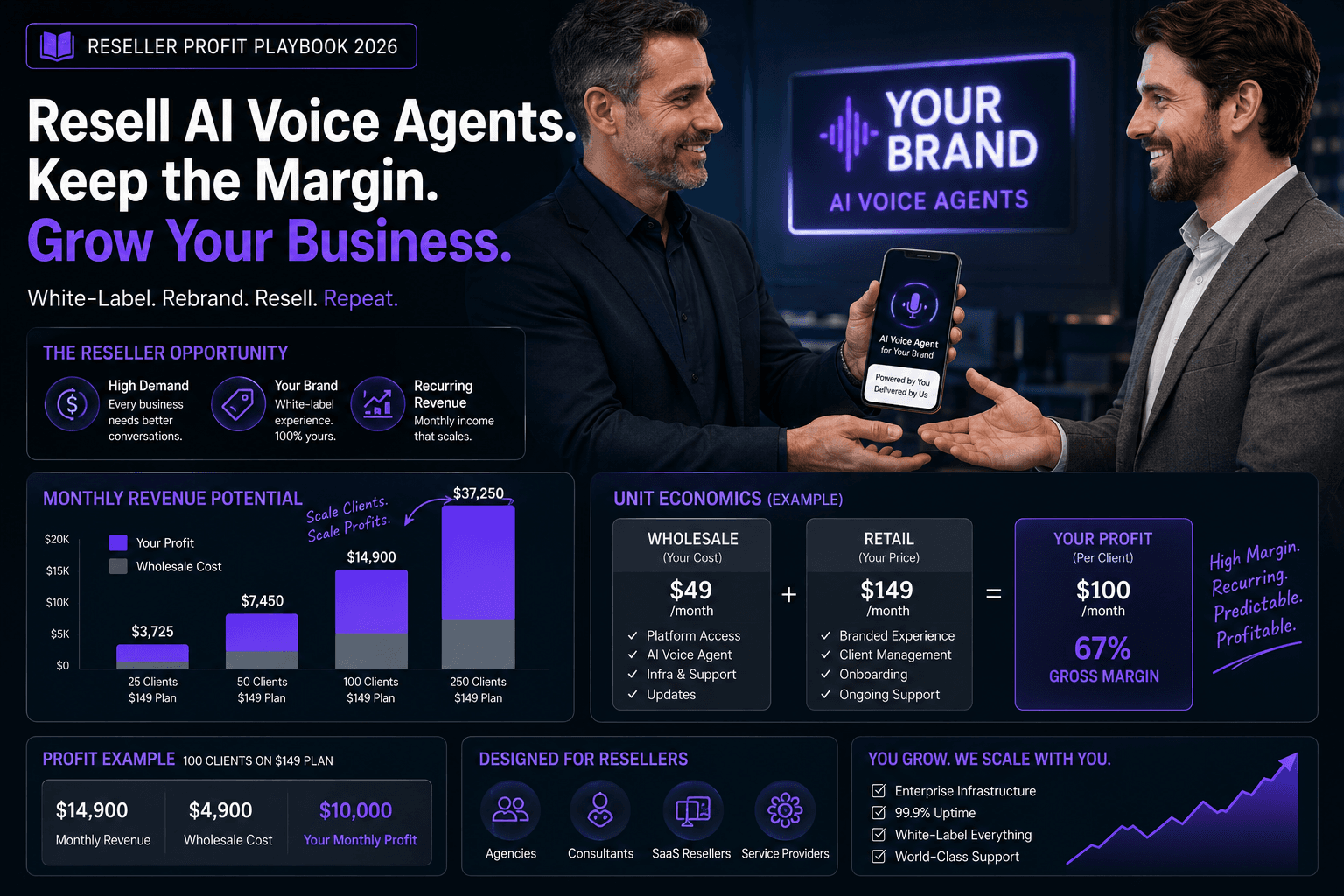
How agencies package and price receptionist services, including multilingual coverage as an upsell tier.