AI Receptionist vs Traditional Answering Service: The Definitive 2026 Cost, Feature & Performance Comparison
Answering service costs are creeping past $1.50/minute while AI receptionists run at $0.09/minute with better accuracy, no per-message fees, and zero hold time. This is the honest, deeply-researched 2026 breakdown of AI receptionist vs answering service cost per month — with provider-by-provider deep-dives (Ruby, AnswerConnect, MAP, PATLive, VoiceNation, SAS), hidden-fee tables, a break-even-by-call-volume calculator, an RFP checklist, and vertical playbooks for medical, dental, legal, home services, real estate, e-commerce, and salons.
Utkarsh Mohan
Published: May 23, 2026
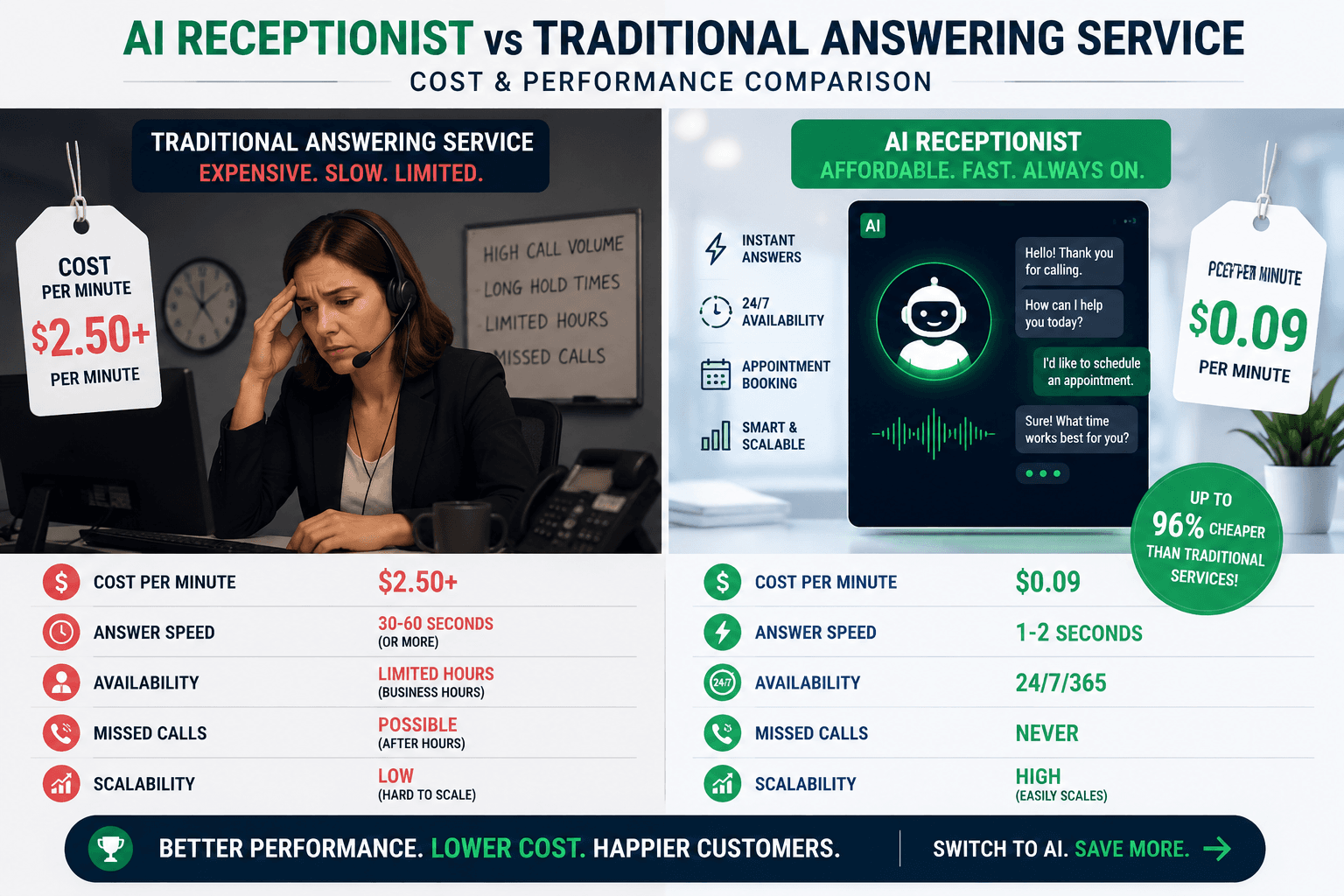
Table of Contents
Table of Contents
If you're paying a traditional live answering service in 2026, you are almost certainly overpaying. Per-minute rates at AnswerConnect, Ruby Receptionists, MAP Communications, and Specialty Answering Service now run between $0.95 and $1.85 per minute — plus per-call fees, per-message fees, after-hours premiums, and monthly minimums that pile $300–$3,500/month on top of usage.
A modern AI receptionist handles the same call types — appointment booking, lead intake, FAQ answering, message taking, call transfer — at $0.07–$0.12 per minute, with no per-call fees, no per-message fees, and no overtime rates because the AI is always available. This guide breaks down the actual numbers, where AI wins decisively, where a live virtual receptionist still has an edge, and how to migrate without dropping calls during the transition.
What an AI Receptionist Is in 2026 (and What It Isn't)
An AI receptionist is a voice AI agent that answers your business phone line, identifies the caller's intent, and resolves the call — by booking an appointment, taking a structured message, answering a common question, qualifying a lead, or transferring to a human when needed. In 2026, the better systems are indistinguishable from a polite, well-trained human receptionist for the first 60–90 seconds of conversation. Many callers don't realize they're talking to AI.
What an AI receptionist is not: a phone tree, an IVR menu, a chatbot, or a recorded voicemail. It's a conversational voice agent that responds in natural language to whatever the caller actually says — not a 'Press 1 for sales' decision tree.
Adjacent terms you'll see in 2026 marketing — AI front desk, conversational virtual receptionist, automated answering service, auto answering service, automated receptionist, automated phone answering system, automated reception system — all refer to the same category. The naming is a vendor differentiation play; the underlying technology is the same conversational voice AI stack.
How an AI Receptionist Actually Handles a Call
Before you compare costs, it helps to understand what's happening inside a modern AI receptionist when the phone rings. The whole pipeline runs in roughly the time it takes a human to say 'one-one-thousand.' Every inbound call moves through five stages, and each stage is where a vendor either earns or loses your trust.
- Answer + transcription (speech-to-text). The call is picked up in under 2 seconds and the caller's audio is streamed to a speech recognition model that converts it to text in real time. Good systems handle accents, background noise (a barking dog, a job-site compressor), and partial sentences without forcing the caller to repeat themselves.
- Intent detection. A language model classifies what the caller actually wants — book an appointment, reschedule, ask about hours or pricing, reach a specific person, report an emergency, or leave a message. This is the step that separates a real AI receptionist from an IVR: there is no menu, the caller just talks.
- Action / fulfillment. Based on intent, the agent does something: queries your live calendar and books an open slot, looks up an order or patient record, answers from a knowledge base of your FAQs, or collects structured intake fields. With Ringlyn AI this is native calendar booking, not a promise to 'have someone call you back.'
- Transfer or escalation. When the call needs a human — a sales-qualified lead, an angry customer, a clinical question outside scope — the agent performs a warm transfer (announcing the caller and context to your team) or a cold transfer (straight handoff), or rings an on-call number per your routing rules.
- Message + logging. If no one is available, the agent takes a structured message (name, callback number, reason, urgency) and writes a clean transcript plus extracted fields into your CRM or inbox — no garbled voicemail to decode.
The reason this matters for a cost comparison: a live answering service performs steps 1, 2, and 5 with a human, but steps 3 and 4 are usually partial — most live operators read from a script card and take a message rather than booking directly into your calendar or resolving the question. You then do the booking yourself. A 2026 AI receptionist closes that loop, which is why it doesn't just cost less; it often resolves a higher share of calls without bouncing them back to your team.
Answering Service Cost Per Month: The Real Numbers
Most traditional answering services don't publish full pricing — quotes are sent after a discovery call so they can be tailored (and inflated). Here are the 2026 ranges we've seen across actual contracts:
| Provider | Monthly Minimum | Per-Minute Rate | Per-Message Fee | After-Hours Premium |
|---|---|---|---|---|
| Ruby Receptionists | $319/mo (100 mins) | $1.55–$1.85 over plan | $1.00–$2.50/message | +15–25% |
| AnswerConnect | $189/mo (50 mins) | $1.25–$1.65 over plan | Included in plan | Included |
| MAP Communications | $45 setup + plan | $0.95–$1.25 | $0.75/message | +10–20% |
| Specialty Answering Service | $48–$1,200/mo | $1.05–$1.55 | $0.50–$1.25/message | +15% |
| VoiceNation | $59/mo (40 mins) | $1.10–$1.45 | Included | Included |
| PATLive | $39/mo (call setup) | $1.49–$1.79 | Bundled | +20% |
Live answering service rates as of 2026 — approximate, varies by contract terms and call volume
What this means in practice: a small medical office handling 200 calls/month at avg 3-minute call length pays ~$900–$1,200/month with a traditional answering service. A small law firm doing 350 calls/month at avg 4 minutes pays ~$1,800–$2,400/month. A multi-location home services business doing 1,000+ calls/month pays $3,500–$8,000/month. And these are before overage charges, weekend premiums, and per-message fees.
The Hidden Fees Buried in Answering Service Contracts
The headline per-minute rate is almost never what you actually pay. Traditional answering services have spent decades engineering line-items that don't show up until your second or third invoice. Here are the charges that most commonly surprise buyers, with approximate 2026 ranges — read every contract for these before you sign.
| Hidden Charge | Typical Range (2026) | Why It Hurts |
|---|---|---|
| Billing increment rounding | Rounded up to 30s or 60s | A 20-second call billed as a full minute can inflate effective per-minute cost 20–40% |
| Per-message / patch fee | $0.50–$2.50 each | Charged on top of minutes every time the operator takes or relays a message |
| Setup / onboarding fee | $45–$250 one-time | Often non-refundable even if you cancel in the first month |
| Monthly minimum / plan floor | $39–$1,200/mo | You pay the floor even in slow months when call volume drops |
| After-hours & holiday premium | +10–25% | Highest-volume hours for many businesses are billed at the highest rate |
| Overage rate | $1.50–$2.75/min | The over-plan rate is materially higher than the in-plan rate |
| Long-distance / toll surcharge | $0.05–$0.20/min | Some carriers still surcharge non-local transfers |
| Holiday staffing surcharge | $25–$75/holiday | Flat charge for major holidays regardless of volume |
| Bilingual / Spanish add-on | +$0.10–$0.40/min or flat | Multilingual handling is rarely included at the base tier |
| Contract / early-termination | 30–90 day notice | You keep paying through a notice period after you've already switched |
Common hidden and add-on fees in live answering service contracts — approximate 2026 ranges; always request a sample invoice before signing
The pattern to notice: nearly every one of these line-items is a per-event or per-condition charge — the busier you get, the more they compound. A modern AI receptionist like Ringlyn AI collapses all of this into two numbers (a flat platform fee plus a single per-minute rate with no per-message, after-hours, holiday, or bilingual surcharge), which is the entire reason switchers see the ~84% average saving cited at the top of this guide.
Answering Service Provider Deep-Dives: Ruby, AnswerConnect, MAP, PATLive, VoiceNation, SAS
The six providers below dominate the U.S. live answering market. None of them is bad at what they do — but each has a distinct sweet spot, pricing posture, and set of contract gotchas. Pricing is described in approximate 2026 ranges; confirm current numbers and terms directly, because most of these vendors quote after a discovery call.
Ruby Receptionists
Good at: Ruby is the premium, brand-forward option. Their receptionists are U.S.-based, well-trained, and genuinely warm — if your differentiator is a high-touch human voice (boutique law firms, high-end professional services), Ruby delivers it. The mobile app and call-handling controls are polished. Weak at / gotchas: It is the most expensive on this list by a wide margin. Plans are sold in capped minute bundles ($319/mo for ~100 minutes is a common entry point), and over-plan minutes run roughly $1.55–$1.85. Per-message handling and after-hours can carry premiums, and there is no native real-time calendar booking the way an AI agent provides — Ruby relays, you book. For anything above light volume, Ruby's per-minute economics are hard to justify versus AI.
AnswerConnect
Good at: AnswerConnect bundles messages into plans (so you're less likely to be nickel-and-dimed on per-message fees) and markets 24/7 coverage with no extra after-hours line-item, which makes invoices more predictable than most. Decent web-chat add-on. Weak at / gotchas: You're still buying capped minute bundles (entry around $189/mo for ~50 minutes), and over-plan minutes run roughly $1.25–$1.65 — so heavy months still escalate quickly. Scripting flexibility is moderate; deep CRM/calendar integration is limited compared to a software-native AI agent.
MAP Communications
Good at: MAP is employee-owned and frequently the best value among traditional human services, with per-minute rates often in the $0.95–$1.25 band — the low end of live pricing. Strong for straightforward message-taking and call patching at volume. Weak at / gotchas: A setup fee (around $45) is common, per-message fees (~$0.75) still apply, and after-hours can add 10–20%. As with all live services, you're paying a human per minute, so even MAP's value pricing is roughly 10x an AI per-minute rate. Booking is relay-based, not native.
PATLive
Good at: PATLive is friendly to very small businesses and lead-gen use cases, with a low entry point and a reputation for capable, U.S.-based agents and good appointment-message workflows. Weak at / gotchas: Per-minute rates are on the higher side ($1.49–$1.79), after-hours can add ~20%, and message handling is bundled in a way that makes true cost hard to predict. For anyone past a few dozen calls a month, the per-minute rate makes it expensive fast.
VoiceNation
Good at: VoiceNation offers fast, low-commitment setup and an inexpensive entry plan (~$59/mo for ~40 minutes) with messages and after-hours generally included — good for businesses that want simple, predictable overflow coverage. Weak at / gotchas: Small minute buckets mean over-plan minutes ($1.10–$1.45) arrive quickly, and the integrations/booking depth are limited. Best as a low-volume safety net rather than a primary front desk.
Specialty Answering Service (SAS)
Good at: SAS is highly configurable, with custom scripting and a wide range of plan sizes ($48 to $1,200+/mo) that scale from tiny to fairly large operations. Good for businesses with idiosyncratic call flows. Weak at / gotchas: The flexibility comes with complexity — per-minute ($1.05–$1.55) plus per-message ($0.50–$1.25) plus after-hours (~15%) means the effective rate is easy to underestimate. Quality can vary by account, and as with every live service, there's no native real-time calendar booking.
“The honest summary across all six: traditional answering services compete on human warmth and configurability, not on price or call resolution. Every one of them bills a human by the minute and relays rather than resolves. That's a fine model for emotionally sensitive, low-volume lines — and an expensive one for high-volume booking, intake, and FAQ work that an AI agent now does end-to-end.”
— Ringlyn AI editorial assessment, 2026
Answering Service Provider Feature Matrix
| Provider | Approx. Per-Min | Native Calendar Booking | Multilingual | 24/7 No Premium | Best Fit |
|---|---|---|---|---|---|
| Ruby Receptionists | $1.55–$1.85 | No (relay only) | Spanish add-on | Premium upcharge | Premium brand voice, low volume |
| AnswerConnect | $1.25–$1.65 | No (relay only) | Spanish add-on | Included | Predictable bundled billing |
| MAP Communications | $0.95–$1.25 | No (relay only) | Spanish add-on | +10–20% | Best value human service |
| PATLive | $1.49–$1.79 | No (relay only) | Spanish add-on | +20% | Very small business, lead-gen |
| VoiceNation | $1.10–$1.45 | No (relay only) | Spanish add-on | Included | Low-volume overflow net |
| Specialty Answering Service | $1.05–$1.55 | No (relay only) | Spanish add-on | +15% | Custom scripting at scale |
| Ringlyn AI (AI receptionist) | $0.09 + $49/mo | Yes — native, real time | 8+ languages native | Included, same rate 24/7 | Booking, intake, FAQ at any volume |
Feature comparison across leading answering services and an AI receptionist — approximate 2026 figures; live-service rates vary by contract
AI Receptionist Pricing in 2026: Per-Minute, Flat Rate, Per Call
| Pricing Model | Typical Rate | Best For | Watch Out For |
|---|---|---|---|
| Per-minute | $0.07–$0.15/min | Variable call volume; predictable cost | Long calls can compound — check if there's a per-call cap |
| Flat rate / unlimited | $199–$799/mo | High call volumes (>1,500 mins/mo) | Fair-use caps in fine print (~5,000 mins/mo) |
| Pay per call answering service | $1.50–$4.50/call | Low volume, lead-gen focus | Per-call rates beat per-minute only on short calls |
| Per-seat / per-extension | $49–$99/mo | Single-line solo practices | Limits concurrent calls to 1–2 |
2026 AI receptionist pricing models — Ringlyn AI publishes per-minute at $0.09 plus a flat platform fee starting at $49/mo
Quick math: that same medical office (200 calls × 3 min = 600 min) pays ~$54 at $0.09/min plus a $49 platform fee — $103/month vs $900–$1,200 with a live service. The law firm (350 × 4 = 1,400 min) pays ~$175/month vs $1,800–$2,400. The home services business (1,000 × 4 = 4,000 min) pays ~$409/month vs $3,500–$8,000 — and at that volume, switching to a flat-rate AI plan caps cost at ~$300/month.
Break-Even by Call Volume: When AI Beats a Live Service
There is a real break-even point. At very low volume, a $39/mo pay-per-call live service can undercut any platform that charges a base fee. The table below models monthly cost at an assumed 3-minute average call length, using Ringlyn AI's $49 platform fee + $0.09/min on the AI side and a conservative $1.30/min blended rate (with light per-message fees) on the live side. Your numbers will vary with call length, but the crossover is consistent: above roughly 30–50 calls per month, the AI receptionist wins, and the gap widens fast.
| Monthly Calls (≈3 min avg) | AI Receptionist (Ringlyn AI) | Live Answering Service | Monthly Savings |
|---|---|---|---|
| 20 calls (60 min) | ~$54 | ~$78 + minimum | Roughly break-even |
| 50 calls (150 min) | ~$63 | ~$195 | ~$132 (68%) |
| 100 calls (300 min) | ~$76 | ~$390 | ~$314 (81%) |
| 200 calls (600 min) | ~$103 | ~$900–$1,200 | ~$800–$1,100 (84%) |
| 500 calls (1,500 min) | ~$184 | ~$2,200–$2,800 | ~$2,000+ (88%) |
| 1,000 calls (3,000 min) | ~$319 (flat-rate plan) | ~$4,200–$5,500 | ~$4,000+ (90%) |
| 2,500 calls (7,500 min) | Flat-rate tier | ~$10,000+ | ~$9,000+ (90%+) |
Modeled monthly cost by call volume at ~3-minute average call length. Live-service figures include a conservative blend of per-minute, minimum, and light per-message fees; actual contracts often run higher.
Two practical takeaways. First, the only zone where a live service is cheaper is sub-30 calls/month with no booking or CRM needs — a genuinely small overflow line. Second, AI savings are not linear: because live services add per-message and after-hours fees as you scale, the percentage saved actually grows with volume, which is the opposite of how most software pricing behaves.
Calculate Your Switch Savings
Ringlyn AI's transparent pricing — $49/mo + $0.09/min — replaces $300–$2,400/month live answering services with zero per-message or after-hours fees.
Side-by-Side: AI Receptionist vs Live Answering Service
| Dimension | Live Answering Service | AI Receptionist (2026) |
|---|---|---|
| Cost per minute | $0.95–$1.85 | $0.07–$0.15 |
| Per-message fee | $0.50–$2.50/message | None — included |
| After-hours premium | +10–25% | None — same rate 24/7 |
| Monthly minimum | $39–$1,200 | $49 platform fee |
| Average answer speed | 12–25 seconds | Under 2 seconds |
| Concurrent calls handled | Limited by staffed reps | Unlimited |
| Languages supported | English (Spanish add-on) | 8–30 languages native |
| Direct calendar booking | Manual — calls or emails you | Native — books in real time |
| CRM logging | Email summary, manual entry | Auto-sync with structured fields |
| Custom greeting + brand voice | Read from script card | Cloned voice + dynamic script |
| Wait time during peak | 2–8 minutes | Zero — every call answered instantly |
| HIPAA / SOC 2 | Tier-dependent, BAA upcharge | Native at standard tiers |
| Transfers to your team | Yes — warm transfer | Yes — warm or cold transfer |
| Setup time | 5–14 days | 1–3 days |
Direct comparison of live answering services vs AI receptionists across the dimensions that matter for small businesses
Accuracy & Where AI Receptionists Still Fail
An honest comparison has to cover where the AI gets it wrong, because no vendor's demo will. For the bread-and-butter call types — booking, rescheduling, hours and pricing FAQs, structured message-taking, lead qualification, warm transfer — a well-configured 2026 AI receptionist resolves the large majority of calls cleanly. The failure modes are predictable, and the good platforms give you controls for each one.
- Heavy accents, crosstalk, and bad lines. Speech recognition is excellent but not perfect. Poor cell reception, two people talking at once, or a very thick accent can cause a misheard name or number. Mitigation: the agent should confirm critical fields ('Let me read that number back to you') and spell-check names.
- Out-of-scope or novel questions. If a caller asks something outside the configured knowledge base, a weak agent hallucinates an answer. A good agent says it doesn't have that information and offers a transfer or callback. Insist on a vendor whose default for unknowns is escalation, not invention.
- Highly emotional calls. Grief, anger, panic. The AI can stay calm and route correctly, but it cannot provide human empathy. These should be detected and transferred, not handled to completion.
- Ambiguous intent. 'I need to talk to someone about my thing from last week.' The agent must ask clarifying questions rather than guess. Test this in your evaluation.
- Rapid topic switching and interruptions. Callers change their mind mid-sentence. Modern agents handle barge-in (the caller talking over the agent), but it's worth verifying in your own pilot.
- Edge-case spelling and addresses. Street names, apartment numbers, and email addresses are where errors concentrate. The agent should confirm these character-by-character when accuracy is load-bearing.
The right way to think about accuracy: measure resolution rate (share of calls the AI fully handles without a human) and misroute rate (calls handled wrong) on your traffic during a pilot — not on a vendor's curated demo. A live answering service has its own error rate too (operators mishear, mistype, and forget to relay messages), so the question is never 'is the AI perfect' but 'does the AI beat your current human baseline on your actual calls.' For routine front-desk work in 2026, it usually does.
Security, HIPAA & PCI for Receptionist Services
If your calls touch health information, payment details, or other regulated data, the receptionist layer is part of your compliance surface — whether it's human or AI. This is an area where buyers often assume a human service is automatically 'safer,' which is not true. A distracted operator reading card numbers aloud in a call center is a real exposure; an encrypted, access-logged, redaction-capable AI pipeline is frequently the more controllable option.
- HIPAA (healthcare). Any service handling patient information must sign a Business Associate Agreement (BAA), encrypt data in transit and at rest, enforce role-based access, and keep audit logs. With traditional services a BAA is often a premium-tier upcharge; Ringlyn AI provides HIPAA-capable handling with a BAA at standard tiers.
- PCI DSS (payments). If callers read out card numbers — common for home services, e-commerce, and clinics taking deposits — you need PCI-aware handling: secure capture or tokenization, suppression of card data from transcripts and recordings, and no storage of raw PAN/CVV. Ask any provider exactly how card data is captured and where it is (or isn't) stored.
- SOC 2. A SOC 2 Type II report is independent evidence that a vendor's security controls actually operate over time. Ringlyn AI is SOC 2 capable; ask any vendor for their current report under NDA.
- Data residency & retention. Know where recordings and transcripts live, how long they're kept, and whether you can set automatic deletion. Shorter retention is lower risk.
- Model-training use. Confirm in writing that your call data is not used to train shared models without explicit consent — a common, under-read clause.
- Redaction & PII handling. The platform should be able to mask sensitive fields (SSNs, card numbers, DOB) in transcripts and analytics by default.
Bottom line: don't grade security on the human-vs-AI axis. Grade it on contracts and controls — BAA, SOC 2, PCI handling, retention, redaction. A modern AI receptionist can meet or exceed a live service on every one of these, and unlike a call center it leaves a complete, queryable audit trail of exactly what was said and accessed.
Use Case: Medical Offices, Law Firms, Dental, Home Services
Medical Offices & Dental Practices
Healthcare is the highest-value vertical for AI receptionist deployment. A dental practice replaces a $35K/year front desk staffer's call-handling load with an AI dental receptionist that books appointments, handles insurance verification questions, runs prescription refill workflows, and routes urgent calls — at ~$150–$300/month all-in. The AI receptionist is HIPAA-compliant by default (Ringlyn AI ships with BAA included), supports patient intake forms via voice, and integrates with Dentrix, Open Dental, Athenahealth, and Epic via API. For dental specifics, see our deep-dive on the AI voice agent for dental offices; for pharmacy and refill workflows, see AI receptionists for pharmacies and prescription refills.
Law Firms
Law firms have specific workflow needs — conflict checks before scheduling consultations, intake question scripts that vary by practice area, after-hours emergency triage. AI receptionists handle this with practice-area-specific intake scripts, sync to Clio or MyCase, and never miss a call after 5 PM. A solo or small firm typically pays $1,800–$3,000/month for an after-hours answering service; an AI receptionist for the same volume runs $80–$200/month. Our dedicated guide on the AI voice agent for law firms covers conflict-check workflows and intake scripting in depth.
Home Services (HVAC, Plumbing, Electrical, Garage Doors)
Home services teams lose 30–45% of inbound calls to voicemail when techs are on jobs. A live answering service partially solves this but bills heavily during storm and peak season. An AI receptionist captures every call, generates quote estimates, dispatches by zip code, books service windows, and triggers SMS confirmations — at flat-rate pricing that doesn't spike during storm response. A 5-truck plumbing operation typically saves $2,000–$4,000/month switching from a national answering service to an AI receptionist.
Real Estate, Insurance, Financial Services
Service-business verticals where speed-to-lead determines conversion: inbound web leads have a 78% drop-off if not contacted within 5 minutes. AI receptionists answer in under 2 seconds, qualify the lead, and book a follow-up call before the prospect closes the browser tab. The cost differential vs a live real estate call answering service ($1,200–$2,500/mo for typical brokerage) is 5–10x in the AI's favor — but the conversion lift from instant response often pays for the AI within the first week.
Salons, Spas & Med Spas
Appointment-dense, walk-in-heavy businesses where the front desk is also doing checkout, retail, and service. Salons and spas lose bookings every time the phone rings mid-blowout. An AI receptionist books by service type and stylist, honors duration and buffer rules, manages memberships and package balances, runs waitlists, and fills last-minute cancellations — at flat pricing instead of a live service's per-minute meter. It also takes after-hours bookings, which for evening-research clients is a meaningful share of revenue.
E-commerce & Retail Support
For online retailers, the receptionist line is really order-status, returns, and pre-sale questions. An AI agent looks up an order by phone number or order ID, answers shipping and return-policy questions from your knowledge base, starts an RMA, and escalates fraud or VIP issues to a human. Because volume spikes hard during promotions and holidays — exactly when live services charge holiday and overage premiums — the AI's flat, unlimited-concurrency model is structurally cheaper at peak. PCI-aware handling matters here if callers read out card numbers (see the security section above).
Home Services Dispatch (After-Hours Triage)
Beyond capturing daytime overflow, the highest-value home-services job is after-hours emergency triage: distinguishing a true emergency (active flooding, gas smell) from a next-morning booking, tagging severity, and only waking the on-call tech when it's real. An AI agent runs a short severity questionnaire on every after-hours call, books the routine ones, and dispatches the emergencies — protecting crew sleep without sending real emergencies to voicemail.
Where Live Answering Services Still Win
Honest assessment — there are still scenarios where a live answering service is the right call:
- Emotionally complex inbound: Funeral homes, hospice services, crisis lines. The AI is technically capable, but for industries where the human voice is part of the service value, a trained human is worth the premium.
- Bilingual + extremely specialized vocabulary: When callers regularly need translation for niche industry terms that fall outside the AI's training data, a bilingual human handles edge cases better. (Note: this gap is closing fast — Ringlyn AI handles legal, medical, and technical vocabularies in 8+ languages by 2026.)
- Live operators required by regulation: A few narrow categories (TCPA-restricted political fundraising in some states, certain health plan inbound) still require human operators. Verify your specific regulatory context.
- Sub-30-call months with no booking workflows: If you take fewer than 30 calls per month and don't need calendar booking or CRM sync, a $39/mo pay-per-call live answering service can be cheaper than an AI platform fee. The break-even tilts to AI quickly above ~50 calls/month.
The Hybrid Model: AI Front Line + Human Overflow
The choice is not strictly AI or humans. The model winning in 2026 is hybrid: the AI receptionist is the always-on front line that handles the high-volume, repetitive 80% (booking, FAQ, intake, message, status), and humans are reserved for the 20% that genuinely needs a person — complex sales, escalations, sensitive conversations. This captures the AI's cost and availability advantages while keeping a human safety net exactly where it adds value.
- AI-first with human escalation: Every call hits the AI; it resolves what it can and warm-transfers the rest to your team during business hours, or to an on-call number after hours. This is the default for most businesses.
- AI-first with live-service overflow: Keep a small live answering service contract purely as the escalation target for the handful of calls the AI routes to a human after hours — far cheaper than routing all calls to the live service.
- Human-first with AI overflow: Your in-house staff answer when available; the AI catches everything they miss — peak-hour overflow, lunch, after-hours — instead of voicemail. Good for teams that want humans on the line whenever staffed but refuse to drop a single call.
- Time-sliced: Humans handle 9–5, the AI owns nights, weekends, and holidays. Eliminates after-hours answering-service premiums entirely.
The economics are compelling because the expensive human minutes are spent only on the calls that justify them. A business paying $2,400/month for a full live service might keep a $200/month overflow contract (or none at all) and run a ~$150/month AI front line — capturing the same coverage at a fraction of the cost, with better booking and logging on the routine majority of calls.
Conversational Virtual Receptionist: The 2026 Default
The shift from menu-driven IVR to conversational virtual receptionist is the biggest UX change in business phone systems since voicemail. Three things made the shift happen in 2024–2026:
- LLM latency dropped below conversational threshold. Sub-500ms end-to-end (STT → LLM → TTS) is now standard. Below 500ms, callers don't feel the AI 'thinking' — the conversation feels human-paced.
- TTS naturalness crossed the uncanny-valley line. ElevenLabs Flash v2.5, Cartesia Sonic-2, OpenAI gpt-4o-mini-tts, and PlayHT 3.0 all produce voices that test-listeners can't reliably distinguish from human recordings in blind tests.
- Voice agent orchestration matured. Platforms like Ringlyn AI ship pre-built workflows for the call types receptionists actually handle (booking, FAQ, intake, transfer, message) so deployment is a configuration job — no engineering required.
The RFP & Evaluation Checklist for Choosing a Receptionist Service
Whether you're evaluating live answering services, AI receptionists, or a hybrid, use the same RFP so you can compare apples to apples. Send these questions to every vendor in writing and make them answer specifically — vague answers are themselves an answer.
Pricing & Billing Transparency
- What is the all-in cost at my projected volume — show me a sample invoice, not a headline rate?
- What is the billing increment (per-second, 30s, or full-minute rounding)?
- List every per-event fee: per-message, per-transfer, setup, after-hours, holiday, bilingual, long-distance.
- What is the monthly minimum and the over-plan/overage rate?
- Is there a contract term and what is the cancellation notice period?
Call Handling & Resolution
- Can you book directly into my calendar in real time, or do you relay and I book?
- How do you handle unknown questions — escalate, or attempt an answer?
- How are warm vs cold transfers handled, and to how many destinations/rules?
- What languages are supported natively, and at what extra cost?
- What is your measured resolution rate and average answer speed?
Integrations, Security & Proof
- Which CRMs, EHRs, calendars, and scheduling tools do you integrate with, and is sync bidirectional and real-time?
- Will you sign a BAA (HIPAA)? Do you hold a current SOC 2 Type II report? How is PCI card data handled?
- What are your data retention defaults, and can I set automatic deletion and redaction?
- Is my call data used to train shared models? Get this in writing.
- Can I run a shadow-mode or pilot trial on my real traffic before committing, and what does onboarding/setup time look like?
Switching Cost & Migration Playbook
- Audit your current service. Pull 3 months of invoices. Compute per-call cost, per-minute cost, and identify the top 5 call types (booking, FAQ, intake, transfer, message). This becomes your AI configuration spec.
- Port-forward, don't port-out. Don't move your business phone number to the AI platform on day one. Set up call forwarding from your current line to a new AI-managed number. If the AI fails, flip forwarding off. Risk: zero.
- Run AI in shadow mode for 7 days. Some platforms (Ringlyn AI included) let you record the live answering service calls and replay them through the AI to measure how the AI would have handled each one. Validates accuracy before any real caller hits the AI.
- Switch 20% of inbound for week 2. Geographic split or random hash — 80% still goes to the live service, 20% to the AI. Compare booking rate, transfer rate, caller complaints. Tune AI prompt if needed.
- Switch 100% in week 3. If shadow mode + 20% pilot both look good, flip the forward target. Keep the live answering service contract live for one more month as a fallback.
- Cancel the live service in week 5–6. Most contracts require 30-day cancellation notice. Don't cancel before you've run 30 days of real AI traffic with no complaints.
Total migration time: 4–6 weeks from kickoff to live-service cancellation. Most teams break even on the AI subscription in month 1 from saved per-minute and per-message fees.
Replace Your Answering Service in 30 Days
Ringlyn AI's 24/7 conversational virtual receptionist books appointments, takes structured messages, qualifies leads, and transfers warm — at 8–10% of the cost of a live answering service.
Frequently Asked Questions
Live answering service costs range from $39/month for ultra-low-volume pay-per-call plans up to $3,500–$8,000+/month for multi-location businesses. Mid-market practices (medical, legal, professional services) typically pay $900–$2,400/month. Per-minute rates run $0.95–$1.85, plus per-message fees ($0.50–$2.50), after-hours premiums (10–25%), and monthly minimums. An AI receptionist at the same call volume typically costs 84% less.
For sub-50 calls/month, the cheapest options are pay-per-call services like PATLive ($1.49/call setup) or VoiceNation's $59/mo entry plan. Above 50 calls/month, an AI receptionist becomes the cheapest option — Ringlyn AI at $49/mo + $0.09/min runs about $103/month for 200 calls of 3 minutes each, versus $900–$1,200/month for a comparable live answering service.
For appointment booking, FAQ answering, intake forms, lead qualification, and warm transfers — yes. 2026 voice AI is indistinguishable from a polite, well-trained human receptionist for the first 60–90 seconds in blind tests. For emotionally complex inbound (funeral, hospice, crisis), the human still wins. For everything else, the AI is faster (sub-2-second answer vs 12–25-second live answer), available 24/7 without overtime fees, handles unlimited concurrent calls, and books directly to your calendar without manual handoff.
Yes — modern AI receptionists like Ringlyn AI are HIPAA-compliant by design, with encryption in transit and at rest, audit logs, role-based access control, and a Business Associate Agreement (BAA) signed at standard tiers. This is a major advantage over generic answering services that often charge premium pricing for HIPAA-tier service or require business associate agreements as upcharges. AI receptionists handle prescription refills, appointment reminders, intake forms, and triage routing in HIPAA-protected workflows out of the box.
Typical migration is 4–6 weeks: 1 week to audit current service and configure AI, 1 week shadow-mode validation, 1 week 20% pilot, 1 week full switch with the live service as fallback, then 30-day cancellation notice on the live contract. Most teams break even on AI subscription cost in the first month from saved per-minute and per-message fees.
In 2026, the terms have converged. Marketing language uses 'AI receptionist,' 'AI front desk,' 'conversational virtual receptionist,' 'automated answering service,' 'automated receptionist,' and 'auto answering service' to describe the same product category: a voice AI agent that answers your business line, holds natural-language conversations, and resolves calls through booking, intake, FAQ, or transfer. Legacy 'virtual receptionist' previously meant a remote human receptionist — that meaning is fading as the AI category dominates.
The headline per-minute rate is rarely what you pay. Watch for billing-increment rounding (a 20-second call billed as a full minute), per-message or patch fees ($0.50–$2.50 each), one-time setup fees ($45–$250), monthly minimums you pay even in slow months, after-hours and holiday premiums (+10–25%), over-plan overage rates ($1.50–$2.75/min), long-distance surcharges, and bilingual add-ons. Always request a sample invoice at your projected volume before signing, and read the cancellation-notice clause (often 30–90 days). A flat-fee-plus-single-per-minute AI receptionist like Ringlyn AI eliminates the per-event fees entirely, which is why switchers save around 84%.
It depends on your priority. Ruby Receptionists is the premium, warmest human option but the most expensive (over-plan minutes ~$1.55–$1.85). MAP Communications is usually the best value among human services (~$0.95–$1.25/min). AnswerConnect and VoiceNation bundle messages and after-hours for more predictable invoices. PATLive suits very small, lead-gen-focused businesses. Specialty Answering Service (SAS) is the most configurable for custom scripting at scale. But all six relay rather than book — none offers native real-time calendar booking — and every one bills a human by the minute at roughly 10x an AI per-minute rate. For booking, intake, and FAQ at any meaningful volume, an AI receptionist wins on both cost and call resolution.
Yes, when the platform is built for it. PCI-aware handling means card data is captured securely or tokenized, suppressed from transcripts and call recordings, and never stored as raw PAN/CVV. This is common in home services, e-commerce, and clinics taking deposits. Ask any provider — human or AI — exactly how card data is captured and where it is (or isn't) retained. A properly configured AI pipeline is often more controllable than a live operator reading card numbers aloud in a call center, because redaction is automatic and every access is logged.
Often, yes. The model winning in 2026 is hybrid: the AI receptionist handles the high-volume, repetitive 80% (booking, FAQ, intake, message, status) as an always-on front line, and humans handle the 20% that genuinely needs a person. You can keep a small live-service contract purely as the after-hours escalation target for calls the AI routes to a human, which is far cheaper than sending every call to the live service. A business paying $2,400/month for a full live service might instead run a ~$150/month AI front line plus a ~$200/month overflow contract — same coverage, a fraction of the cost.
Yes. In most deployments you keep your current business number and provider and route calls to the AI with call forwarding or a SIP connection, so there is no rip-and-replace of your phone system. It works alongside common VoIP platforms and traditional carriers, and you can send only after-hours and overflow calls to the AI at first, then expand coverage once you have validated it on your real traffic. When a call needs a person, the AI warm-transfers to your team or an on-call number, so your existing extensions and routing rules still matter.