
AI Phone Answering After Hours: What It Catches and What It Costs
The economics of answering the calls that currently go to voicemail, and how to decide which after-hours calls are worth automating.
Utkarsh Mohan•Jul 20, 2026
A working guide to deploying voice AI in a dealership BDC and service lane — real 2026 cost-per-appointment benchmarks, what DMS integration actually means, the four call types worth automating first, and the three where a human still has to pick up.
Divyesh Savaliya
Published: Mar 16, 2026

A customer fills out a form on your website at 8:40 on a Tuesday evening asking about a specific trim. Your BDC closed at seven. The lead sits in VinSolutions overnight, gets picked up at 9:15 the next morning, and by then that person has already submitted the same form to two other stores and taken a call from whichever one dialled first. You paid a third-party aggregator for that lead. You will pay for it again next month.
This is the problem outbound voice AI for car dealerships is genuinely good at solving, and it is worth being precise about why. The AI is not a better salesperson than your best closer. It is not more persuasive, and it will not save a deal your desk has already mishandled. What it does is answer in four seconds at 8:41 PM on a Tuesday, every Tuesday, without a schedule or a callback queue. In a business where response time is the dominant variable in internet lead conversion, that alone is worth more than most dealers expect.
This guide covers what an AI voice agent for auto sales actually costs against a fully loaded BDC rep, which call types pay back first, how far DMS integration really goes in 2026, and — the part most vendor material skips — the calls where you should route to a human immediately. If you are evaluating platforms rather than the category itself, the 2026 voice AI tech stack breakdown covers the underlying components, and dealer groups looking to run this across multiple rooftops under their own brand should start with the agency licence.
Most dealers underestimate their BDC cost because they look at the salary line. The salary line is roughly half the real number. Industry cost analyses through 2026 put a fully loaded BDC representative at $6,000 to $9,000 per month once you include base pay, commission or bonus, payroll taxes, benefits, the share of a BDC manager's salary that rep consumes, CRM and dialer seats, and — the line nobody budgets — the cost of turnover.
Turnover is the expensive part. BDC roles churn hard. Every departure costs you the recruiting spend, three to six weeks of reduced output while the replacement ramps, and a vacancy gap during which leads age out entirely. A lead that ages out is not a lead you convert later at a lower rate. It is a lead you already paid for and will never touch.
Scaled up, the numbers get uncomfortable. A three-person BDC realistically runs $180,000 to $300,000 per rooftop per year all in. A five-agent in-house BDC lands between $240,000 and $360,000 annually. Outsourced BDC services come in materially cheaper at $48,000 to $96,000 per year, which is why so many stores use them despite the well-known quality trade-off. AI-driven BDC coverage currently prices in the $18,000 to $36,000 per year band.
| BDC Model | Annual Cost (per rooftop) | Coverage | Main Trade-off |
|---|---|---|---|
| In-house, 3 reps | $180,000 – $300,000 | Business hours, staffed shifts | Turnover, vacancy gaps, no after-hours coverage |
| In-house, 5 reps | $240,000 – $360,000 | Extended hours, some weekend | Highest fixed cost; scales linearly with volume |
| Outsourced BDC | $48,000 – $96,000 | Contracted hours, often extended | Weaker product knowledge, generic scripts, no DMS write access |
| AI voice agent | $18,000 – $36,000 | 24/7/365, unlimited concurrency | Cannot negotiate, escalates edge cases, needs script maintenance |
| AI + smaller human team | $120,000 – $200,000 | 24/7 with human escalation | Requires clear routing rules and ongoing tuning |
2026 dealership BDC staffing models compared on fully loaded annual cost per rooftop
The last row is the one most successful deployments actually land on. Replacing a BDC outright is rarely the right move, and vendors who pitch it that way tend to lose the account by month four. The pattern that holds up is AI handling first response, qualification, and appointment setting around the clock, with a smaller and better-paid human team taking escalations, negotiations, and anything with a trade-in complication.
Not every dealership call is a good automation candidate. If you try to automate everything at once you will produce a bad customer experience and conclude the technology does not work. It works, but it works unevenly, and the sequencing matters more than the platform you pick.
Rank candidate call types by two variables: how structured the conversation is, and how much it costs you when nobody picks up. High structure plus high cost of missing it equals automate now. Low structure plus low cost equals leave it alone.
What sits below the line: F&I rate discussions, trade-in valuation beyond basic qualification, complaint calls from a customer who has already escalated once, and anything involving a service comeback. Those go to a human on the first ring.
If you take one number away from this guide, make it this one: the interval between form submission and first live conversation predicts internet lead conversion better than almost any other variable you control. Not the script. Not the closer. The clock.
The mechanism is not mysterious. A shopper submitting a form at 8:40 PM is in an active research session with several tabs open. They are comparing your store against two or three others in the same twenty-minute window. The first store to have a real conversation frames the entire comparison — sets the trim expectations, anchors the trade-in discussion, and books a time. Everyone who calls afterward is arguing against an appointment that already exists.
Traditional BDCs respond in five to thirty minutes during staffed hours and not at all outside them. An AI agent responds in under five seconds, at any hour, to an unlimited number of simultaneous leads. During a weekend sale event when forty leads arrive in an hour, concurrency stops being a technical detail and becomes the whole point — a three-person BDC works that queue sequentially and the fortieth person hears from you tomorrow.
| Scenario | Human BDC | AI Voice Agent |
|---|---|---|
| Weekday 2 PM, single lead | 5–15 minutes | Under 5 seconds |
| Weekday 2 PM, 12 leads at once | 15–90 minutes for the queue tail | Under 5 seconds, all twelve in parallel |
| Tuesday 8:40 PM | Next morning, 9–11 AM | Under 5 seconds |
| Sunday, store closed | Monday morning | Under 5 seconds |
| Holiday weekend event, 40 leads/hour | Queue collapses; tail leads age out | All handled in parallel |
First-response time by scenario — the gap widens sharply outside staffed hours and under concurrent load
Be careful how you read this table. It measures speed to first conversation, not close rate. An AI agent that answers in four seconds and mishandles the conversation is worse than a human who calls back in twenty minutes and handles it well. Speed only compounds when the conversation underneath it is competent, which is a script and integration problem, not a latency problem.
Vendor ROI calculators are built to produce a favourable number. Build your own — it takes about twenty minutes and you will trust the output. You need four figures from your own reporting, and all four are available in your CRM.
Now work an example. Take a store with 400 internet leads a month, a 25% set rate, a 65% show rate, a 22% close rate on shown appointments, and $3,200 combined gross. That is 400 × 0.25 × 0.65 × 0.22 = roughly 14 units a month from internet leads, contributing about $45,000 in gross.
Say AI first response lifts the set rate from 25% to 31% — a realistic improvement driven almost entirely by catching after-hours and concurrent leads that previously went unworked. Hold every other variable constant. You get 400 × 0.31 × 0.65 × 0.22 = roughly 17.7 units, contributing about $56,700. Call it $11,700 a month in incremental gross against a platform cost in the $1,500 to $3,000 range.
That is a good return, and it is also the optimistic reading. Two cautions. First, some of that lift is cannibalised — a portion of after-hours leads would have converted anyway when you called back the next morning. Second, the set rate improvement assumes your appointment confirmation process is solid; if it is not, a higher set rate just means a higher no-show count. Discount the result by a third and it is still comfortably worth doing.
Track cost per shown appointment, not cost per set appointment. Set appointments are easy to inflate and mean nothing on their own. At $7,500 per rep per month against 35 shown appointments, a human BDC rep costs roughly $214 per shown appointment. That is your benchmark. Any AI deployment should be measured the same way, and if a vendor quotes you a cost per set appointment, ask them to restate it per shown.
Spin up an agent on your own store's call flow and watch how it handles internet leads, service bookings, and after-hours overflow before you commit to anything.
Sales gets the attention; fixed operations pays the bills. Service and parts absorption is what carries a rooftop through a slow quarter, and the service lane phone is one of the worst-run communication channels in the entire business.
The failure is structural rather than anyone's fault. Between 7:30 and 9:30 in the morning the drive is full, advisors are walking around vehicles with customers, and the phone rings continuously. An advisor has two bad options: abandon the person in front of them, or let it ring. Most let it ring. Callers who wanted an oil change booking hang up and call the independent shop down the road, and that customer is frequently gone for good — not just for this service, but for the next four years of maintenance.
An AI agent handling the service line takes the entire category of routine booking off the advisors. It checks what the customer drives, what they need, reads open availability from the service scheduler, offers real slots, and writes the appointment back. Advisors keep their attention on the customer standing in front of them, which is where the upsell actually happens.
One caveat worth stating plainly. Do not automate the diagnostic conversation. When a customer is describing an unfamiliar noise, a warning light, or a driveability problem, that call needs an advisor. The AI should recognise the intent, take the vehicle details, and transfer — not attempt to triage a mechanical symptom.
Recall work is the cleanest automation case in the entire dealership, and it is the one most stores implement last. The call is fully scripted, the outcome is binary, the volume is large, and the manufacturer is applying pressure on completion rate.
A recall campaign covering eight thousand affected VINs is a genuinely miserable staffing problem. Handled manually it means temps, weeks of dialling, inconsistent messaging, and a completion rate that stalls somewhere well short of target. An automotive recall notification AI voice bot works the same list overnight, calls at appropriate local times across time zones, delivers identical compliant language on every contact, checks part availability, books the repair against a real service calendar, and produces a per-VIN audit log.
The audit log matters more than the speed. Manufacturer recall reporting requires demonstrating outreach, and a per-VIN record of contact attempts, timestamps, outcomes, and full transcripts is materially stronger documentation than a spreadsheet a temp updated by hand at the end of each shift.
| Campaign Stage | Manual Approach | AI Voice Agent Approach |
|---|---|---|
| 8,000-VIN outreach | 3–5 weeks with temp staff | Overnight to 3 days, time-zone aware |
| Message consistency | Varies by caller and by fatigue | Identical compliant language every call |
| Parts availability check | Advisor callback required | Checked live during the call |
| Appointment booking | Second call in most cases | Booked on the first contact |
| Compliance documentation | Manually maintained spreadsheet | Per-VIN log with timestamps and transcripts |
| Cost | Temp wages plus manager oversight | Per-minute platform cost |
Manufacturer recall campaign execution compared across manual and automated outreach
Your CRM contains several thousand previous customers, and a meaningful slice of them are in a position to trade profitably right now. They have positive equity, their lease matures in five months, or their payment history and mileage make them an obvious upgrade candidate. Almost nobody calls them, because calling them is tedious, low-yield per dial, and always loses to working today's fresh leads.
This is exactly the work to hand to an agent that does not get bored and does not have to choose. Equity mining at scale is a volume game with a low hit rate and excellent economics on the hits — you are sourcing certified pre-owned inventory and a new sale in one conversation.
Set expectations correctly on this one. Equity mining hit rates are low — single digit percentages on contact-to-appointment is normal. The case for it is that the marginal cost of an additional dial is a few cents, so a campaign that would never justify a human's time is comfortably profitable when a machine runs it.
The main dealership number is a routing problem wearing a customer service costume. Callers want service, parts, a specific salesperson, a finance question, directions, hours, or the body shop. A receptionist spends most of the day transferring, and every transfer is an opportunity to drop the call.
AI call handling for dealerships works well here because intent detection is genuinely a solved problem. The agent identifies what the caller wants in the first sentence or two, and routes accordingly — with context attached, so the receiving extension gets a whisper summarising who is calling and why rather than a cold connection.
The real gain is in what never needs transferring at all. Hours, directions, whether a specific stock number is still available, what documents to bring for a trade, whether the parts counter has an item — that is a large share of inbound volume and none of it requires a person. Handling it at the front removes constant low-value interruption from every department behind it.
If your market has a meaningful share of customers who prefer Spanish, this is also the highest-leverage place to deploy language handling. Routing a Spanish-speaking caller to whichever salesperson happens to be bilingual is a staffing dependency, not a process. We cover the operational side of that in the multilingual answering service guide.
"Integrates with your DMS" is the most overloaded phrase in automotive software sales. It can mean a real bidirectional API, or it can mean a nightly CSV drop. Both get described the same way on a slide. The difference determines whether the deployment works.
There are four distinct levels, and you should establish in writing which one a vendor is actually offering before signing anything.
| Level | What It Does | What Breaks |
|---|---|---|
| Read-only export | Nightly CSV of inventory and customers | Sold vehicles quoted as available; stale pricing |
| Read API | Live inventory and customer lookup during the call | Agent cannot book; every appointment needs a human step |
| Write API | Creates leads, notes, and appointments in the CRM | Usually still cannot see live service capacity |
| Bidirectional with scheduler | Reads real service capacity and writes confirmed appointments | Requires per-DMS certification; not available on every platform |
The four levels of dealership system integration, and the specific failure each one produces
Aim for the bottom row on service and the third row at minimum on sales. An agent that books a service appointment without visibility into actual bay capacity will cheerfully overbook Saturday morning, and your service manager will end that pilot for you within a week.
In practice you are dealing with CDK Global, Reynolds and Reynolds, Tekion, or Dealertrack on the DMS side, and VinSolutions, DealerSocket, or Elead on the CRM side. Integration depth varies significantly by combination, and access is often gated behind the DMS vendor's own certification programme rather than being purely a technical matter. Ask specifically: which of our systems do you have certified write access to today, and can you show me a live booking on that stack.
One more practical point. Whatever the integration level, insist that every call produces a structured summary and a full transcript written back to the customer record. This is worth more than most dealers anticipate — six months in, you have a searchable archive of every objection, every competitor mentioned by name, and every model your market asked for and you did not stock.
Any vendor who tells you their agent handles everything is either inexperienced or hoping you are. Knowing the failure modes in advance is what separates a deployment that survives past ninety days from one that gets switched off after a bad Saturday.
There is also a cultural failure worth naming. If your sales team believes the AI exists to eliminate their jobs, they will undermine it — they will not follow up on its appointments, and they will happily point at every mistake it makes. Introduce it as after-hours coverage and lead overflow, because that framing is both more palatable and more accurate.
Outbound automotive calling is regulated, and automation increases both your volume and your exposure. This section is not legal advice, and you should have your compliance counsel review any outbound programme before it goes live. But there are a few things worth understanding before you talk to a vendor.
Ask any vendor to show you how the platform handles each of these, specifically. Suppression that requires a manual export and re-upload is not suppression. If the answer to "what happens when a customer says stop calling" involves a person doing something the next morning, keep looking.
Deployments fail from over-scoping far more often than from technology problems. The plan below deliberately starts with the narrowest possible use case, because the objective in month one is a working reference case your staff believes in, not full coverage.
By day thirty you have a defensible number and a team that has heard the thing work. That is the point at which extending into equity mining, recall campaigns, and daytime overflow becomes an easy internal conversation rather than a fight.
Three paths, and the right one depends on how many rooftops you operate and whether you want this to be a cost line or a revenue line.
Buy a subscription if you run one to three rooftops. Fastest path to live, someone else maintains the telephony and model stack, and the economics work comfortably at that scale.
Build it yourself if you have genuine engineering capacity and unusual requirements. Be realistic about scope — you are taking on speech recognition, a language model, text to speech, telephony, turn-taking latency, call recording, and DMS certification, and then maintaining all of it. The tech stack guide lays out the components honestly. Most dealer groups that start here end up buying within a year.
Licence and resell it if you run a dealer group, an automotive marketing agency, or a BDC service business. Instead of paying per rooftop, you licence the platform, brand it as your own, and either deploy across your group at fixed cost or sell it to other dealers as a service. Agencies serving automotive clients typically bill $500 to $1,500 per rooftop per month against a fixed licence, which is a substantially better business than reselling somebody else's subscription. The agency licence covers the branded route, and the self-hosted licence is the option for groups with data residency requirements or a preference for running on their own infrastructure.
Most general-purpose voice agents fail in a dealership for an unglamorous reason: they have no concept of a stock number, a trim level, or a service scheduler, so every automotive deployment becomes a custom integration project priced accordingly.
Ringlyn ships with automotive call flows already built — internet lead qualification, service booking, recall outreach, equity mining — and with the escalation rules described earlier configured by default rather than left for you to discover. Response latency sits under a second, which matters because the pauses are what make an agent sound synthetic and cost you the caller's confidence in the first ten seconds.
On integration, every call writes a structured summary and full transcript back to the customer record, and appointment writes go into the live scheduler rather than a queue somebody clears in the morning. On commercials, single rooftops run on a subscription; groups and agencies licence the platform outright and brand it as their own.
The honest pitch is narrower than most you will hear. Voice AI will not fix a weak desk, a thin inventory position, or a follow-up culture that does not exist. What it will reliably do is make sure that the Tuesday 8:40 PM lead gets a real conversation at 8:40 PM, that the service phone is answered during the morning rush, and that eight thousand recall calls happen this week rather than next month.
Walk through internet lead response, service booking, and a recall campaign with someone who has deployed this in dealerships — then decide whether the numbers work for your rooftop.
Most single-rooftop deployments run between $18,000 and $36,000 per year, which covers platform access and call minutes. Compare that against a fully loaded BDC representative at $6,000 to $9,000 per month once you include benefits, manager oversight, software seats, and turnover cost. A three-person in-house BDC realistically costs $180,000 to $300,000 per rooftop annually. Dealer groups running multiple rooftops usually move to a fixed platform licence instead of per-store subscriptions, because the per-rooftop cost falls sharply past three or four stores.
No, and deployments built on that assumption tend to fail. The pattern that works is AI handling first response, qualification, and appointment setting around the clock, with a smaller and better-paid human team taking escalations, negotiations, trade-in discussions, and anything involving an upset customer. Most stores that succeed with this end up with a smaller BDC doing higher-value work rather than no BDC at all. Framing it internally as after-hours coverage and overflow is both more accurate and much easier for your team to accept.
Under five seconds, at any hour, to an unlimited number of leads at once. A human BDC responds in five to thirty minutes during staffed hours and not at all outside them. The concurrency matters as much as the raw speed: when forty leads arrive during a weekend sale event, a three-person BDC works that queue sequentially and the last several people hear from you the following day, while an AI agent handles all forty in parallel.
That depends entirely on integration depth, and this is the question to press vendors on. There are four levels: a nightly CSV export, a read-only API, a write API that creates leads and notes, and full bidirectional integration that reads live service capacity and writes confirmed appointments. Only the last one genuinely books. An agent without visibility into real bay capacity will overbook Saturday morning. Ask specifically which of your systems the vendor has certified write access to today and ask to see a live booking on that stack.
The common combinations are CDK Global, Reynolds and Reynolds, Tekion, or Dealertrack on the DMS side, with VinSolutions, DealerSocket, or Elead on the CRM side. Integration depth varies significantly by combination and access is frequently gated behind the DMS vendor's own certification programme rather than being purely technical. Do not accept 'we integrate with all major DMS platforms' as an answer. Ask which specific certifications are live today and request a demonstration on your exact stack.
Recall work is the cleanest automation case in a dealership because the call is fully scripted, the outcome is binary, and the volume is large. Upload the affected VIN list and the agent calls each owner at an appropriate local time, delivers identical compliant language, checks part availability, and books the repair against a real service calendar. A campaign covering eight thousand VINs that would take temp staff three to five weeks completes in one to three days. The per-VIN audit log with timestamps and transcripts is also stronger manufacturer documentation than a manually maintained spreadsheet.
It should never be allowed to. Configure a hard policy: quote MSRP and current advertised offers only, then move to booking the appointment. Anything beyond that routes to the desk. The same applies to trade-in valuation, where qualifying details like year, make, model, trim, mileage, and condition are fine but producing a number over the phone is not. Blind phone quotes create arguments when the vehicle arrives and the appraisal differs.
Price negotiation, trade-in valuation, upset customers, anything involving a repair that has already been back once, diagnostic conversations about unfamiliar noises or warning lights, and complex financing or F&I questions. Build a rule for recognition failures too: after two consecutive failed recognitions on a heavy accent or poor line, route to a person rather than asking the caller to repeat themselves a third time.
Roughly one in five booked service appointments does not show industry-wide, and automated confirmation calls 24 to 48 hours ahead reduce that. Be sceptical of vendors quoting a precise percentage, because the improvement depends heavily on your starting point. A store with no confirmation process at all sees a large gain; a store already running manual confirmations sees a modest one. Measure your own baseline before deploying so you can attribute the change honestly.
A narrow first use case can be live in under two weeks. Full coverage across sales and service takes longer, and the constraint is usually DMS integration certification rather than configuration. A sensible thirty-day plan is: instrument your baseline metrics in week one, run after-hours internet lead response only in week two, listen to every recorded call and tune in week three, then add the service line and measure against baseline in week four. Deployments fail from over-scoping much more often than from technical problems.
Automated marketing calls to mobile numbers in the United States require prior express written consent, which your lead forms should already capture. Call recording consent varies by state and several require all-party consent, so recording disclosure needs to be configured by the caller's jurisdiction. Do-not-call requests must suppress immediately and permanently across every campaign, and calling windows apply in the recipient's local time. Recall notification generally sits on firmer ground than cold sales outreach because it is safety-related, but have compliance counsel review any outbound programme before launch.
Yes, and past three or four rooftops it is usually the better economic structure. Instead of paying a per-store subscription, you licence the platform, apply your own branding, and deploy across the group at a fixed cost. The same model works for automotive marketing agencies and BDC service businesses, which typically bill $500 to $1,500 per rooftop per month against a fixed licence cost. Groups with data residency requirements or a preference for their own infrastructure can run a self-hosted licence instead.
Track cost per shown appointment rather than cost per set appointment, because set appointments are easy to inflate and mean little in isolation. At $7,500 per rep per month against 35 shown appointments, a human BDC rep costs roughly $214 per shown appointment, and that is your benchmark. Also record speed to lead, appointment set rate, show rate, service line abandonment, and after-hours call volume before you deploy. Without a baseline you cannot attribute any improvement, and vendors will happily supply their own numbers instead.
Current neural voice models handle natural pacing, interruptions, and automotive terminology well, and most callers do not identify them as synthetic in a short booking conversation. Latency matters more than voice quality here: a delay of more than about a second before each response is what makes an agent feel artificial, regardless of how good the voice sounds. Many dealers also choose to have the agent identify itself as a virtual assistant at the start of the call, which costs very little in conversion and removes an entire category of customer complaint.
The economics of answering the calls that currently go to voicemail, and how to decide which after-hours calls are worth automating.

Speech recognition, language models, text to speech, and telephony — the real components, tradeoffs, and costs of building rather than buying.
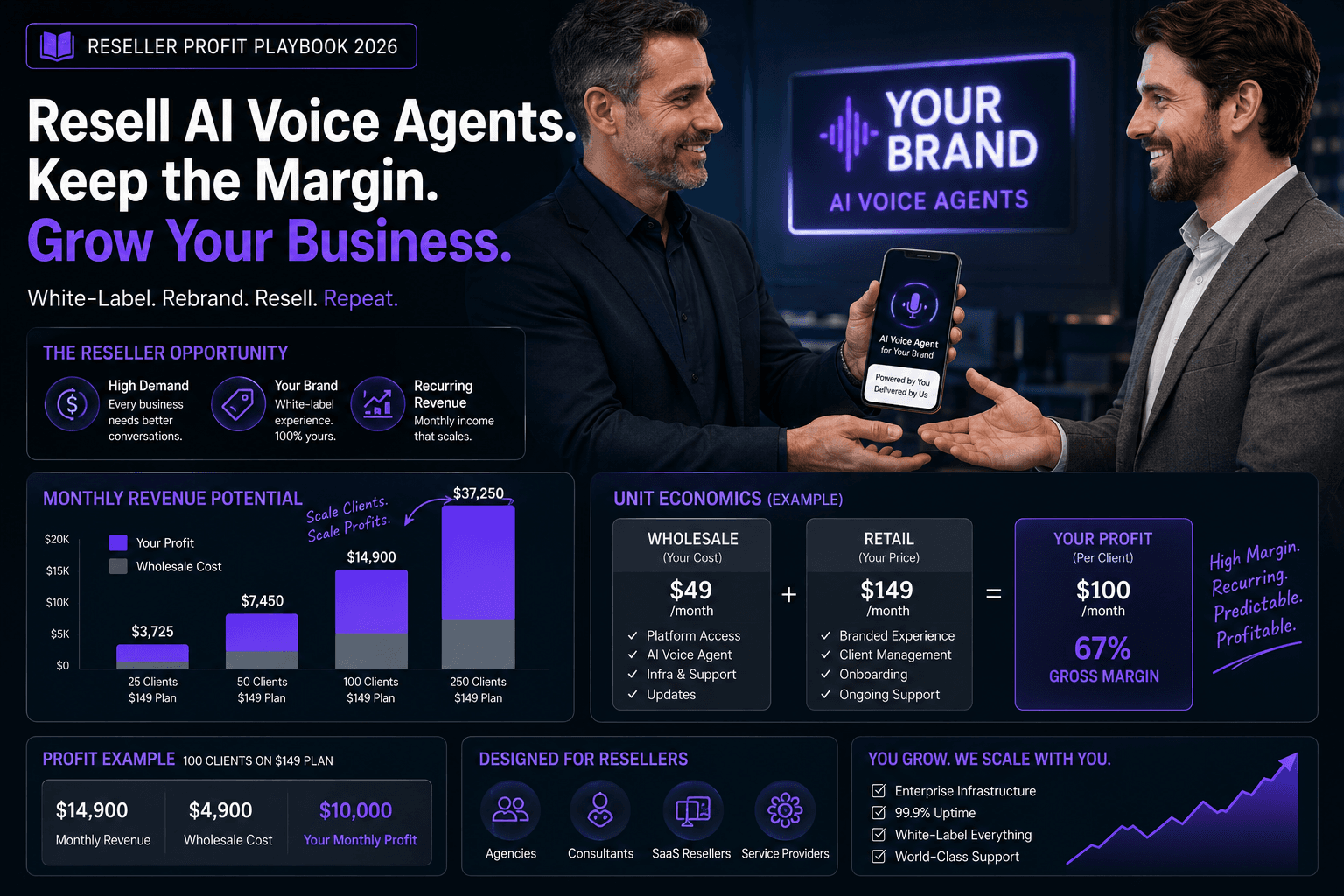
What agencies charge, what platforms cost, and where the margin actually sits when you resell voice AI under your own brand.