
AI Voice Agent for Restaurants: Takeout, Reservations, and Guest Service
How an AI voice agent handles takeout orders, table reservations, and guest calls during the rush.
Utkarsh Mohan•Mar 16, 2026
How Australian restaurants, cafes, and pubs use an AI voice agent to answer the phone during service: bookings, takeaway orders, BYO and surcharge questions, keeping your number, multi-state time zones, the Privacy Act, Spam Act, and Do Not Call rules, and what to compare before you sign up.
Utkarsh Mohan
Published: Nov 8, 2026
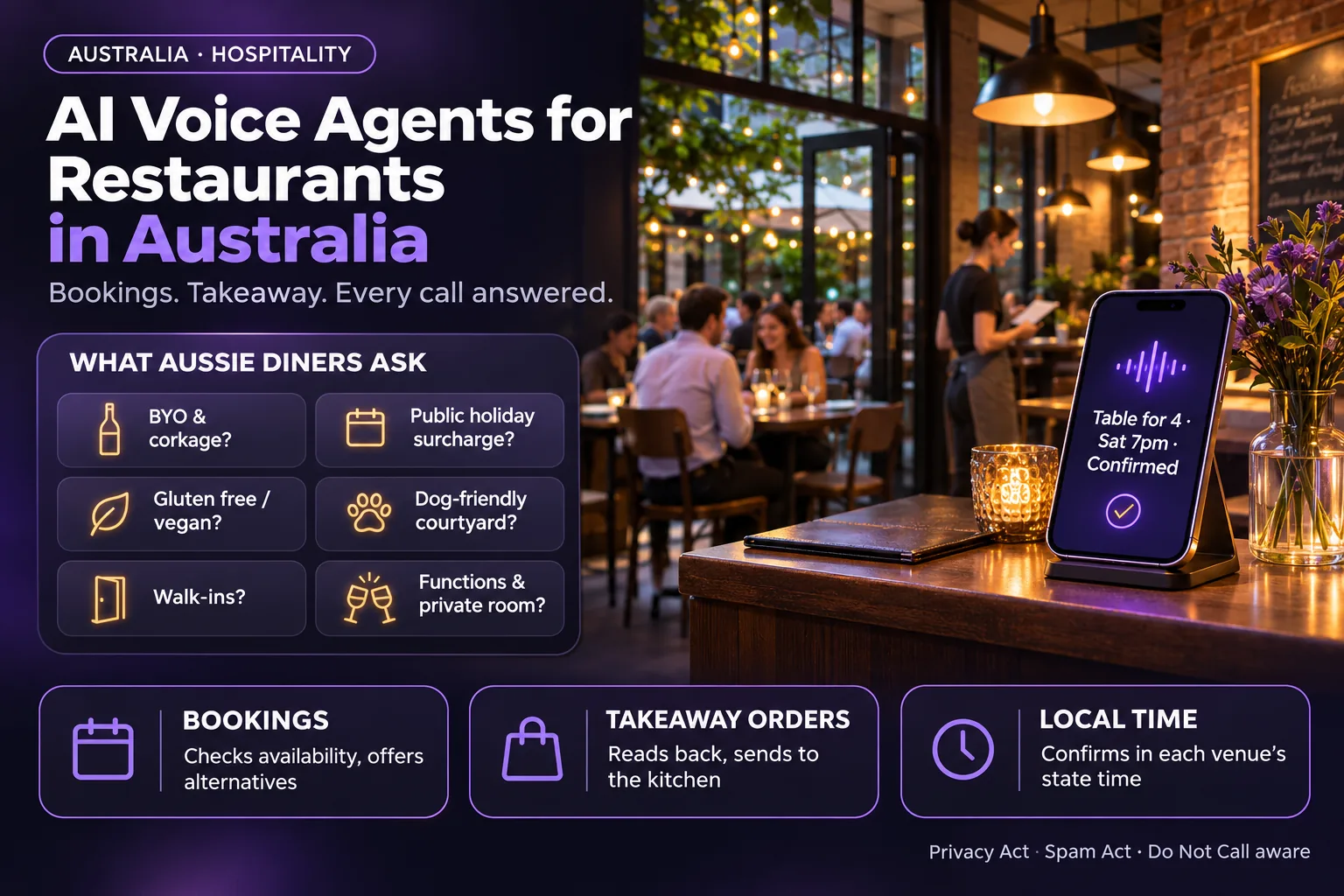
At 6:30 on a Friday the host is seating a walk-in four, the floor manager is fixing a docket, and the phone behind the pass has rung three times. One of those calls was a booking for eight tomorrow night. Another was a takeaway order. Neither caller left a message, and both have already rung the place down the road.
An AI voice agent for restaurants takes those calls instead. This guide covers how that works for Australian venues specifically: the local questions it needs to answer, how it fits with the booking platforms and POS systems common here, and the Australian privacy, spam, and call-recording rules to check first. For the product overview, Ringlyn's AI voice agent for restaurants page covers the setup, and the restaurant AI voice agent guide goes deeper on takeaway and reservation calls in general.
The phone rings hardest at the times the floor is busiest. Booking calls for tonight and tomorrow, takeaway orders, and "are you open?" questions all arrive between late afternoon and the middle of service. In a venue with a lean front-of-house team, whoever would answer the phone is also seating, running food, or taking payment.
Staffing a dedicated phone person is expensive in Australia, particularly in the hours you need one. Penalty rates under the Restaurant Industry Award make evenings, Sundays, and public holidays the costliest hours to roster, and those are exactly the hours the phone is busiest. Most venues end up letting the phone ring out, or pointing callers to an online booking link they may not use.
The agent answers in a natural Australian English voice and handles the call the way a good host would. It is not a press-one menu. Callers simply say what they want.
An agent loaded with a generic restaurant script will stumble on the questions that are routine in Australia. Give it clear answers to these before it takes a single call.
| Question | What the agent needs from you |
|---|---|
| Are you BYO, and is there corkage? | Wine only or all alcohol, corkage per bottle or per person, and any nights it does not apply |
| Is there a public holiday surcharge? | Whether you charge one, how much, and the exact wording on your menu |
| Is there a Sunday surcharge? | The same, if you apply one on weekends |
| Can you do gluten free, vegan, or nut free? | What the kitchen can and cannot guarantee, in your words |
| Can I bring the dog? | Whether dogs are allowed in the courtyard or outdoor area |
| Is there a kids menu or high chairs? | Yes or no, and any limits on numbers |
| Do you take walk-ins? | Your walk-in policy and when the agent should suggest booking |
| Can I book a function or the private room? | Minimum numbers and who to transfer the call to |
Common Australian restaurant phone questions and the answer the agent needs on file
Surcharges deserve care. The ACCC expects surcharges to be disclosed clearly, so the agent should state yours exactly as your menu does, not round it or leave it out. If the policy changes for a long weekend, update the agent at the same time as the menu.
Most Australian venues already take online bookings through a platform such as OpenTable, SevenRooms, ResDiary, or NowBookIt. The agent should write phone bookings into the same diary, so the host stand sees one book and the online and phone channels cannot double-book the same table.
Ringlyn connects to booking systems through their APIs and webhooks rather than through a native plug-in for each one. Before you commit, check that your platform gives API access on your plan and allows bookings to be created and changed through it, not just read. If it does not, the agent can still take the booking and send it to the host stand as a message, which is better than a missed call but not as clean as a direct write. The POS and reservation integration guide has the checklist.
Phone takeaway is still a large share of orders for many suburban venues, and unlike delivery apps it carries no commission. The agent takes the order item by item, handles changes such as "no onion" or "sauce on the side", reads the full order back, and gives a pickup time based on how busy the kitchen is.
You do not need to publish a new number. Most Australian carriers and VoIP providers let you forward calls from your existing landline, 1300, or 1800 number in three ways, and you can mix them by time of day.
| Forwarding type | What happens | Good for |
|---|---|---|
| On busy | Calls go to the agent only when your line is engaged | Venues that want staff to answer when they can |
| On no answer | Calls go to the agent after a set number of rings | Catching calls during service |
| Unconditional | Every call goes straight to the agent | Before opening, after close, or for the whole of service |
Ways to route an existing restaurant number to an AI voice agent
A common setup is to forward on no answer during lunch, forward everything during dinner service, and forward everything after close. Test each forward from a mobile before going live, because some carriers handle 1300 and 1800 numbers differently from a standard local line.
Groups with venues in more than one state need to set opening hours and booking times per venue, in that venue's local time. Queensland, Western Australia, and the Northern Territory do not observe daylight saving, so from October to April, Brisbane is an hour behind Sydney and Melbourne, Perth is three hours behind, and Adelaide moves with the eastern states but stays half an hour behind them.
The agent should always confirm a booking in the venue's local time and say so, for example "7pm Brisbane time", when a caller might be ringing from another state. Outbound calls such as booking confirmations should go out at sensible hours in the guest's time zone, not head office's.
This is a summary to take to your adviser, not legal advice. Four sets of rules come up when Australian venues automate the phone.
Ringlyn's agent speaks English, Spanish, French, German, Hindi, and Japanese, and detects which one the caller is using. That covers Australian English callers, many tourists, and Hindi-speaking callers. It does not currently cover Mandarin, Cantonese, Arabic, Vietnamese, or Punjabi, which are among the most common languages spoken at home in Australia after English.
If a meaningful share of your callers speak one of those languages, set the agent to recognise that it cannot help and transfer or take a callback for a staff member who can, rather than pushing the caller through in English. The multilingual answering service guide covers how language detection and handover work.
Australian venues have long had the option of a telephone answering service: a call centre that answers in your name and passes on messages. That keeps the phone from ringing out, but someone at the venue still has to call the guest back, check the diary, and confirm the booking. For a takeaway order or a table tonight, that callback usually comes too late.
| Restaurant phone answering service | AI receptionist for restaurants | |
|---|---|---|
| Booking for tonight | Message for staff to return | Booked into the diary on the call |
| Takeaway order | Usually not taken | Taken, read back, and sent to the kitchen |
| BYO, parking, dietary questions | Answered only if scripted | Answered from your notes |
| Several callers at once | Queued with the operator's other clients | All answered at once |
| Cost model | Per call or per minute, often with a monthly minimum | Monthly plan plus usage |
How the two models handle a typical Australian restaurant's calls
A human answering service still suits a venue whose calls are mostly messages for the owner, such as suppliers, job applicants, and function enquiries that need a long conversation. For booking and takeaway lines, an AI receptionist resolves the call. The AI receptionist vs answering service comparison covers the trade-offs in more detail.
Ringlyn's plans are priced in US dollars and start at US$49 a month; the pricing page lists what each plan includes. When you compare any provider, local or overseas, work out the cost for your real call volume rather than the headline price.
Ringlyn's AI receptionist for restaurants books tables, takes orders, and answers BYO and surcharge questions on your existing number.
An AI voice agent for restaurants in Australia answers the calls that arrive while your team is serving: bookings, takeaway orders, and the BYO, surcharge, and dietary questions that make up most of the rest. Keep your number and forward to it, write bookings into the diary you already use, keep confirmation texts free of promotions, tell callers about recording, and be clear about which languages it covers. Start after hours, read the transcripts, then move it into service. The AI receptionist for restaurants page shows how Ringlyn sets it up.
Yes. It answers in an Australian English voice, takes bookings and takeaway orders, answers hours, BYO, parking, and dietary questions, and sends text confirmations. It runs on your existing number through call forwarding, and passes complaints and function enquiries to a manager.
It connects through the booking platform's API and webhooks. Platforms commonly used in Australia include OpenTable, SevenRooms, ResDiary, and NowBookIt. Check that your plan allows bookings to be created and changed by API; if not, the agent can send phone bookings to the host stand as messages instead.
Yes. Most Australian carriers and VoIP providers let you forward a landline, 1300, or 1800 number when the line is busy, after a set number of rings, or for every call. Many venues forward on no answer at lunch and forward every call during dinner service and after close.
A text that only confirms a booking or order is treated differently from a promotional message. Once a text includes an offer or marketing content, it becomes a commercial electronic message that needs consent, sender identification, and a working unsubscribe. Keep confirmation texts factual and check with your adviser.
Ringlyn's agent speaks English, Spanish, French, German, Hindi, and Japanese. It does not currently speak Mandarin, Cantonese, Arabic, Vietnamese, or Punjabi, so venues with many callers in those languages should set it to hand those calls to a staff member or take a callback.
A phone answering service takes messages that staff must return. An AI receptionist completes the call: it books the table, takes the takeaway order, and answers questions from your notes, then sends a confirmation. Answering services still suit venues whose calls are mostly messages for the owner.
How an AI voice agent handles takeout orders, table reservations, and guest calls during the rush.

The integrations to set up first and the tests to run before you go live.
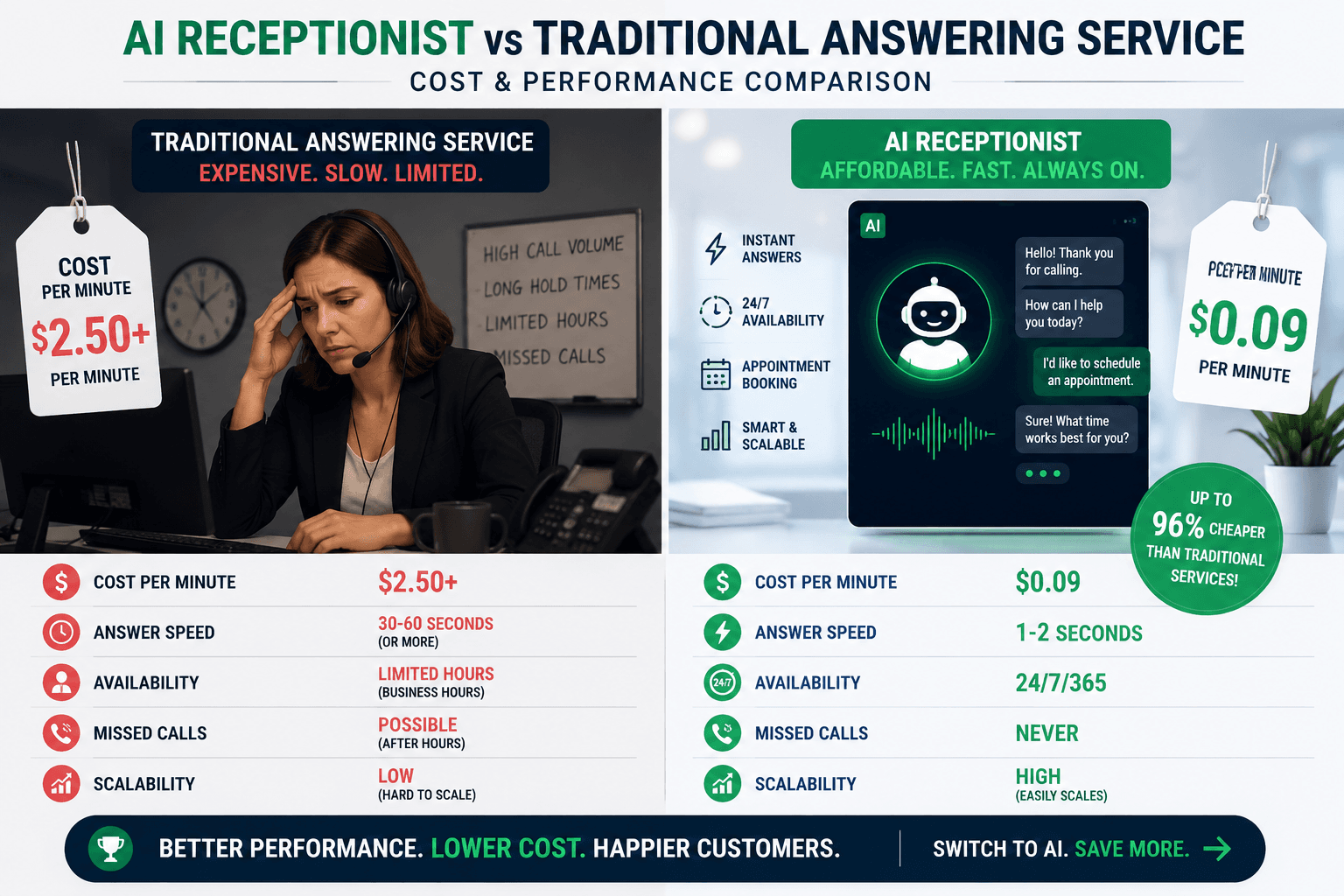
A cost, feature, and performance comparison of the two ways to cover a phone line you cannot staff.