White-Label Virtual Assistant: Sell AI Voice VAs Under Your Own Brand (2026)
A complete 2026 playbook for building a white-label virtual assistant business — resell AI voice VAs under your own brand, understand reseller margins, and see why a white-label AI virtual assistant beats staffing human VAs. Includes margin economics, build-vs-buy math, and how Ringlyn's White-Label plan powers it all.
Divyesh Savaliya
Published: Jul 20, 2026
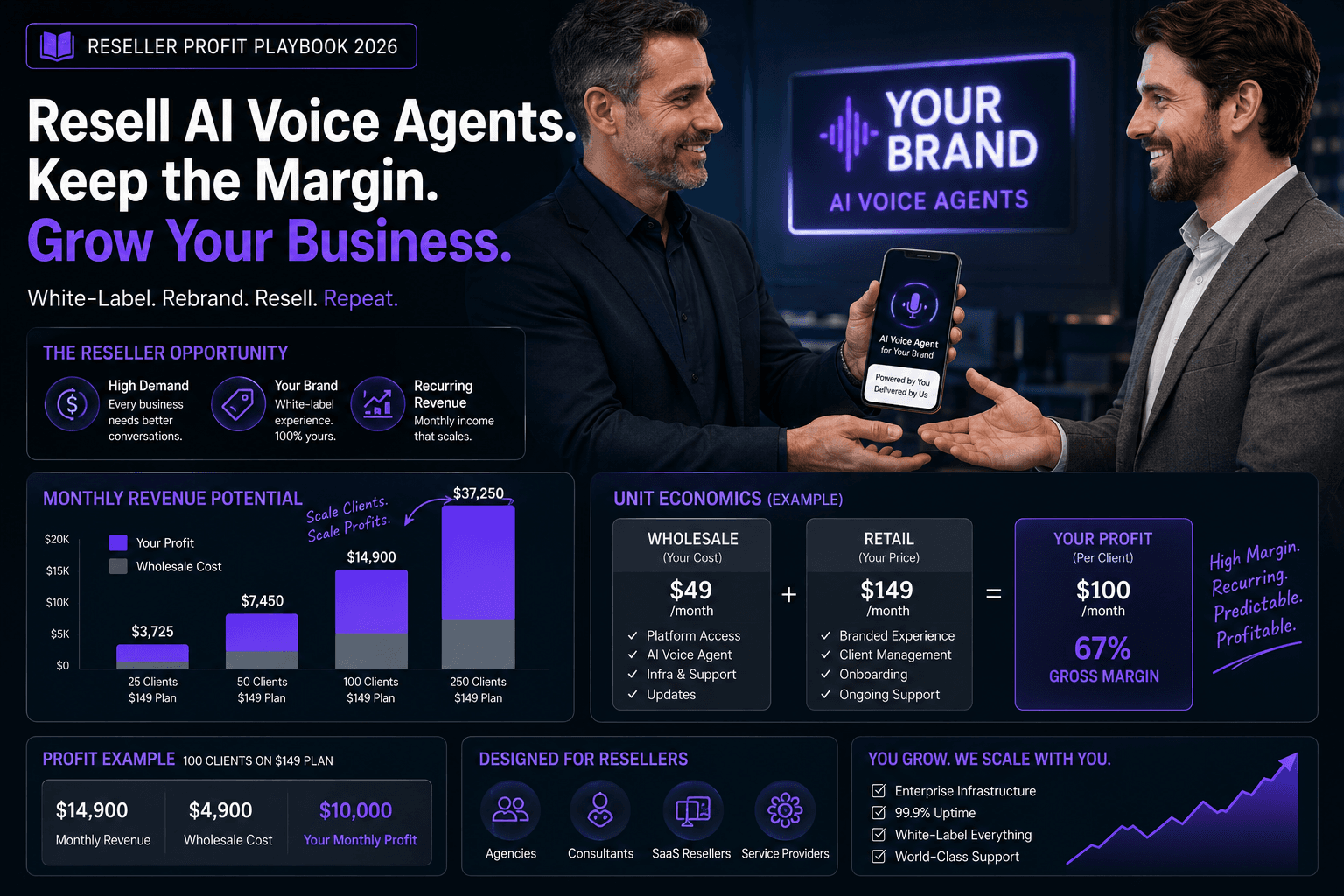
Table of Contents
Table of Contents
What Is a White-Label Virtual Assistant?
A white-label virtual assistant is an AI-powered voice agent that answers calls, books appointments, qualifies leads, and handles routine phone conversations — but branded entirely as your own product rather than the vendor's. When you resell a white label VA, your clients see your logo, your domain, your dashboard, and your pricing; the underlying platform that actually runs the voice AI stays completely invisible. This is the same commercial model that powers most SaaS resale businesses, applied to the fastest-growing category in customer communications: conversational voice AI. Instead of hiring, training, and managing rooms full of human assistants, you package a white label AI virtual assistant that works 24/7, scales instantly, and never asks for a raise, then sell it under your agency's brand as a recurring subscription.
The distinction that matters most in 2026 is the shift from the traditional meaning of "virtual assistant" — a remote human contractor handling admin work — to an AI virtual assistant that conducts real, natural-sounding phone conversations. Modern voice AI has crossed the quality threshold where callers frequently cannot tell they are speaking with software, thanks to sub-second latency, neural voice synthesis, and noise-robust speech recognition that holds up on real phone lines. That leap is exactly why agencies, BPOs, and vertical SaaS companies are racing to resell virtual assistant service offerings powered by AI: the product finally works well enough to put your brand on it, and the margin structure is dramatically better than reselling human labor. If you are exploring how to start an AI voice agent business in 2026, the white-label virtual assistant is the single most repeatable, highest-margin package you can build.
AI Voice VA vs Human Virtual Assistant
For two decades the virtual assistant industry meant offshore or remote human contractors — capable, but constrained by the fundamental economics of human labor. A human VA works a shift, then goes offline. They handle one call at a time. They need training, management, benefits or contractor fees, and they churn. When a client's call volume spikes, you scramble to staff up; when it drops, you carry idle payroll. Every seat you sell carries a recurring human cost that eats directly into your margin, which is why traditional VA agencies typically operate on 20 to 40 percent gross margins at best. A white label AI virtual assistant inverts every one of these constraints.
An AI voice VA answers every call instantly, 24 hours a day, 7 days a week, including weekends and holidays, with zero staffing overhead. It handles unlimited concurrent conversations, so a single deployment can pick up 5 calls or 500 simultaneously without a hold queue. It never has a bad day, never goes off-script, and delivers identical quality on the thousandth call as it did on the first. Critically for a reseller, there is no per-seat labor cost — once your platform subscription is fixed, every additional client seat you sell is almost pure margin. That is the structural reason a white-label AI VA business scales to margins a human-staffed agency can never reach. The table below in the margin economics section makes this concrete, but the intuition is simple: you are selling software capacity, not human hours.
- Availability: A human VA covers a shift; an AI virtual assistant covers 24/7/365 with no overtime, no callouts, and no coverage gaps.
- Scale: Human VAs handle one call each; an AI VA handles unlimited concurrent calls, absorbing volume spikes without added headcount.
- Cost structure: Every human seat is a recurring labor cost; every AI seat is incremental margin on a fixed platform fee.
- Consistency: AI never fatigues, forgets the script, or varies in tone — quality is identical on call one and call ten thousand.
- Speed to deploy: Hiring and training a human VA takes weeks; spinning up a new AI VA agent for a client takes minutes in a no-code builder.
Why Resell a Virtual Assistant Service in 2026?
The market timing for a white-label virtual assistant business in 2026 is close to ideal. Small and mid-sized businesses across dental, home services, legal, real estate, automotive, and healthcare are all feeling the same pain: they miss calls, they lose leads to voicemail, and they cannot afford a full-time receptionist for every location. They already understand the concept of a "virtual assistant," so you are not educating the market from scratch — you are simply offering a better, always-on version at a price that undercuts human staffing. When you resell virtual assistant service offerings powered by AI, you meet demand that already exists with a product that is finally good enough to trust with live customers.
The second reason is the revenue model. A white-label VA is sold as a monthly subscription, which means every client you sign compounds into predictable, recurring monthly revenue rather than one-time project fees. Agencies that have historically lived on project-based or retainer income find that adding an AI VA line creates the kind of durable MRR that raises the entire valuation of the business. Retention is strong too — once a client's phone line is running through your branded AI assistant and connected to their CRM and calendar, switching costs are high and churn is low. For agencies already serving SMBs with marketing, web, or GoHighLevel services, bolting on a white-label AI virtual assistant is one of the highest-leverage upsells available, and it pairs naturally with the conversion-focused pages on our agency program.
White-Label VA Margin Economics
The reason resellers gravitate toward AI voice agents platforms with high margins is best shown with numbers. Below is an illustrative model of a reseller on Ringlyn's White-Label plan at a fixed $2,497 per month, selling AI virtual assistant seats to SMB clients at $299 per month each. The key mechanic is that the platform cost is fixed, so as you add seats your effective cost per seat falls and your gross margin climbs toward the platform's structural ceiling. This is the compounding-margin dynamic that makes a white-label VA business fundamentally more attractive than reselling human labor, where every new seat adds a new recurring cost.
| Seats sold | Monthly revenue | Platform cost | Gross profit | Gross margin | Effective cost/seat |
|---|---|---|---|---|---|
| 10 seats | $2,990 | $2,497 | $493 | 16% | $249.70 |
| 20 seats | $5,980 | $2,497 | $3,483 | 58% | $124.85 |
| 40 seats | $11,960 | $2,497 | $9,463 | 79% | $62.43 |
| 75 seats | $22,425 | $2,497 | $19,928 | 89% | $33.29 |
| 150 seats | $44,850 | $2,497 | $42,353 | 94% | $16.65 |
Illustrative white-label AI virtual assistant margin model (Ringlyn White-Label plan at $2,497/mo fixed, seats sold at $299/mo). Figures are illustrative and depend on your pricing and usage.
Two things stand out. First, there is a clear break-even and scaling threshold: the first handful of seats mostly cover your fixed platform cost, but every seat after that flows almost entirely to gross profit, pushing margins from the teens into the high 80s and 90s as volume grows. A human VA agency selling the same 150 seats would be carrying 150 people's worth of recurring labor cost and fighting to hold 30 percent margin. Second, because the platform fee is flat, your effective cost per seat collapses as you scale — at 150 seats you are delivering a premium branded AI assistant for under $17 of platform cost while charging $299. Real deployments will vary with usage-based minute overages and your own pricing, but the structural advantage is durable: a white label AI virtual assistant is one of the highest-margin recurring products an agency can sell.
Build vs Buy: Should You Build Your Own AI VA Platform?
Every agency that gets serious about a white-label virtual assistant business eventually asks whether it should build its own voice AI stack instead of licensing a white-label platform. On paper, building looks like it captures more margin. In practice, building a production-grade AI voice agent from scratch means integrating and maintaining speech-to-text, a low-latency LLM orchestration layer, neural text-to-speech, telephony across carriers, noise suppression, call recording, transcription, analytics, CRM connectors, a multi-tenant client dashboard, and billing — then keeping all of it running at 99.9 percent uptime while the underlying models change every few months. That is a multi-engineer, multi-year commitment before you sign your first client, and the maintenance burden never ends.
| Factor | Build your own platform | Buy a white-label platform (Ringlyn) |
|---|---|---|
| Time to first client | 6-18+ months of engineering | Days — configure branding and launch |
| Upfront cost | $250k-$1M+ in engineering and infra | Fixed $2,497/mo White-Label plan |
| Ongoing maintenance | Dedicated engineering team required | Handled by the platform vendor |
| Voice quality / latency | You must tune and host every model | ElevenLabs + Gemini voices, optimized pipeline |
| Noise-robust recognition | You build and maintain it | Built in and continuously improved |
| Compliance (HIPAA, encryption) | Your responsibility to certify | HIPAA-compliant architecture included |
| Billing / rebilling | Build your own | Stripe rebilling built in |
| Margin ceiling | Higher in theory, rarely realized | 85-94% once you scale seats |
Build vs buy for a white-label AI virtual assistant business.
For the overwhelming majority of agencies, buying a white-label platform is the correct decision. It converts an open-ended engineering gamble into a fixed, predictable monthly cost, and it lets you spend your energy on the two things that actually grow the business: sales and client success. The theoretical extra margin from building is almost always erased by engineering payroll, infrastructure bills, and the opportunity cost of a 12-month build during which competitors are already signing your prospects. Buy the platform, put your brand on it, and go to market now — you can always revisit building once you have hundreds of seats and a reason to.
What to Look for in a White-Label AI Virtual Assistant Supplier
Not every voice AI vendor is built to be resold. When you evaluate noise-robust voice AI white-label integration suppliers, you are choosing the foundation your entire brand will sit on, so the selection criteria are stricter than for a tool you use internally. The single most important requirement is complete brand removal — if the vendor's name, logo, or domain leaks through anywhere in the client experience, from the dashboard to system emails to the login URL, the white-label promise is broken. Look for full brand removal, custom domain support, and a genuinely white-labeled client dashboard, not just a logo swap.
- Complete brand removal: No vendor branding anywhere the client can see — dashboard, emails, login page, or documentation.
- Custom domain: Clients access the assistant through your URL, reinforcing that this is your product.
- Noise-robust voice recognition: Real phone calls happen in noisy environments; the assistant must transcribe accurately over background noise, cross-talk, and poor connections.
- Low latency and premium voices: Sub-second response and natural neural voices (ElevenLabs, Gemini) so callers stay engaged and do not feel they are talking to a robot.
- Stripe rebilling: Built-in billing so you set your own prices and collect recurring revenue automatically without building a billing system.
- Compliance: HIPAA-compliant architecture and enterprise-grade encryption so you can sell into regulated verticals without assuming raw liability.
- Native CRM integrations: First-party connectors (HubSpot, Salesforce, GoHighLevel) so client workflows just work without brittle middleware.
- Multi-tenant management: A single dashboard to manage many client accounts, agents, and phone numbers cleanly.
How Ringlyn's White-Label Plan Works
Ringlyn's White-Label plan at $2,497 per month was purpose-built for resellers who want to sell AI voice virtual assistants under their own brand without touching infrastructure. It provides complete brand removal from every customer-facing touchpoint, custom domain support so your clients access the platform through your own URL, a fully white-labeled client dashboard that you present as your proprietary product, and Stripe rebilling integration that lets you define your own pricing tiers and automatically collect recurring revenue from your clients — with Ringlyn never appearing anywhere in the experience. Underneath your brand, clients get the same production-grade engine that powers Ringlyn directly: ElevenLabs and Gemini neural voices, sub-second orchestration, noise-robust speech recognition, HIPAA-compliant architecture, call recordings and transcripts, sentiment analysis, batch calling, and native CRM integrations.
The practical effect is that you get the entire technical foundation of a voice AI company — voice quality, telephony, compliance, analytics, and billing — as a fixed monthly cost, and you layer your brand, your pricing, and your client relationships on top. Because the plan carries the full feature set with no per-seat platform charge, the margin economics shown earlier hold: your cost is fixed while your revenue scales with every seat you sell. That combination of complete white-labeling, built-in Stripe rebilling, and a compliance-ready, noise-robust engine is what makes Ringlyn one of the AI voice agents platforms with high margins that resellers can actually build a durable business on.
“We stopped trying to staff human VAs the month we launched our branded AI assistant. Our first ten clients covered the platform fee, and everything after that has been margin we never had before. Our clients think we built the technology ourselves — they see our logo, our domain, our dashboard — and honestly, from their side, we did. We just didn't have to hire a single engineer to do it.”
— Illustrative scenario based on common white-label reseller patterns
Launching Your White-Label VA Business in 5 Steps
- Pick your niche and offer: Choose one or two verticals you already understand — dental, home services, real estate, legal — and define exactly what your AI virtual assistant will do for them (answer calls, book appointments, qualify leads, handle after-hours). A focused offer sells far faster than a generic one.
- Set up your White-Label plan: Subscribe to Ringlyn's White-Label plan, connect your custom domain, upload your branding, and configure the client dashboard so every touchpoint carries your name. Set up Stripe rebilling with your own pricing tiers.
- Build a template agent: Use the no-code builder to create a reusable AI VA configured for your niche — greeting, conversation flow, appointment booking logic, CRM sync, and call transfer rules. This becomes the template you clone for each new client in minutes.
- Sign your first clients: Sell the always-on, never-misses-a-call value proposition against the cost of a human receptionist. Onboard each client by cloning your template agent, connecting their calendar and CRM, and porting or provisioning their phone number.
- Scale and retain: Add seats as fast as you can sell them — remember every new seat is near-pure margin — and keep churn low with reporting that proves value (calls answered, appointments booked, leads captured) delivered under your brand.
Pricing Your White-Label Virtual Assistant Seats
Because you control pricing under a white-label model, seat pricing is one of your most important levers. The right anchor is not the platform cost — it is the cost of the human alternative your client is comparing against. A part-time human receptionist or answering service typically runs $1,500 to $3,500 per month, and it still only covers business hours. Against that backdrop, pricing your always-on AI virtual assistant at $199 to $499 per month per location reads as an obvious bargain to the client while delivering the 80 to 90 percent-plus margins shown in the economics table to you. Do not underprice out of fear; you are selling 24/7 coverage that never misses a call, and that is worth far more than the platform fee behind it.
Most successful resellers offer two or three tiers — for example a base tier for single-location call answering and appointment booking, a growth tier that adds outbound follow-up and batch calling, and a premium tier for multi-location clients with advanced analytics and CRM automation. Tiering lets you capture more value from larger clients while keeping an accessible entry point for small businesses, and it creates a natural upgrade path that lifts your average revenue per account over time. Bundle the AI VA with services you already sell — websites, ads, GoHighLevel automation — to raise switching costs and make the whole relationship stickier. For a deeper breakdown of packaging and go-to-market motion, the complete white-label guide linked above and our agency program walk through the full funnel.
Launch Your Own Branded AI Virtual Assistant
Resell AI voice VAs under your own brand with complete white-labeling, Stripe rebilling, and 85%+ margins — on Ringlyn's White-Label plan.
Frequently Asked Questions
A white-label virtual assistant is an AI-powered voice agent — one that answers calls, books appointments, and qualifies leads — that you resell under your own brand instead of the vendor's. Your clients see your logo, your domain, your dashboard, and your pricing, while the underlying platform stays completely invisible. It lets agencies and SaaS companies offer an always-on AI VA as their own product without building any voice AI technology themselves. On Ringlyn's White-Label plan at $2,497 per month, you get complete brand removal, a custom domain, a white-labeled dashboard, and Stripe rebilling so you can sell AI voice assistants entirely under your own name.
To resell a virtual assistant service under your own brand, subscribe to a white-label voice AI platform, connect your custom domain, apply your branding to the client dashboard, and set your own prices with built-in Stripe rebilling. You then build a reusable template AI agent for your target niche, clone it for each new client, connect their calendar and CRM, and provision a phone number. With Ringlyn's White-Label plan the entire technical foundation — voices, telephony, compliance, analytics, and billing — is included as a fixed monthly cost, so you focus only on branding, sales, and client success rather than engineering.
Because a white-label AI virtual assistant has no per-seat labor cost, resellers can hold gross margins of roughly 85 to 94 percent once they scale past their fixed platform fee. On Ringlyn's $2,497 per month White-Label plan, selling 40 seats at $299 per month generates about $11,960 in monthly recurring revenue at a 79 percent gross margin, and 150 seats pushes margin above 90 percent because the platform cost stays flat while revenue scales. Human-staffed VA agencies typically top out around 20 to 40 percent margins because every seat carries recurring labor cost — the AI model is structurally far more profitable.
A human virtual assistant works a shift, handles one call at a time, and carries recurring labor cost, training overhead, and churn. An AI virtual assistant answers every call 24/7/365, handles unlimited concurrent conversations, delivers identical quality on every call, and costs nothing extra per seat once your platform subscription is fixed. That means an AI VA scales instantly during call spikes, never misses an after-hours call, and lets a reseller earn far higher margins than reselling human labor. For most SMB phone-handling use cases — answering, booking, and lead qualification — a modern noise-robust AI voice assistant matches or exceeds human coverage at a fraction of the cost.
The AI voice agents platforms with the highest margins for resellers are those that charge a fixed white-label fee rather than a per-seat platform cost, because that lets your margin climb as you add seats. Look for complete brand removal, custom domain support, Stripe rebilling, noise-robust speech recognition, premium neural voices, and HIPAA-compliant architecture. Ringlyn's White-Label plan fits this profile: a flat $2,497 per month covers the full feature set, so every additional seat you sell is near-pure margin, allowing resellers to reach 85 percent-plus gross margins at scale.
When evaluating noise-robust voice AI white-label integration suppliers, prioritize accurate speech recognition over background noise, cross-talk, and poor phone connections, since real calls are rarely made in quiet rooms. Beyond noise robustness, require complete brand removal, custom domain support, a white-labeled dashboard, low sub-second latency, premium neural voices, Stripe rebilling, HIPAA-compliant architecture, and native CRM integrations. Ringlyn provides all of these on its White-Label plan, pairing a noise-robust, low-latency engine with full white-labeling so the assistant performs reliably on live calls while appearing entirely as your own product.
For nearly all agencies, buying a white-label platform is the better decision. Building your own AI VA platform means integrating and maintaining speech recognition, LLM orchestration, neural voices, telephony, noise suppression, compliance, analytics, CRM connectors, and billing — a multi-engineer, multi-year effort costing hundreds of thousands of dollars before your first client. Buying converts that into a fixed monthly cost and lets you launch in days. The theoretical extra margin from building is almost always erased by engineering payroll and the opportunity cost of a long build while competitors sign your prospects. Ringlyn's White-Label plan gives you a production-grade, compliance-ready engine under your brand immediately.
Price against the human alternative your client is comparing to, not against your platform cost. A part-time receptionist or answering service runs $1,500 to $3,500 per month and only covers business hours, so pricing an always-on AI virtual assistant at $199 to $499 per month per location reads as an obvious bargain while delivering you 80 percent-plus margins. Most successful resellers offer two or three tiers — a base tier for call answering and booking, a growth tier adding outbound follow-up, and a premium tier for multi-location clients — to capture more value from larger accounts and create a natural upgrade path that raises revenue per client over time.