
How To Reduce High Call Abandonment Rates with AI Voice Agents
The tactical fixes: zero hold times, instant answering, and driving abandonment below 2%.
Utkarsh Mohan•Jul 14, 2026
Benchmark figures for voice bot and IVR abandonment in 2026, a structured root cause analysis method that tells you where in the call people are hanging up and why, the eight causes that account for most of it, and how the platforms differ on abandonment.
Utkarsh Mohan
Published: Aug 17, 2026
Abandonment is the most quoted number in contact centre reporting and one of the least useful in the form it is usually quoted. "Our abandonment rate is 12%" tells you something is wrong. It does not tell you whether callers are giving up in the queue, in the menu, mid-conversation with a bot, or during a transfer — and those four are different problems with different fixes.
This guide covers what a good voice bot abandonment rate looks like in 2026, how to run a proper root cause analysis on your own data, the causes that actually account for most of it, and how to judge a platform if abandonment is the reason you are shopping. If you want the tactical version, the how to reduce call abandonment with AI voice agents guide covers the fixes; this one is about diagnosis.
Comparing your abandonment rate against someone else's is meaningless until you agree on what counts, and almost nobody does. Four definitional choices change the number substantially.
Write your definition down before you measure. The most common reason two teams disagree about whether abandonment improved is that they were never measuring the same thing.
For a voice bot specifically — meaning callers who hung up while in conversation with an automated agent, not while waiting for a human — the useful bands are narrower than general call abandonment, because there is no queue to blame.
| Voice bot abandonment rate | Reading | What it usually means |
|---|---|---|
| Under 5% | Strong | Fast responses, clear opening, an obvious route to a human when needed |
| 5–10% | Normal | Working as intended; the residual is callers who wanted a person from the start |
| 10–20% | Needs work | Usually one specific failure — a slow opening, a bad intent prompt, or a broken transfer |
| 20–35% | Structural problem | Callers are being asked to do something the bot cannot deliver |
| Over 35% | The bot is the problem | Turn it off for the affected intents while you rebuild |
Practical reading of voice bot abandonment rates, 2026
One caveat that matters more than the bands. A low abandonment rate on a bot that resolves nothing is not a success — it means callers politely sat through a useless conversation before being transferred. Always read abandonment next to resolution rate and transfer rate. A bot with 3% abandonment and an 80% transfer rate is an expensive greeting.
For total call abandonment across the whole contact centre, the widely used target band is 5–8%, with under 5% considered strong and over 10% treated as a structural issue. Sales lines are usually held to a tighter standard than support lines, because an abandoned sales call is directly attributable lost revenue.
Benchmarks vary widely by sector because call urgency and caller tolerance vary. These are directional ranges to orient against, not targets to adopt uncritically — your own trend over time is a far more useful comparison than anyone else's average.
| Context | Typical abandonment | Why it sits there |
|---|---|---|
| Emergency or urgent service lines | Very low | Callers will not hang up; they wait, so the metric hides the pain |
| Healthcare scheduling | Elevated | Long queues, callers try again later, high repeat-call rate |
| Retail and e-commerce support | Moderate, spikes seasonally | Peak-driven; abandonment tracks staffing gaps almost exactly |
| Financial services | Lower | High-value calls, callers persist, but tolerance for menus is low |
| Home services and trades | High | Callers ring the next company on the list within a minute |
| Automotive service | High at 7–9am | Concentrated peak against a fixed advisor count |
| Legacy touch-tone IVR of any kind | Highest | Menu depth is the single biggest driver of early abandonment |
Directional abandonment patterns by context
The last row is the one worth acting on. Menu-tree IVR produces abandonment at a rate no staffing model can compensate for, because callers give up before they ever reach a queue. If your abandonment is concentrated in the first thirty seconds, you have a menu problem, not a capacity problem.
A root cause analysis on abandonment is not a survey exercise. Every abandoned call left a recording, a transcript, and a timestamp, and those three tell you almost everything. Here is a method that works in an afternoon.
“The single most useful chart in abandonment analysis is a histogram of seconds-to-hangup. Averages tell you the rate; the distribution tells you the cause.”
| Cause | Signature in the data | Fix |
|---|---|---|
| Response latency | Abandons cluster after a pause; callers talk over the bot | Reduce end-to-end turn latency below ~800ms; add a filler acknowledgment during lookups |
| Long or scripted opening | Spike at 3–8 seconds | Cut the greeting to one sentence and ask an open question immediately |
| Menu depth | Abandons before any intent is captured | Replace the menu with an open 'how can I help' and classify from the answer |
| No visible route to a human | Callers repeat 'agent', 'operator', 'representative' before hanging up | Honour the request on the first ask, every time |
| Asking for data the caller does not have | Abandons at the same question, one intent dominant | Make identifiers optional; look up by phone number where possible |
| Recognition failure | Repeated rephrasing, then hangup; correlates with accents and poor lines | Transfer after two consecutive failures instead of a third attempt |
| Silent hold during lookups | Abandons mid-conversation with no caller speech before them | Never leave dead air; speak during the wait |
| Broken or cold transfer | Abandons at the handoff, plus queue abandons immediately after | Warm transfer with context; check the target queue's capacity before offering it |
The eight most common voice bot abandonment causes and their data signatures
In most analyses, two of these eight account for more than half the abandoned calls. Fixing the top two before touching anything else is nearly always the right sequencing, and it is also the fastest way to build internal confidence that the analysis was worth doing.
Voice conversation has a rhythm, and humans are extremely sensitive to violations of it. In natural speech the gap between turns is roughly 200 milliseconds. A voice bot that takes a second and a half to respond is not slightly slower — it is outside the range a caller reads as conversational, and they start assuming the line has dropped.
| End-to-end turn latency | How the caller experiences it | Effect on abandonment |
|---|---|---|
| Under 500ms | Natural, conversational | Negligible latency-driven abandonment |
| 500–800ms | Slightly deliberate but fine | Minimal |
| 800ms–1.2s | Noticeably slow; callers start repeating themselves | Rising |
| 1.2–2s | Feels broken; callers talk over the bot | Substantial |
| Over 2s | Read as a dropped call | Severe |
Turn latency and its effect on caller behaviour
Two practical notes. First, latency is not one number — it is speech recognition finalisation, model inference, speech synthesis start, and network transit, and a regression in any one of them shows up as abandonment. Second, database and API lookups are the usual culprit in production, not the models. If your agent has to hit a slow CRM mid-call, speak during the wait rather than leaving silence. Callers tolerate "let me pull that up" far better than dead air.
Containment — the share of calls handled without a human — is the metric vendors lead with, and optimising for it directly is one of the most reliable ways to make abandonment worse. A bot that refuses to transfer will show excellent containment right up until you notice the abandonment rate and the repeat-call volume.
Read the four together or none of them mean anything.
If a vendor will only quote containment, ask for the other three. The reluctance is informative.
Platforms reduce abandonment through four mechanisms, and it is worth knowing which one you are actually buying, because they are not equally available.
| Mechanism | What it removes | Who offers it well |
|---|---|---|
| Unlimited concurrency | Queue abandonment entirely — there is no queue | Any modern AI voice platform; this is the baseline benefit |
| Sub-second turn latency | Latency-driven mid-conversation abandonment | Varies enormously; test it yourself rather than trusting a spec sheet |
| Intent-based routing instead of menus | Early abandonment before intent capture | Conversational platforms; not legacy IVR with a voice skin |
| Immediate, reliable escalation | Abandonment from callers who wanted a human | Requires warm transfer with context and real queue awareness |
The four mechanisms by which voice AI reduces abandonment
The first mechanism does most of the work and is why abandonment is the metric that moves fastest after deploying voice AI. If nobody waits, nobody gives up waiting. The other three determine whether you trade queue abandonment for in-conversation abandonment, which is a real risk with a badly configured bot and the reason some deployments show a flat total with a very different distribution underneath.
When you evaluate, do this rather than reading feature lists: call the vendor's demo number, interrupt the agent mid-sentence, ask for a human immediately, and ask a question that requires a lookup. Those three interactions expose barge-in handling, escalation policy, and latency under load — the three things that determine your post-deployment abandonment rate. Ringlyn is built around all three, with unlimited concurrent calls, sub-second responses, intent routing without a menu tree, and escalation on the first request rather than the third.
Abandonment reduction is usually justified financially, and the calculation is simpler than most business cases make it. Two components: the cost of the calls you stop losing, and the cost of the coverage you no longer have to staff.
| Line | How to calculate it | Notes |
|---|---|---|
| Recovered call value | Abandoned calls per month × conversion rate × average value | Use your answered-call conversion rate; it is conservative for abandons |
| Repeat-call cost removed | Repeat calls avoided × average handle time × loaded agent cost per minute | Frequently larger than teams expect |
| Coverage cost avoided | Headcount you would need for peak and after-hours × loaded cost | Compare against peak requirement, not average |
| Platform cost | Flat subscription, or per-minute × projected volume | Model at 3× current volume; per-minute pricing scales against you |
| Implementation and tuning | Internal hours for the first 60 days | Always non-zero; budget it or it appears as a surprise |
A voice AI cost savings benchmark that survives finance review
The line most business cases omit is repeat-call cost. A contact centre where 15% of calls are somebody ringing back about an unresolved issue is paying for that volume twice — once in handle time and once in the churn it eventually produces. Removing it is often the largest single saving, and it only becomes visible once you measure the 24-hour repeat rate. The voice AI budget and ROI planning guide works through a full model.
Ringlyn answers unlimited simultaneous calls in under two seconds, routes by intent instead of a menu, and escalates on the first request.
Three habits keep abandonment reporting trustworthy, and all three are easy to lose under pressure to show improvement.
A good voice bot abandonment rate is under 5%, read alongside a resolution rate that justifies it and a repeat-call rate that confirms it. Get those three moving in the right direction together and the number stops being a metric you defend and becomes one you can act on.
Under 5% is strong, 5–10% is normal, 10–20% indicates a specific fixable failure, 20–35% is structural, and over 35% means the bot should be disabled for the affected intents while it is rebuilt. But the rate alone is misleading: a bot with 3% abandonment and an 80% transfer rate is an expensive greeting. Always read abandonment beside resolution rate and 24-hour repeat-call rate.
The widely used target band is 5–8%, with under 5% considered strong and over 10% treated as a structural problem rather than a staffing wobble. Sales lines are typically held to a tighter standard than support lines because an abandoned sales call is directly attributable lost revenue. Comparisons across organisations are close to meaningless unless both use the same short-abandon threshold and denominator.
Eight steps: segment abandons by stage (before first response, during intent capture, mid-conversation, during lookup, during transfer, post-transfer queue); plot seconds-to-hangup as a distribution rather than an average; sort by intent, since abandonment is never uniform; read fifty transcripts from the single worst stage-and-intent combination; listen to ten as audio, because transcripts hide latency and talk-over; check repeat callers; correlate with time of day and concurrency; and write each cause as a specific sentence rather than a category.
Eight causes explain most of it: response latency, a long scripted opening, menu depth, no visible route to a human, asking for data the caller does not have to hand, repeated recognition failure, silent dead air during lookups, and broken or cold transfers. In most analyses two of these account for over half the abandoned calls, so fix the top two before touching anything else.
Natural human conversation has roughly a 200ms gap between turns. Under 500ms end-to-end feels conversational; 800ms to 1.2 seconds and callers start repeating themselves; over two seconds and they read it as a dropped call. Latency is not one number — it is recognition finalisation, model inference, speech synthesis start, and network transit — and in production the usual culprit is a slow CRM or database lookup rather than the models. Speak during the wait instead of leaving silence.
Platforms reduce it through four mechanisms: unlimited concurrency (which removes queue abandonment entirely and does most of the work), sub-second turn latency, intent-based routing instead of a menu tree, and immediate reliable escalation with warm transfer. The first is baseline across modern platforms; the other three vary enormously. Test them yourself — call the demo number, interrupt mid-sentence, ask for a human immediately, and ask a question requiring a lookup.
No, and optimising for it directly makes abandonment worse. A bot that refuses to transfer shows excellent containment right up until you look at abandonment and repeat calls. Read four metrics together: containment, resolution (containment minus resolution is your hidden failure volume), abandonment by stage, and 24-hour repeat-call rate. If a vendor will only quote containment, the reluctance tells you something.
Because callers give up before they ever reach a queue, so no staffing model compensates for it. If your abandonment is concentrated in the first thirty seconds, you have a menu problem rather than a capacity problem. Replacing the top-level tree with an open question and intent classification is usually the largest single reduction in early-stage abandonment available to a contact centre.
Five lines: recovered call value (abandoned calls × your answered-call conversion rate × average value), repeat-call cost removed (calls avoided × average handle time × loaded agent cost per minute), coverage cost avoided (headcount needed for peak and after-hours, not average), platform cost modelled at three times current volume, and implementation and tuning hours for the first sixty days. The line most business cases omit is repeat-call cost, which is frequently the largest saving.
Yes, and it happens when queue abandonment falls while in-conversation abandonment rises, leaving the total flat. That is the signature of a rushed deployment with slow responses, a long opening, or an escalation path that does not honour the first request for a human. It is also why you should report abandonment by stage rather than in total — the aggregate number can hide the trade entirely.
The tactical fixes: zero hold times, instant answering, and driving abandonment below 2%.
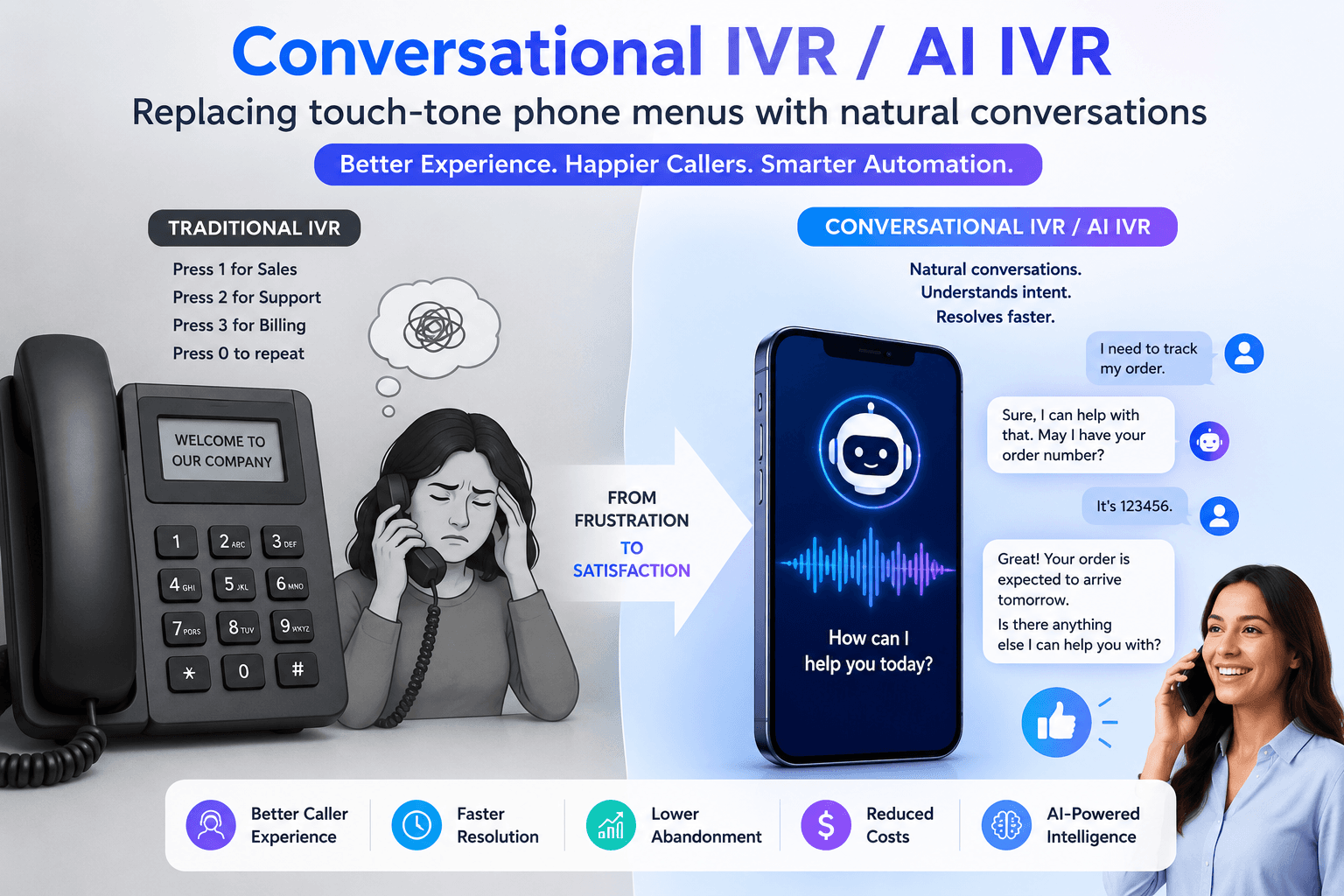
AI IVR vs touch-tone vs voice agent — containment, intent design, and a 60-day migration plan.

Scalability, security, compliance, and total cost of ownership across the enterprise platforms.