Conversational IVR Guide 2026: AI IVR vs Touch-Tone vs Voice Agent (Containment, Intents, Best IVR Software, Migration)
Touch-tone IVR drives 67% of callers to abandon within 90 seconds. Conversational IVR — also called AI IVR or IVA (Intelligent Virtual Assistant) — replaces the menu tree with natural language understanding, barge-in, and call deflection that contains 40–60% of calls without an agent. This is the complete 2026 guide to conversational IVR: how it works (STT→LLM→TTS), legacy IVR vs conversational IVR vs full voice agent, designing intents and fallback flows, containment and deflection ROI, CX metrics (containment, CSAT, AHT, FCR), self-service use cases, integrations, best IVR software, visual IVR, and a 60-day migration plan.
Utkarsh Mohan
Published: May 23, 2026
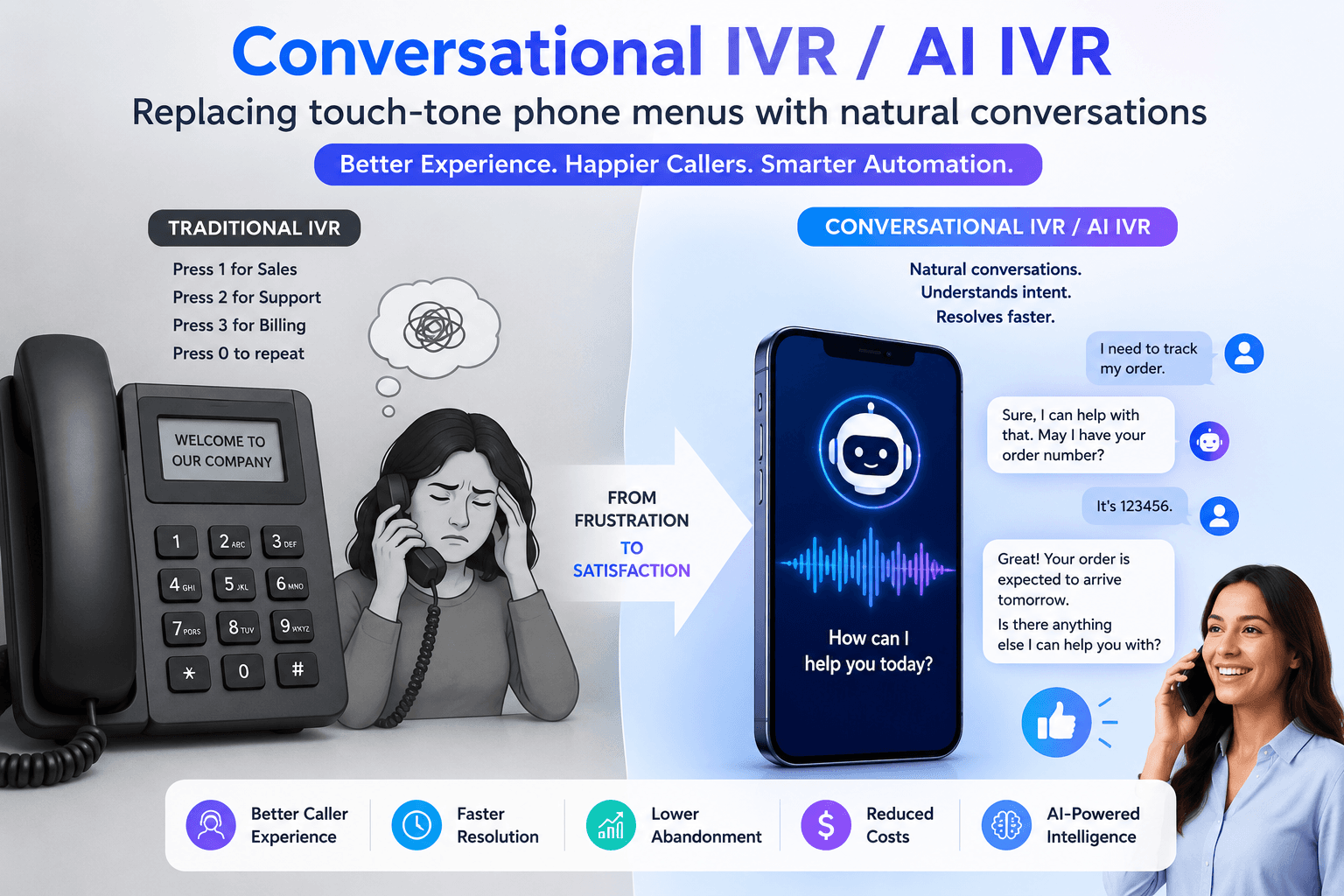
Table of Contents
Table of Contents
If your business still answers the phone with 'Press 1 for sales, Press 2 for support, Press 3 for billing,' you are training your callers to hang up. The data is unambiguous: 67% of callers abandon a traditional touch-tone IVR within 90 seconds, and 34% of those don't call back. Conversational IVR — sometimes called AI IVR or IVA (Intelligent Virtual Assistant) — replaces the menu with natural language understanding, dropping abandonment to under 15% and resolving 40–60% of calls without ever touching a human agent.
This guide covers what conversational IVR actually is, how it differs from legacy IVR providers, which platforms are the best IVR software in 2026, how to write prompts that don't get abandoned, what IVR analytics actually matter, and a practical 60-day plan to migrate from touch-tone to conversational without dropping calls during cutover.
What Conversational IVR Is (and How It's Different from Touch-Tone)
Conversational IVR is an interactive voice response system that uses natural language understanding instead of DTMF keypress menus. Instead of 'Press 1 for sales,' the caller hears 'How can I help you today?' and speaks their need in their own words. The system classifies the intent, optionally asks a clarifying follow-up, then resolves the call directly (booking, status check, FAQ answer) or routes to the right human agent.
The death of the menu tree
The single defining feature of conversational IVR is the absence of a menu tree. A touch-tone IVR is a decision tree: the caller is forced to translate their actual problem ('my invoice is wrong') into whatever pre-baked category the designer chose ('Press 3 for billing'). Every layer of that tree leaks callers — research across contact centers consistently shows roughly a third of callers drop off at each additional menu level, which is why menus deeper than two levels are effectively call-abandonment machines. Conversational IVR removes the translation step entirely. The caller states the problem in their own words, and the natural language understanding (NLU) layer maps that utterance directly to an intent, no matter how the caller phrased it.
Barge-in: the caller can interrupt
A subtle but enormous usability difference is barge-in — the ability for the caller to interrupt the system mid-sentence and have it stop talking and listen. Touch-tone systems force callers to sit through the entire prompt before pressing a key. Conversational IVR with proper barge-in (and endpointing that detects when the caller has finished speaking) feels like talking to a person who is actually paying attention. Combined with sub-second response latency, barge-in is the difference between a system callers tolerate and one they actively prefer to a hold queue.
The contrast with traditional IVR is stark:
| Dimension | Traditional Touch-Tone IVR | Conversational IVR (AI IVR) |
|---|---|---|
| Input method | DTMF keypress (1, 2, 3) | Natural language speech |
| Caller cognitive load | High — memorize menu | Low — speak normally |
| Menu depth tolerance | 2 levels before drop-off | Unlimited — no menu |
| Average time to right destination | 90–120 seconds | 10–20 seconds |
| Abandonment rate | 60–75% | 10–18% |
| Self-service resolution | 5–15% (FAQ playback) | 40–60% (full AI conversation) |
| Multilingual support | Multiple menu trees, hard to maintain | Single agent, 8–30 languages native |
| Update effort | Re-record audio, redeploy menu | Edit prompt text, deploy in minutes |
| Caller satisfaction (CSAT) | 2.8–3.4 / 5 | 4.1–4.6 / 5 |
Touch-tone IVR vs Conversational IVR / AI IVR — 2026 contact center industry data
Touch-Tone IVR vs Conversational IVR vs Full Voice Agent
There are really three rungs on the voice-automation ladder, and conflating them is the most common mistake buyers make in 2026. The first rung is legacy touch-tone IVR: DTMF menus that only route, never resolve. The second is conversational IVR (also called CAI — conversational AI, or an IVA): natural-language input that can both route and resolve a defined set of intents. The third is a full AI voice agent: an autonomous agent that holds open-ended, multi-turn conversations, takes actions across systems, handles outbound as well as inbound, and is not constrained to a fixed intent library. Conversational IVR is the bridge — it modernizes the front door without requiring you to re-architect your entire contact center.
Where each one fits
The honest framing: touch-tone IVR is what you are replacing, conversational IVR is the right starting point for most contact centers, and a full voice agent is where you grow into once containment is high and you want the AI to own entire call types end-to-end (including outbound reminders, collections, and proactive notifications). Platforms like Ringlyn AI span the conversational-IVR and full-voice-agent rungs in one system, so you start with intent-based deflection and expand into autonomous handling without changing vendors.
| Capability | Touch-Tone IVR | Conversational IVR (CAI / IVA) | Full AI Voice Agent |
|---|---|---|---|
| Input | DTMF keypress only | Natural language speech | Natural language, multi-turn, open-ended |
| Primary job | Route to a queue | Route and resolve defined intents | Own entire call types end-to-end |
| Resolution scope | None (playback only) | Top 10–30 intents | Broad, including long-tail and novel requests |
| Barge-in / interruptibility | No | Yes | Yes, with natural turn-taking |
| Backend actions | None | Lookups + transactional (book, pay, status) | Multi-system orchestration + complex workflows |
| Outbound capability | No | Limited (callback, confirmations) | Full outbound (reminders, follow-up, collections) |
| Setup effort | Re-record audio menus | Define intents + connect systems (days) | Define goals + guardrails, ongoing tuning |
| Best fit | Legacy you are migrating off | Most contact centers modernizing the front door | High-volume teams automating whole call types |
Legacy IVR vs conversational IVR (CAI/IVA) vs full AI voice agent — the three rungs of voice automation in 2026
IVA vs IVR: The Distinction That Matters in 2026
The IVA vs IVR question shows up constantly in 2026 RFP language and vendor pitches. The honest answer: in 2026, the terms overlap. Here's the distinction as the industry uses it:
- IVR (Interactive Voice Response): The historical term for any automated voice menu system. Originally meant DTMF-only systems. Now used as an umbrella for everything from touch-tone menus to fully conversational AI systems. When someone says 'IVR' in 2026, you have to ask whether they mean legacy touch-tone or modern AI-driven.
- IVA (Intelligent Virtual Assistant): A newer term emphasizing conversational AI capability — natural language understanding, multi-turn dialogue, contextual memory, integration with backend systems for actual resolution (not just routing). An IVA call center or IVA contact center deployment means the AI resolves calls, not just routes them.
- Conversational IVR / AI IVR: Hybrid terminology. Means a system that does what an IVA does (natural language, intent recognition, resolution) but positioned as an upgrade to existing IVR infrastructure.
Practical answer: if you're evaluating vendors, ignore the IVA-vs-IVR label and ask three questions instead. (1) Does the system accept natural language input or only DTMF? (2) Can it resolve calls end-to-end (booking, status check, payment) or does it only route to agents? (3) Does it integrate with your backend (CRM, EHR, billing) to look up caller-specific data? Those answers matter; the IVA/IVR label doesn't.
How AI IVR Actually Works: Intent Recognition, Entity Extraction, Routing
The STT → LLM → TTS loop
At the core of every conversational IVR is a real-time loop: speech-to-text (STT) transcribes the caller, a large language model (LLM) (or a fine-tuned intent classifier) interprets the transcript and decides what to do, and text-to-speech (TTS) speaks the response back. The entire round trip has to complete in well under a second for the conversation to feel natural — humans perceive pauses longer than roughly 800ms as awkward. This is why latency engineering, streaming STT, and barge-in handling matter as much as the language model itself. Ringlyn AI runs this loop with real-time orchestration so the agent answers, interprets, looks up data, and responds without the dead air that makes lesser systems feel robotic. The numbered pipeline below expands each stage:
- Speech-to-Text (STT): The caller's utterance is transcribed in real time. Deepgram Nova-3, AssemblyAI Universal-2, or in-stack STT from the IVR provider. Sub-300ms latency is table stakes.
- Intent recognition: The transcribed text is classified into one of N defined intents (billing dispute, appointment booking, account balance, claim status, etc.). Confidence scores are attached. The intent recognition model is either a fine-tuned classifier or a general LLM with intent definitions in the system prompt.
- Entity extraction: Specific data points are pulled from the utterance — claim numbers, dates, amounts, locations. 'I have a claim from last Tuesday for $1,200' yields entities: claim_recency=last_tuesday, amount=1200.
- Context lookup: Caller phone number is matched against CRM/contact records. Recent call history, account status, open tickets are pulled into context before any routing or resolution decision.
- Resolution or routing: If the intent can be resolved by the AI (FAQ, status check, booking), it's resolved. If not, the routing engine selects the destination based on intent + caller context + agent availability + queue depth.
- Logging and learning: Every interaction is logged with intent classification, confidence score, resolution outcome, and (if routed) the agent's disposition. This data feeds back into model retraining weekly.
Designing Intents, Flows, and Escalation Paths
A conversational IVR is only as good as its intent design. The goal is not to anticipate every possible sentence — modern NLU generalizes across phrasings — but to define the right set of intents, the data each one needs, and a clean fallback when the AI is unsure. Get this wrong and you end up with a system that confidently misroutes; get it right and you contain the majority of calls on day one.
Start from your top intents, not your org chart
The most common design mistake is mirroring your internal departments ('Sales,' 'Support,' 'Billing') instead of the caller's actual reasons for calling. Pull 200–500 recent call recordings or transcripts and cluster them by what the caller wanted. You will almost always find that 70–80% of call volume collapses into 8–15 intents. Build those first. The long tail — rare, complex, or emotionally charged calls — should route cleanly to a human rather than being forced into a half-baked automated flow.
Slot filling: collect what the action needs
Each resolvable intent has a set of slots — the data the AI must collect before it can act. An 'order status' intent needs an order number or a phone-number lookup; an 'appointment booking' intent needs a service type, provider, and time window. Good flow design asks for slots conversationally and only when needed, confirms them before committing, and uses backend lookups (via CRM or calendar integration) to pre-fill anything the caller shouldn't have to repeat. Ringlyn AI matches the inbound number against your CRM so a known caller is greeted by name and most slots are already filled.
Fallback and escalation: design the handoff, not just the failure
Every conversational IVR needs a confidence threshold and a graceful exit. When intent confidence is low, when the caller asks twice, when frustration cues appear, or when the request falls outside the intent library, the system should escalate — ideally with a warm transfer that passes the full transcript, identified intent, and any collected slots to the human agent so the caller never has to repeat themselves. The escalation path is where most deployments live or die: a fast, context-rich handoff turns a failed automation into a good experience, while a dead-end ('I didn't get that, goodbye') destroys trust. Ringlyn AI supports warm transfer with full context handoff and can fall back to a human, voicemail, or callback per your rules.
| Trigger | What the AI Detects | Recommended Flow Action |
|---|---|---|
| Low intent confidence | Top intent below your confidence threshold | Ask one clarifying question, then warm-transfer if still unclear |
| Explicit human request | Caller says 'agent,' 'representative,' 'person' | Acknowledge and transfer immediately — do not loop |
| Repeated failure | Same intent attempted twice without resolution | Escalate with full transcript and collected slots |
| Frustration cues | Raised tone, profanity, 'this is ridiculous' | Empathize, stop selling automation, transfer to a human |
| Out-of-scope request | Intent outside the defined library | Route to the correct queue; log for future intent expansion |
| Sensitive / high-risk | Complaint, legal, medical emergency, churn risk | Escalate to a specialized human queue, never auto-resolve |
Fallback and escalation triggers every conversational IVR flow should define before launch
Call Deflection and Containment Rate: The Numbers That Pay for the Project
Two metrics justify the entire investment in conversational IVR: call deflection and containment rate. They are related but distinct. Deflection is the share of calls that never reach a live agent because the IVR resolved them (or pushed them to self-service). Containment rate is the share of calls fully handled by the AI from start to finish without any human handoff. A call can be deflected to a callback queue without being contained; a contained call is always deflected. Containment is the harder, more honest number — and the one to optimize.
Why every contained call has a hard dollar value
A live agent call typically costs a contact center somewhere in the range of $4–$12 in fully loaded labor depending on geography and complexity, while a contained conversational-IVR call costs a fraction of that in per-minute platform fees. The math is simple: multiply your monthly call volume by your containment rate by the labor cost per call you avoid. Even a conservative deployment that contains 40% of a 20,000-call month removes 8,000 agent calls — and that capacity either reduces headcount cost or absorbs growth without new hires. These are industry-typical estimate ranges, not a guarantee, but the direction is consistent across deployments.
| Monthly Call Volume | Containment Rate | Calls Contained / Month | Est. Labor Cost Avoided (at $6/call) |
|---|---|---|---|
| 5,000 | 40% | 2,000 | ~$12,000/mo (~$144K/yr) |
| 10,000 | 45% | 4,500 | ~$27,000/mo (~$324K/yr) |
| 20,000 | 50% | 10,000 | ~$60,000/mo (~$720K/yr) |
| 50,000 | 55% | 27,500 | ~$165,000/mo (~$1.98M/yr) |
| 100,000 | 60% | 60,000 | ~$360,000/mo (~$4.32M/yr) |
Containment ROI illustration — estimate ranges using $6 fully loaded cost per avoided agent call; your numbers will vary by labor cost and intent mix
Note the second-order savings that this table understates: contained calls also shrink hold queues, which lifts CSAT and reduces abandonment on the calls that do reach an agent, and they free your best agents for the complex, revenue-bearing conversations where humans actually add value. For a deeper treatment of the abandonment side of this equation, see the related guide below.
Self-Service Use Cases: What Conversational IVR Resolves Without an Agent
The fastest path to high containment is to automate the high-frequency, low-complexity calls that drown your agents in repetitive work. These are the intents where a backend lookup plus a confirmation resolves the call completely. The table below maps the most common self-service intents to how a conversational IVR resolves each — and where it should escalate instead.
| Common Intent | What the Caller Wants | How Conversational IVR Resolves It | When It Escalates |
|---|---|---|---|
| Order / shipment status | Where is my order? | Verify identity, look up order in CRM/OMS, read status and ETA | Lost/damaged shipment or refund dispute |
| Billing & balance | What do I owe? When is it due? | Authenticate, pull balance, read due date, take a payment | Disputed charge or hardship request |
| Appointment booking | Book / reschedule / cancel | Check live calendar, offer slots, confirm and write back | Complex multi-provider or clinical needs |
| Password / account reset | I'm locked out | Verify identity, trigger reset link by SMS, confirm access | Suspected fraud or account takeover |
| FAQ / hours / policy | Quick informational question | Answer from connected knowledge base, no human needed | Question outside the knowledge base |
| Make a payment | Pay my bill by phone | Authenticate, take secure payment, send confirmation | Partial payment or payment plan setup |
| Appointment reminder confirm | Confirm or change my visit | Outbound or IVR confirm, one-tap reschedule | Caller wants to discuss the visit itself |
| Renew / cancel service | Manage my subscription | Look up plan, process renewal, capture cancel reason | Retention / win-back conversation |
High-frequency self-service intents and how a conversational IVR contains each one — with a defined escalation path for the exceptions
A practical rule: automate the intent fully only when (1) the action is reversible or low-risk, (2) identity can be verified to the sensitivity of the action, and (3) the knowledge or system of record is reliably available to the AI. Everything else is a candidate for partial automation — collect context, then escalate with a warm transfer.
Best IVR Software in 2026: Provider Comparison
| Platform | Type | Best For | Starting Cost |
|---|---|---|---|
| Ringlyn AI | Full conversational IVR + voice agent | SMB to mid-market — replace IVR, resolve calls end-to-end | $49/mo + $0.09/min |
| Five9 IVA | Enterprise IVR + IVA upgrade | Existing Five9 customers adding AI IVR | Bundled with Five9 seat ($175+) |
| Genesys Cloud CX | Enterprise CCaaS with native AI IVR | Large contact centers (500+ seats) | Enterprise — $75–$200/seat/mo |
| NICE CXone + Enlighten | Enterprise IVR + AI agent assist | Enterprises with QA-heavy operations | Enterprise — custom pricing |
| Amazon Connect + Lex | Cloud IVR with NLU integration | AWS-native organizations | $0.018/min Connect + Lex usage |
| Google CCAI (Contact Center AI) | NLU + agent assist for existing IVR | Organizations layering AI on legacy IVR | $0.06–$0.12/min Dialogflow |
| Twilio Studio + AI Studio | Programmable IVR with AI building blocks | Engineering-led organizations | $0.0085/min Twilio + Studio costs |
| Avaya Experience Platform | Enterprise voice with AI capabilities | Avaya CCaaS customers | Enterprise pricing |
| Kore.ai | Conversational AI platform (voice + chat) | Enterprise multi-channel deployments | Enterprise — $50K+/year |
| Free IVR (Asterisk + open source NLU) | Self-hosted DIY | Engineers with strong telecom skills | Free + your engineering time |
Best IVR software / IVR providers in 2026 — pricing approximate, varies by deployment size
The segmentation logic: if you're SMB to mid-market and want a conversational IVR that resolves calls (not just routes), Ringlyn AI's per-minute pricing makes it the clear price-to-feature winner. If you're already on Five9, Genesys, or NICE, the AI IVR add-on from your existing vendor is usually the lowest-friction path. If you're enterprise with multi-channel needs, Cognigy, Kore.ai, or PolyAI win. Developer-led teams that want to assemble their own stack often start with Vapi, Synthflow, Retell AI, Bland AI, or Bolna AI on top of Twilio — flexible, but you own the orchestration, latency tuning, and compliance work yourself. Free IVR is real but only viable if you have a serious telecom engineer on staff. For a build-vs-buy breakdown of the underlying components, see the tech-stack guide below.
Replace Your Touch-Tone IVR in 30 Days
Ringlyn AI's conversational IVR understands callers in natural language, resolves 40–60% of calls without agents, and integrates with Five9, Genesys, NICE, and Twilio Flex.
Integrations: CRM, Telephony, and Knowledge Base
A conversational IVR that cannot read or write to your systems is just a friendlier menu. Resolution — the whole point — depends on three integration surfaces working together: the telephony layer that carries the call, the system of record (CRM, OMS, EHR, billing) that holds caller data, and the knowledge base that answers informational questions. The depth of these integrations, far more than the cleverness of the language model, determines how many calls you can actually contain.
Telephony and contact-center routing
The conversational IVR has to sit in front of your existing phone numbers and play nicely with your ACD/CCaaS. In practice that means SIP/PSTN connectivity (often via Twilio, Telnyx, or your carrier) and the ability to perform a warm transfer into a Five9, Genesys, NICE, or Twilio Flex queue with call context attached. Ringlyn AI integrates at this layer so you keep your numbers and your agents, and the AI simply becomes the intelligent first touch that contains what it can and hands off the rest with full context.
CRM, calendar, and systems of record
Real resolution requires read-write access to the system that owns the data: looking up an order, reading a balance, booking a slot, resetting an account. Two-way CRM and calendar integration lets the AI identify the caller from the inbound number, pull their history into context, and write the outcome back so the record stays clean. Ringlyn AI provides CRM and calendar integration out of the box, which is what turns an 'order status' or 'appointment booking' intent from a routing decision into a fully contained, self-service call.
Knowledge base and compliance
Informational intents (hours, policies, eligibility, how-to questions) are best answered from a connected, grounded knowledge base rather than the model's general training, which keeps answers accurate and on-policy. For regulated industries, the integration layer is also where compliance lives: Ringlyn AI is HIPAA and SOC 2 capable, supports multilingual handling across 8+ languages from a single agent, and runs 24/7 — so a healthcare or financial-services deployment can authenticate callers and resolve sensitive intents without exposing protected data. Fast setup means most of this connects in days, not the multi-quarter integration slog enterprise CCaaS rollouts are known for.
Visual IVR: When the Caller's Phone Becomes the Menu
Visual IVR is the hybrid where the caller gets an SMS link mid-call that opens a visual menu on their phone screen (web-based, no app required). The caller picks the option visually instead of listening to a long audio menu. Used most heavily in financial services and government services where the menu is necessarily long.
Visual IVR is useful when: (a) the menu is genuinely complex and can't be reduced to a single natural-language question, (b) the caller might want to upload a document (driver's license photo, claim photo) during the call, (c) the caller needs to view information (account balance, statement) that's easier to read than hear. In 2026, conversational IVR + visual IVR fallback for document upload is the strongest combination.
Writing IVR Prompts That Don't Get Abandoned
IVR prompts are the actual scripted phrases the system speaks. Bad prompts cause abandonment even on conversational IVR. The five rules that matter:
- Open with an open-ended question, not a menu. 'How can I help you today?' beats 'You can ask about appointments, billing, or general questions.' The latter trains callers to think in menu categories; the former invites them to speak naturally.
- Keep prompts under 6 seconds. Caller attention drops sharply at the 7-second mark on an automated system. If you need to communicate more, break it into multiple short turns with caller acknowledgment in between.
- Lead with the verb, not the qualifier. 'I can book that appointment for you' beats 'Yes, regarding your appointment booking request, I am able to assist with that.' Verb-first matches conversational expectation.
- Confirm before committing. 'I'm booking you for Tuesday at 2 PM with Dr. Smith — does that work?' beats silent action. Confirmation is the single biggest CSAT lever.
- Acknowledge frustration explicitly. When the system detects frustration cues (raised voice, 'agent,' 'representative,' repeat phrases), the prompt should pivot: 'I hear you — let me get a person on the line right away.' Don't make the caller fight the IVR for transfer.
IVR Analytics: What to Measure, What to Ignore
| Metric | Why It Matters | Target (Conversational IVR) |
|---|---|---|
| Abandonment rate (IVR stage) | Single most important metric — measures whether callers tolerate the system | Under 15% |
| Intent classification accuracy | Are you routing/resolving the right calls? Misroute = bad CSAT + repeat call | 92%+ |
| Self-service resolution rate | % of calls resolved without agent handoff — direct cost savings | 40–60% by 90 days |
| Containment rate (per intent) | Resolution rate broken down by intent — finds underperforming intents | Track top 10 intents |
| Average IVR handle time | Time from call answer to resolution or transfer — lower is better | Under 90 seconds |
| Transfer rate (intent → agent) | % of calls that fall through to human — high transfer = AI underperforming | Under 50% by 90 days |
| Repeat call rate (within 7 days) | Same caller calling back for same issue = first call didn't resolve | Under 8% |
| CSAT (post-IVR survey) | Direct measure — survey 10% of calls | 4.0+ / 5 |
| Frustration trigger rate | % of calls where caller says 'agent' / 'representative' immediately = AI failed | Under 12% |
Conversational IVR analytics — the metrics worth tracking weekly in 2026
Metrics to ignore (or de-prioritize): raw call volume (it tells you nothing about IVR quality), total minutes (a vanity metric), and 'AI usage' (irrelevant — the question is whether the AI is solving caller problems).
The five CX metrics executives actually ask about
The operational metrics above tell you whether the IVR is healthy; the CX metrics below tell your leadership whether it's working. Track these five as the executive scorecard. Containment rate is the headline — the percentage of calls fully handled without a human. CSAT measures whether callers were satisfied with the experience, surveyed post-call. AHT (Average Handle Time) should fall for the calls that do reach agents, because the IVR has already collected context. Abandonment should drop sharply as hold queues shrink. And FCR (First Call Resolution) — did the caller's issue get solved on the first call, with no callback within a week — is the truest measure of quality across both AI and human handling. A conversational IVR that lifts containment but tanks FCR is failing; the two must move together.
| CX Metric | What It Tells Leadership | Direction After Conversational IVR |
|---|---|---|
| Containment rate | Share of calls fully resolved by the AI, no human | Up — target 40–60% within 90 days |
| CSAT (post-call survey) | Whether callers liked the experience | Up — from ~3.0 (touch-tone) toward 4.2+ |
| AHT (Average Handle Time) | Agent efficiency on escalated calls | Down — context is pre-collected for agents |
| Abandonment rate | Callers giving up in queue or in-IVR | Down — from 60–75% to 10–18% |
| FCR (First Call Resolution) | Issue solved on first contact, no callback | Up — the truest quality signal; watch with containment |
The five customer-experience metrics that justify a conversational IVR to leadership — and the direction each should move
IVR Testing Software and Why You Need It
IVR testing software — also called an IVR tester — automatically dials your IVR with scripted scenarios and reports where the system breaks. Critical for two reasons:
- Regression testing: Every time you change a prompt or routing rule, you risk breaking something else. IVR testing software runs your top 50 caller scenarios end-to-end and flags regressions before they hit production callers.
- Multilingual coverage: Manually validating that your IVR handles Spanish, French, Hindi, and Japanese callers correctly is impractical. Automated IVR testing dials in each supported language with native-speaker scripted utterances and validates correct intent classification.
Notable IVR testing tools in 2026: Cyara (enterprise standard), Hammer (Empirix legacy, still strong), Spearline (call quality + IVR validation combined), and the built-in IVR test runners in Ringlyn AI, Genesys, and Five9. For free IVR test starts, Twilio's TestRTC gives you basic functionality.
From Touch-Tone to Conversational: A 60-Day Migration Plan
- Week 1: Audit current IVR. Map every menu node, every routing rule, every prompt. Pull abandonment data by node. Identify the top 10 caller intents (this becomes your conversational IVR's initial intent library).
- Week 2: Define intents and write prompts. Write the open-ended greeting, the top-10 intent confirmation prompts, and the routing/resolution logic per intent. Pick conversational IVR platform (Ringlyn AI for SMB-mid; Five9/Genesys/NICE if already on those platforms).
- Week 3: Build in shadow mode. Deploy conversational IVR on a test number. Have internal team and a small group of friendly customers dial in to validate intent classification and resolution flows.
- Week 4: Run IVR testing software regression. 200+ automated test calls across top intents, languages, and edge cases. Fix breakages.
- Week 5: 10% pilot. Route 10% of real production traffic to conversational IVR. Keep 90% on legacy IVR. Compare abandonment, CSAT, resolution rate.
- Week 6: 50% pilot. Increase to 50% routing. Watch for capacity issues; tune confidence thresholds based on first 1,000 calls of real production data.
- Week 7: 100% switch. Full cutover. Legacy IVR remains as fallback for one more week in case of platform issues.
- Week 8: Decommission legacy IVR. Cancel legacy provider contract on standard 30-day notice. Move to optimization mode — tune top 3 underperforming intents weekly.
60 days from kickoff to legacy IVR decommission is realistic for mid-market contact centers (50–500 seats). Enterprise deployments (1,000+ seats, multi-channel) typically take 4–6 months due to integration complexity and change management — but the IVR-specific work still finishes in 60 days; the rest is enterprise process.
Cut Your Call Abandonment 40%+
Ringlyn AI's conversational IVR replaces touch-tone menus with natural language understanding — deploys in 60 days, integrates with Five9, Genesys, NICE, and Twilio Flex.
Frequently Asked Questions
Conversational IVR (also called AI IVR) is an interactive voice response system that accepts natural language speech instead of DTMF keypress input. Instead of 'Press 1 for sales,' the caller hears 'How can I help you today?' and speaks their need in their own words. Compared to traditional touch-tone IVR, conversational IVR cuts abandonment from 60–75% down to 10–18%, resolves 40–60% of calls without agent handoff, and supports multiple languages from a single agent rather than separate menu trees.
IVA (Intelligent Virtual Assistant) emphasizes the conversational AI capability — natural language, multi-turn dialogue, backend integration for actual call resolution (not just routing). IVR is the umbrella term that historically meant DTMF menu systems but in 2026 is used for anything from legacy touch-tone to modern AI-driven. The terms overlap. Practical evaluation: ignore the label and ask whether the system (1) accepts natural language input, (2) can resolve calls end-to-end, (3) integrates with your CRM/EHR/billing for caller-specific data.
Depends on size: for SMB to mid-market (1–500 seats) wanting conversational IVR with resolution, Ringlyn AI at $49/mo + $0.09/min is the best price-to-feature ratio. For existing Five9, Genesys, or NICE customers, the AI IVR add-on from your CCaaS is the lowest-friction path. For AWS-native organizations, Amazon Connect + Lex. For Fortune 500 multi-channel, Cognigy or Kore.ai. Truly free IVR exists via Asterisk + open-source NLU but requires serious telecom engineering.
Five rules: (1) Open with an open-ended question, not a menu — 'How can I help you today?' beats 'You can ask about appointments, billing, or...' (2) Keep prompts under 6 seconds — attention drops at 7 seconds. (3) Lead with the verb — 'I can book that' beats 'Yes, regarding your booking request, I can assist.' (4) Confirm before committing — 'Booking you for Tuesday 2 PM, correct?' (5) Acknowledge frustration explicitly — when the caller says 'agent' or repeats themselves, immediately offer human transfer without making them fight the IVR.
Visual IVR is the hybrid where the caller receives an SMS link mid-call that opens a web-based visual menu on their phone (no app required). Used for: (a) genuinely complex menus that can't be reduced to a natural-language question, (b) document upload scenarios (driver's license photo, claim photo), (c) information display that's easier to read than hear (balances, statements). In 2026, the strongest combination is conversational IVR for normal calls + visual IVR fallback for document upload or complex selection.
The metrics that matter weekly: abandonment rate at the IVR stage (target under 15% for conversational IVR), intent classification accuracy (target 92%+), self-service resolution rate (target 40–60% by 90 days), containment rate broken down per intent, average IVR handle time (under 90 seconds), transfer rate (under 50% by 90 days), repeat call rate within 7 days (under 8%), CSAT from post-IVR survey (target 4.0+/5), and frustration trigger rate (under 12%). The five CX metrics leadership cares about are containment rate, CSAT, AHT (average handle time), abandonment, and FCR (first call resolution). Ignore raw call volume and 'AI usage' — those are vanity metrics.
Deflection is the share of calls that never reach a live agent because the IVR resolved them or pushed them to self-service (including callbacks or self-service web flows). Containment rate is the stricter, more honest number: the share of calls handled by the AI from start to finish with no human handoff at all. A call can be deflected to a callback queue without being contained, but every contained call is by definition deflected. Optimize for containment, because it has a hard dollar value — every contained call removes a fully loaded agent-labor cost of roughly $4–$12 (industry-typical estimate). At a 50% containment rate on a 20,000-call month, that is 10,000 agent calls avoided.
They are different rungs on the same ladder. Touch-tone IVR only routes. Conversational IVR (also called CAI or an IVA) accepts natural language and can both route and resolve a defined library of intents — it is the right starting point for most contact centers modernizing the front door. A full AI voice agent goes further: open-ended multi-turn conversation, broad action-taking across systems, and outbound capability (reminders, follow-ups, collections), not constrained to a fixed intent set. Platforms like Ringlyn AI span both, so you can start with intent-based conversational IVR and expand into autonomous, end-to-end voice agent handling without switching vendors.
Run a phased cutover rather than a flip-the-switch replacement. Audit your current menu tree and pull the top 10–15 caller intents from real transcripts, build and test those intents in shadow mode on a test number, then route traffic in stages: 10%, then 50%, then 100%, keeping the legacy IVR live as a fallback for one extra week before decommissioning. Use automated IVR testing software to regression-test top scenarios and every supported language before each traffic increase. For mid-market contact centers this is realistic in about 60 days; large enterprise multi-channel deployments typically take 4–6 months due to integration and change management. See the 60-day migration plan above for the week-by-week breakdown.
No — in most 2026 deployments conversational IVR sits in front of your existing contact center rather than replacing it. The AI becomes the intelligent first touch on your existing phone numbers, contains the calls it can resolve, and performs a warm transfer into your Five9, Genesys, NICE, or Twilio Flex queue with the caller's intent and collected context attached. This layering approach means you keep your numbers, your agents, and your ACD routing while modernizing the front door, which is typically why teams can pilot conversational IVR in weeks rather than committing to a full CCaaS migration. Confirm the specific telephony and transfer integrations with any vendor before you commit, since depth of integration is what determines how many calls you can actually contain.