
Inside the Ringlyn AI Platform: The Architecture Powering Next-Generation Enterprise Voice AI
A deep technical look at the platform capabilities that make Ringlyn AI the enterprise choice for large-scale conversational AI.
Utkarsh Mohan•Feb 17, 2026
An authoritative look at enterprise AI call center automation: the deployment frameworks, operational models, and measurable outcomes from Ringlyn AI's largest enterprise customers — the organizations processing millions of AI-handled calls across global operations.
Divyesh Savaliya
Published: Feb 20, 2026

Updated May 2026 with Q2 2026 deployment outcomes and refreshed industry case study figures. There is a significant gap between deploying an AI call assistant for a few hundred calls per week and operating an enterprise AI calling infrastructure that handles millions of conversations per month across multiple time zones, languages, regulatory jurisdictions, and business units. Ringlyn AI's enterprise customer base — which crossed 16M+ AI-handled calls per month in Q2 2026, up from 10M+ in early 2026 — provides direct visibility into what it actually takes to succeed at this scale.
This analysis draws on anonymized data and operational frameworks from Ringlyn AI's largest enterprise deployments. It is designed for technology executives, enterprise architects, and operations leaders who are planning or managing large-scale AI calling programs.
Enterprise AI calling at scale is qualitatively different from small or mid-market deployment in several dimensions that are easy to underestimate during planning:
The phrase enterprise call assistant is used loosely across the market, so it is worth defining precisely before discussing deployment at scale. An enterprise call assistant is a production-grade conversational voice agent that answers and places phone calls autonomously, understands natural speech in real time, retrieves and updates data in live business systems, and either resolves the interaction end-to-end or hands it to a human specialist with full context. It is distinguished from a consumer chatbot or a scripted IVR by three properties: it operates over the telephony network at production volume, it is governed by enterprise security and compliance controls, and it is accountable to measurable business outcomes rather than novelty. In practice this means the assistant is not a single feature but an operational layer that sits between your customers or employees and your systems of record.
The most common planning mistake is to treat an enterprise call assistant as a one-directional inbound deflection tool — an IVR replacement and nothing more. (If an AI IVR replacement for your contact center is the immediate goal, our conversational IVR guide covers that migration specifically.) The organizations extracting the most value from Ringlyn AI deploy across a wider surface. A single assistant configuration, or a small family of them sharing the same knowledge base and integrations, typically covers both inbound and outbound calling and both customer-facing and internal-facing use cases. Consolidating these on one platform matters because the underlying investments — telephony connectivity, CRM integration, compliance guardrails, transcript governance, and conversation-design discipline — are shared across every use case, so each additional workflow is dramatically cheaper to add than the first.
Enterprise voice work divides cleanly into four quadrants defined by direction (inbound versus outbound) and audience (customer-facing versus internal). Most enterprises begin in one quadrant and expand into the others as confidence grows:
The internal helpdesk quadrant deserves particular attention because it is where many enterprises see the cleanest early wins. An IT service desk fielding thousands of monthly password-reset and access-request calls, or an HR shared-services team answering the same fifty benefits questions every open-enrollment season, presents a nearly ideal automation profile: high volume, repetitive intent, a tolerant internal audience, and no external regulatory exposure beyond ordinary data protection. Because Ringlyn AI's pricing is flat and includes telephony rather than metering per-minute, routing high-volume internal traffic through the assistant does not create the runaway usage bills that make per-minute platforms risky for always-on internal lines.
| Quadrant | Representative Workflows | Primary Metric |
|---|---|---|
| Inbound CX | Account servicing, order status, billing, Tier-1 support, scheduling | Containment / self-service rate |
| Outbound engagement | Reminders, renewals, collections, lead qualification, surveys | Contact rate & conversion |
| Internal helpdesk | IT resets & ticket triage, HR benefits, field dispatch, branch ops | Agent hours saved / deflection |
| Specialist augmentation | Authentication, intent capture, data intake, warm transfer | Human handle time reduction |
The four quadrants of enterprise voice work an enterprise call assistant can cover
Ringlyn AI's infrastructure is engineered for elastic, fault-tolerant operation at enterprise scale. The key architectural decisions that enable reliable performance at 10,000+ concurrent calls:
For an enterprise routing a meaningful share of its customer contact through a voice AI platform, the vendor's reliability becomes the enterprise's reliability. A consumer-grade tool can absorb an occasional outage; an assistant answering the main line for a bank, a hospital network, or a national retailer cannot. This is why the service-level agreement — not the demo — is the document that decides enterprise deals. The headline figure is uptime, and the difference between tiers is larger than it looks: 99.9% availability permits roughly 43 minutes of downtime per month, while 99.95% permits about 22 minutes and 99.99% only about 4. Multiplied across millions of calls, those minutes are thousands of unanswered customers, so enterprises should insist on a contractual uptime commitment appropriate to the criticality of the lines they are automating, backed by service credits that actually bite.
Uptime alone is an incomplete contract. A robust enterprise SLA also specifies conversational latency targets (the round-trip responsiveness that keeps a call from feeling laggy), incident-response and escalation commitments with named severity levels, a published status page and proactive outage notification, and recovery objectives (RTO/RPO) that state how quickly service is restored and how little data is lost after a disruption. Just as important is the operating model behind the paper: a named technical account manager, an enterprise support tier with defined response times for P1 incidents, and change-management notice before platform updates that could affect production behavior. Ringlyn AI's enterprise agreements are structured around these dimensions rather than uptime in isolation, because at scale the failure that hurts most is rarely a total outage — it is a silent latency regression or a mishandled change window that degrades thousands of calls before anyone notices.
| SLA Dimension | What Enterprises Should Require | Why It Matters at Scale |
|---|---|---|
| Uptime commitment | Contractual availability target with service credits | 43 min/month at 99.9% vs 4 min at 99.99% is thousands of missed calls |
| Conversational latency | Target response-time bands, monitored and reported | Lag, not outages, is the most common cause of degraded call quality |
| Incident response | Severity levels with defined P1 response and escalation | Determines how fast a production problem is contained |
| Status & notification | Public status page plus proactive outage alerts | Enterprises must inform their own stakeholders in real time |
| Recovery objectives | Stated RTO/RPO for disruptions | Bounds worst-case downtime and data loss |
| Change management | Advance notice before behavior-affecting updates | Prevents silent regressions across live call flows |
The service-level dimensions that matter beyond a headline uptime number
At enterprise scale, security and compliance stop being a checklist item and become the gating factor for whether a deployment ships at all. A voice assistant that handles account numbers, health information, or payment data touches nearly every control domain an enterprise security team cares about — identity, encryption, data residency, retention, access control, and auditability. The evaluation question is not whether an AI platform can hold a fluent conversation; it is whether the platform can satisfy the enterprise's information-security review, vendor-risk assessment, and regulatory examination without exception.
Identity and access (SSO and RBAC): Enterprise operators expect single sign-on through their existing identity provider so that access to the assistant's configuration, transcripts, and analytics is governed by the same joiner-mover-leaver process as every other corporate system. Role-based access control should separate who can design conversation flows, who can view unredacted transcripts, who can export data, and who can change compliance settings — so that a conversation designer cannot reach raw PII and a support analyst cannot silently alter a required disclosure script.
Audit logging and transcript governance: Every call should produce a tamper-evident record — authenticated identity where applicable, intent, actions taken against back-end systems, disclosures delivered, and outcome — retained under a configurable policy and exportable for internal audit or regulator review. Governance also means controlling what is kept: sensitive fields such as card numbers and government IDs should be redacted from stored recordings and transcripts inline, and retention windows should be tunable per data class so the enterprise keeps what regulation requires and discards what it does not.
Data residency and regulatory posture: Multinational operators frequently must keep EU-resident data in the EU and apply jurisdiction-specific handling. Ringlyn AI supports HIPAA workflows with a Business Associate Agreement for healthcare deployments, and its compliance guardrails can enforce per-jurisdiction disclosures, calling-hour restrictions, and consent capture. For organizations with the strictest data-control requirements — where customer audio and transcripts cannot leave infrastructure the enterprise controls — the platform offers a self-hosted deployment option that keeps the entire pipeline inside the customer's own environment.
| Governance Domain | Enterprise Requirement | How It Is Satisfied |
|---|---|---|
| Identity & access | SSO via corporate IdP; least-privilege access | Single sign-on plus role-based access control across config, transcripts, and exports |
| Data protection | Encrypt in transit; redact regulated fields | TLS on voice data; inline redaction of card numbers, government IDs, and other PII |
| Auditability | Examination-ready record of every call | Tamper-evident logs: identity, actions, disclosures, outcome; exportable transcripts |
| Data residency | Region-specific storage and handling | Per-jurisdiction configuration; self-hosted option keeps data in the enterprise's environment |
| Regulatory posture | HIPAA / sector rules; consent & disclosures | BAA for healthcare; guardrails enforce disclosures, calling hours, and consent capture |
Enterprise governance domains and how a voice AI platform should address each
The single most consequential architectural choice for a security-sensitive enterprise is where the data lives. Managed cloud is the fastest path to production and is appropriate for the majority of workloads. But regulated institutions, government-adjacent operators, and enterprises with contractual data-control obligations often require that customer data never transit a third-party cloud at all. This is the specific problem the self-hosted model solves, and it is worth evaluating deliberately rather than defaulting to cloud because it is convenient.
The security section above established that enterprises expect single sign-on and role-based access control. At true scale, identity is not a one-time configuration but a lifecycle problem: hundreds of administrators, conversation designers, QA analysts, and compliance reviewers join, change roles, and leave over the life of a deployment, and every one of those events must be reflected in who can touch the assistant. The failure mode enterprises fear most is not a weak password — it is a departed employee whose access to unredacted transcripts was never revoked. Solving that at scale requires automated provisioning, not manual account administration.
The mechanism enterprises standardize on is SCIM provisioning driven from the corporate identity provider (Okta, Microsoft Entra ID, and similar). When SCIM is wired up, creating a user or assigning a group in the IdP automatically provisions the corresponding access to the assistant platform, and — critically — deprovisioning in the IdP automatically removes it, so the joiner-mover-leaver process the enterprise already runs governs the voice platform for free. SSO via SAML or OIDC handles authentication for each session; SCIM handles the account lifecycle behind it. Together they mean the security team never maintains a separate list of who has access to the AI platform, because the answer is always the same as the corporate directory.
Beyond provisioning, enterprise identity programs layer on session and access controls that matter specifically for a system holding call recordings and PII. The following capabilities are the ones enterprise security reviews most commonly test for:
An enterprise call assistant is only as capable as the systems it can reach. A voice agent that cannot see a customer's account, order, or case history is a more articulate IVR — it can talk, but it cannot resolve. The dividing line between a demo and a production deployment is integration depth: the assistant must authenticate callers against the identity layer, read and write the CRM, query operational systems for live data, and connect to the telephony estate that carries the call. The four integration surfaces that matter most at enterprise scale are CRM, contact-center/CTI, telephony/SIP, and the back-office systems of record.
The CRM is the assistant's memory of the customer relationship. Ringlyn AI integrates with major CRMs including Salesforce, HubSpot, and GoHighLevel, so the assistant can look up the caller, read recent case notes and open items, and — critically — write back a structured summary, outcome, and follow-up task at the end of every call. This write-back is what makes escalations coherent: a human agent who picks up a transferred call sees exactly what the assistant already did, rather than asking the customer to repeat themselves. Beyond the CRM, enterprise deployments commonly integrate order-management, billing, ticketing, and scheduling systems through REST APIs so the assistant works from live data rather than a stale nightly export.
Enterprises rarely start from a blank telephony slate. They have carrier contracts, existing phone numbers, SIP trunks, and an installed contact-center platform. A production assistant must slot into that estate rather than force a rip-and-replace: connecting via SIP so existing numbers and carriers keep working, and coexisting with contact-center routing so calls can move between the assistant and human queues. Because Ringlyn AI's pricing bundles telephony into the flat plan rather than billing it separately, enterprises avoid the common surprise of a low platform quote paired with unpredictable per-minute carrier pass-through charges at volume.
The highest-value moment in any hybrid deployment is the handoff. A cold transfer — dumping the caller into a human queue with no information — erases the goodwill the assistant built and forces the customer to start over. A warm transfer carries context: the assistant passes the authenticated caller identity, the captured intent, the data it collected, and its own recommended next action to the human agent, ideally as a screen-pop in the agent's existing desktop. Done well, warm transfer turns the assistant into a force multiplier for the human team — every escalated call arrives pre-qualified and pre-documented, so the specialist spends their time on judgment rather than data collection. Defining the escalation triggers precisely — sentiment thresholds, specific high-risk intents, explicit customer requests for a person — is one of the disciplines that separates high-performing enterprise programs from struggling ones.
A large enterprise is not one call flow; it is dozens. Sales, billing, technical support, claims, collections, HR, and IT each have distinct intents, distinct back-end systems, distinct compliance obligations, and distinct human queues to escalate into. The naive approach — a separate assistant per department, each configured in isolation — recreates the fragmentation that made the legacy phone tree miserable, and it multiplies maintenance across teams that then drift out of sync. The scalable pattern is the inverse: a single assistant layer that fronts the whole organization, identifies the caller's intent in natural language, and routes to the correct department, workflow, and knowledge scope behind the scenes — without ever asking the caller to 'press 4 for billing.'
Making one platform serve many departments cleanly depends on a few architectural choices. Intent detection replaces the menu tree, so a caller who says 'I was double-charged and my app won't log in' is understood to have a billing intent and a technical intent and is handled or split accordingly. Each department is given its own guardrails, disclosures, and system integrations — billing can read the payment ledger, HR cannot — so a shared assistant never leaks one business unit's data or authority into another's conversation. And skills-based handoff means that when a call does escalate, it lands in the right human queue with the right context, rather than a general pool that then transfers the customer a second time. Directing inbound numbers (DIDs) to the appropriate department flow (the routing mechanics are unpacked in our guide to smart call routing with AI IVR) while sharing the common telephony, compliance, and analytics layer is what lets a single deployment cover the whole enterprise without a combinatorial explosion of separately maintained bots.
Financial services organizations deploying Ringlyn AI at scale operate under the most demanding regulatory requirements in any industry. Key deployment characteristics for this sector:
Primary use cases: Collections outreach, account management follow-up, fraud alert notifications, loan application status, insurance renewal campaigns, and inbound account inquiry handling.
Compliance architecture: TCPA-compliant dialing controls including do-not-call registry integration, calling hour enforcement by state, consent management with audit trail, mandatory disclosure statements at call initiation, and call recording with secure storage and configurable retention policies aligned with regulatory requirements.
Outcomes observed: Collections contact rates increased 45% through consistent multi-touch outreach; operational cost per account contacted reduced by 73% compared to human agent model; regulatory audit trail completeness improved from 82% to 100%.
Healthcare organizations deploy Ringlyn AI for patient communication workflows that improve outcomes while reducing administrative burden on clinical staff.
Primary use cases: Appointment reminders and confirmations, post-discharge follow-up, medication adherence outreach, preventive care reminders, insurance verification intake, and after-hours nurse triage support.
Compliance architecture: HIPAA BAA in place; PHI handling controls; patient opt-out management; consent documentation; integration with EMR systems for patient context retrieval.
Outcomes observed: Appointment no-show rates reduced by 34% through automated reminder and confirmation sequences; post-discharge follow-up contact rates increased from 61% to 94%; clinical staff administrative time reduced by approximately 15 hours per week per department.
Large retail and e-commerce organizations deploy Ringlyn AI to automate the revenue operations workflows that previously required significant manual effort.
Primary use cases: Order confirmation and shipping update outreach, abandoned cart recovery calls, loyalty program engagement, seasonal campaign outreach, inbound customer service, and post-purchase feedback collection.
Outcomes observed: Abandoned cart recovery rate improved by 28% through AI-powered follow-up calling within 2 hours of abandonment; customer service call resolution rate improved from 67% to 79% for Tier-1 inquiries; campaign outreach cost reduced by 81% vs. human agent equivalent.
Enterprises deploy Ringlyn AI under three models, and the right choice is driven less by call volume than by data-control requirements, brand strategy, and internal engineering capacity. Choosing deliberately at the outset avoids expensive re-platforming later, because the models differ in where data lives, who operates the infrastructure, and whose brand the assistant carries.
Managed cloud is the default and the fastest route to production. Ringlyn AI operates the infrastructure, handles scaling and updates, and the enterprise configures workflows and integrations. It suits the large majority of deployments, including most regulated ones that are satisfied by contractual controls, a BAA where applicable, and inline redaction. Self-hosted deploys the platform inside the enterprise's own environment so customer audio and transcripts never leave infrastructure the enterprise controls — the model of choice for organizations with strict data-residency mandates or contractual prohibitions on third-party data processing, in exchange for the enterprise taking on more of the operational burden. White-label is aimed at organizations that resell voice AI to their own clients under their own brand — agencies, BPOs, software vendors, and systems integrators building a voice-AI line of business on top of Ringlyn's platform.
| Dimension | Managed Cloud | Self-Hosted | White-Label |
|---|---|---|---|
| Where data lives | Ringlyn-operated cloud with contractual controls | Inside the enterprise's own environment | Ringlyn-operated, isolated per brand |
| Best for | Most enterprises wanting fastest time-to-value | Strict data-residency or contractual data-control needs | Agencies, BPOs, and vendors reselling under their own brand |
| Operational burden | Lowest — Ringlyn runs the infrastructure | Higher — enterprise operates the stack | Low — platform managed, brand owned by partner |
| Branding | Enterprise's own agent on Ringlyn's platform | Fully controlled by the enterprise | Fully white-labeled to the partner |
| Time to production | Fastest | Longer — environment provisioning and review | Fast once partner onboarding completes |
The three models are not mutually exclusive across a large organization. A multinational might run managed cloud for its low-sensitivity outbound reminder campaigns, self-hosted for a regulated healthcare or banking line where data cannot leave its environment, and evaluate white-label for a subsidiary that packages customer service to downstream clients. During model selection, two destinations are worth reviewing directly:
The technology decision is often the easy part of an enterprise voice AI program; the procurement and rollout path is where timelines are actually won or lost. A mid-market buyer can sign up and deploy in a week, but an enterprise purchase runs through information-security review, vendor-risk assessment, legal and data-protection agreements, and stakeholder alignment before a single production call is placed. Teams that treat these as surprises discover them serially and stretch a deployment across quarters; teams that anticipate them run the tracks in parallel and reach production far faster. The single most common accelerant is starting the security review and the data-processing agreement on day one rather than after a successful pilot.
Security and legal review is where documentation the vendor already has on hand determines the pace. Enterprises will request the platform's security posture (SOC 2 Type II reporting, penetration-test summaries), a data-processing agreement and, for healthcare, a Business Associate Agreement, a data-flow and sub-processor inventory, and answers to a standardized security questionnaire. Ringlyn AI's enterprise team supplies these as part of the evaluation so the buyer's risk function is not blocked waiting on the vendor. In parallel, the buyer should confirm the deployment model that satisfies its data-control requirements — managed cloud, self-hosted, or white-label — because that decision shapes the entire review, and re-opening it late forces the security assessment to restart.
The rollout itself works best as a staged program rather than a single cutover. A representative enterprise sequence:
Analysis of Ringlyn AI's most successful enterprise deployments reveals consistent patterns that distinguish high-performing programs from those that struggle to scale:
Enterprise AI calling programs succeed or fail on measurement discipline. The programs that sustain executive support are the ones that instrument outcomes from day one and report them in the language the CFO and the head of CX already use. Four metrics carry most of the weight: containment, average handle time, customer satisfaction, and agent hours saved.
A worked example makes the math concrete. Consider a mid-size enterprise fielding 120,000 inbound calls per month with an average human handle time of 6 minutes. Before automation, that is 12,000 agent-hours per month (120,000 × 6 ÷ 60). Suppose the assistant achieves 60% containment on the eligible call mix — 72,000 calls fully resolved — and for the 48,000 escalated calls it trims roughly 90 seconds of authentication and intake from each human interaction. The automated calls remove 7,200 agent-hours (72,000 × 6 ÷ 60). The escalated calls remove another 1,200 agent-hours (48,000 × 1.5 ÷ 60). The program removes roughly 8,400 agent-hours per month — the equivalent of about 50 full-time agents at 160 productive hours each — before counting any outbound or internal-helpdesk workload added to the same platform.
| Metric | Before Automation | After (60% Containment) | Effect |
|---|---|---|---|
| Monthly inbound calls | 120,000 | 120,000 | Unchanged |
| Calls fully handled by AI | 0 | 72,000 | +72,000 contained |
| Human agent-hours / month | 12,000 | ~3,600 | ~8,400 hours removed |
| Full-time agent equivalent freed | — | ~50 FTE | Reallocation or avoided hiring |
| After-hours coverage | Limited by staffing | 24/7 | No coverage gaps |
Illustrative enterprise ROI model — 120,000 monthly inbound calls at 60% containment (figures are illustrative; actual results depend on call mix and containment achieved)
Two cautions keep the ROI case honest. First, containment is a function of call mix, not a platform constant — intents with clean resolution paths (balance checks, order status, appointment scheduling) contain far higher than open-ended complaint or negotiation calls, so the blended rate depends on which intents you automate first. Second, the cost side of the equation is easier to model when the platform's pricing is predictable. Ringlyn AI's flat pricing that bundles telephony means the savings calculation is not eroded by per-minute usage bills that scale with the very volume you are trying to automate — the enterprise captures the agent-hour savings without a variable cost line rising to meet it.
Share your call volume, handle time, and use-case mix, and Ringlyn AI's enterprise team will build a tailored containment and savings estimate.
The ROI model above counts agent-hours saved; the total-cost-of-ownership question is broader and is usually what a CFO actually asks: over three years, what does each way of answering the phone truly cost? The comparison that matters is not AI versus 'doing nothing' but AI against the two alternatives an enterprise already runs — a legacy IVR platform and a staffed contact center — because those carry costs that rarely appear on a single line item. A legacy on-premise IVR looks cheap once amortized but hides professional-services fees for every menu change, telephony charges billed separately, and the opportunity cost of the calls it fails to contain. A human contact center is dominated by fully-loaded labor, which scales linearly with volume and climbs with every seasonal peak, plus recruiting, training, attrition, and facilities overhead.
An AI call assistant changes the shape of the cost curve rather than just shaving a percentage off it. Its cost is largely fixed and does not scale linearly with call volume, which is precisely why containment translates so directly into savings. The comparison below is directional rather than a quote — actual figures depend on volume, call mix, and containment — but it captures the structural differences enterprises weigh. One point deserves emphasis specific to this platform: many voice AI vendors advertise a low platform price and then bill telephony per minute, which reintroduces a variable cost that grows with the very volume you automated. Ringlyn AI's flat pricing bundles telephony, so the TCO stays predictable as volume climbs — the enterprise is not buying down agent cost only to watch a usage meter climb up to replace it.
| Cost Factor | AI Call Assistant | Legacy IVR | Staffed Contact Center |
|---|---|---|---|
| Cost vs volume | Largely fixed — does not scale linearly with calls | Fixed license, but low containment pushes calls to agents | Scales linearly with volume and peaks |
| Primary cost driver | Flat platform subscription | License plus per-change professional services | Fully-loaded agent labor |
| Telephony | Bundled into flat plan | Billed separately | Billed separately |
| Change / maintenance | Self-service configuration | Vendor professional services per menu change | Retraining and QA overhead |
| Scaling to peaks | Elastic, no added headcount | Capacity-bound | Overtime or seasonal hiring |
| After-hours coverage | 24/7 at no extra cost | Limited to menu playback | Premium shift pay or unavailable |
Most enterprise voice AI pilots do not fail on the technology. They stall in the gap between a pilot that works on twenty hand-picked calls and a production line that has to work on every call, including the ones nobody scripted. A representative failure looks like this. A team pilots an assistant on order-status calls, hits strong containment in week two, and widens the traffic. By week five, containment has dropped because the pilot calls were the clean ones: callers with an order number to hand, speaking in short sentences, from a landline. Production callers are in cars, on speakerphone, reading the wrong number, or calling about something that is not an order at all.
The teams that get through this treat the first 90 days as a measurement exercise rather than a launch. In the first month they listen to a sample of real calls every day, tag the failures by cause (speech recognition, missing data, bad escalation rule, unclear prompt), and fix the largest cause first. In month two they widen by intent rather than by volume, adding the next-easiest call type only when the current one is stable. In month three they set the numbers they will report upward: containment by intent, human handle time on escalated calls, and CSAT side by side. Anyone selling enterprise AI call center automation who promises a clean ramp with no tuning period has not run one at scale.
Enterprise-scale deployment surfaces failure modes and organizational challenges that smaller deployments mask. The lessons below are drawn from real program challenges across Ringlyn AI's enterprise customer base:
Three updates from Q2 2026 expand and sharpen the original deployment patterns documented above. First, the enterprise base has grown from 10M+ to 16M+ AI-handled calls per month, with the highest-volume customer now processing 4.2M monthly calls on Ringlyn AI alone. Second, two industry verticals have emerged as high-growth deployment categories: insurance (claims intake, FNOL triage, policyholder retention) and real estate (lead qualification, listing inquiry response, agent matching). Insurance customers are reporting 38–52% reduction in claims intake processing time; real estate brokerages are seeing 2.4× improvement in lead-to-appointment conversion. Third, the Q2 2026 cost-per-handled-call has compressed roughly 35% versus 2025 baselines, materially expanding the set of use cases where the ROI math closes for enterprise deployment.
What hasn't changed: the critical success factors above — executive ownership, data quality investment, conversation design discipline, defined escalation intelligence, continuous optimization culture — remain the strongest predictors of enterprise program success. The organizations that scaled fastest in Q2 2026 are not the ones with the largest budgets; they are the ones that invested in the operational disciplines from the start.
Every enterprise voice AI programme eventually reaches a governance question that is more consequential than any feature comparison: how much of this stack should we own? The answer is rarely obvious, because the three options fail in different ways. Multi-tenant SaaS is fastest to deploy and hardest to defend in a security review. Building in-house gives total control at a cost most organisations badly underestimate — twelve to eighteen months and a senior engineering team before the first production call. Licensing sits between the two and is the option most enterprise buyers have not seriously evaluated, usually because vendors do not lead with it.
| Dimension | Managed multi-tenant SaaS | Licensed / self-hosted | Build in-house |
|---|---|---|---|
| Time to production | Weeks | Days to weeks once infrastructure is ready | 12–18 months |
| Where call data resides | Vendor infrastructure | Your cloud account or data centre | Yours |
| Security review difficulty | Sub-processor list and shared-tenancy questions | A region name and an account ID | Straightforward, internally owned |
| Cost structure | Per-minute or per-seat, scales with success | Fixed licence plus usage at cost | Capex plus permanent headcount |
| Roadmap dependency | Total — you wait on the vendor backlog | None with source code; low without | None |
| Data residency control | Whatever regions the vendor offers | Any region you can deploy to | Any |
| Exit cost | High — data extraction and re-platforming | Low — you already hold the environment | N/A |
The enterprise ownership decision for voice AI: three genuinely different risk and cost profiles
The pattern worth noticing is that the cost columns diverge over time rather than at the point of purchase. Per-minute pricing is a fee that scales with how well your programme is doing, which is comfortable at pilot volume and quietly punishing at 4 million calls a month. A fixed licence inverts that: your platform cost stops growing while your call volume does not, so the crossover point arrives and then the gap widens every quarter. For an enterprise running material volume, the ownership question is ultimately a finance question wearing an IT costume. Both routes are set out on the self-hosted licence page, with the reseller-oriented variant on the white-label overview.
Enterprise procurement teams are trained to ask about exit, and voice AI vendors are unusually bad at answering. It is worth being specific, because the failure modes are concrete rather than theoretical. If the relationship ends — you consolidate vendors, the pricing changes, the provider is acquired, or the platform is simply outgrown — four things determine how painful the transition is, and all four should be settled in the contract rather than discovered during the transition.
The reason this matters at the evaluation stage rather than the renewal stage is that exit terms are cheap to negotiate before signature and nearly impossible afterwards. A vendor confident in their product will not resist a clear data-portability clause. Resistance to that clause is itself a useful signal about how the relationship will feel in year three.
Our enterprise team will co-design your scale architecture and implementation plan — including an honest recommendation on managed, self-hosted, or licensed deployment for your volume and compliance posture.
Plan on roughly a quarter for a single intent and a single business unit, longer when security review, data-processing agreements and telephony changes run in series rather than in parallel. These are planning estimates, not guarantees, and they vary with call mix and integration depth. The step that most often surprises teams is the drop in containment when real callers replace pilot callers, so budget a tuning period with daily transcript review rather than expecting the pilot numbers to carry over.
For most enterprises it replaces the menu tree rather than the whole contact center. Callers state their need in their own words, the assistant authenticates them and handles the intents it can resolve, and everything else is passed to a human queue with context attached. The practical approach is to keep the legacy IVR running in parallel while you move one intent at a time, which gives you a rollback path and clean before-and-after numbers.
Measure containment by intent rather than as one blended number, the share of calls that escalate and why, handle time on the calls that do reach a human, and post-call satisfaction. Also tag each failed call by cause: recognition, missing data, escalation rule or prompt. That cause breakdown tells you what to fix first, which a single containment figure never will.
The three options fail differently, so the answer depends on volume and compliance posture rather than preference. Managed multi-tenant SaaS deploys in weeks but is hardest to defend in a security review, because the answer to where data lives is a sub-processor list rather than an account ID. Building in-house gives total control at a cost most organisations underestimate — twelve to eighteen months and a senior engineering team before the first production call. Licensing sits between: days to weeks to production, call data in your own cloud account, a fixed platform cost, and no roadmap dependency. Crucially, the cost columns diverge over time rather than at purchase: per-minute pricing scales with how well your programme is doing, while a licence stops growing. For enterprises running material volume, this is a finance decision wearing an IT costume.
Five things, all cheap to negotiate before signature and nearly impossible afterwards. First, whether recordings and transcripts export in a usable format — a CSV of metadata is not the same as audio plus structured summaries, so specify format and timeline in writing. Second, who holds the phone numbers: numbers provisioned under a vendor's telephony account make porting a negotiation, while numbers in your own carrier account make it an afternoon's work, and this single point causes more transition pain than everything else combined. Third, whether the deployment keeps running during transition — on a licence it does, on a subscription service ends when billing does. Fourth, whether conversation design, scripts, and knowledge base content are exportable. Fifth, whether data deletion is evidenced rather than merely asserted.
Ringlyn AI's elastic infrastructure scales to support tens of thousands of concurrent calls across distributed regions. Enterprise customers with predictable peak volume requirements can provision reserved capacity to guarantee availability during campaign launches and seasonal spikes. Contact our enterprise team to discuss capacity planning for your specific volume requirements.
Ringlyn AI's compliance framework supports jurisdiction-specific configuration: different disclosure requirements, calling hour restrictions, and consent mechanisms can be applied per phone number, per campaign, or per business unit. The platform maintains separate compliance audit trails by jurisdiction and supports data residency requirements for EU, US, and APAC deployments.
Yes. Ringlyn AI supports integration with on-premise and cloud telephony infrastructure via SIP trunking, PSTN connectivity, and API-based integration with major telephony platforms. Legacy contact center platforms from Avaya, Cisco, and Genesys can be connected through established integration pathways. Our enterprise implementation team will assess your specific telephony environment during the scoping phase.
Expansion follows a structured program with four phases: Validate (pilot results analysis and optimization), Expand (additional use cases and business units), Scale (full production rollout), and Optimize (continuous improvement and new use case identification). Ringlyn AI's enterprise success team provides dedicated program management support across all phases, including executive stakeholder management, technical implementation oversight, and performance governance.
The Ringlyn AI enterprise platform processed 16M+ AI-handled calls per month in Q2 2026, up from 10M+ in early 2026. The largest single-customer deployment now handles 4.2M monthly calls. Two industry verticals — insurance and real estate — emerged as the fastest-growing deployment categories in Q2 2026, with insurance customers reporting 38–52% reductions in claims intake processing time and real estate brokerages seeing 2.4× improvements in lead-to-appointment conversion.
Insurance and real estate have outperformed initial 2025 outcome projections in Q2 2026. Insurance use cases (FNOL claims intake, policyholder retention, claims status updates) benefit from highly structured conversation flows that pair well with AI agent reliability — driving the 38–52% intake processing time reductions seen across Q2 2026 deployments. Real estate use cases benefit from speed-to-contact dynamics: AI agents that contact inbound leads within seconds of inquiry convert 2.4× better than human-staffed contact within hours, which has been the historical pattern.
An enterprise call assistant is a production-grade conversational voice agent that answers and places phone calls autonomously, understands natural speech in real time, reads and writes data in live business systems, and either resolves the interaction end-to-end or hands it to a human specialist with full context. It differs from a legacy touch-tone IVR in that callers speak their request in their own words instead of navigating a menu tree, and it differs from a text chatbot in that it operates over the telephony network at production volume under enterprise security and compliance controls. In practice enterprises deploy it across four quadrants: inbound customer experience, outbound customer engagement, internal employee helpdesk (IT and HR), and specialist augmentation where the assistant handles authentication and intake before a warm transfer.
Yes. Enterprise deployments are designed to pass information-security review: single sign-on through the enterprise's identity provider, role-based access control separating who can design flows, view unredacted transcripts, export data, and change compliance settings, and tamper-evident audit logs capturing authenticated identity, actions taken, disclosures delivered, and outcomes for every call. Sensitive fields such as card numbers and government IDs are redacted from stored recordings and transcripts inline, and retention windows are configurable per data class. For data-residency and strict data-control requirements — where customer audio and transcripts cannot leave infrastructure the enterprise controls — Ringlyn AI offers a self-hosted deployment model, alongside HIPAA workflows with a Business Associate Agreement for healthcare.
Three. Managed cloud is the fastest route to production, with Ringlyn operating the infrastructure and the enterprise configuring workflows and integrations — appropriate for most workloads, including regulated ones satisfied by contractual controls, a BAA where applicable, and inline redaction. Self-hosted deploys the platform inside the enterprise's own environment so customer data never leaves infrastructure the enterprise controls, in exchange for the enterprise taking on more operational responsibility — the model for strict data-residency or contractual data-control mandates. White-label lets agencies, BPOs, and software vendors resell voice AI to their own clients under their own brand. A single large organization can mix models across business units — managed cloud for low-sensitivity campaigns, self-hosted for a regulated line, and white-label for a reselling subsidiary.
Four metrics carry most of the weight: containment (the share of calls resolved end-to-end without escalation, the primary cost lever), average handle time (which falls even on escalated calls because the assistant does authentication and intake before a warm transfer), customer satisfaction (CSAT or NPS, to ensure automation is not degrading experience), and agent hours saved (the most executive-legible figure). As a worked example, an enterprise handling 120,000 inbound calls per month at 6 minutes average handle time spends 12,000 agent-hours monthly; at 60% containment the assistant removes roughly 8,400 of those hours — about 50 full-time agents' worth — before adding any outbound or internal-helpdesk workload. Because Ringlyn AI's flat pricing bundles telephony, those savings are not eroded by per-minute usage bills that rise with the volume being automated.
For lines carrying real customer contact, insist on a contractual uptime commitment backed by service credits — and read the number carefully, because 99.9% availability permits about 43 minutes of downtime per month while 99.99% permits only about 4. But uptime is an incomplete contract on its own. A strong enterprise SLA also specifies conversational latency targets, incident-response and escalation commitments with defined severity levels, a public status page with proactive outage notification, recovery objectives (RTO/RPO), and advance notice before platform changes that could affect production behavior. Ringlyn AI's enterprise agreements are structured around these dimensions together, because at scale the most damaging failure is usually a silent latency regression or a mishandled change window rather than a total outage.
Yes. Beyond single sign-on for authentication, enterprises can drive account lifecycle through SCIM from their identity provider (such as Okta or Microsoft Entra ID). Creating or grouping a user in the IdP provisions the matching access to the platform, and — critically — deprovisioning in the IdP automatically revokes it, so the organization's existing joiner-mover-leaver process governs access without a separately maintained user list. This closes the orphaned-access gap enterprises worry about most: a departed employee retaining access to unredacted transcripts. Enterprise identity controls also include IdP group-to-role mapping for least privilege, just-in-time elevation for sensitive actions like unredacted transcript access and data export, logged break-glass emergency access, and inheritance of the enterprise's own MFA and session policies.
The scalable pattern is a single assistant layer that fronts the whole organization and uses natural-language intent detection instead of a press-1-press-2 menu to route each caller to the correct department flow. Each business unit gets its own integrations, disclosures, and data access — billing can read the payment ledger, HR cannot — isolated within the shared assistant, while telephony, compliance, redaction, and analytics remain common infrastructure so one update propagates everywhere at once. When a call escalates, skills-based handoff lands it in the specific human queue matched to the intent, and multi-intent calls can be split or sequenced so a single conversation resolves a billing question and opens a technical ticket without a second manual transfer. This avoids the combinatorial maintenance burden of running a separate, independently configured bot per department.
The meaningful comparison is against the two systems an enterprise already runs. A legacy on-premise IVR looks inexpensive once amortized but hides professional-services fees for every menu change, separately billed telephony, and the cost of the calls it fails to contain. A staffed contact center is dominated by fully-loaded labor that scales linearly with volume and climbs with every seasonal peak, plus recruiting, training, attrition, and facilities. An AI call assistant changes the shape of the curve rather than shaving a percentage off it: its cost is largely fixed and does not scale linearly with volume, which is why containment converts so directly into savings. One caveat specific to vendor selection — many platforms advertise a low price and then bill telephony per minute, reintroducing a variable cost that grows with the volume you automated. Ringlyn AI's flat pricing bundles telephony, keeping three-year TCO predictable as volume climbs.
A deep technical look at the platform capabilities that make Ringlyn AI the enterprise choice for large-scale conversational AI.
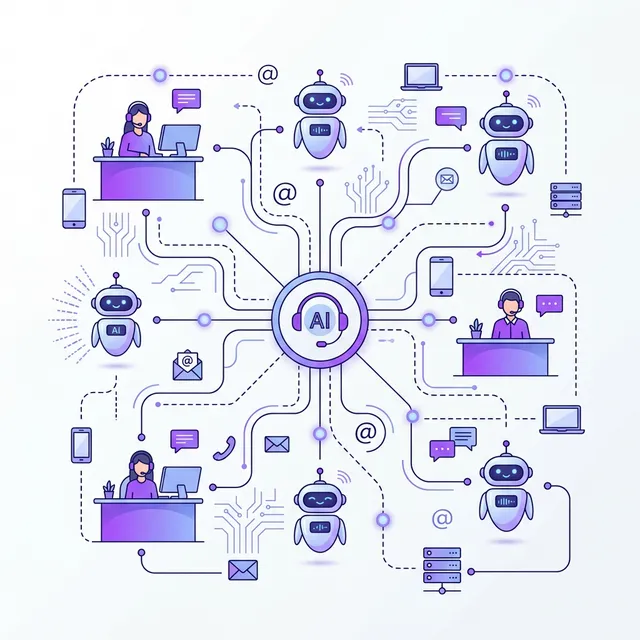
The definitive operational guide for enterprise CX leaders deploying conversational AI at scale.
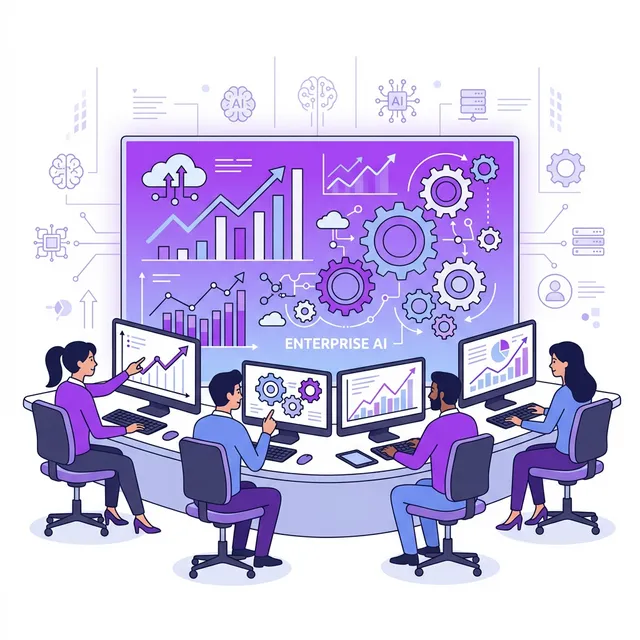
The complete executive guide to deploying AI call automation as a strategic lever for support scalability and cost transformation.