
The Enterprise Executive's Definitive Guide to AI Voice Agents in 2026
Everything C-suite leaders need to know about AI voice agents — from business case to implementation roadmap.
Utkarsh Mohan•Feb 19, 2026
Discover the Ringlyn AI platform — enterprise voice AI architecture, core features, integrations, compliance, and use cases. Full 2026 platform overview.
Utkarsh Mohan
Published: Feb 17, 2026
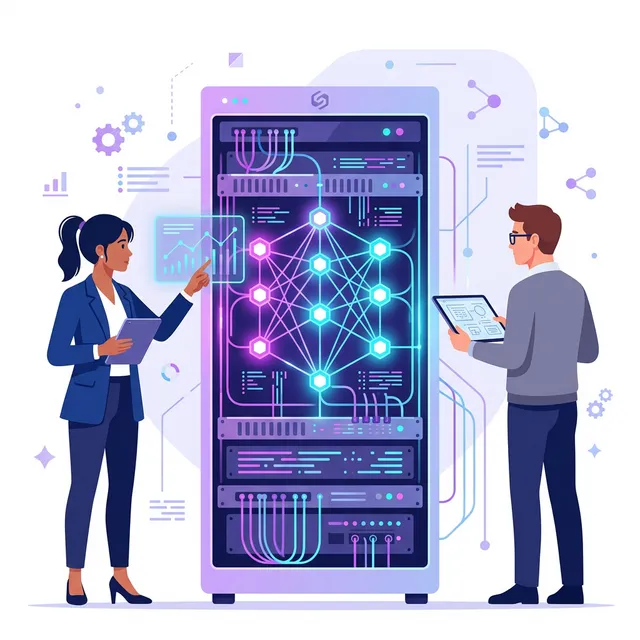
The Ringlyn AI platform is an enterprise-grade AI voice agent infrastructure that handles inbound and outbound phone calls autonomously — booking appointments, qualifying leads, resolving support tickets, and collecting payments at scale. This guide covers everything you need to understand how the Ringlyn AI platform works, what it can do, and whether it is the right fit for your organization.
Ringlyn AI is an AI-powered voice agent platform purpose-built for enterprise and high-growth businesses that need to automate phone-based customer interactions without sacrificing conversation quality. Unlike generic chatbot or IVR solutions, Ringlyn AI deploys fully conversational voice agents — capable of handling complex, multi-turn dialogue, querying live business data, and executing actions inside the systems your team already uses.
The Ringlyn platform serves a broad range of business functions: inbound customer support, outbound sales and lead qualification, appointment scheduling, payment reminders, patient intake, insurance verification, and more. A single Ringlyn AI deployment can manage thousands of concurrent calls with sub-700ms response latency — delivering a caller experience that independent evaluators consistently rate as natural, helpful, and on-brand.
“Ringlyn AI was architected with a single governing principle: enterprise organizations deploying conversational AI at scale should not have to choose between capability and reliability.”
— Ringlyn AI Engineering Team
The Ringlyn AI platform is a three-layer architecture — a conversation intelligence engine, a real-time voice processing layer, and an enterprise integration layer — working together to handle every call from first ring to final outcome. Here is how each layer contributes to the complete voice AI experience.
Every Ringlyn AI conversation is powered by a purpose-built LLM orchestration layer that routes tasks — intent recognition, knowledge retrieval, response generation, action execution — to the most appropriate model for each job. Ringlyn AI supports native integration with OpenAI, Anthropic, and Google model families (including GPT-5, Claude 3.7 Sonnet, and Gemini 3.1 Flash) and uses retrieval-augmented generation (RAG) to surface accurate, contextually relevant answers from your product documentation, CRM records, and knowledge bases in real time. This eliminates the hallucination risks of static LLM knowledge and ensures agents always respond from current, authoritative data.
The Ringlyn AI platform is not a voice-only island. The integration layer connects every agent directly to the systems that contain your business data and process logic — CRMs, helpdesks, calendars, telephony platforms, and custom APIs — so agents can look up records, book appointments, create tickets, and log outcomes without requiring human handoff for routine tasks. This is what separates a true AI voice platform from a sophisticated phone bot.
Also read: Explore All Ringlyn AI Features →
The comparison below evaluates the Ringlyn AI platform against legacy IVR systems and human-only call teams across the dimensions that matter most to operations leaders conducting a voice AI evaluation.
| Capability | Ringlyn AI Platform | Legacy IVR / Basic Bot | Human-Only Team |
|---|---|---|---|
| Concurrent call capacity | Unlimited (elastic scaling) | Limited by trunk/license count | 1 call per agent |
| Conversation quality | Natural, multi-turn dialogue | Rigid menu-driven flows | High quality, but variable |
| 24/7 availability | Always on, zero overtime cost | Always on (no intelligence) | Requires shift staffing |
| Live CRM / data access | Real-time read and write | None | Manual lookup required |
| Cost per call | Fraction of human agent cost | Low, but limited utility | High (salary + overhead) |
| Compliance tooling | Built-in HIPAA, TCPA, GDPR | Basic and manual | Training-dependent |
| Analytics and QA coverage | 100% of calls, automated | None | Sample-based (5–10%) |
| Time to deploy | 2–8 weeks to production | Weeks (limited value ceiling) | Months (hiring + training) |
Callers decide whether they trust a voice agent in the first three seconds, so Ringlyn AI treats conversational latency as a hard engineering constraint rather than a best-effort metric. The gap between a human-feeling exchange and an obviously robotic one is measured in milliseconds. The platform holds a strict end-to-end latency budget — the total time between a caller finishing their sentence and the agent beginning its spoken reply — under 700ms at p50 and under 550ms at p95 on 2026 model routes. Achieving this consistently under production load requires optimizing every stage of the turn: speech capture, endpointing, transcription, reasoning, response generation, and speech synthesis all run in a streaming pipeline where later stages begin before earlier ones fully complete.
The single most important perceptual factor is turn-taking. Humans overlap, interrupt, and backchannel; a rigid system that waits for a fixed silence window before responding feels sluggish and stilted. Ringlyn AI uses a semantic endpointing model that predicts when a caller has actually finished a thought — distinguishing a mid-sentence pause from a completed turn — rather than relying on a naive silence timer. When a caller interrupts the agent mid-sentence (barge-in), the agent stops speaking within roughly 100ms, discards the interrupted response, and re-plans around what the caller just said. This is the behavior that most reliably makes an AI feel present rather than pre-recorded.
Voice output quality is equally deliberate. Ringlyn AI streams neural TTS audio in chunks so the first syllable is audible before the full sentence has finished synthesizing, and it applies prosody modeling so numbers, dates, currency, and proper nouns are pronounced the way a human agent would say them — 'four-oh-five' for a room extension, 'twenty twenty-six' for a year. The table below breaks down where the sub-700ms latency budget is actually spent, which is useful context for any team evaluating voice AI vendors on real performance rather than marketing claims.
| Pipeline Stage | Typical Latency Contribution | How Ringlyn AI Optimizes It |
|---|---|---|
| Audio capture & jitter buffer | 20–40ms | Adaptive jitter buffering tuned per carrier; regional media servers close to the caller |
| Streaming speech recognition (ASR) | 80–150ms | Incremental transcription that emits partial results before the caller stops speaking |
| Semantic endpointing | 50–120ms | Predictive turn-completion model instead of a fixed silence timeout |
| LLM reasoning & response generation | 150–300ms | Routing to the fastest capable model; response streamed token-by-token |
| Neural TTS synthesis (first audio) | 90–180ms | Chunked streaming so the first syllable plays before the sentence finishes |
| Network & media transport | 40–80ms | In-region SIP media handling to minimize round-trip time |
Where the sub-700ms end-to-end latency budget is spent on a typical Ringlyn AI turn (2026 production routes)
One of the most common questions about the Ringlyn AI platform is: what systems does it connect to? The answer covers virtually every enterprise category. The integration layer supports native connectors, REST API actions, and webhook-triggered workflows so that any system your team uses can become part of the agent's capabilities — no custom middleware required for the supported platforms.
| Integration Category | Supported Platforms | What the Agent Can Do |
|---|---|---|
| CRM | Salesforce, HubSpot, Microsoft Dynamics, Zoho | Read and write contact records, log call outcomes, trigger workflow automations |
| Helpdesk | Zendesk, ServiceNow, Freshdesk, Intercom | Open tickets, update case status, retrieve ticket history mid-call |
| Calendar & Scheduling | Google Calendar, Outlook, Calendly, Acuity | Check real-time availability, create and modify appointments, send confirmations |
| Telephony | Twilio, Vonage, Amazon Connect, Genesys | SIP trunking, number management, warm and cold call transfers |
| Data & BI | Snowflake, BigQuery, Databricks, Looker | Real-time data retrieval, post-call analytics export, BI dashboard feeds |
| Custom / Internal Systems | Any REST API or webhook-compatible endpoint | Configurable HTTP actions triggered by conversation events or agent decisions |
Ringlyn AI integration ecosystem — current as of Q2 2026
Also read: Browse Ringlyn AI Use Cases →
Beyond its native connectors, Ringlyn AI is a programmable platform that engineering teams can extend to fit any workflow. The core extensibility primitive is the custom action — a declarative definition that gives the agent a new capability by describing an API the agent can call mid-conversation. When a caller's request maps to an action (check an order status, verify eligibility, reschedule a delivery), the LLM orchestration layer decides in real time to invoke it, passes structured arguments extracted from the conversation, receives the response, and speaks the result back to the caller naturally. Actions are defined once and reused across agents, with input validation, retry policies, and timeout handling configured per action.
Ringlyn AI exposes a full REST API and an event webhook system so the platform slots cleanly into existing engineering practices. Teams can create and update agents programmatically, provision phone numbers, launch and manage outbound campaigns, and pull transcripts, recordings, and structured call outcomes into their own data warehouse. Webhooks fire on lifecycle events — call started, call ended, transfer initiated, action invoked, voicemail detected — enabling real-time downstream automation such as triggering a CRM workflow the moment a qualified lead is captured. Server-side SDKs cover the most common backend languages, and a published OpenAPI specification keeps client generation straightforward for everything else.
For teams building on top of Ringlyn AI, the platform supports environment separation (sandbox and production), versioned agent configurations with rollback, and granular API keys scoped to specific capabilities. Conversation design itself is version-controlled: prompt changes, knowledge base updates, and action definitions are tracked so teams can A/B test agent variants and roll back a regression without redeploying infrastructure. The developer surface is deliberately the same one Ringlyn AI's own solutions engineers use, which means anything achievable in a guided implementation is also achievable through the API.
Regulated industries — healthcare, financial services, insurance, and legal — require a compliance posture that most voice AI platforms cannot credibly deliver. Ringlyn AI's security architecture was built to pass the scrutiny of Fortune 500 legal and security teams, and ships with the certifications that regulated enterprises require before deployment:
A voice agent that drops calls or degrades during a traffic spike is worse than no agent at all, because the failure happens live, in front of a customer. Ringlyn AI's 99.9% uptime SLA is backed by an architecture designed to absorb both routine load variation and unexpected surges without human intervention. The platform runs across multiple availability zones with active-active redundancy, so the loss of any single zone reroutes traffic transparently. Telephony connectivity is multi-homed across carrier partners, which means a problem at one SIP provider fails over to another rather than taking calls offline.
Elastic concurrency is the property that makes Ringlyn AI viable for businesses with spiky call patterns — a product recall, a marketing blast, a seasonal rush, or a viral moment. Capacity scales horizontally with demand, so the difference between handling 5 concurrent calls and 500 is invisible to the caller. Each conversation is isolated, so a slow response from one integration or a difficult call never degrades other in-flight conversations. Where an upstream model provider experiences elevated latency, the orchestration layer reroutes new turns to an alternate model route, trading a marginal quality difference for continued sub-second responsiveness rather than letting the caller wait.
Graceful degradation is engineered explicitly rather than left to chance. If a downstream system a caller needs is unavailable — a CRM, a payment gateway, a scheduling API — the agent does not fail silently or invent an answer; it acknowledges the limitation, captures the caller's intent and callback details, and either escalates to a human or logs a structured follow-up task. Every one of these events is recorded in the tamper-evident audit log and surfaced in analytics, so operations teams see reliability signals in real time rather than discovering them through customer complaints. This combination of redundancy, elastic scale, and deliberate failure handling is what allows Ringlyn AI to carry mission-critical call volume for regulated enterprises.
The Ringlyn AI platform is industry-agnostic at the infrastructure level, but ships with pre-built conversation templates and compliance configurations for the sectors that rely most heavily on phone-based customer communication:
Starter, Growth, Professional, and White-Label tiers — find the plan that fits your call volume and requirements.
Traditional contact centers analyze 5–10% of calls through manual QA sampling. The Ringlyn AI platform transcribes, scores, and classifies 100% of calls automatically — giving operations and strategy teams a complete, structured view of every customer interaction that would otherwise be invisible.
Ringlyn AI is available in three deployment configurations to accommodate organizations at different stages of AI adoption and with varying data sovereignty requirements:
All enterprise customers receive a dedicated implementation team, a named Customer Success Manager, and a structured onboarding program covering integration setup, conversation design, voice persona configuration, and analytics configuration. Most organizations are live in production within 4–8 weeks; simple single-use-case pilots often launch in under 3 weeks.
Enterprise buyers rightly discount vendor promises about ease of deployment, so it is worth being concrete about what the first 30 days on Ringlyn AI actually involve. Onboarding is structured in four phases: discovery and use-case scoping, integration and conversation design, testing and calibration, and a supervised production rollout. A named implementation lead and Customer Success Manager own the timeline, and the goal of the first phase is a precise definition of success — which call types the agent will handle, what actions it will take, what the escalation rules are, and which metrics define go-live readiness.
The build phase connects the agent to your systems and shapes its behavior. Integrations are configured against your CRM, telephony, calendar, and any custom APIs; the knowledge base is populated from your documentation and business rules; and the conversation designer defines the agent's persona, tone, and guardrails. This is where domain nuance is captured — how to handle an ambiguous request, when to offer an alternative, exactly how to phrase a compliance disclosure. Because configuration is largely no-code with API access available where needed, your operations team retains ownership of the agent rather than depending on the vendor for every change after launch.
Before a single real customer reaches the agent, it is tested against recorded and simulated calls, edge cases, and adversarial inputs, then calibrated on quality, accuracy, and escalation behavior. Go-live is typically staged — routing a small percentage of traffic first, or a single call type — so the team can observe real conversations and tune before scaling to full volume. Most single-use-case deployments reach production in two to three weeks; multi-system, multi-language, or heavily regulated deployments run four to eight weeks. The steps below outline the standard path.
The Ringlyn AI platform ships continuous updates across model coverage, compliance certifications, and platform capabilities. The most significant additions delivered in 2026 include:
One part of the platform gets far less attention than the conversational engine and matters enormously to a specific audience: the multi-tenancy and branding layer that lets an agency, MSP, telecom reseller, or vertical software company run Ringlyn as their own product. This is not a logo-upload feature bolted on late. It runs through the architecture, because the operational difference between a tool you use and a product you sell is almost entirely infrastructure.
Retrofitting any of this onto a single-tenant system is close to a rewrite, which is why it is worth knowing it is present before you need it. The commercial framing sits on the white-label voice AI page, and the receptionist-focused packaging for local-business resellers is on the white-label AI receptionist page.
The same platform is available three ways, and the right one depends on two questions rather than on feature preference: who the end customer is, and whether call data is permitted to leave your environment. Everything else follows from those answers.
| Path | Who it fits | Where data lives | What you own | Commercial shape |
|---|---|---|---|---|
| Managed platform | Businesses answering their own phones, at any size | Ringlyn infrastructure | Your configuration and data | Monthly subscription from $49 |
| Self-hosted licence | Regulated teams and high-volume operations | Your cloud account or data centre | The running environment and all data | One-time licence plus annual support |
| Agency source-code licence | Anyone selling voice AI to clients | Wherever you deploy it | The full production codebase | One-time licence, no revenue share |
Three deployment paths for the same platform — the decision is driven by end customer and data residency, not features
The shortest version: if your own organisation is answering its own phones, the managed platform is almost always correct. If a regulator, client, or internal security policy requires that call recordings and transcripts never leave a controlled environment, take the self-hosted licence. If businesses other than yours will pay you for this, you need resale rights and source code, which is the agency licence. The full decision framework, including the payback maths for each, is set out in agency versus self-hosted.
Schedule a technical briefing with our solutions team — we will walk through the architecture, integrations, and compliance documentation relevant to your deployment.
Yes — the multi-tenancy and branding layer is built into the architecture rather than bolted on. Each client account holds its own agents, knowledge base, numbers, call data, transcripts, and search index, isolated at the platform level rather than by an application-layer convention a forgotten filter could bypass. Credentials and integrations are per tenant, so one client can run GoHighLevel and Google Calendar while another runs Salesforce and a bespoke API, and offboarding is a key revocation rather than an untangling exercise. Branding covers the custom domain and certificate, the application, transactional email sent from your own SMTP, and invoices carrying your business name — with no 'powered by' badge and no vendor telemetry. You connect your own Stripe account so payments settle directly to you, and per-tenant rate limiting stops one client's outbound campaign degrading another's inbound answer time.
Two questions decide it: who the end customer is, and whether call data may leave your environment. If your own organisation is answering its own phones and there is no hard residency requirement, the managed platform is almost always correct and starts at $49 per month. If a regulator, client, or internal security policy requires that recordings and transcripts never leave a controlled environment, take the self-hosted licence — one-time cost plus annual support, with the application, database, and storage inside your own cloud account or data centre. If businesses other than yours will pay you for this, you need resale rights and source code, which is the agency licence: a one-time purchase of the full production codebase with unlimited client accounts and no revenue share.
Ringlyn AI is an enterprise AI voice agent platform that automates inbound and outbound phone calls using conversational AI. Unlike basic IVR or chatbot systems, Ringlyn AI conducts fully natural, multi-turn conversations — handling appointment scheduling, lead qualification, customer support, payment collection, and other phone-based workflows autonomously. It integrates with CRMs, helpdesks, calendars, and custom APIs so that agents can take action inside your business systems in real time without human handoff.
The Ringlyn AI platform operates across three layers. The conversation intelligence engine uses multi-model LLM orchestration — supporting OpenAI, Anthropic, and Google model families — with retrieval-augmented generation (RAG) to produce accurate, contextually appropriate responses from live business data. The voice processing layer handles automatic speech recognition (ASR) and neural text-to-speech (TTS), delivering sub-700ms end-to-end latency. The integration layer connects to your enterprise systems — CRM, helpdesk, calendar, telephony — so agents can read data and execute actions mid-call without transferring to a human.
Core Ringlyn AI platform capabilities include: multi-model LLM orchestration with configurable routing policies; neural ASR and TTS with custom voice cloning; retrieval-augmented generation for real-time knowledge access; native integrations with Salesforce, HubSpot, Zendesk, Calendly, Twilio, and more; HIPAA, SOC 2 Type II, ISO 27001:2022, and GDPR compliance; 100% call transcription with automated QA scoring; real-time sentiment analysis and intent classification; and flexible deployment via managed cloud, dedicated cloud, or self-hosted VPC.
Ringlyn AI supports native connectors for leading CRM platforms (Salesforce, HubSpot, Microsoft Dynamics, Zoho), helpdesk tools (Zendesk, ServiceNow, Freshdesk, Intercom), calendar and scheduling systems (Google Calendar, Outlook, Calendly, Acuity), telephony platforms (Twilio, Vonage, Amazon Connect, Genesys), and data/analytics systems (Snowflake, BigQuery, Databricks, Looker). Any system that exposes a REST API or webhook interface can also be connected through configurable HTTP action triggers — no custom middleware required.
Yes. Ringlyn AI is HIPAA compliant and offers Business Associate Agreements (BAAs) for healthcare customers. The platform also holds HITRUST CSF certification (added Q2 2026), SOC 2 Type II attestation, and ISO 27001:2022 certification — making it one of the most comprehensively certified AI voice platforms available to regulated enterprise buyers. Data can be stored in US, EU, or APAC regions to meet residency requirements, and self-hosted VPC deployment is available for organizations requiring complete data sovereignty.
Ringlyn AI is available across four tiers: Starter ($49/month), Growth ($99/month), Professional ($199/month), and White-Label ($2,497/month). Each tier differs in call volume capacity, feature access, integration depth, and support level. Enterprise customers on the White-Label tier receive full platform resale rights, custom branding, and dedicated support. Visit the Ringlyn AI pricing page for a full feature-by-feature comparison.
Ringlyn AI is used across healthcare (patient intake, appointment reminders, insurance verification), financial services and insurance (lead qualification, payment collections, policy renewals), real estate (buyer qualification, showing scheduling, follow-up nurture), SaaS and technology (trial conversion, renewal outreach, churn prevention), e-commerce (order status updates, return handling), legal and professional services (client intake, document collection), and staffing and recruiting (candidate screening, interview scheduling). Built-in HIPAA, TCPA, and GDPR tooling makes the platform deployable in regulated sectors where most voice AI solutions cannot operate.
Traditional IVR systems route callers through rigid menu trees and cannot understand natural speech — callers must press buttons or say exact phrases to navigate. Ringlyn AI conducts genuine multi-turn conversations in natural language, understands intent regardless of how it is phrased, retrieves live data from connected systems, and takes action mid-call (booking, ticket creation, payment processing) without transferring to a human. IVR systems also provide zero post-call analytics; Ringlyn AI transcribes, scores, and classifies 100% of calls automatically.
Most enterprise deployments complete in 4–8 weeks from contract signature to production launch. A single-use-case pilot with standard CRM integration typically goes live in 2–3 weeks. Multi-system integrations, custom voice persona creation, and complex workflow configurations add time, but are fully supported by Ringlyn AI's dedicated implementation team. All enterprise customers receive structured onboarding, integration support, and conversation design guidance throughout the process.
Ringlyn AI maintains an end-to-end response latency under 700ms at p50 and under 550ms at p95 on 2026 model routes — the time between a caller finishing their sentence and the agent beginning to speak. It achieves this through a streaming pipeline where transcription, reasoning, and neural text-to-speech overlap rather than run sequentially. A semantic endpointing model predicts when a caller has actually finished speaking instead of waiting on a fixed silence timer, and barge-in handling lets the agent stop within roughly 100ms when interrupted. Neural TTS is streamed in chunks with prosody modeling so numbers, dates, and proper nouns are pronounced naturally, producing a conversation that independent evaluators consistently rate as human-like.
Yes. Ringlyn AI is a fully programmable platform with a REST API, server-side SDKs, an OpenAPI specification, and an event webhook system. Developers can create and manage agents, provision phone numbers, run outbound campaigns, and export transcripts, recordings, and structured call outcomes to their own data warehouse. The core extensibility primitive is the custom action — a declarative API definition the agent can invoke mid-conversation to look up or write data — and webhooks fire on lifecycle events (call started, call ended, transfer, action invoked, voicemail detected) for real-time downstream automation. Sandbox and production environments, versioned agent configurations with rollback, and scoped API keys support safe, team-based development.
Ringlyn AI backs its 99.9% uptime SLA with active-active redundancy across multiple availability zones, multi-homed telephony connectivity that fails over between carriers, and elastic concurrency that scales horizontally so handling 500 concurrent calls is as seamless as handling 5. Each conversation is isolated, so a slow integration or a difficult call never degrades other in-flight conversations, and the orchestration layer reroutes to an alternate model route if an upstream provider's latency spikes. When a downstream system is unavailable, the agent degrades gracefully — acknowledging the limitation, capturing caller intent, and escalating or logging a follow-up rather than failing silently — with every event recorded in a tamper-evident audit log.
Everything C-suite leaders need to know about AI voice agents — from business case to implementation roadmap.
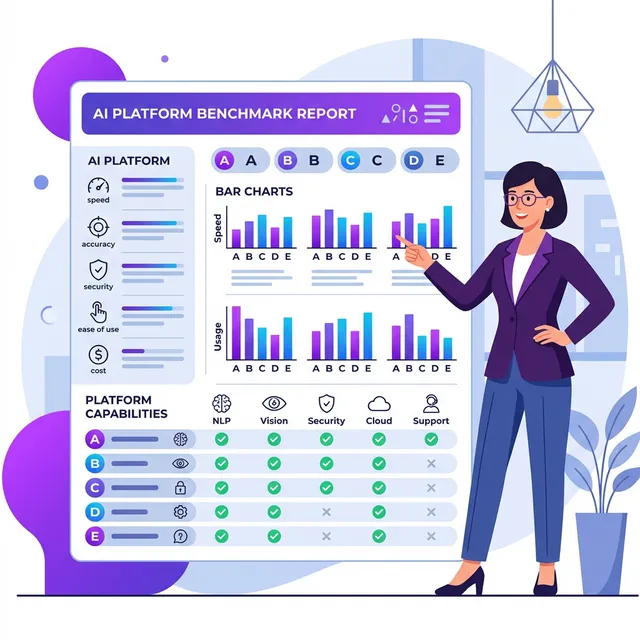
A head-to-head analysis of ten leading voice AI platforms evaluated against enterprise deployment criteria.
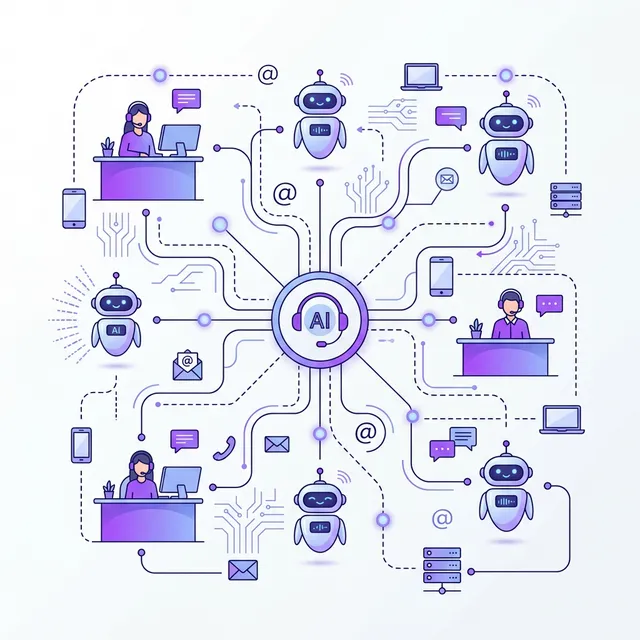
How leading enterprises are restructuring customer service around conversational AI.