For the better part of two decades, the dominant assumption governing enterprise customer service strategy was simple: human agents are inherently preferable to automated systems. Automation was a cost-cutting measure — necessary, perhaps, but always positioned as an inferior substitute for genuine human interaction. The customer experience literature reinforced this relentlessly. Press '0' for a representative. Because talking to a real person was always better.
That assumption is now empirically wrong. And for enterprises that have built their CX infrastructure around it, the reckoning is accelerating.
A convergence of three forces — generational expectation shifts, AI capability maturation, and compounding frustration with legacy human-staffed call centers — has produced what analysts are calling the "Customer Preference Inversion." Enterprise buyers, B2B customers, and high-value consumers are no longer settling for AI as a fallback. They are requesting it. In some segments, they are refusing to engage with brands that cannot deliver it.
This article examines the structural forces driving this inversion, the enterprise data underpinning it, and the strategic imperatives it creates for large organizations and the investors evaluating them.
See how Ringlyn AI delivers the AI-first service experience your enterprise customers now demand
Schedule a live platform demonstration with our enterprise solutions team
The Customer Preference Inversion Explained
The Preference Inversion is not a marginal trend confined to tech-savvy millennials. It is a broad, measurable, cross-demographic shift in how customers evaluate service quality — and it is reshaping what enterprise CX excellence looks like.
The core dynamic is this: for the majority of service interactions, customers now associate AI-delivered service with higher quality — not lower. Speed is the primary driver. Consistency is the second. Privacy (particularly in financial and healthcare contexts) is the third and fastest-growing.
When PwC surveyed 15,000 consumers across 12 markets in their 2025 Global Consumer Insights report, 58% said that when they contact a company for a routine service issue, they would prefer to resolve it through an intelligent automated system than wait for a human agent. Among 25-to-44-year-olds — the cohort now making the majority of B2B purchasing decisions — that figure reached 71%.
“The question is no longer whether customers will accept AI in the service channel. The question is whether they will accept a brand that doesn't offer it.”
— Gartner CX Research Division, 2025 Annual Report
This matters enormously for enterprise strategy. Customer service has historically been a cost center optimized for volume throughput and CSAT scores. The Preference Inversion reframes it as a competitive differentiator — one where AI-first organizations gain measurable loyalty and revenue advantages over those still running predominantly human agent models.
The Psychology Behind Choosing AI
Understanding why customers prefer AI for a growing range of interactions requires moving beyond surface-level convenience arguments. The psychological drivers are more nuanced — and more durable — than simple impatience.
1. Consistency Reduces Cognitive Load
Every interaction with a human agent carries implicit uncertainty. Will this agent be knowledgeable? Will they be having a bad day? Will they apply the same policy interpretation as the last agent I spoke to? This uncertainty creates cognitive load that customers experience as friction, even when the agent is competent and helpful. AI agents eliminate this variability. Every interaction follows the same knowledge base, the same policy logic, and the same quality standard. For enterprise customers managing complex, multi-touchpoint service relationships, this consistency is not merely convenient — it is strategically valuable.
2. Immediacy Meets Rising Expectations
The experience of instant digital gratification — same-day delivery, real-time data, on-demand content — has permanently recalibrated customer expectations around response time. A 2025 Zendesk Customer Experience Trends report found that 73% of enterprise customers now consider a wait time of more than two minutes for service contact to be unacceptable. AI voice agents answer in under two seconds, at any hour, without queues. This is not a marginal improvement — it is a categorical shift in service availability that human staffing models cannot replicate without prohibitive cost.
3. Privacy and Judgment-Free Interaction
This is the most underappreciated driver of AI preference, particularly in regulated industries. A significant proportion of customers — especially in healthcare, financial services, and legal contexts — find it easier to discuss sensitive issues with an AI than with a human agent. The absence of social judgment, the perception of guaranteed confidentiality, and reduced embarrassment enable more candid conversations. Healthcare providers implementing AI voice agents for patient intake and follow-up have consistently reported higher rates of disclosure around sensitive symptoms and medication non-adherence than equivalent human-staffed processes.
4. Perceived Competence of Specialized AI
Modern AI voice agents trained on deep, domain-specific knowledge bases routinely outperform generalist human agents on technical accuracy. When a customer calls a telecom provider about a network configuration issue, or a bank about a complex product query, an AI agent with access to the complete product knowledge base and real-time account data will deliver a more accurate, more complete answer than a human agent reading from the same documentation. Customers recognize this — and they value expertise over the social comfort of human connection for technical interactions.
What the Enterprise Data Actually Shows
The preference shift is not anecdotal. Enterprise deployments of AI voice agents are generating performance data that creates a compelling, measurable case. The following metrics represent aggregated benchmarks from large-scale enterprise implementations across financial services, healthcare, telecommunications, and professional services sectors.
| Performance Metric | Human Agent Benchmark | AI Voice Agent Performance | Improvement |
|---|
| Average Handle Time (AHT) | 6.8 minutes | 3.2 minutes | −53% |
| First Contact Resolution (FCR) | 71% | 88% | +17 points |
| Customer Satisfaction (CSAT) | 3.9 / 5.0 | 4.3 / 5.0 | +10% |
| Average Wait Time | 4.2 minutes | <3 seconds | −99% |
| Cost Per Interaction | $8.50 – $12.00 | $0.85 – $1.80 | −85% |
| After-Hours Coverage | Limited / costly | 100% / 24-7 | Full coverage |
| Escalation Rate | N/A (baseline) | 12% require human | 88% fully resolved |
| Agent Consistency Score | 67% | 99.4% | +32 points |
Enterprise AI Voice Agent Performance Benchmarks — Ringlyn AI Customer Aggregated Data, 2025–2026
The data challenges a foundational assumption: that AI-assisted service is a quality compromise. Across every objective metric, enterprise AI voice agent deployments are outperforming legacy human-staffed models — not in spite of removing human agents from the interaction, but in many cases because of it.
The Six Domains Where AI Outperforms Human Agents
Not all service interactions are created equal. The performance advantages of AI voice agents are most pronounced in specific interaction categories that, collectively, represent the majority of enterprise contact center volume.
- Routine Inquiry Resolution: Account status, policy questions, order tracking, and FAQ-category queries. AI agents resolve these interactions faster, more consistently, and at a fraction of the cost, with no knowledge gaps or policy interpretation errors.
- Appointment Scheduling and Calendar Management: AI voice agents can access real-time calendar systems, apply complex scheduling logic, handle multi-party coordination, and confirm bookings with follow-up communication — all within a single call interaction that takes under 90 seconds.
- Lead Qualification at Scale: Outbound AI agents can execute structured qualification frameworks across thousands of prospects simultaneously, scoring and prioritizing leads against predefined criteria with perfect consistency — without the fatigue, inconsistency, or morale issues that afflict human SDR teams doing repetitive qualification calls.
- Proactive Customer Outreach: Payment reminders, renewal notifications, satisfaction surveys, and compliance communications — AI agents execute these at enterprise scale with personalized, contextually aware conversations that outperform mass SMS or email campaigns on engagement and response rates.
- Post-Interaction Follow-Up: AI agents can initiate structured follow-up calls after key customer events, delivering a quality of proactive engagement that most enterprises simply cannot resource with human agents at the requisite scale.
- Overflow and After-Hours Management: The economic case for 24/7 human staffing is negative for all but the highest-margin enterprises. AI agents provide full-quality service coverage at all hours, capturing revenue and resolving issues that would otherwise generate churn.
The Winning Architecture: Strategic Human-AI Deployment
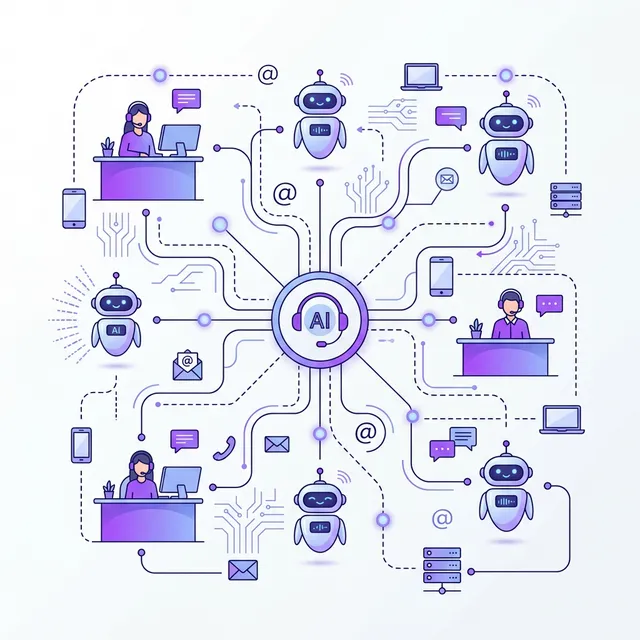
The highest-performing enterprise CX organizations in 2026 are not choosing between human agents and AI. They are deploying a tiered architecture that routes interactions to the most appropriate resource based on complexity, emotional context, and strategic value.
The architecture follows a logical hierarchy: AI handles the high-volume, lower-complexity tier (typically 70–85% of all interactions), freeing human specialists to focus exclusively on high-stakes situations — complex dispute resolution, major account escalations, strategic enterprise relationships — where human judgment, empathy, and authority genuinely add value.
| Interaction Type | Optimal Handler | Rationale |
|---|
| Routine account inquiries | AI Voice Agent | High volume, structured, no judgment required |
| Appointment scheduling | AI Voice Agent | Fully systematizable, speed advantage critical |
| Lead qualification (outbound) | AI Voice Agent | Volume and consistency requirements favor AI |
| Payment reminders / collections | AI Voice Agent | Consistent policy application reduces risk |
| After-hours support | AI Voice Agent | 24/7 coverage economically viable only with AI |
| Complex complaint resolution | Human Specialist | Emotional intelligence and authority required |
| Major account management | Human Specialist | Relationship depth and strategic judgment needed |
| Regulatory / compliance situations | Human Specialist | Legal exposure requires human accountability |
This architecture produces a powerful secondary benefit: by eliminating routine work from human agents' queues, organizations dramatically improve human agent job satisfaction, retention, and performance on the high-value interactions that remain. The best enterprises are not deploying AI to downsize their service organization — they are deploying it to upgrade it.
The Investment Case for AI-First Customer Service
For investors and enterprise leaders evaluating the financial logic of AI-first service transformation, the return profile is unusually strong and unusually fast. Unlike most enterprise technology transformations, AI voice agent deployments typically reach positive ROI within 60 to 90 days of full deployment — driven by three concurrent financial effects.
- Direct Cost Reduction: Enterprises report 75–90% reductions in per-interaction cost when shifting volume to AI agents. For a contact center handling 50,000 interactions per month at an average human-agent cost of $9.00 per interaction, shifting 75% of volume to AI at $1.20 per interaction generates $292,500 in monthly savings — $3.5M annually.
- Revenue Recovery from Service Failures: The leading cause of customer churn in enterprise B2B and high-value B2C contexts is not price — it is unresolved service friction. AI agents, with their 88% first-contact resolution rates and zero wait times, materially reduce churn rates. A 1-percentage-point improvement in retention across a customer base with $100M in recurring revenue is worth $1M annually.
- Revenue Generation from Outbound Capacity: AI voice agents unlock outbound call capacity that was previously economically infeasible. Proactive outreach programs — re-engagement campaigns, upsell/cross-sell initiatives, renewal acceleration — generate measurable incremental revenue that directly offsets and typically exceeds implementation costs.
“Enterprises that have completed full AI voice agent deployments report an average 340% return on investment over 18 months, with the investment typically recovering within the first fiscal quarter post-deployment.”
— McKinsey Digital, 2025 AI in Customer Service Survey
Enterprise Implementation Roadmap
The path from legacy call center to AI-first service architecture follows a proven sequence that leading Ringlyn AI enterprise customers have executed in as little as 6 to 12 weeks.
- Phase 1 — Interaction Audit (Weeks 1–2): Map and categorize all interaction types by volume, complexity, and human-value-add. Identify the AI-addressable tier — typically 65–80% of total volume.
- Phase 2 — Agent Architecture Design (Weeks 2–4): Design conversation flows, escalation logic, and integration architecture with existing CRM, ERP, and telephony systems. Define success KPIs and measurement frameworks.
- Phase 3 — Controlled Deployment (Weeks 4–8): Deploy AI agents to a defined interaction subset with parallel human oversight. Collect performance data, tune conversation logic, and validate KPIs against targets.
- Phase 4 — Scaled Rollout (Weeks 8–12): Expand AI agent deployment to full target interaction volume. Redefine human agent roles around the high-value interaction tier. Establish continuous performance monitoring and optimization cadence.
- Phase 5 — Continuous Optimization (Ongoing): Leverage call analytics, sentiment analysis, and conversion data to continuously improve conversation quality, resolution rates, and customer satisfaction scores.
The Competitive Risk of Waiting
The most significant strategic risk in this market is not moving too fast on AI adoption — it is moving too slowly. The Preference Inversion is not a future trend that enterprises have time to monitor from a distance. It is a present competitive dynamic that is already influencing purchasing decisions, loyalty scores, and customer lifetime value calculations.
Enterprises that deploy AI-first service architectures in 2026 will enter a compounding advantage cycle: lower per-interaction costs fund further AI capability investment, which drives higher satisfaction scores, which reduces churn and improves retention economics, which funds continued investment. Enterprises that delay will find themselves attempting to close this gap against competitors who have 18 to 24 months of operational learning and customer trust built into their AI systems.
The customer preference data is clear. The financial case is compelling. The technology is enterprise-ready. The decision is now a strategic one, not a technical one.
Position your enterprise at the forefront of the AI-first service revolution
Ringlyn AI's enterprise platform is purpose-built for large-scale, secure, compliant AI voice agent deployment