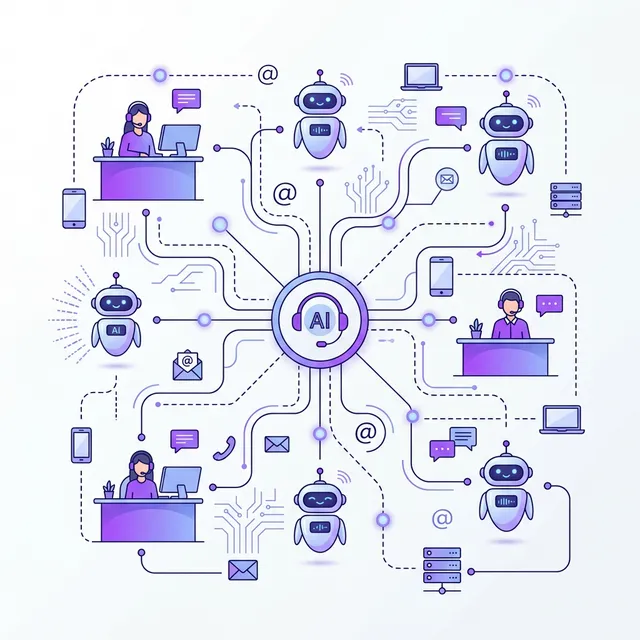
In 2026, AI voice agents have crossed a critical threshold — they are no longer a technology experiment confined to innovation labs. They are production-grade infrastructure being deployed by Fortune 500 companies, global financial institutions, and large healthcare networks to handle millions of customer interactions monthly. The question facing enterprise leaders is no longer whether to adopt AI voice agents, but how quickly they can do so without ceding ground to faster-moving competitors.
Deloitte's 2026 Global AI Predictions report found that 25% of enterprises already using generative AI have deployed AI agents, with that figure projected to double by the end of 2027. At the same time, Gartner estimates that by 2027, conversational AI will handle more than 50% of enterprise contact center volume — a projection that was considered ambitious just 24 months ago. The inflection point has arrived.
The Strategic Context: Why Voice AI Is Now Board-Level
Enterprise customer experience has entered a new competitive era. Consumer expectations — shaped by Amazon, Apple, and a generation of digital-native brands — now demand instant, intelligent, and personalized responses regardless of the channel or hour. Traditional contact center models, burdened by high labor costs, geographic constraints, and inconsistent quality, are structurally incapable of meeting these expectations at scale.
AI voice agents resolve this structural tension. They deliver consistent, brand-aligned, 24/7 communication at a marginal cost per call that is 60–80% lower than equivalent human agent operations. For enterprises processing tens of thousands of calls monthly, this is not an incremental improvement — it is a fundamental restructuring of the cost and quality curve of customer communication.
“Organizations that deploy conversational AI across their customer engagement stack are projected to outperform sector peers on customer satisfaction scores by 25% by 2027.”
— Gartner Customer Experience Research, 2025
What AI Voice Agents Actually Are (and Are Not)
The term 'AI voice agent' is frequently misunderstood — both overstated by vendors and underestimated by skeptics. At its core, a modern AI voice agent is an autonomous software system that can conduct full telephone conversations with humans, processing spoken language in real time, generating contextually relevant responses, taking defined actions (such as updating CRM records, booking appointments, or routing calls), and completing end-to-end customer journeys without human intervention.
Unlike the Interactive Voice Response (IVR) systems of the previous decade — which operated on rigid menu trees and keyword matching — today's AI voice agents are powered by large language models (LLMs), neural text-to-speech with sub-100ms latency, voice activity detection (VAD), and real-time data integrations. They do not follow a script. They reason, adapt, and resolve within the boundaries you define.
- Inbound call handling: Customer service, complaint resolution, account management, technical support triage
- Outbound engagement: Lead qualification, appointment scheduling, collections, proactive customer outreach
- Omnichannel continuity: Seamless handoff and context-sharing between voice, SMS, and chat channels
- Post-call intelligence: Automated call summaries, sentiment analysis, CRM updates, and compliance logging
- Overflow and after-hours coverage: Zero dropped calls regardless of volume spikes or time zones
See how Ringlyn AI handles enterprise call volume at scale
Request a live platform demonstration for your team
Debunking the Three Myths Stalling Enterprise Adoption
Myth 1: AI Voice Agents Are Designed to Eliminate Your Workforce
The most persistent misconception about enterprise voice AI is that its purpose is wholesale headcount elimination. This framing misrepresents both the technology's design philosophy and the most successful deployment models. AI voice agents are optimally positioned as workforce multipliers — they absorb the high-volume, low-complexity interactions that consume 60–70% of agent time, freeing skilled human representatives to focus on escalated, revenue-critical, and relationship-sensitive interactions.
A McKinsey analysis of enterprise contact center AI deployments found that the most effective implementations reduced agent headcount by 40–50% while simultaneously handling 20–30% more total call volume. The net effect is not replacement but reallocation — your best agents spend more time on the conversations that drive revenue and customer lifetime value, while AI handles the transactional volume that previously eroded their capacity and morale.
Myth 2: AI Voice Agents Operate in a Legal and Ethical Gray Zone
Concerns about AI-generated voice and automated outreach are legitimate and deserve serious treatment — which is precisely why the leading enterprise platforms have built regulatory compliance into their core architecture. AI voice agents are fully legal when deployed with appropriate disclosure practices, consent mechanisms, and in alignment with applicable regulations including TCPA (United States), GDPR (European Union), and sector-specific frameworks in healthcare (HIPAA) and financial services (FINRA/FCA).
Enterprise-grade platforms like Ringlyn AI provide built-in compliance tooling, call recording disclosure automation, opt-out management, and audit trail generation — giving legal and compliance teams the documentation infrastructure they require before deployment.
Myth 3: AI Voice Agents Only Handle Simple, Scripted Interactions
This perception reflects the state of the technology circa 2022, not 2026. Modern AI voice agents powered by frontier LLMs and sophisticated orchestration layers are capable of multi-turn reasoning, context retention across a full conversation, real-time data lookups, dynamic objection handling, complex scheduling logic, and conditional workflow execution. They are being deployed today for enterprise use cases including debt collection, insurance claims intake, healthcare patient follow-up, and B2B sales qualification — tasks that demand genuine reasoning capability, not script traversal.
The Business Case: ROI, Cost Structure & Competitive Leverage
For enterprise finance and strategy teams evaluating AI voice agent investment, the economic case is compelling across multiple dimensions. The following analysis assumes a mid-sized enterprise contact center processing 50,000 calls per month.
| Cost Category | Traditional Call Center (Human Agents) | AI Voice Agent Infrastructure |
|---|
| Cost per call (fully loaded) | $6–$12 | $0.08–$0.20 |
| Monthly operational cost (50K calls) | $300,000–$600,000 | $4,000–$10,000 |
| After-hours coverage | Overtime premium / outsourcing | Included, no additional cost |
| Scale-up speed (2× volume) | 6–12 weeks recruitment & training | Minutes (platform configuration) |
| Call quality consistency | Variable (fatigue, agent variance) | Uniform across all interactions |
| Regulatory compliance documentation | Manual, error-prone | Automated, audit-ready |
| CRM data accuracy post-call | 60–70% (manual entry errors) | 99%+ (automated, structured capture) |
Cost comparison based on industry benchmarks and Ringlyn AI customer deployment data
Beyond direct cost reduction, enterprise adopters consistently report three secondary business impacts that amplify the ROI case: (1) revenue recovery from previously missed after-hours leads and overflow calls, (2) accelerated sales cycles due to 24/7 lead qualification and immediate follow-up, and (3) improved customer satisfaction scores driven by consistent service quality and zero wait times.
Legacy Infrastructure vs. Modern Conversational AI
| Capability | Ringlyn AI Voice Agents | Legacy IVR / Traditional Systems |
|---|
| Conversation model | Free-form natural language, LLM-powered reasoning | Menu-driven, touch-tone navigation |
| Caller experience | Conversational, empathetic, resolution-oriented | Frustrating, high abandonment rates |
| Real-time data access | Webhook-driven, sub-second data retrieval | Polling-based, significant data lag |
| Post-call processing | Automated summaries, structured CRM updates | Manual agent notes, inconsistent |
| Voice quality | Neural voice cloning, human-indistinguishable | Robotic, low-fidelity TTS |
| Scalability | Elastic, unlimited concurrent calls | Hardware-constrained, linear cost scaling |
| Analytics depth | Sentiment, intent classification, conversion tracking, full transcript analysis | Call volume, hold time, transfer rate |
| Implementation timeline | 1 hour Max | 6–18 months (hardware + programming) |
What Enterprise-Grade AI Voice Agents Must Deliver
Not all AI voice agent platforms are equivalent. Enterprise deployments have requirements that consumer-grade or developer-focused tools cannot reliably meet. When evaluating platforms for large-scale deployment, technology and procurement leaders should assess the following critical capabilities:
1. Sub-800ms End-to-End Latency
Conversation latency is the single most important determinant of perceived naturalness. Research consistently shows that response delays exceeding 800ms cause callers to perceive the interaction as robotic. Enterprise-grade platforms must achieve consistent sub-800ms latency across the full pipeline — speech recognition, LLM inference, and speech synthesis — including during peak load conditions.
2. Enterprise Security & Compliance Architecture
Large organizations operating in regulated industries require SOC 2 Type II certification, HIPAA Business Associate Agreement availability, GDPR-compliant data residency options, end-to-end call encryption, and role-based access controls. These are non-negotiable requirements for procurement approval in financial services, healthcare, insurance, and government-adjacent sectors.
3. Native CRM and Workflow Integration
AI voice agents that operate in isolation from your existing systems of record deliver a fraction of their potential value. Enterprise platforms must provide pre-built integrations with Salesforce, HubSpot, Microsoft Dynamics, ServiceNow, and the ability to connect to proprietary systems via REST API and webhooks. Agents should be able to read, write, and trigger workflows in these systems in real time during active calls.
4. Intelligent Escalation and Human Handoff
No AI agent should operate without a clearly defined escalation path. Enterprise deployments require context-preserving live transfer to human agents, with full call transcript, sentiment summary, and identified caller intent passed to the receiving representative. This ensures that escalated calls are handled efficiently and that customers never have to repeat themselves — a key driver of customer satisfaction in hybrid AI-human service models.
5. Configurable LLM Engine and Prompt Control
Enterprise use cases are diverse and specialized. A platform that locks customers into a single LLM provider or prohibits custom system prompt configuration cannot adapt to the specific knowledge domains, compliance requirements, and conversation objectives of large organizations. Leading platforms support multi-LLM routing, custom model fine-tuning, and granular prompt configuration that allows enterprise teams to define exactly how their AI agents reason, respond, and escalate.
Enterprise-ready AI voice agents, deployed at your scale
Ringlyn AI supports Fortune 500 deployments with dedicated onboarding and SLA guarantees
A Phased Implementation Roadmap for Large Organizations
Successful enterprise AI voice agent programs follow a structured rollout methodology that manages risk while accelerating time to value. The following phased approach reflects patterns observed across Ringlyn AI's enterprise customer base:
- Phase 1 — Pilot (Weeks 1–4): Select one high-volume, well-defined use case (e.g., appointment reminders, inbound FAQ handling). Deploy in a single business unit. Establish baseline KPIs: call completion rate, customer satisfaction, cost per resolved interaction.
- Phase 2 — Validate (Weeks 5–8): Analyze pilot data. Optimize conversation flows based on transcript review and sentiment analysis. Confirm ROI against baseline. Secure internal stakeholder buy-in using pilot performance data.
- Phase 3 — Expand (Weeks 9–16): Extend to additional use cases and business units. Deepen CRM integrations. Build out escalation workflows. Train human agents on working alongside AI effectively.
- Phase 4 — Scale (Month 5+): Full production deployment across the enterprise. Implement continuous optimization cycles. Use analytics to identify new automation opportunities. Establish a Center of Excellence for ongoing AI voice program governance.
From Pilot to Platform: Making the Transition
The organizations that derive the greatest competitive advantage from AI voice agents are those that treat the technology as a strategic platform, not a point solution. This means investing in the governance structures, data quality foundations, and cross-functional alignment needed to continuously expand and optimize AI-driven communication across the enterprise.
Ringlyn AI is purpose-built for this trajectory — from a single-use-case pilot to an enterprise-wide conversational AI infrastructure layer. Our platform supports unlimited agent configurations, multi-channel deployment, real-time analytics, and dedicated enterprise support, giving your organization the foundation to lead rather than follow in the AI-driven customer experience era.
Build the conversational AI infrastructure your enterprise needs
Join the forward-thinking organizations already deploying Ringlyn AI at scale