
AI Voice Agent for Dental Offices: Patient Calls, Scheduling, and Insurance Verification
The same front-desk overload in a dental practice, with recall campaigns and insurance verification in place of plans of care.
Utkarsh Mohan•Mar 31, 2026
How an AI receptionist works in a chiropractic office or physical therapy clinic — the calls it answers, the new-patient intake script that books the first visit, why plan-of-care rebooking is worth more than answering the phone, how it compares with a chiropractic answering service, and what it must never handle.
Utkarsh Mohan
Published: Sep 21, 2026
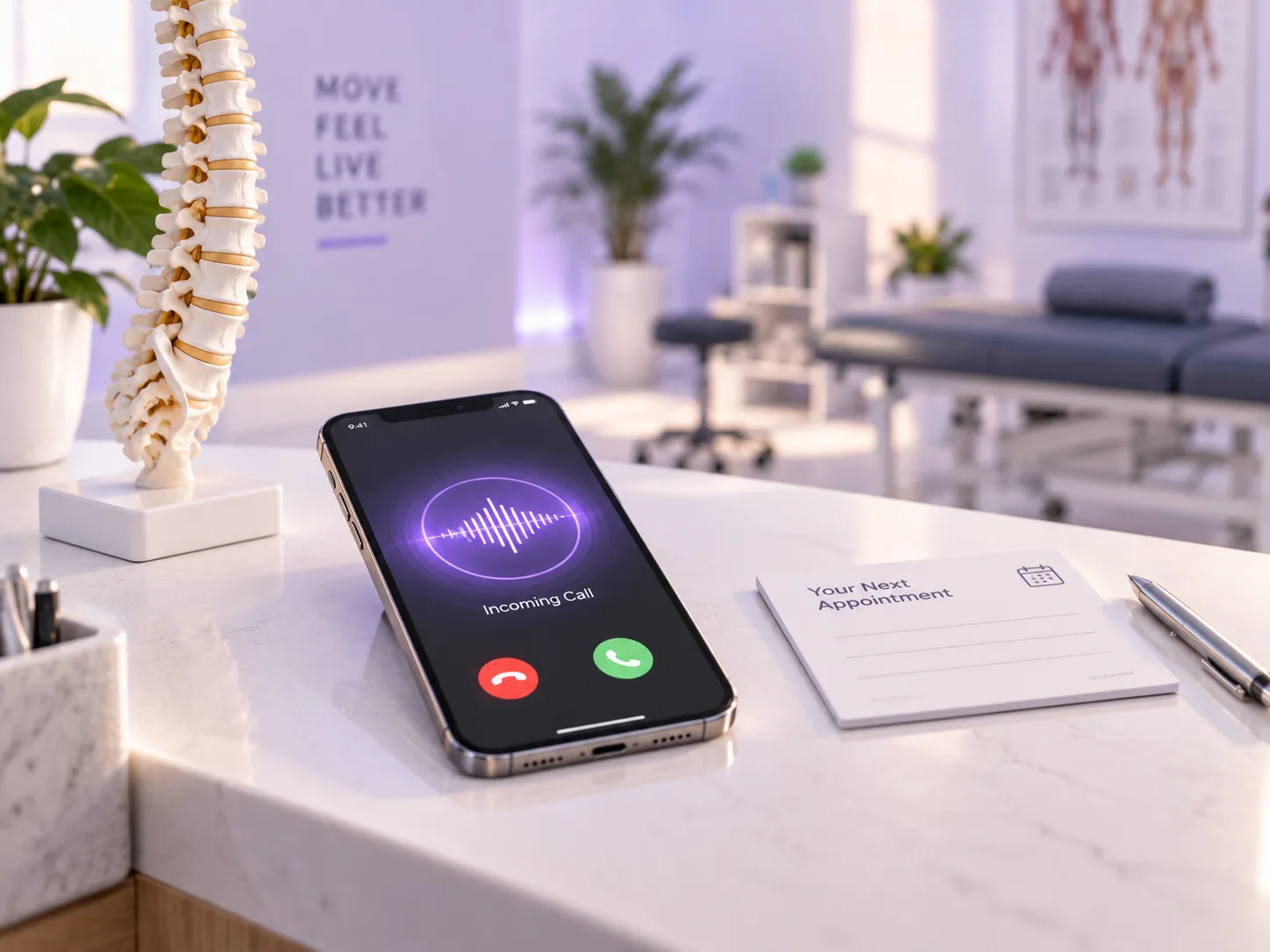
Every chiropractic office and outpatient physical therapy clinic has the same scene at 4:45pm. One person at the front desk is checking out a patient, taking a copay, and printing a home-exercise sheet, while the phone rings for the third time in two minutes. The call that rings out is, more often than not, a new patient who found you on Google and is now calling the next clinic on the list.
An AI receptionist for chiropractors and physical therapy clinics fixes that call, but that is the smaller half of the value. The bigger half is the calls nobody at the front desk ever has time to make: rebooking the patient who left without scheduling visit four, confirming tomorrow's 7am slots, and reaching the patients who quietly dropped off their plan of care two weeks ago. This guide covers both halves, and it is honest about the calls a clinic should never hand to software. If you want the broader comparison of the categories first, the AI receptionist vs answering service guide covers it; the AI answering service page covers the product.
Rehab clinics have an unusual phone pattern. Patients come back two or three times a week for six to twelve weeks, so a single practitioner's caseload generates far more scheduling traffic than a GP or dental practice of the same size. Every visit is a check-in, a check-out, a rebook, and often a reschedule. The front desk is doing transactional work continuously, and the phone competes with the patient standing in front of them — who always wins.
The result is predictable. Calls cluster at opening, at lunch, and between 4pm and 6pm, which are also the hours the desk is busiest in person. Those are exactly the windows where new-patient calls go to voicemail. And new patients rarely leave a voicemail for a clinic they have never visited; they call the next result.
| When the call comes in | What usually happens today | What an AI receptionist changes |
|---|---|---|
| 7:00–8:30am, first patients arriving | Phone rings while the desk checks people in | Answered on the first ring, booked straight into the schedule |
| 12:00–1:30pm, desk on lunch | Voicemail or an auto-attendant | New patient booked, existing patient rescheduled |
| 4:00–6:00pm, check-out rush | Calls ring out; rebooks get skipped | Every call answered; missed rebooks called back the same evening |
| Evenings and weekends | Voicemail, returned the next morning | Booked in real time against open slots |
| Practitioner in a treatment room | Solo practices miss the call entirely | Handled without interrupting the treatment |
Where a chiropractic or PT clinic's phone coverage breaks down
Most clinic calls are structured and repetitive, which is exactly what a voice agent does well. A realistic split for a chiropractic office or PT clinic looks like this:
| Call type | Can the AI handle it end to end? | What it does |
|---|---|---|
| New-patient booking | Yes | Captures complaint, referral source, and insurance; books the initial evaluation |
| Existing-patient reschedule or cancel | Yes | Moves the visit against real availability; offers the waitlist slot to someone else |
| Hours, location, parking, what to wear | Yes | Answers from the clinic's own information |
| Does my insurance cover this? | Partly | Captures carrier and member ID; says what the clinic accepts; never quotes a benefit |
| Cash-pay and package pricing | Yes | Quotes the clinic's published self-pay rates and packages |
| Billing questions on a statement | Partly | Takes the details and routes to billing; does not negotiate balances |
| Pain got worse after treatment | No | Routes to a clinician, or to emergency guidance for red-flag symptoms |
| Referral from a physician's office | Yes | Takes the referral details and books the patient, or schedules a callback |
Typical chiropractic and physical therapy call types, and where the AI stops
A virtual receptionist for a chiropractic office that handles the first three rows alone usually removes the majority of inbound call volume from the desk. The remaining calls are the ones that genuinely benefit from a person, and they now reach a person who is not also juggling three others.
Here is the part most vendors do not talk about, because it is not about answering the phone. A physical therapy episode is a plan of care — say, two visits a week for six weeks. The evaluation happens, the patient feels a bit better after visit three, and somewhere between visit three and visit five a meaningful share of patients simply stop coming. Nobody decided they were discharged. They left without booking the next visit, or cancelled one and never rescheduled.
Clinically, that is a patient who did not finish their rehab. Financially, it is the most important number in the clinic, because the visits that disappear are the ones after the costly evaluation — the ones that make the episode profitable. Chiropractic care plans have the same shape, with the same drop-off after the patient first feels relief.
“The front desk rarely loses a plan of care by saying the wrong thing. It loses it by not making a call — the rebook nobody had time for, the cancellation nobody followed up. Those are outbound calls, and they are the ones an AI receptionist is best at.”
So when you evaluate an AI receptionist for a physical therapy clinic, the question is not only whether it answers inbound calls well. It is whether it can run three outbound jobs every day without anyone remembering to start them: rebook every patient who left without a next appointment, follow up every cancellation within hours, and work the list of patients whose plan of care has gone quiet.
A new-patient call is the highest-value call the clinic receives, and it should follow a script that ends in a booked evaluation rather than a message. This is the sequence that works:
Every one of those steps writes structured data. By the time the patient arrives, the front desk knows the complaint, the payer, the referral source, and whether it is an auto or work-comp case — none of which they had to type.
"Do you take my insurance?" and "do I need a referral?" are two of the most common questions a PT or chiropractic clinic hears, and both need careful handling.
Because rehab patients book many visits, no-shows compound. One missed visit is lost revenue; a pattern of missed visits is a plan of care falling apart. Three automations do most of the work:
The voice and SMS appointment reminder guide covers channel choice and compliance in detail, and the automated appointment reminder calls page shows the product.
This is the campaign that usually pays for the whole deployment. Every clinic has a list of patients with an open plan of care and no future appointment. Most clinics know that list exists, and almost none work it consistently, because it is a list of awkward phone calls with no obvious owner.
An AI receptionist works it every day. The call is simple and non-judgemental: "We noticed you haven't been in since the 4th and wanted to check how your shoulder is doing. Would you like to get your next visit on the calendar?" Patients who say they feel better can be offered a discharge or progress visit, which closes the episode properly. Patients who mention the pain came back get booked. Patients who mention cost, transport, or schedule get routed to a person who can solve that problem.
| Reactivation list | When to call | What the agent offers |
|---|---|---|
| Left without booking the next visit | Same day, after close | The next two slots that fit their usual pattern |
| Cancelled and never rescheduled | Within 24 hours of the cancellation | A reschedule this week |
| Open plan of care, no visit in 14 days | Weekly | A check-in and a booked visit, or a discharge visit |
| Discharged patients, 6–12 months later | Quarterly | A maintenance or re-evaluation visit, where appropriate |
The four reactivation lists worth automating in a rehab clinic
People look for a chiropractor or physical therapist when they are in pain, which is often in the evening or at the weekend. A patient who wakes up on Saturday with a locked-up lower back wants a Monday appointment booked now, not a voicemail greeting. An after-hours answering service for a physical therapy clinic that can actually book — rather than take a message — converts those calls while the intent is highest. The after-hours phone answering guide covers the broader case.
For solo chiropractors and small PT practices, the treatment room is the real gap. When the practitioner is with a patient, nobody answers the phone at all. An AI receptionist means the practitioner never has to choose between the patient on the table and the one on the line.
| Dimension | AI receptionist | Traditional answering service | Additional front-desk hire |
|---|---|---|---|
| Books directly into the schedule | Yes, against live availability | Usually takes a message | Yes |
| Simultaneous calls | Unlimited | Depends on operator staffing | One at a time |
| Evenings and weekends | Included | Included, often at a higher rate | Overtime or not covered |
| Outbound rebooking and reactivation | Runs daily, automatically | Rarely offered | Only when the desk has time |
| Knows your clinic's own details | Configured once, consistent | Generic scripts across many clients | Yes, after training |
| Cost model | Flat monthly plan | Per minute or per call | Salary plus benefits |
| Clinical judgement and empathy on hard calls | No — routes to a person | Limited | Yes |
The honest reading of that table: a chiropractic answering service is a message-taking layer, and a new front-desk hire is still one conversation at a time. The AI receptionist is the only one of the three that both books in real time and makes the outbound calls a rehab clinic depends on. It does not replace your front desk; it lets the people there spend their time on the patient in front of them.
An AI receptionist that cannot see the schedule is a message-taker with a nicer voice. Integration is what separates the two, and it is the first thing to check. Clinics run on a wide range of systems — WebPT, Jane, ChiroTouch, Prompt, Raintree, and others, plus general-purpose calendars for smaller practices — and support varies by vendor.
Where a native connector does not exist, Ringlyn connects through its REST API and real-time webhooks, or through a calendar sync the scheduler already supports. Ask any vendor which of the four capabilities above work with your specific system before you sign — "we integrate with EHRs" is not an answer. The CRM and system integration page lists what is available.
Once the agent hears a complaint, an injury, or an insurance member ID, it is handling protected health information. That makes the vendor a business associate, and the following are non-negotiable regardless of which platform you choose:
Clinics with stricter data-residency requirements, such as hospital-affiliated outpatient groups, can run the platform on their own infrastructure under the self-hosted licence.
Set up an AI receptionist for your chiropractic office or PT clinic — inbound booking, rebooking, reminders, and reactivation on one agent.
A clinic deployment is defined as much by what it refuses as by what it does. Set these as hard routing rules on day one:
Numbers vary by region, payer mix, and specialty, so treat the following as a template to fill in with your own figures rather than a benchmark.
| Input | Illustrative value | Your clinic |
|---|---|---|
| New patients per month | 60 | From your scheduler |
| Planned visits per episode | 10 | Average plan of care |
| Visits actually completed per episode | 6 | Completed visits divided by episodes |
| Average collected per follow-up visit | $90 | Net collections, not charges |
| Visits lost per month to drop-off | 240 | 60 x (10 - 6) |
| Revenue behind those visits | $21,600 | 240 x $90 |
| If reactivation recovers one visit in five | $4,320 per month | Before any new-patient calls are counted |
Illustrative plan-of-care math — replace every value with your own
Against a flat plan that starts at $49 a month, the reactivation campaign alone usually clears the cost many times over, before counting a single new patient caught at 5pm. More importantly, those recovered visits are patients finishing rehab they were prescribed. The voice AI budgeting and ROI guide has a fuller model.
An AI receptionist for a chiropractic office or physical therapy clinic earns its place in two ways. Inbound, it answers every call — including the new patient at 4:55pm and the one on Saturday morning — and books them straight into the schedule. Outbound, it makes the calls your desk never has time for: rebooking, confirmations, waitlist fill, and reactivating patients who dropped off their plan of care. Keep red-flag symptoms, clinical advice, and unhappy patients with your people. Measure missed calls, no-show rate, and completed visits per episode. If the last one rises, the deployment is working — for the clinic and for the patients who finished their rehab.
It is a voice agent that answers a chiropractic office's phone in a natural voice, books and reschedules appointments against the clinic's real schedule, answers questions about hours, location, accepted insurance, and self-pay pricing, and routes anything clinical to a person. Unlike a voicemail box or an auto-attendant, it completes the booking during the call. Most deployments also use it for outbound calls such as appointment confirmations and rebooking patients who left without a next visit.
Yes, and PT clinics often get more value than other practices because their scheduling load is so high. Patients attend two or three times a week for several weeks, which creates continuous booking, rescheduling, and rebooking traffic. The biggest gain is usually outbound: rebooking patients who left without a next appointment and reactivating those who dropped off their plan of care between visits three and five.
For most clinics, yes. A traditional chiropractic answering service usually takes a message and bills per minute or per call, so the patient still waits for a callback. An AI receptionist books directly into the schedule during the call, handles unlimited simultaneous callers, and runs outbound rebooking and reminder campaigns that answering services rarely offer. An answering service can still make sense for purely clinical after-hours triage handled by licensed staff.
Through three automations. Conversational confirmations 24 to 48 hours ahead let patients confirm, reschedule, or cancel on the call, turning cancellations into reschedules. Same-day waitlist calls fill slots that open up. And a follow-up call within an hour of a missed visit rebooks the patient before the gap turns into a dropped plan of care.
It can tell them which carriers and networks the clinic accepts, because that is the clinic's own information. It should not state specific benefits such as visit limits, deductibles, or copays. Instead it captures the carrier, member ID, and subscriber details so the front desk can verify benefits before the first visit, which is the same answer a well-trained human receptionist gives.
Only if the vendor signs a Business Associate Agreement and meets the technical safeguards: encryption of audio and transcripts in transit and at rest, access controls, audit logs, identity verification before discussing appointments, and a defined retention and deletion policy. Require all of these before any patient call goes through the system. Clinics with data-residency requirements can run Ringlyn on their own infrastructure under the self-hosted licence.
Support differs by system and by vendor, so ask specifically. The capabilities that matter are reading provider availability in real time, writing bookings back, pulling lists of patients with no future appointment, and logging call summaries against the patient record. Where no native connector exists, Ringlyn connects through its REST API and real-time webhooks or through a calendar sync the scheduler already supports.
Red-flag symptoms such as loss of bladder or bowel control, saddle numbness, chest pain, or a sudden severe headache, which need emergency guidance immediately. Also pain or new problems after treatment or surgery, any request for clinical advice, billing disputes, and any caller who asks for a person. Configure these as hard routing rules before go-live.
Ringlyn plans start at $49 a month on a flat monthly basis rather than per-minute billing. The more useful number is the return: in a rehab clinic, recovering even a fraction of the follow-up visits lost to plan-of-care drop-off usually covers the cost many times over, before counting any new patients captured during busy hours or after close.
About two weeks for a careful rollout: two days to measure a baseline, three to configure clinic details and connect the scheduler, a few days running as overflow while staff review recordings, then adding confirmations and rebooking, and finally reactivation campaigns. A basic after-hours answering setup can be live in a day.
The same front-desk overload in a dental practice, with recall campaigns and insurance verification in place of plans of care.
Channel choice, DNC compliance, and why a conversational reminder that reschedules beats a one-way notification.
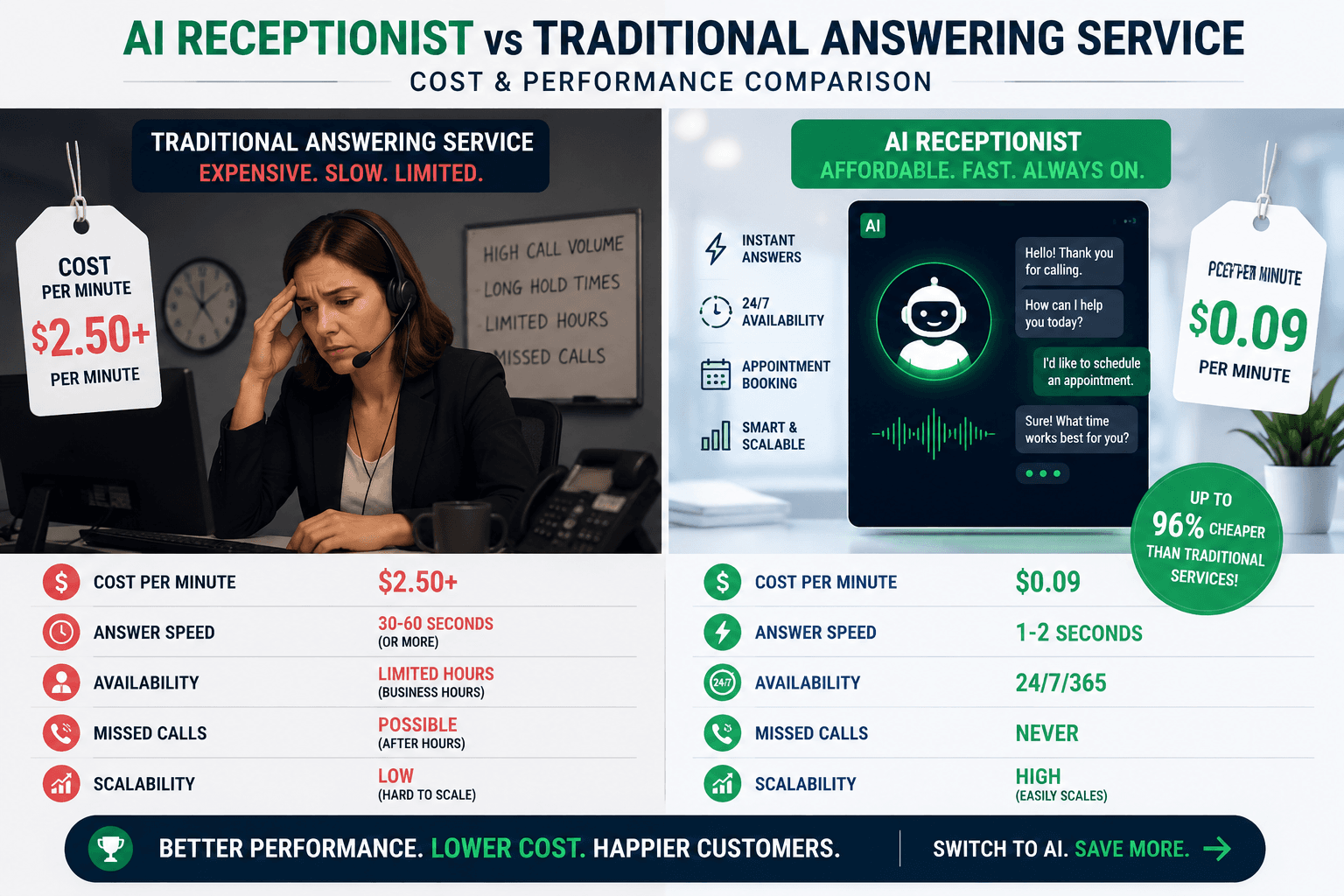
A cost, feature, and performance comparison of the two ways to cover a phone line you cannot staff.