Updated June 2026 with 2026 benchmarks and the latest production failure-mode data. Every team that ships a production voice AI agent knows the gap between demo and reality. The prototype worked flawlessly. Stakeholders were excited. Then the real-world calls started: callers talked over the agent and got ignored. Long pauses made people hang up or repeat themselves. The agent confidently cited a price discontinued months ago. A SIP trunk went silent for three seconds mid-conversation. These are not edge cases — they are the predictable failure modes of voice AI implementation that most teams discover only after launch.
This guide covers the 8 most common voice AI challenges at technical depth: what causes each failure, how to diagnose it in production, and the concrete engineering decisions that resolve it. Whether you are evaluating a custom-built stack or a purpose-built platform, this is the analysis you need to make that decision with clear eyes.
The Real Cost of Voice AI Implementation Failure
Voice AI has an unusually high pilot-to-production failure rate. Q1 2026 analyst data consistently places the failure rate for enterprise voice AI pilots at 65–75% — projects that consumed months of engineering time before being shelved. The reasons are almost never 'the technology is not ready.' They are:
- Sub-optimal latency that degrades call quality below caller tolerance — round-trip delay above 500ms is perceptible; above 800ms it actively breaks natural conversation
- Barge-in detection that either cuts the agent off on background noise or ignores callers who genuinely try to interject
- LLM responses that are factually wrong, off-brand, or confidently hallucinated — destroying caller trust in the first interaction
- Telephony infrastructure failures under real PSTN/SIP conditions that the development environment never replicated
- Compliance exposure from unintentional call recording, unconsented AI calls, or PHI handling violations
- Cost structures that looked acceptable at 1,000 calls per month and became unsustainable at 50,000
The good news: every one of these failure modes has known solutions. The costly outcome is that most teams discover them sequentially — fixing latency, then barge-in, then hallucination, then compliance — in a multi-month engineering slog. This guide gives you the map before you start.
Challenge 1: Latency — The Silent Killer of Voice AI Adoption
Latency is the most common voice AI failure mode and the most underestimated before deployment. Human conversation operates on an implicit timing contract: responses within roughly 200ms feel natural; 300–500ms is perceptibly slow but tolerable; above 500ms callers begin questioning whether the system heard them; above 800ms many callers start repeating themselves, disrupting conversation flow. At 1.5 seconds of round-trip delay, call abandonment rates climb sharply and agent-handled calls start generating consistently negative feedback.
A production voice AI call involves at minimum three sequential AI processing steps: speech-to-text (STT/ASR), large language model inference (LLM), and text-to-speech synthesis (TTS). Each adds latency independently — a fast ASR model contributes 80–120ms, a streaming LLM response starts arriving in 100–200ms, and TTS synthesis adds another 100–300ms before the first audio chunk reaches the caller. Stack these with network round-trips, SIP signaling overhead, and jitter buffers, and a naive sequential implementation easily sits at 800ms–1.5 seconds end-to-end.
The engineering solutions are well-understood in 2026: streaming ASR (transcribe in real-time as the caller speaks, not after voice activity detection fires); streaming LLM with parallel TTS prefill (begin synthesizing audio as tokens arrive, not after the full response is complete); pre-synthesized audio fragments for common response openings; and edge inference nodes placed geographically near your telephony point of presence. Sub-300ms median latency is achievable with this architecture — and should be your baseline requirement, not an aspirational target.
Challenge 2: Barge-In and Interruption Handling
Barge-in is the technical term for a caller speaking while the AI agent is mid-response. In human conversation this is completely normal — callers interject to ask a question, correct a misunderstanding, say 'yes I understand, skip ahead,' or simply keep the conversation moving. A voice AI agent that ignores legitimate barge-ins feels robotic and frustrating. One that fires on background noise, laughter, or 'mm-hmm' acknowledgements clips itself constantly and sounds broken.
The technical challenge is distinguishing intentional speech from ambient noise, backchannels, and environmental audio. A simple voice activity detector (VAD) — the default in most SDKs and off-the-shelf voice AI systems — cannot make this distinction reliably. It operates purely on energy levels and produces false positives (cutting the agent off mid-sentence on ambient noise) and false negatives (missing a caller who speaks softly to interject).
A production barge-in system requires a multi-signal approach: a VAD for initial detection, a classifier trained to distinguish deliberate speech from backchannels and noise, and tunable confidence thresholds that can be adjusted per deployment context — a busy contact center floor is much noisier than a quiet home office. The agent's response logic must also handle interruption gracefully: stopping TTS output immediately, issuing a brief acknowledgement, and processing the new caller utterance as the primary input rather than resuming the interrupted response.
Challenge 3: Accuracy, Hallucination, and Prompt Drift
LLM-powered voice agents share the hallucination problem of text-based chatbots — but voice AI has near-zero tolerance for it. When a web chatbot gives a wrong answer, the user can re-read, correct, and retry. When a voice agent tells a caller their appointment is Thursday when it is Tuesday, or quotes a service price that has not been valid for two quarters, the damage to trust is immediate and often irreversible. The caller heard confidence and acted on it.
The root causes of hallucination in production voice AI are: (1) no grounding — the base model generates from training data, not from your current product, pricing, or policy documentation; (2) prompt drift — as conversation turns accumulate, earlier system prompt instructions lose influence in the LLM's context window; (3) real-time pressure — the latency constraint prevents slow reasoning chains; and (4) out-of-scope queries where the model improvises rather than deferring to a human.
The solution architecture has three layers. First, retrieval-augmented generation (RAG): the agent retrieves relevant facts from a curated knowledge base at query time rather than relying on model memory — current pricing, product specs, and policy documents are fetched dynamically, not recalled from training. Second, strict output guardrails: system prompt constraints that define what the agent is authorized to say, with fallback instructions that route out-of-scope queries to a human rather than allowing improvised responses. Third, confidence-gated escalation: structured output validation or logit scoring that detects low-confidence responses before they reach the caller.
Challenge 4: Telephony and SIP Integration Complexity
Voice AI demos run over WebSockets and WebRTC — clean, low-latency protocols designed for browser-to-server streaming. Production voice AI runs over the PSTN — the telephone network — via SIP trunks, with all the attendant complexity: codec negotiation (G.711 μ-law vs. a-law vs. Opus), jitter buffers, packet loss handling, DTMF tone detection, SIP re-INVITE for mid-call changes, and carrier-specific behavior that varies between Twilio, Vonage, Bandwidth, Telnyx, and direct carrier SIP arrangements.
The failure modes are numerous and hard to reproduce in a development environment: audio streams that drop silently without a SIP error code; G.711 encoding artifacts that confuse ASR models tuned for wideband audio; SIP session timers that terminate calls longer than 30 minutes; DTMF tones that overlap with voice audio and corrupt the speech recognition pipeline; and warm-transfer failures where SIP REFER completes but audio never bridges to the receiving leg.
Solving telephony integration properly requires either deep SIP expertise — FreeSWITCH or Asterisk configuration, media server management, carrier SIP trunk profiling — or a platform that has already solved it at scale. The difference between a platform with tens of millions of production SIP calls already under its belt and a fresh custom integration is measured in months of debugging time and a category of failure modes you cannot anticipate until you encounter them in production.
Challenge 5: Scaling Costs and Infrastructure
Voice AI unit economics appear favorable at small scale and can deteriorate sharply as volume grows. The cost components of a production voice AI call are: (1) STT transcription — typically $0.006–$0.016 per minute depending on provider and model; (2) LLM inference — highly variable, from under $0.002/min for optimized Gemini 3.1 Flash configurations to $0.015+/min for verbose GPT-4o system prompts at high token counts; (3) TTS synthesis — $0.015–$0.030 per minute for premium neural voices; and (4) telephony minutes — $0.007–$0.015 per minute via SIP trunk depending on carrier and geography.
At 1,000 calls averaging 5 minutes each, these costs are manageable. At 100,000 calls, the LLM component alone can represent tens of thousands of dollars monthly — and a poorly optimized system prompt or model choice can 3–5× that cost versus an equivalent well-optimized implementation. The scaling cost levers available to engineering teams are: prompt compression (reducing input token counts without degrading agent capability); model routing (using cheaper, faster models for simple turns and frontier models only for complex reasoning); TTS caching (pre-synthesizing high-frequency response fragments); and auto-scaling compute (matching infrastructure capacity to real-time call volume rather than over-provisioning for theoretical peaks).
Stop reinventing solved problems
Ringlyn AI handles latency optimization, barge-in detection, SIP integration, and compliance out of the box — so your engineering team ships product instead of platform infrastructure.
Challenge 6: Compliance — TCPA, HIPAA, GDPR, and PCI
Voice AI deployments involving consumers, patient data, or payment information operate inside a dense regulatory landscape that most engineering teams underestimate at project start. Getting compliance wrong is not a fine risk — at call volume, statutory damages under TCPA and data breach liability under HIPAA or GDPR can exceed the total engineering investment in the project many times over.
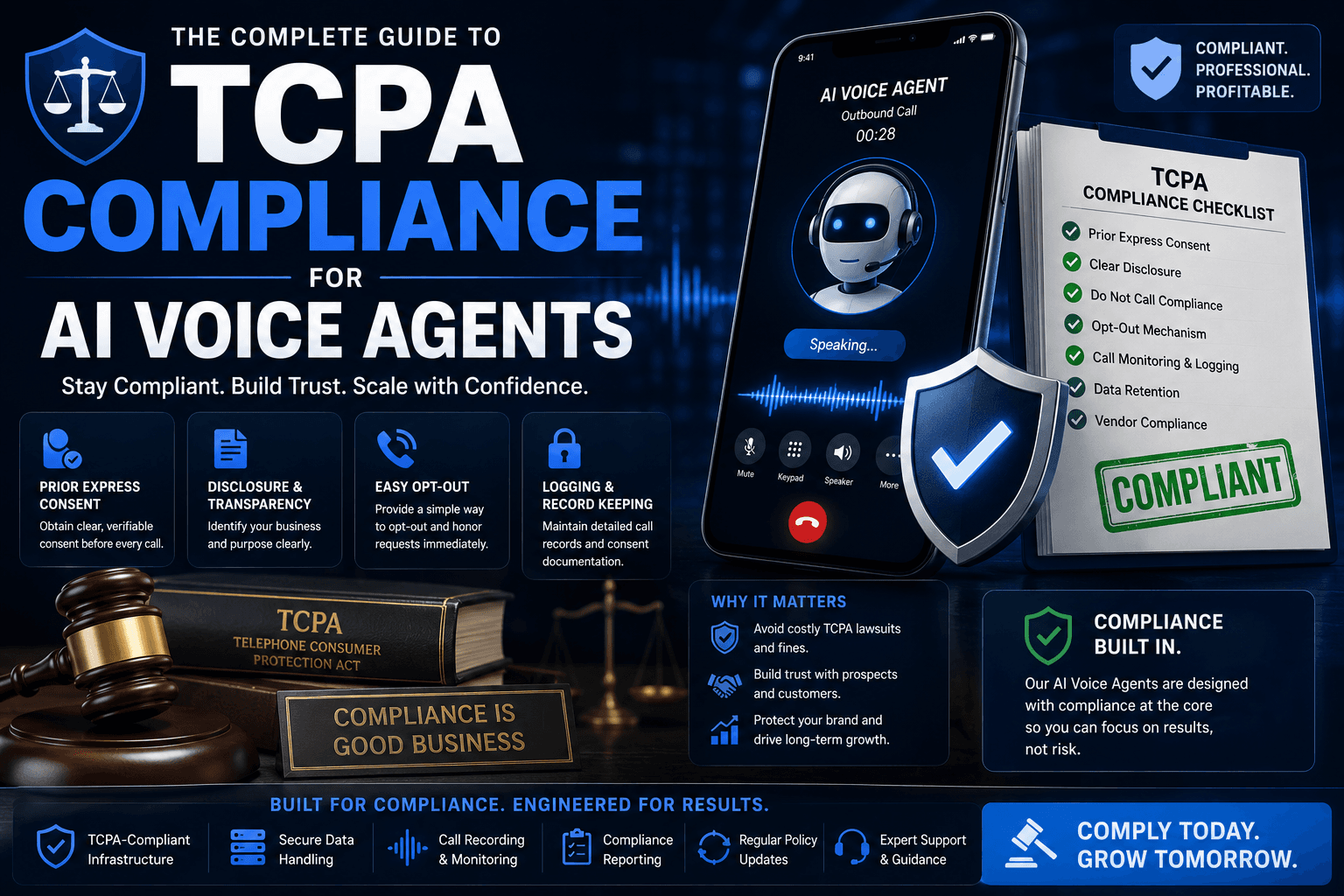
TCPA (Telephone Consumer Protection Act) requires prior express written consent before placing AI-generated or pre-recorded calls to mobile numbers; a clear disclosure at the start of each call that the caller is an AI agent; and do-not-call list scrubbing before every outbound campaign run. Statutory damages are $500–$1,500 per call, with no cap on class actions. A mid-sized outbound campaign run without proper consent management can generate catastrophic liability before a single complaint is filed.
HIPAA applies to any voice AI agent that receives, processes, or stores protected health information — appointment confirmation calls, prescription refill reminders, insurance verification conversations. Compliance requires a signed Business Associate Agreement (BAA) with every vendor in the call stack; PHI redaction from transcripts and system logs; strict access controls and audit trails; and data retention policies that satisfy HIPAA's minimum necessary standard. A misconfigured logging pipeline that writes PHI to an unencrypted datastore is a HIPAA violation regardless of the agent's conversation design.
PCI DSS applies when callers speak payment card numbers during a call. The compliant solution is pause-and-resume recording combined with DTMF injection for card capture: the agent pauses audio recording during payment capture, routes card data through a PCI-compliant payment pathway that never touches the AI stack, and resumes normal call recording after the transaction completes. Any architecture that passes card data through the LLM or STT pipeline creates out-of-scope PCI exposure.
Challenge 7: Multi-Turn Context and Conversation State
Voice AI conversations are fundamentally stateful: the agent's understanding of caller intent builds across every exchange, and each response must be coherent with everything said earlier in the call. This is straightforward for 2–3 turn exchanges and becomes a real engineering challenge for longer conversations — appointment scheduling with complex rescheduling logic, insurance enrollment with multi-step verification, or technical support calls where the caller describes multiple symptoms before the issue is identified.
LLMs have finite context windows. A 20-minute call with verbatim transcript injection can generate 12,000–18,000 tokens — approaching or exceeding the practical limit for real-time inference at low latency. Beyond the hard limit, there is a well-documented 'lost in the middle' attention effect: information presented at the beginning and end of a long context receives stronger attention than information in the middle, meaning the agent can effectively 'forget' critical facts from earlier in the call even when they are technically within the context window.
The solution is explicit conversation state management: a structured state object that tracks entities (caller name, account ID, stated intent, confirmed facts, outstanding questions) separately from the raw transcript. At each turn, the system prompt receives a compressed state summary rather than the full call transcript — keeping the effective context window manageable while preserving all information that drives correct agent behavior. This architecture also enables graceful recovery: if the call connection is interrupted and re-established, the agent resumes from the state object rather than starting the conversation over.
Challenge 8: Human Handoff Without Dropping the Call
Human handoff is where many otherwise well-built voice AI deployments fail at the finish line. The agent correctly identifies that the caller needs a human. The transfer is initiated. Then: the caller hears dead air, gets connected to an agent who knows nothing about why they are being transferred, and has to repeat their entire problem from the beginning. Each of these outcomes negates the goodwill built during the AI-handled portion and actively degrades the customer experience that voice AI was supposed to improve.
A production-grade human handoff requires three things working in coordination. First, warm transfer via SIP REFER: the human agent leg is connected and audio is confirmed before the AI agent releases the call — the caller experiences this as a brief hold, not a disconnect. Second, context packet delivery: a structured summary of the conversation (caller name, stated issue, entities captured, sentiment score, recommended next action) is pushed to the human agent's desktop at or before the moment of connection. Third, graceful bridging: the transition preserves full call recording continuity for quality assurance, and the human agent sees the transcript immediately rather than discovering it after the fact.
The implementation complexity is non-trivial regardless of platform: SIP REFER handling varies between carriers; agent desktop integration requires API work against your CRM or CCaaS system; and the context packet format must match the receiving system's data model. Teams that build this from scratch routinely underestimate this single component by 4–6 weeks of engineering time.
Voice AI Challenge–Solution Matrix
| Challenge | Root Cause | Solution Approach | Ringlyn AI Default |
|---|
| Latency >500ms | Sequential STT → LLM → TTS pipeline plus network hops | Streaming ASR + parallel TTS prefill + edge inference nodes | Sub-300ms median; edge nodes across major geographies |
| False or missed barge-in | Energy-only VAD; no speech intent classification | ML barge-in classifier + tunable confidence thresholds per deployment | Configurable barge-in sensitivity; backchannel filtering built in |
| LLM hallucination | No grounding; prompt drift in long calls; no guardrails | RAG knowledge base + output guardrails + confidence-gated escalation | Built-in knowledge base grounding; strict fallback to human on low confidence |
| SIP/PSTN failures | Protocol mismatch; codec issues; carrier variance | Battle-tested media server (FreeSWITCH/Asterisk) + carrier SIP + multi-codec | Direct carrier SIP; G.711 + Opus; hardened transfer logic across major carriers |
| Scaling cost spikes | Verbose prompts; no model routing; over-provisioned infra | Prompt compression + model routing + TTS caching + auto-scale | Usage-based pricing; auto-scaling; optimized default prompts |
| TCPA/HIPAA/PCI exposure | No consent management; PHI in logs; card data in recordings | Consent capture + PHI redaction + PCI pause-record protocol | TCPA disclosure templates; HIPAA BAA available; PCI-safe recording pause |
| Context loss in long calls | Full-transcript injection hits context window limits | Structured state object + compressed context injection per turn | Persistent session memory; configurable context compression |
| Failed human handoff | No warm transfer; no context delivery to receiving agent | SIP REFER warm transfer + CRM context packet at bridge moment | One-click warm transfer; full transcript auto-delivered to CRM on connect |
The 8 most common voice AI implementation challenges, their root causes, and how Ringlyn AI addresses each by default
Build vs Buy: The Voice AI Decision Framework for 2026
Every team building a voice AI product faces the build-versus-buy question. The case for building from scratch is real: complete control over every layer, no vendor dependency, and the ability to optimize and differentiate at the infrastructure level. The case for buying is equally real: each of the 8 challenges above represents months of focused engineering work to solve correctly in production, and most teams should be building their product — not re-building a voice AI platform.
Build if: your core product IP lives in the voice AI infrastructure layer itself (you are building a voice AI platform, not a product that uses voice AI as a communication channel); your use case has requirements that no existing platform can satisfy; or your call volume is large enough that per-minute platform costs exceed build-and-operate costs over a 3-year horizon — typically above 3–5 million minutes per month at current infrastructure pricing.
Buy if: you have a vertical SaaS product, a services business, or an agency building AI calling solutions for clients; your team's expertise and competitive advantage is in your domain, not voice infrastructure; you need to reach production in weeks rather than months; or your compliance requirements (HIPAA, TCPA, PCI) would require significant platform engineering work on top of the 8 technical challenges above.
For the majority of teams — vertical SaaS companies, agencies building AI calling products, growth-stage startups with significant inbound or outbound call volume — the 8 challenges in this guide are solved problems on a purpose-built platform. The engineering investment belongs in the product that differentiates your business, not in re-solving latency optimization, SIP integration, and compliance infrastructure from scratch.
Building the Voice AI Evaluation and Data Flywheel
The eight challenges above are what teams see in a single call. The challenge that separates a voice AI product that improves every week from one that plateaus is invisible on any single call: the evaluation and data flywheel. Most teams ship an agent, watch a few call recordings, tweak the prompt by hand, and call it iteration. That works for the first fifty calls and collapses at scale — you cannot manually review 40,000 calls a month, and 'it sounded fine on the three I listened to' is not a quality bar you can defend to a customer whose booking rate just dropped.
A real flywheel has four moving parts. Automated transcription and tagging of every production call, so each conversation becomes structured data (intent, outcome, escalation reason, sentiment, containment) rather than an audio file nobody opens. An offline evaluation suite — a growing set of scored test conversations that a prompt or model change must pass before it ships, so you catch regressions before customers do rather than after. Production monitoring that alerts on the metrics that actually predict churn: containment rate, task-completion rate, escalation rate, and average handle time, tracked per agent and per customer. And a labeling loop where failed or escalated calls are reviewed, root-caused, and converted into new evaluation cases — so every failure permanently raises the floor instead of recurring silently.
The strategic point for a startup: your evaluation dataset is the compounding asset, not your prompt. Prompts and models are commodities that any competitor can copy or that a frontier lab can obsolete overnight. A curated set of thousands of scored, domain-specific conversations that encode exactly how your customers' calls should go is proprietary, and it gets more valuable with every call you handle. Teams that treat eval as an afterthought re-solve the same failures forever; teams that build the flywheel early turn their call volume into a moat.
| Metric | What It Measures | Healthy 2026 Target | Why It Predicts Churn |
|---|
| Containment rate | Share of calls resolved without human handoff | 70–90% (use-case dependent) | Low containment means the agent is not doing the job the customer paid for |
| Task-completion rate | Calls where the intended action (booking, capture, answer) actually completed | 85%+ of contained calls | A call can be 'contained' yet fail silently — this catches it |
| Escalation accuracy | Correct escalations vs. false handoffs and missed handoffs | 90%+ correct | Wrong escalations either dump work on humans or trap frustrated callers |
| Eval regression rate | Offline test cases that fail after a change ships | 0 net-new failures per release | Silent regressions are the top cause of 'it worked last week' outages |
| Time-to-fix on flagged calls | Interval from failure to new eval case + shipped fix | Under one week | A slow loop means the same failure keeps recurring in production |
The core evaluation and monitoring metrics that turn call volume into a compounding quality advantage rather than an unreviewable backlog.
Reliability Engineering: SLAs, Failover, and Observability
Voice AI is a real-time system with no retry button. When a web request fails, the user refreshes. When a voice agent stalls for four seconds or drops mid-sentence, the caller hangs up and the moment is gone — and if that caller was a patient confirming surgery or a lead worth thousands, the failure is expensive and immediate. Reliability is not a launch-week concern you address after the product works; it is a first-class requirement that shapes the architecture from day one, and it is the difference between a demo and something a business will route its phone number to.
Production-grade reliability rests on three pillars. Redundancy at every dependency: STT, LLM, and TTS providers all have outages, so a serious deployment runs with fallback providers and automatic failover — if your primary LLM endpoint degrades, calls route to a secondary within the same turn rather than dying. Graceful degradation: when a component is slow, the agent should have pre-scripted holding behavior ('let me pull that up for you') and safe fallbacks rather than dead air, and it should fail toward a human handoff rather than toward a hallucination. Deep observability: per-call traces that capture the latency contribution of every pipeline stage, so when p95 latency creeps up you can attribute it to ASR, network, LLM, or TTS instead of guessing — you cannot fix what you cannot measure at the turn level.
This is also where the honest build-versus-buy math bites hardest. Uptime is not a feature you build once; it is an operational commitment measured in on-call rotations, incident runbooks, provider contracts, and carrier relationships that must hold at 3 AM on a holiday. A startup that promises a customer 99.9% uptime is signing up for roughly eight hours of allowed downtime per year across every dependency in the stack — a bar that is extremely hard to clear on a self-built platform in the first year, and one of the strongest reasons product teams route reliability to a platform that already operates at that level.
Hiring and Team Structure for a Voice AI Startup
Voice AI is one of the most cross-disciplinary products a startup can build, and the most common hiring mistake is staffing it like a normal web app. A conversation that works in production requires expertise that rarely lives in one person: real-time media and telephony, applied LLM and prompt engineering, conversation and UX design for a voice-only channel, and the domain knowledge of the industry you are selling into. Teams that hire three generic full-stack engineers and expect them to figure out SIP, barge-in tuning, and eval infrastructure by reading docs consistently underestimate the specialization the domain demands.
The good news for a small team is that a purpose-built platform collapses several of these roles. If the platform already solves telephony, latency, barge-in, and compliance, you do not need a dedicated media-systems engineer or a telephony specialist in your first ten hires — you need people who are excellent at conversation design, at building the eval flywheel, and at understanding your customers' workflows. That is the real leverage of build-versus-buy in headcount terms: buying the infrastructure lets you spend your scarce early hires on the layer that differentiates your product instead of on plumbing every competitor also has to build.
- Conversation designer: owns dialogue flows, escalation logic, tone, and the prompt/knowledge-base structure — the single highest-leverage early hire for agent quality.
- Applied AI / evaluation engineer: builds the offline eval suite, monitoring, and labeling loop; turns call data into shippable improvements.
- Media / telephony engineer: only if you are building infrastructure — on a platform, this role is largely absorbed by the vendor.
- Domain expert (often a founder or early customer-facing hire): encodes what a 'good call' means in your vertical; without this, the agent is generically competent and specifically wrong.
- Customer success / implementation: voice AI is sold on outcomes, so the person who onboards accounts, tunes knowledge bases, and reads early call transcripts directly drives retention.
Go-to-Market: Selling Voice AI Without Overpromising
The fastest way to lose a voice AI customer is to win them with a demo that the production deployment cannot match. Voice AI demos are seductive — a scripted, quiet, cooperative call sounds magical — and the gap between that demo and a real caller with a strong accent on a noisy line at 11 PM is exactly the set of challenges this guide covers. Go-to-market discipline means selling the outcome you can actually deliver at scale (every call answered, appointments booked, leads captured, clean human handoff) rather than an unbounded promise that the agent handles literally everything a human could.
The most durable 2026 go-to-market motion for voice AI is outcome-anchored and proof-driven. Lead with a specific, measurable before-and-after — missed-call rate, after-hours capture, cost per booked appointment — because buyers do not want 'AI'; they want the revenue leak closed. Run a scoped pilot on a real slice of the customer's call volume so the proof comes from their calls, not your demo. And be explicit about the containment boundary: telling a prospect 'the agent handles 85% of these call types end-to-end and warm-transfers the rest with full context' builds far more trust, and far less churn, than implying it handles 100%. Underpromising the scope and overdelivering on the calls inside that scope is how voice AI products retain accounts past the first invoice.
Build vs License: The Decision That Determines Your Burn Rate
Every voice AI startup makes this decision, usually implicitly and usually in the first week. The founding engineer wants to build the stack, which is entirely understandable, and the question of whether the stack is the differentiation rarely gets asked out loud. It should be, because the answer determines your burn rate for the next eighteen months and, for a large share of voice AI companies, decides whether there is a company at the end of them.
The honest test is uncomfortable but simple: if a competitor licensed an equivalent platform tomorrow, would you still win? If the answer is yes — because you have distribution in a vertical, proprietary data, an integration nobody else has, or a workflow only you understand — then the platform is not your moat and building it is deferred revenue disguised as engineering. If the answer is no, and the technology genuinely is the product, then build it, but budget honestly for what that means.
| Dimension | Build the platform | License an existing platform |
|---|
| Time to first paying customer | 9–18 months | Days to weeks |
| Upfront cost | $150,000+ in senior engineering | One-time licence in the low five figures |
| Ongoing engineering load | Permanent — telephony, models, infra, multi-tenancy | Feature work on top of a maintained base |
| Where the differentiation lives | In the stack, if you can stay ahead | In distribution, vertical depth, and workflow |
| Risk profile | Technical and market risk simultaneously | Market risk only |
| Investor narrative | Deep tech, harder to fund pre-revenue | Revenue traction, easier to fund on numbers |
| What you own at the end | Everything, if you survive | The code, with a source-code licence |
Build versus license for a voice AI startup — the question is whether the stack or the distribution is your actual moat
There is a third option that founders frequently miss: license the platform with source code, ship to customers immediately, and rebuild the components that turn out to matter once you know which ones those are from real usage. That sequence carries market risk only, produces revenue while you learn, and leaves you owning the codebase either way. The licence structures are compared on the white-label voice AI page and in the agency versus self-hosted breakdown.
Unit Economics: Why Voice AI Startups Run Out of Runway
Voice AI has a particular way of killing companies that looks nothing like the usual startup failure. Revenue grows, customers are happy, retention is fine — and gross margin quietly deteriorates until the business is running a treadmill. The cause is almost always the same: costs that scale with usage sitting underneath pricing that does not, combined with a support model nobody costed.
- Per-minute costs stack invisibly. Telephony, speech recognition, language model inference, and voice synthesis each look trivial per minute and together often land between $0.06 and $0.18. Multiply by a customer running 15,000 minutes and the abstraction stops being harmless.
- Flat pricing without a cap is a bet you will lose. One customer launching an unannounced outbound campaign can turn your best-margin account into your worst in a single billing period. Publish a fair-usage threshold rather than discovering the need for one.
- Support is the largest hidden line. An hour a month per account of script tuning and hand-holding is $40 to $200 of real cost that appears nowhere in the price list, and it is the first thing founders give away to close a deal.
- Custom integrations are permanent liabilities. Every bespoke connector built to win one logo becomes maintenance you own forever. Price them as one-time projects or decline them.
- Onboarding is unprofitable without a setup fee. Script building, number porting, integration, and testing is genuine labour. Absorbing it into the monthly fee means the first three months of every account lose money.
- Platform fees compound against you. If you are reselling someone else's stack on a revenue share, your margin compresses precisely as you succeed — which is why licensing changes the shape of the business rather than just the cost.
The corrective is unglamorous: know your fully-loaded cost to serve per account before you set a price, bound your support commitment in writing per tier, charge for onboarding, and publish an overage threshold high enough that most customers never see it. Startups that do this run 60 to 85 percent gross margin. Startups that do not tend to discover the problem at the point they try to raise on the numbers. The pricing mechanics are worked through in detail in the voice agent pricing and margins guide.
See exactly what Ringlyn AI costs at your call volume
Transparent per-minute pricing with no platform fees to start — calculate your ROI before committing a single hour of engineering time.