SIP Trunk Pricing 2026: Cost Per Minute Across Twilio, Telnyx, Bandwidth, Plivo, Vonage, voip.ms & More
SIP trunk pricing varies 20x across providers for identical workloads. This deep 2026 guide compares SIP trunk providers, cost per minute, pricing models (per-minute vs per-channel vs unlimited), monthly DID rental, setup and porting fees, inbound vs outbound rates, toll-free, international rates, hidden regulatory fees like E911, and wholesale SIP trunk pricing — with worked cost estimates by call volume for high-volume AI voice deployments.
Utkarsh Mohan
Published: May 23, 2026
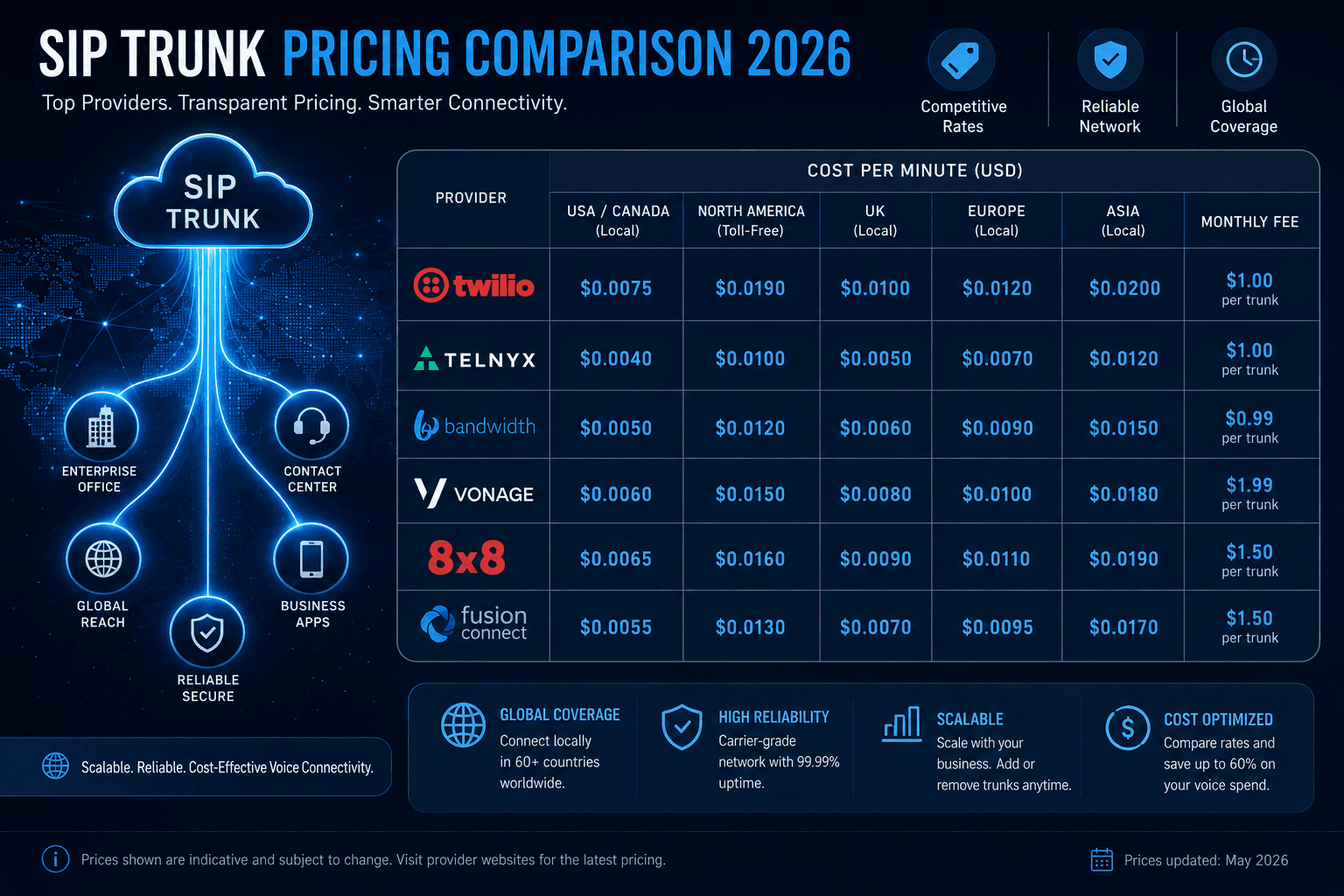
Table of Contents
Table of Contents
If you're running an AI voice agent at any meaningful volume in 2026, the SIP trunk underneath it is one of your three largest cost lines (alongside the LLM and the TTS). Pick the wrong trunk and you'll overpay by 5–20x. Pick the right trunk and the underlying voice carriage runs you $0.003–$0.008 per minute — at which point your AI orchestration, LLM, and TTS costs dominate the cost stack.
This guide compares SIP trunk pricing across the 12 providers most commonly used for AI voice deployments in 2026: Twilio, Telnyx, Bandwidth, Plivo, Vonage, voip.ms, Sinch, Vonage Business, SignalWire, 8x8, RingCentral, and wholesale carriers. We cover per-minute rates, DID rental, channel pricing, SMS, media streams (critical for AI voice), inbound vs outbound asymmetry, international rates, and how to pick the right trunk for your workload.
What SIP Trunking Actually Is (and Why AI Voice Needs It)
SIP (Session Initiation Protocol) trunking is the modern replacement for legacy PRI/T1 phone lines. A SIP trunk carries voice calls over the public internet to and from the PSTN (the traditional phone network), giving you a programmable, software-defined phone system instead of physical phone lines.
For AI voice agents specifically, the SIP trunk does five jobs:
- Connects PSTN calls into your AI infrastructure — when a customer dials your business number, the SIP trunk delivers the call audio to your voice agent stack.
- Places outbound PSTN calls from your AI agent — when your AI cold caller dials a prospect, the SIP trunk carries the outgoing leg to the prospect's carrier.
- Provides DIDs (phone numbers) — local, toll-free, vanity — your inbound presence and your branded caller ID display register against numbers owned and routed by the trunk provider.
- Carries STIR/SHAKEN attestation — for outbound calls to be attested as A-tier (not 'Spam Likely'), the trunk provider must support and sign the call.
- Streams real-time audio for AI processing — modern AI voice agents need media streams (raw audio frames pushed to your STT/LLM in real time), not just SIP signaling. Twilio Media Streams, Telnyx Media Streaming, and similar features are what make AI voice possible on these trunks.
Why AI voice agents stress a SIP trunk differently than a call center
A traditional contact center has a predictable concurrency profile: 40 agents means at most 40 simultaneous calls, and capacity planning is a once-a-year exercise. An AI voice agent fleet behaves nothing like this. A single outbound campaign can spin up 200 simultaneous calls in under a minute, then drop to zero, then surge again — all on the same trunk. This is why concurrency model matters more than headline per-minute rate for AI workloads. Channel-based trunks (where you pre-buy a fixed number of concurrent paths) punish this bursty pattern: you either over-provision channels you rarely use, or you hit a ceiling and calls fail with a 503. Metered per-minute trunks absorb the burst — you pay only for the minutes you actually carry, and concurrency scales elastically up to the provider's account limits.
The second difference is media handling. A human call center forwards audio between two humans; the carrier never needs to touch the media in real time. An AI agent must receive every audio frame, run it through speech-to-text, and inject synthesized audio back into the call with sub-second latency. That requires the trunk to fork or stream the RTP media to your application — and the codec it uses directly affects transcription accuracy and latency. G.711 (PCMU/PCMA) at 64 kbps is uncompressed and AI-friendly; Opus is higher quality but not universally supported on the PSTN side; G.729 is bandwidth-efficient but its lossy compression measurably degrades STT accuracy. For AI voice, prefer trunks that deliver G.711 or raw PCM media streams and avoid forcing transcoding through G.729.
SIP trunking vs CPaaS vs a bundled AI platform
Three layers often get conflated. A raw SIP trunk (VoIP.ms, Flowroute, a wholesale carrier) hands you a SIP credential and DIDs — you bring your own SBC, call control, and application logic. A CPaaS (Twilio, Telnyx, Plivo, SignalWire) wraps that trunk in a programmable API with webhooks, media streams, and managed STIR/SHAKEN, so you write application code instead of running SIP infrastructure. A bundled AI voice platform (Ringlyn AI, Bland AI, Vapi, Synthflow) goes one level higher again: the telephony, media handling, STT, LLM, and TTS are pre-assembled, so you configure an agent rather than wire up trunks at all. Ringlyn AI bundles the SIP layer into its managed platform specifically so customers never have to assemble, peer, or reconcile a separate trunk — which is the difference between shipping in days and engineering for months.
How SIP Trunk Pricing Works: Per-Minute, Per-Channel, Per-DID
SIP trunk providers bill across multiple line items. Confusion about which dimensions you'll actually use is the #1 reason teams overpay.
| Cost Line | Typical 2026 Range | When It Matters |
|---|---|---|
| Per-minute outbound voice (US) | $0.0035–$0.020 | Any outbound voice — direct cost per call duration |
| Per-minute inbound voice (US) | $0.0040–$0.015 | Any inbound voice — applies to received calls |
| DID rental (local US number) | $0.50–$1.50/mo per number | Every number you own — scales with DID count |
| DID rental (toll-free US) | $1.00–$3.00/mo per number | Toll-free presence |
| DID rental (vanity / custom) | $10–$100/mo per number + setup | Branded vanity numbers (1-800-FLOWERS-style) |
| Per-channel pricing (legacy) | $25–$50/mo per concurrent channel | Only on channel-based plans — most modern trunks are per-minute |
| SMS per outbound message | $0.0075–$0.025/msg | SMS notifications, two-factor, confirmations |
| SMS per inbound message | $0.0050–$0.015/msg | Reply handling |
| Media streams (audio streaming for AI) | $0.004–$0.008/min | All AI voice agents — required, not optional |
| STIR/SHAKEN attestation | Included or $0.001/call | All outbound calls in 2026 |
| Branded caller ID registration | $5–$20/mo per DID + $500–$2,000 setup | All commercial outbound DIDs |
SIP trunk pricing dimensions for AI voice workloads — 2026
The pricing model that matters for AI voice: per-minute voice + per-minute media streams + per-DID monthly + per-message SMS. Channel-based pricing is a legacy model that doesn't fit AI workloads (where concurrent call count is highly variable). Avoid channel-based contracts unless your call pattern is steady-state.
Setup, porting, and one-time fees people forget
The per-minute rate is the number everyone compares, but one-time fees can dominate your first invoice. Number porting (moving an existing DID to a new provider) typically runs $5–$15 per number and takes 1–4 weeks; toll-free ports can cost more and take longer. Trunk setup on retail CPaaS is usually $0, but wholesale and enterprise SIP often carry activation and SBC provisioning fees of $250–$2,000. A2P 10DLC brand and campaign registration (required for US SMS) adds a one-time brand vetting fee plus a recurring campaign fee. And branded caller ID / Trust Hub onboarding can carry a $500–$2,000 setup before the monthly per-DID charge even begins. Always model these against your first 90 days, not just steady-state. For the broader cost picture once these are layered onto the AI stack, see our AI voice agent pricing per minute breakdown.
SIP Trunk Pricing Models Compared: Metered vs Channel vs Unlimited
There are three fundamentally different ways to be billed for the voice carriage itself, and choosing the wrong one is where most overspend originates. Get this decision right before you ever compare per-minute rates between providers — the model you pick changes which provider is cheapest for your specific workload.
Metered (per-minute): the AI-voice default
Metered (per-minute) billing charges only for the seconds you actually carry — the dominant model at every CPaaS (Twilio, Telnyx, Plivo, SignalWire) and the right default for AI voice because it tracks bursty, variable concurrency. There is no concurrency ceiling to provision in advance (subject to account-level limits), so a campaign that surges from 0 to 200 simultaneous calls and back costs exactly what it carried. Inbound and outbound are usually metered separately, and media streaming for AI is metered on top — model all three lines, not just outbound voice.
Per-channel and unlimited: when steady volume changes the math
Per-channel billing charges a flat monthly fee per concurrent call path (e.g., $25/channel/month for 20 simultaneous calls) and usually bundles 'unlimited' minutes within those channels. It is efficient only when your call volume is high and steady, so each channel stays busy most of the working day — the moment your concurrency is bursty, you either over-provision idle channels or hit a hard ceiling that fails calls with a 503. Unlimited / seat-based plans (RingCentral, 8x8) bundle voice into a per-user subscription; they target hosted-PBX human users on desk phones, are rarely API-first, lack media streams, and their terms of service frequently prohibit automated dialing — so they are a poor fit for programmatic AI fleets regardless of headline price.
| Pricing Model | How You're Billed | Best Fit | Where It Hurts AI Voice |
|---|---|---|---|
| Metered (per-minute) | Pay per second of voice + media carried | Bursty, variable, or unpredictable AI concurrency | None — this is the default for AI workloads |
| Per-channel (concurrent) | Flat $/month per simultaneous call path; minutes bundled | High, steady-state volume where channels stay busy | Idle channels you pre-paid for; 503s when you exceed the ceiling |
| Unlimited / seat-based | Flat per-user/month, voice bundled in | Human hosted-PBX users on a desk phone | Not API-first; no media streams; ToS often bans automated dialing |
| Wholesale / committed | Negotiated $/min against a monthly spend commit | 500k+ min/month with engineering to operate it | Below the commit, you pay for minutes you never used |
SIP trunk pricing models compared — pick metered for AI voice unless volume is high and steady (2026)
2026 SIP Trunk Provider Comparison: 12 Providers Ranked
| Provider | Outbound US/min | Inbound US/min | DID/mo | Media Streams | Best For |
|---|---|---|---|---|---|
| Twilio | $0.013–$0.020 | $0.0085 | $1.15 | $0.004/min | AI voice (most popular, best DX) |
| Telnyx | $0.005–$0.010 | $0.0055 | $1.00 | Included | Cost-conscious AI deployments at scale |
| Bandwidth | $0.0035–$0.008 | $0.0050 | $0.50–$1.50 | Custom | Enterprise, high-volume outbound |
| Plivo | $0.0055–$0.012 | $0.0055 | $0.80 | $0.004/min | Mid-market AI deployments |
| Vonage API (Nexmo) | $0.013–$0.018 | $0.0090 | $1.50 | $0.004/min | Enterprise needing Vonage brand/SLAs |
| voip.ms | $0.009 (per-min plan) | $0.0085 | $0.85–$4.25 | Limited | Small business, low volume |
| SignalWire | $0.0055 | $0.0050 | $0.85 | Included | Twilio alternatives, API parity |
| Sinch | $0.010–$0.015 | $0.0080 | $1.25 | $0.004/min | Enterprise, global reach |
| 8x8 | $0.013–$0.020 | Included w/ seat | Included | Limited | Hosted PBX users adding SIP |
| RingCentral SIP Station | $24.99/seat (unlimited US) | Included | Included | No native AI streams | Hosted PBX, not AI-first |
| Wholesale (Inteliquent, etc.) | $0.003–$0.005 | $0.003–$0.005 | $0.30–$0.80 | Custom | 100k+ min/mo, technical capacity to manage |
| Pre-bundled (Ringlyn AI) | Included in $0.09/min | Included | Included | Included | Skip the SIP shopping entirely |
2026 SIP trunk provider comparison — US per-minute rates, DID rental, media streams support. Pricing approximate.
Patterns worth noting: Twilio is the most expensive but has the best developer experience and broadest feature coverage. Telnyx, Plivo, and SignalWire are clear Twilio alternatives at 40–60% lower cost with comparable APIs. Bandwidth and wholesale carriers are cheapest but require more technical depth. voip.ms is the budget pick for small business but lacks the AI features (media streams, STIR/SHAKEN automation) needed for production AI voice.
The CPaaS tier: Twilio, Telnyx, Plivo, SignalWire
This is where most AI voice teams should start. Twilio is the reference implementation — broadest feature set, best docs, largest community — and you pay a premium for it. Telnyx is the strongest value play: media streaming is included rather than metered separately, US outbound lands near $0.005/min, and the API is genuinely comparable in depth; its owned-network backbone also tends to give more consistent latency. Plivo sits in the middle on price with a clean API and strong international SMS. SignalWire is built by ex-FreeSWITCH engineers and offers near Twilio-API compatibility, which makes it the easiest migration target if you've already written against Twilio's API and want to cut cost without rewriting.
Carrier-grade and wholesale: Bandwidth, Sinch, Inteliquent
Bandwidth owns its own Tier-1 network and sits between CPaaS and pure wholesale — excellent rates and STIR/SHAKEN posture for high-volume US traffic, but a heavier onboarding than Twilio. Sinch and Vonage (Nexmo) compete for global enterprise deals with strong least-cost routing and SLAs. True wholesale (Inteliquent/Sinch Voice, Lumen, Verizon) reaches $0.003–$0.005/min but assumes you bring your own SBC, attest your own calls, and commit to monthly minimums — covered in detail below.
Budget and DIY trunks: voip.ms, Flowroute, SignalWire
For small-business or hobbyist use, voip.ms offers genuinely cheap per-minute and pay-as-you-go DIDs ($0.85–$4.25/mo) with both per-minute and flat-rate channel plans — but it is a raw SIP provider without the managed media streams, automated A2P registration, and STIR/SHAKEN tooling that production AI voice needs. Flowroute (now part of Intrado/West) is a developer-friendly DIY trunk with transparent metered pricing and good US coverage, popular for teams running their own Asterisk/FreeSWITCH but willing to write more plumbing. The throughline: these tiers save money on the trunk itself and spend it back in engineering — fine if you already operate SIP infrastructure, costly if you don't.
Skip the SIP Trunk Shopping
Ringlyn AI bundles SIP trunking, media streams, DID rental, STIR/SHAKEN, and branded caller ID into one $0.09/min rate. No multi-vendor billing reconciliation.
Twilio Cost Breakdown: Voice, SMS, Media Streams
Twilio is the most common starting point for AI voice deployments because its developer experience leads the category. How much does Twilio cost in practice for AI voice?
| Twilio Service | 2026 Rate (US) | Notes |
|---|---|---|
| Programmable Voice — outbound | $0.013–$0.020/min | Varies by destination type (mobile vs landline) |
| Programmable Voice — inbound (local DID) | $0.0085/min | Per-minute on received calls |
| Programmable Voice — inbound (toll-free) | $0.0220/min | Toll-free inbound is significantly more expensive |
| Local DID rental | $1.15/mo per number | Includes basic voice routing |
| Toll-free DID rental | $2.00/mo per number | Plus higher per-minute inbound |
| Twilio SMS pricing — outbound (US) | $0.0079/msg | Twilio cost per SMS — standard A2P 10DLC rate |
| Twilio text pricing — inbound (US) | $0.0075/msg | Reply-handling on local long codes |
| Twilio SMS pricing India (outbound) | $0.0083/msg | International SMS rates vary widely |
| Twilio Media Streams pricing | $0.004/min per stream | Required for any AI voice agent — runs in parallel with voice charge |
| Twilio Voice Insights | $0.0025/min (Advanced tier) | Optional but useful for AI voice QA |
| STIR/SHAKEN A-attestation | Included on verified numbers | Number verification process required |
| Twilio Trust Hub / Branded Calling | $10–$15/mo per DID | Branded caller ID display |
Twilio 2026 cost breakdown — voice, SMS, media streams, and AI-specific services
Practical example: an AI cold-calling deployment running 5,000 outbound minutes/month on Twilio costs roughly: $0.013 voice + $0.004 media streams = $0.017/min × 5,000 = $85/month just for the trunk. Add $11.50 for 10 DIDs, $50 for branded caller ID, and you're at ~$150/month in pure trunk costs — before any AI processing layer.
Compare that to Telnyx for the same workload: $0.005 voice + $0 media streams (included) = $0.005/min × 5,000 = $25/month + $10 DIDs = $35/month. Same call quality, ~75% cheaper. Telnyx API is comparable to Twilio in completeness and DX.
Wholesale SIP Trunk Pricing: When Volume Justifies It
Wholesale SIP trunk pricing from Tier-1 carriers (Inteliquent, Bandwidth Wholesale, Level 3/Lumen, Verizon Wholesale) lands at $0.003–$0.005/min for US voice — about half the retail rate from Twilio or Telnyx.
The catch: wholesale contracts typically require:
- Minimum monthly commit — usually $5,000–$25,000/month. Below this, retail is cheaper.
- Direct interconnect — your infrastructure has to connect to the wholesale carrier's network via dedicated peering or specific transit providers. You're not just hitting an API.
- Your own SBC (Session Border Controller) — wholesale doesn't bundle the call control layer. You run your own Kamailio, OpenSIPS, or commercial SBC.
- Engineering operations — wholesale relationships need active management. Carrier maintenance windows, DID porting issues, fraud monitoring, and CDR reconciliation are your problems.
- Compliance and STIR/SHAKEN attestation — you have to register as a service provider, attest your own calls, and handle complaints.
Practical rule: at under 100,000 outbound minutes per month, stay on retail SIP (Telnyx, Plivo, SignalWire). At 100,000–500,000/month, consider wholesale with a CPaaS reseller in front. At 500,000+/month, direct wholesale starts to pay off.
Inbound vs Outbound SIP Rates: The Asymmetry That Matters
Most providers charge differently for inbound vs outbound, and the asymmetry direction varies by provider:
- Twilio, Vonage: Inbound is cheaper than outbound. Outbound carries termination fees (paid to the destination carrier); inbound has lower per-minute cost.
- Bandwidth: Inbound and outbound nearly identical at scale; pricing depends on customer's negotiated commit.
- Toll-free DIDs (any provider): Inbound is significantly more expensive than local DID inbound — toll-free fees compensate the originating carrier.
Implication for AI voice workload design: an AI receptionist (mostly inbound) optimizes differently than an AI cold caller (mostly outbound). For receptionists, look at inbound per-minute first and DID rental second. For cold callers, outbound per-minute and media streams dominate. Toll-free inbound is the most expensive minute on most providers — use local DIDs unless you specifically need toll-free presence.
International SIP Trunking: Per-Country Rate Tables
International SIP rates vary 100x by destination. Quick reference (outbound, retail):
| Destination | Twilio /min | Telnyx /min | Notes |
|---|---|---|---|
| United Kingdom (landline) | $0.018 | $0.012 | Mobile UK significantly higher (~$0.080) |
| Canada | $0.013 | $0.005 | Functionally same as US for most workloads |
| Australia (mobile) | $0.130 | $0.090 | Mobile termination fees are high globally |
| Germany (landline) | $0.018 | $0.010 | Mobile DE: $0.110+ |
| India (landline) | $0.045 | $0.038 | Mobile IN: $0.075 |
| Mexico (mobile) | $0.092 | $0.075 | Pre-paid mobile dominant; rates reflect |
| Brazil (mobile) | $0.150 | $0.135 | Among most expensive globally |
| Philippines (landline) | $0.050 | $0.045 | Mobile PH: $0.180 |
| Singapore (any) | $0.018 | $0.013 | Highly competitive |
International SIP trunk pricing samples — 2026 retail rates, varies by carrier route choice
For international AI voice deployments, work with carriers offering region-specific routes (least-cost routing, LCR) rather than relying on a single global provider. Sinch and Bandwidth offer the strongest LCR optimization for global outbound.
Custom Toll-Free Numbers and Vanity DID Pricing
Custom toll-free numbers (1-800-FLOWERS, 1-800-CONTACTS-style vanity numbers) carry separate pricing dimensions:
- Standard toll-free DID (random): $1.00–$3.00/mo + per-minute inbound at higher rate.
- Vanity toll-free (custom word/digits): $25–$500/mo depending on memorability and availability. Premium vanities (8XX numbers spelling common words) can run $1,000+/mo or require purchase from the toll-free aftermarket.
- Vanity local DID (e.g., 1-415-RINGLYN): $20–$100/mo. Same rate structure but cheaper than vanity toll-free.
- Setup/porting fees: $25–$500 one-time per vanity number depending on current ownership.
Vanity numbers are a brand investment, not a cost optimization. For AI voice deployments where the AI books the conversation (not the caller-ID display), vanity numbers rarely improve outcomes enough to justify the premium. Spend the budget on branded caller ID registration instead — your business name displayed on the recipient's phone matters more than a memorable number.
Estimate Your SIP Cost: Worked Examples and Hidden Fees
The fastest way to avoid a surprise invoice is to build the estimate yourself from four inputs: monthly minutes (inbound + outbound separately), average call duration, how many DIDs you need, and your SMS volume. Everything else is a derivative of those numbers.
A worked example by call volume
Below, the same outbound AI-calling workload is priced across three monthly volumes at a representative metered retail rate (Telnyx-class: $0.005/min voice, media streams included) and at the most expensive mainstream retail rate (Twilio-class: $0.013/min voice + $0.004/min media streams). DID and branded-caller-ID costs are held constant at 10 local DIDs. Figures are 2026-approximate and exclude taxes and regulatory fees, which are itemized in the next table.
| Monthly Outbound Volume | Telnyx-class (voice+media incl.) | Twilio-class ($0.013 + $0.004) | Approx. Savings | Notes |
|---|---|---|---|---|
| 10,000 min (~3,300 calls @ 3 min) | ~$50 + $10 DIDs = $60 | ~$170 + $11.50 DIDs + $50 BCID = $231 | ~$170/mo | Below this, the provider barely matters in absolute dollars |
| 100,000 min (~33k calls) | ~$500 + $10 DIDs = $510 | ~$1,700 + $11.50 + $50 = $1,761 | ~$1,250/mo | Inflection point: evaluate wholesale with a CPaaS reseller |
| 500,000 min (~165k calls) | ~$2,500 + DIDs = ~$2,510 | ~$8,500 + fees = ~$8,560 | ~$6,000/mo | Direct wholesale ($0.003–$0.005) now beats retail |
| 1,000,000 min (~330k calls) | ~$5,000 retail / ~$3,500 wholesale | ~$17,000 retail | $12,000+/mo | Wholesale + own SBC pays for the engineering overhead |
Worked SIP cost estimate by outbound volume — metered retail vs premium retail, 2026-approximate, taxes excluded (BCID = branded caller ID)
Two takeaways. Under ~10,000 minutes/month the absolute difference between providers is small enough that developer experience and time-to-launch matter more than per-minute rate. Above ~100,000 minutes/month the per-minute rate dominates everything and is worth aggressive negotiation or a wholesale move.
Hidden fees and gotchas checklist
These are the line items that don't appear in the headline per-minute rate but show up on the invoice. Regulatory and tax surcharges in particular can add 15–25% to a US SIP bill, and most published rate cards quote pre-tax.
| Hidden Fee / Gotcha | Typical 2026 Cost | Who Charges It | How to Avoid Surprise |
|---|---|---|---|
| E911 fee (per DID) | $0.50–$1.50/mo per number + per-call surcharge | All US voice providers (regulatory) | Multiply by DID count; mandatory, not optional |
| Regulatory recovery / USF surcharge | +5–18% of US usage | Most US carriers | Ask for an all-in quote including surcharges |
| State/local telecom taxes | +3–10% of usage | Varies by billing address | Budget 15–25% on top of pre-tax US rates |
| Number porting (in/out) | $5–$15 per DID (TF higher) | Gaining/losing provider | Confirm both port-in AND port-out fees before committing |
| A2P 10DLC registration | One-time brand fee + recurring campaign fee | US SMS via The Campaign Registry | Required for any US SMS; register before launch |
| Toll-free inbound premium | $0.018–$0.022/min vs ~$0.0085 local | All providers | Use local DIDs unless toll-free presence is required |
| Short-duration / connection fee | Min-billing increment (often 6s or 60s) | Some wholesale carriers | Check billing increment — AI calls are often short |
| Minimum monthly / inactivity fee | $10–$25/mo floor | voip.ms, some wholesale | Confirm there's no floor if volume is spiky |
| Branded caller ID setup | $500–$2,000 one-time + $5–$20/mo per DID | Twilio Trust Hub, peers | Front-load into first-90-days budget |
SIP trunk hidden-fee and gotcha checklist for AI voice — 2026-approximate
“The per-minute rate is the part of a SIP bill everyone negotiates and the smallest part of the total surprise. Porting fees, A2P registration, branded-caller-ID setup, and a 15–25% regulatory-and-tax stack are what actually move the first three invoices.”
How to Pick a SIP Trunk Provider for AI Voice Agent Workloads
- Native media streams support. Non-negotiable for AI voice. Twilio, Telnyx, Plivo, Vonage, SignalWire, Sinch all support it. voip.ms, RingCentral, 8x8 do not (or have very limited support).
- STIR/SHAKEN A-attestation. Must be supported and easy to enable. Twilio Trust Hub, Telnyx Trust Center, and equivalents at other providers.
- API depth + documentation. Twilio leads, then Telnyx, then Plivo and SignalWire (both Twilio-API-compatible). The depth matters when your AI orchestration layer needs programmable call control.
- Pricing transparency. Published per-minute rates are a green flag. Providers requiring 'contact sales' for basic pricing are usually expensive.
- Regional reach. If you serve international callers, verify the provider's coverage in your target countries. Sinch and Bandwidth lead globally; Twilio is strong in EN-speaking markets.
- Compliance posture. SOC 2 Type II audit, GDPR Data Processing Addendum, HIPAA-eligible products (for healthcare). All major providers offer these, but verify before contracting.
- Outage history. Check the provider's status page history. Twilio, Telnyx, Bandwidth have all had multi-hour outages in the past 24 months. Multi-provider failover (active or warm-standby) is worth designing in for any business-critical deployment.
- Or — skip all of this. Use a bundled AI voice platform (Ringlyn AI, Bland AI, Synthflow) that includes the SIP trunk in the per-minute rate. Skip the multi-vendor billing reconciliation.
All-In SIP + AI Voice for $0.09/min
Ringlyn AI bundles SIP trunking, media streams, DIDs, STIR/SHAKEN attestation, branded caller ID, LLM, STT, TTS, and CRM integration. One bill. One vendor. One per-minute rate.
Frequently Asked Questions
US SIP trunk per-minute rates range from $0.003 (wholesale carriers like Inteliquent at 100k+ min/mo commit) to $0.020 (Twilio retail outbound). Mid-market retail (Telnyx, Plivo, SignalWire) lands at $0.005–$0.010/min. Add DID rental ($0.50–$1.50/mo per local number, $1–$3 for toll-free), media streams for AI voice (~$0.004/min), and STIR/SHAKEN attestation. A 5,000 outbound min/month AI deployment runs $35–$150/month in pure SIP costs depending on provider.
For under 100,000 minutes/month: Telnyx at ~$0.005/min outbound with media streams included is the cheapest production-grade option. SignalWire and Plivo are close competitors. voip.ms is cheaper per-minute on its rate plan ($0.009) but lacks the AI features (media streams, robust STIR/SHAKEN) needed for production AI voice. Above 100k/min, wholesale via Inteliquent or Bandwidth Wholesale at $0.003–$0.005 wins, but requires engineering capacity to manage.
For a typical AI voice deployment: $0.013–$0.020/min outbound voice + $0.004/min Twilio Media Streams + $0.0085/min inbound + $1.15/mo per DID + $10–$15/mo per branded caller ID. A 5,000 outbound min/month deployment runs ~$85 for voice + $20 for media streams + $11.50 for 10 DIDs + $50 branded caller ID = ~$165/month in Twilio charges. Twilio cost per SMS adds $0.0079/outbound message (A2P 10DLC). Twilio SMS pricing India runs $0.0083/msg. Twilio is ~3x more expensive than Telnyx for the same AI voice workload.
Wholesale SIP trunk pricing from Tier-1 carriers (Inteliquent, Bandwidth Wholesale, Lumen/Level 3) runs $0.003–$0.005/min for US voice — roughly half retail. Catches: $5,000–$25,000/month minimum commit, direct interconnect requirements, you run your own SBC (Session Border Controller), and you handle compliance + STIR/SHAKEN registration yourself. Rule of thumb: under 100k min/month, retail SIP is cheaper after engineering cost. 100k–500k/month, wholesale via a CPaaS reseller. 500k+/month, direct wholesale pays off.
Yes — non-negotiable for production AI voice. Media streams (Twilio Media Streams, Telnyx Media Streaming, equivalent at other providers) push raw audio frames from the SIP call to your STT/LLM stack in real time. Without media streams, the SIP trunk only handles call control (setup, teardown, DTMF) and your AI agent can't actually hear the caller or speak back. Providers without good media streams support (RingCentral SIP Station, voip.ms, 8x8) are functionally not viable for AI voice deployments.
If you have engineering bandwidth and want maximum flexibility, assemble: pick Telnyx/SignalWire for SIP, a leading LLM for reasoning, Deepgram or AssemblyAI for STT, ElevenLabs or Cartesia for TTS, and orchestrate via Vapi or Retell. Realistic cost: $0.10–$0.18/min all-in, plus 6–10 engineering weeks to build. If you want production AI voice in days not months, use a bundled platform: Ringlyn AI at $0.09/min bundles SIP + media streams + DIDs + STIR/SHAKEN + branded caller ID + LLM + STT + TTS + CRM integration. The bundle is typically cheaper than assembly once engineering time is factored in.
Per-minute (metered) bills only for the seconds you carry and is the right default for AI voice because concurrency is bursty and variable — you never pre-provision capacity. Per-channel bills a flat monthly fee per concurrent call path (e.g., ~$25/channel/month) with minutes bundled in, which is efficient only at high, steady volume where each channel stays busy; bursty AI traffic either over-pays for idle channels or fails calls when it exceeds the channel ceiling. Unlimited/seat-based plans (RingCentral, 8x8) bundle voice into a per-user subscription aimed at human desk-phone users, are rarely API-first, and often prohibit automated dialing — avoid them for AI fleets.
Beyond the per-minute rate: E911 fees ($0.50–$1.50/mo per DID plus a per-call surcharge, mandatory in the US), regulatory/USF recovery surcharges (+5–18% of usage), state and local telecom taxes (+3–10%), number porting ($5–$15 per DID, toll-free higher), one-time A2P 10DLC brand and campaign registration for SMS, branded caller ID setup ($500–$2,000 one-time + $5–$20/mo per DID), and sometimes a billing-increment minimum or monthly inactivity floor. Budget 15–25% on top of pre-tax US rates for the regulatory-and-tax stack alone, since most published rate cards are quoted pre-tax.
Start with four inputs: monthly minutes (inbound and outbound separately), average call duration, number of DIDs, and SMS volume. Multiply outbound minutes by your outbound rate, add the same for inbound, add media-streaming per-minute (unless your provider includes it, like Telnyx), add per-DID monthly rental, then layer SMS and the 15–25% tax/regulatory stack. Worked example: 100,000 outbound min/month at a Telnyx-class $0.005/min with media included is ~$500 + ~$10 DIDs = ~$510/month pre-tax; the same volume at a Twilio-class $0.013 voice + $0.004 media is ~$1,700 + fees. Above ~100,000 minutes/month, evaluate wholesale; below ~10,000, developer experience matters more than the rate.
Prefer G.711 (PCMU/PCMA) or raw PCM media streams. G.711 is uncompressed at 64 kbps and gives speech-to-text the cleanest signal with minimal latency. Opus is higher quality but not universally supported across the PSTN. Avoid forcing G.729 transcoding: its aggressive lossy compression measurably degrades transcription accuracy, which directly hurts your AI agent's comprehension. The trunk must also support media streaming (forking RTP audio to your application in real time) — without it, the trunk only handles call control and the AI can't hear or speak.
Two mechanisms matter most, and both depend on your SIP trunk provider. First, STIR/SHAKEN attestation: for outbound calls to be signed at the highest A-tier level, the trunk provider must support and correctly attest your calls, which typically requires verifying ownership of your numbers. Second, branded caller ID registration (Twilio Trust Hub and equivalents), which displays your business name on the recipient's phone and usually runs $5–$20/mo per DID plus a $500–$2,000 one-time setup. In most 2026 deployments teams also rotate outbound numbers, keep per-number call volume reasonable, and monitor number reputation to reduce spam-labeling. Providers with weak STIR/SHAKEN tooling — such as some budget or seat-based trunks — make this materially harder, which is one reason production AI voice tends to favor CPaaS-tier or bundled platforms.