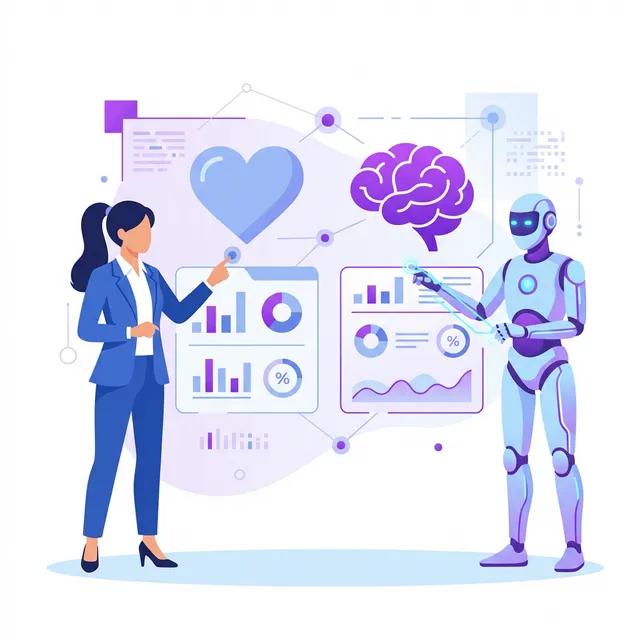
The premise seems absurd on its face: software systems demonstrating greater empathy than trained human customer service professionals. And yet, across multiple enterprise deployments and third-party research studies conducted in 2025 and 2026, this pattern has emerged with enough consistency to demand serious examination. The organizations that dismiss it as a statistical anomaly are already falling behind those that have built it into their customer experience strategy.
The Paradox That Challenges Every Assumption About AI
A Capgemini Research Institute study found that 73% of consumers globally trust content created by generative AI — a figure that surprised even the researchers who produced it. More specifically, in direct comparisons of AI-handled and human-handled customer service interactions, AI interactions consistently rated higher on specific emotional intelligence markers: patience, attentiveness, non-judgmental tone, and consistent follow-through.
This is not because AI agents are more emotionally sophisticated than humans in any philosophical sense. It is because they are structurally incapable of the emotional failures that most frequently damage customer relationships: impatience, defensiveness, distraction, fatigue, bias, and inconsistency. In the absence of these failure modes, AI interactions present as more reliably empathetic — even if that empathy is architecturally produced rather than genuinely felt.
“Customers don't measure empathy in the abstract. They measure it in whether they felt heard, whether their issue was taken seriously, and whether the interaction ended with a resolution. On all three dimensions, well-designed AI voice agents are now competitive with — and often superior to — the average human representative.”
— Enterprise Customer Experience Research Consortium, 2025
Emotional Intelligence in Enterprise Customer Interactions
In enterprise customer service contexts, emotional intelligence manifests across five observable dimensions that researchers use to evaluate interaction quality:
- Active listening signals: Demonstrating attention through acknowledgment, accurate recall, and responsive follow-up questions
- Tone modulation: Adjusting communication style and pace to match the customer's emotional state
- Frustration de-escalation: Responding constructively to emotionally charged or escalating situations without mirroring negative affect
- Patience under complexity: Maintaining composure and engagement when interactions are difficult, lengthy, or repetitive
- Resolution commitment: Conveying genuine investment in reaching a satisfactory outcome for the customer
Human representatives score highly on these dimensions when they are well-rested, appropriately compensated, properly trained, and emotionally engaged. The problem is that these conditions are not consistently achievable across a large, geographically distributed contact center workforce handling thousands of interactions per day. AI voice agents, by contrast, deliver identical performance on all five dimensions across the hundredth call of the day and the ten-thousandth.
Why AI Is Winning: The Consistency Advantage
The research on human performance variability in customer service is sobering. Studies of contact center agent performance consistently document significant degradation in key emotional intelligence metrics across a single shift — with frustration signals, shortened responses, and decreased active listening all increasing as the day progresses. Agents handling calls at hour seven perform meaningfully worse on customer-rated empathy metrics than the same agents at hour one.
AI voice agents have no equivalent of shift fatigue. They do not have difficult personal circumstances that bleed into professional interactions. They do not carry frustration from a previous caller into the next conversation. They do not have implicit biases that manifest subtly in tone or word choice when interacting with customers from different demographic groups. This structural consistency does not make AI agents better at empathy in a human sense — it makes them reliably adequate in contexts where human performance is unreliable.
The Technical Architecture of AI Empathy
Modern AI voice agents deployed on platforms like Ringlyn AI achieve their empathy-adjacent performance through several coordinated technical mechanisms:
Real-Time Sentiment Analysis and Tone Adaptation
Advanced voice AI systems analyze caller vocal characteristics — pitch, pace, volume, and pause patterns — in real time to classify emotional state. When a caller exhibits frustration signals, the agent dynamically adjusts its own tone: slower pace, lower register, more deliberate acknowledgment statements. This adaptation happens in milliseconds and is imperceptible to the caller as a mechanical process.
Contextual Memory and Continuity
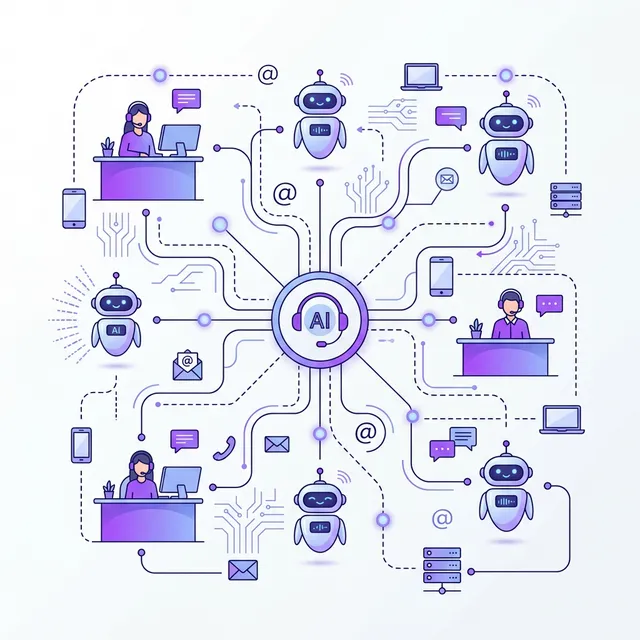
One of the most significant sources of customer frustration in traditional contact centers is the requirement to repeat information across multiple interactions or to multiple agents within a single interaction. AI voice agents with access to full customer history via CRM integration never ask a customer to repeat themselves. This single capability — which is technically trivial but operationally transformative — accounts for a disproportionate share of the empathy score advantage AI agents demonstrate.
Backchanneling and Conversational Naturalness
AI voice agents engineered for empathetic interaction are designed with backchanneling capabilities: the conversational affirmations ('I understand,' 'absolutely,' 'that makes sense') that signal attentiveness in human conversations. Combined with voice activity detection and intelligent turn-taking models, these features create the subjective experience of being listened to — a primary component of customer-rated empathy.
Enterprise Evidence: What the Data Shows
| Empathy Metric | Human Agent Average | AI Voice Agent Average | Delta |
|---|
| Customer felt heard (% agree) | 71% | 84% | +13pp |
| Issue taken seriously (% agree) | 68% | 81% | +13pp |
| Representative patience rating (1–10) | 7.1 | 8.6 | +1.5 |
| Interaction free of bias/judgment (% agree) | 74% | 94% | +20pp |
| Consistent quality across interactions | Variable ±23% | ±2% | Structural advantage |
| Escalation rate (frustration-driven) | 18% | 7% | -11pp |
| First-contact resolution (FCR) rate | 64% | 71% | +7pp |
Composite data from enterprise AI voice deployments, 2025–2026. Results vary by use case and implementation quality.
The Optimal Model: Human-AI Collaboration
The strategic implication of this data is not that enterprises should replace human agents entirely. It is that the allocation of customer interactions between AI and human agents should be rethought based on a more sophisticated understanding of where each excels.
AI voice agents are structurally superior for high-volume, routine interactions where consistency and availability are the primary value drivers. Human agents are irreplaceable for genuinely complex problem-solving, relationship-critical interactions, high-value customer escalations, and situations requiring nuanced judgment that falls outside trained parameters. The enterprises achieving the best customer experience outcomes are those that have designed their customer journey to route each interaction type to the appropriate handler — with AI handling the majority of volume and humans focused on the interactions where their uniquely human capabilities deliver the greatest value.
Strategic Implications for CX Leadership
For enterprise CX leaders, the empathy data reframes three strategic questions:
- Workforce design: If AI agents consistently outperform human agents on routine interaction empathy metrics, the justification for large frontline headcount in transactional roles is weakened. The strategic investment should shift toward fewer, higher-skilled human agents handling escalated and relationship-critical interactions.
- Quality assurance: Traditional QA frameworks built around sampling human agent performance need to evolve. AI-handled interactions generate 100% transcription and scoring data, enabling continuous quality assurance rather than sample-based review.
- Customer journey design: The question is no longer whether to use AI for customer interactions, but which interactions should be AI-first, which should be human-first, and which require a hybrid approach. This is a design decision that belongs at the senior CX leadership level.
Design a customer experience where AI and humans both perform at their best
Ringlyn AI provides the conversational AI infrastructure for enterprise CX transformation