
AI Voice Agents 2026: The Enterprise Deployment Guide
AI voice agents in 2026 are production-ready infrastructure. This enterprise guide covers $0.06–$0.16 per-call economics, compliance, and deployment roadmaps.
Utkarsh Mohan•Feb 19, 2026
A plain-English guide to AI voice agents — what they actually are, how the speech-to-text, LLM, and text-to-speech pipeline works under the hood, and how to build one yourself in minutes with Ringlyn AI.
Utkarsh Mohan
Published: Sep 18, 2026
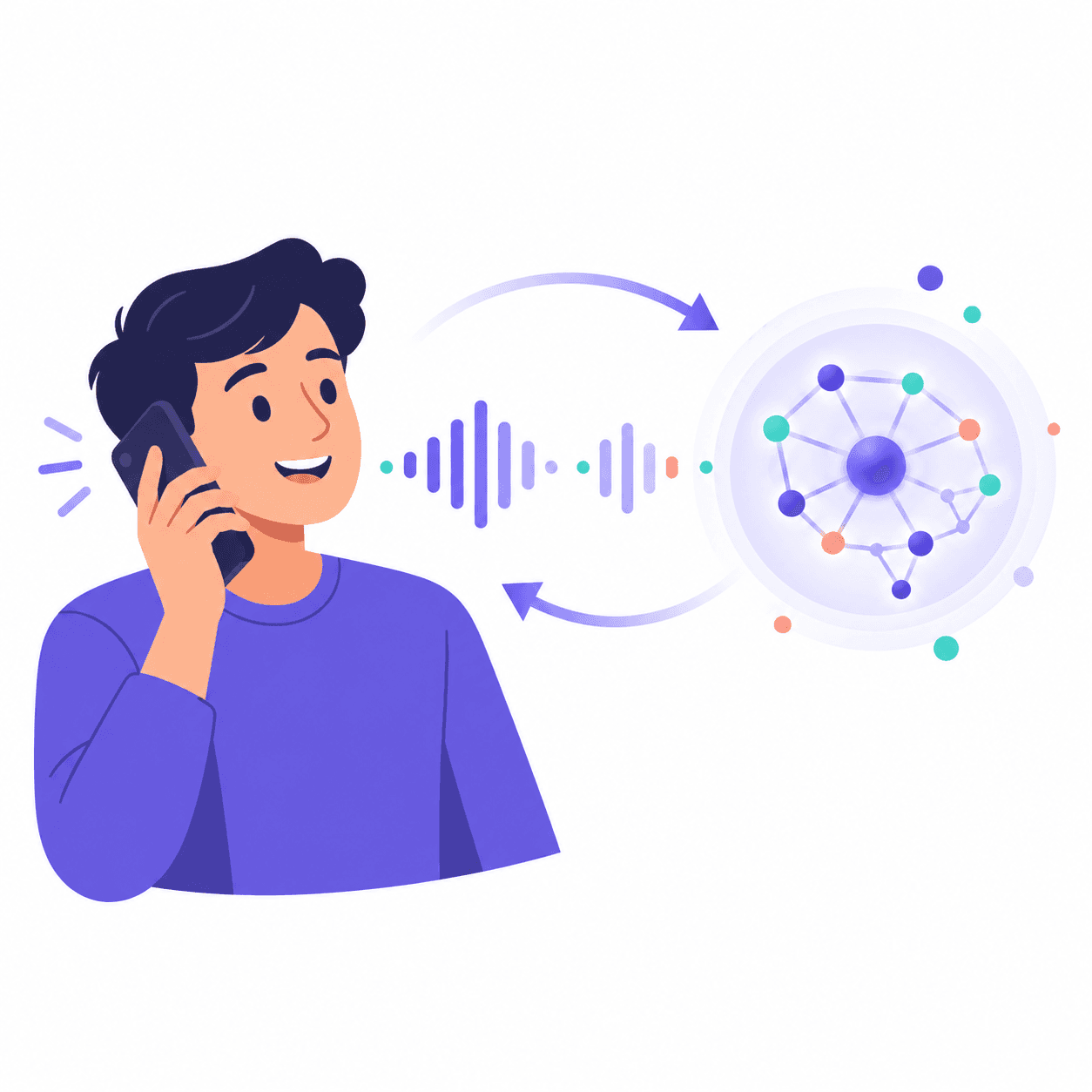
Type "AI voice agent" into Google in 2026 and you'll get everything from enterprise call-center platforms to weekend hackathon projects claiming the same label. That's because the term describes a genuinely new category of software — one that didn't really exist in usable form five years ago — and the category is moving fast enough that most explanations are already out of date. This guide answers the two questions everyone actually has: what is an AI voice agent, in plain terms, and how does it actually work under the hood, from the moment someone speaks into the phone to the moment they hear a reply.
We'll also show the fastest path from reading this article to having a working voice agent of your own — because unlike most emerging technology categories, this one no longer requires an engineering team or a six-figure budget to try.
An AI voice agent is a software system that holds a real, spoken conversation over the phone to complete a task — answering a question, booking an appointment, qualifying a lead, or resolving a support issue — without a human on the other end of the line. It listens to what a caller says, understands the intent behind it, decides how to respond, and speaks that response back in a natural voice, in something close to real time.
That definition matters because it rules out a lot of things people casually call "voice AI." A voice agent is not a pre-recorded phone tree ("Press 1 for Sales"). It's not a chatbot with a text-to-speech voice bolted on top, reading back canned responses. And it's not a voice assistant like Siri or Alexa answering one-off commands. A voice agent carries a conversation — it remembers what was said two sentences ago, handles a caller changing their mind mid-sentence, and takes an action (updating a record, sending a confirmation, transferring the call) as a direct result of what was discussed.
Anyone who has called a bank, airline, or insurance company in the last two decades has met the technology voice agents replace: Interactive Voice Response, or IVR. IVR systems work by matching a caller's touch-tone input or a small set of recognized keywords to a rigid decision tree built in advance. If your reason for calling isn't one of the options on the menu, the system has no way to help you — it can only route you closer to a human or loop you back to the start.
A voice agent inverts that model. Instead of forcing the caller's request into a menu the business designed ahead of time, it lets the caller say what they actually want, in their own words, and figures out the rest. This is the difference between a system that routes calls and one that resolves them.
| Capability | AI Voice Agent | Traditional IVR |
|---|---|---|
| How callers interact | Free-form natural language — say anything, in any order | Fixed menu options — press a number or say a matched keyword |
| Handles the unexpected | Yes — reasons about intent even for phrasing it hasn't heard before | No — anything off-script routes to a human or a dead end |
| Conversation memory | Tracks context across the full call | None — each menu selection is evaluated in isolation |
| Can take action | Books, updates, and transfers with live system access | Limited to pre-built routing paths |
| Caller experience | Feels like talking to a person | Feels like navigating a phone menu |
| Setup effort | Minutes to configure on a modern platform | Weeks of call-flow design and telephony configuration |
Strip away the branding and every AI voice agent — enterprise or hobbyist — runs on the same three-stage pipeline, wrapped around a telephony connection. Understanding these three stages is the fastest way to actually understand the technology, rather than just its marketing.
The single most important engineering detail in that pipeline is that none of these stages wait for the previous one to fully finish. Speech is transcribed as it's spoken; the language model starts reasoning on partial transcripts; the reply is spoken as it's generated, not after. This overlapping, or streaming, is what separates a voice agent that feels conversational from one that feels like talking into a walkie-talkie with a two-second delay after every exchange.
Also read: How to Build a Voice AI Agent in 2026: Step-by-Step Tutorial with Architecture, Tools, and Code
There's a specific technical problem underneath "the AI feels slow," and it's not usually the AI model itself — it's turn-taking: knowing precisely when the caller has finished speaking. Older systems solve this crudely, waiting for a fixed stretch of silence (often 700ms–1 second) before assuming the caller is done. That approach either cuts people off mid-thought or leaves an awkward gap that makes the agent feel hesitant.
Modern voice agents use neural end-of-turn detection instead — models trained to read tonality, pacing, and sentence structure to predict whether a caller has actually finished a thought or just paused to breathe. This is the single biggest factor in whether a call feels like a natural back-and-forth or a laggy interrogation, and it's why the best 2026 platforms now hold full response cycles — hearing the end of a sentence and beginning to reply — to under one second.
| What Callers Notice | Under ~1 Second | Over ~2 Seconds |
|---|---|---|
| Perceived naturalness | Feels like a real conversation | Feels robotic or broken |
| Caller behavior | Speaks normally, doesn't repeat themselves | Talks over the agent, hangs up, or shouts "hello?" |
| Trust in the system | High — caller stops thinking about the technology | Low — caller becomes aware they're talking to a machine |
Perceived response latency is the single largest driver of whether a voice agent feels credible
"Voice agent" covers a range of jobs, and most real deployments are one of three shapes:
Sounding human is about more than voice quality. A handful of specific behaviors separate an agent that feels genuinely conversational from one that's clearly reading a script with a nicer voice attached:
Talk to a live Ringlyn AI voice agent right now — no signup required
The reason voice agents have moved from novelty to standard business infrastructure in 2026 is that the use cases translate directly into hours saved and calls answered, not just a cool demo:
| Use Case | What the Agent Does | Common Industries |
|---|---|---|
| Front-desk / reception | Answers every call, books appointments, answers FAQs, forwards urgent calls | Healthcare, dental, legal, home services |
| After-hours coverage | Picks up calls outside business hours instead of sending them to voicemail | All service businesses |
| Appointment reminders | Calls to confirm, reschedule, or cancel — reducing no-shows | Healthcare, salons, professional services |
| Lead qualification | Calls new leads within seconds of a form submission and gathers key details | Real estate, insurance, solar, B2B sales |
| Customer support triage | Resolves routine questions and escalates complex ones with full context | SaaS, retail, telecom, financial services |
| Payment & collections follow-up | Compliant outreach to capture payment commitments | Financial services, utilities, healthcare billing |
The AI voice agent use cases businesses are actually deploying in 2026
If you want to actually build a voice agent, there are two real paths, and the right one depends entirely on what you're optimizing for.
Most businesses — anyone who isn't building voice AI infrastructure as their actual product — get to a better outcome faster on a managed platform, simply because the hard parts (sub-second latency, natural turn-taking, reliable telephony at scale) are already solved and battle-tested across millions of calls, rather than something a small team has to discover the hard way in production.
This is where the theory turns into something you can actually try today. Ringlyn AI is a managed voice agent platform built specifically so that going from an idea to a live, answering phone number doesn't require an engineering team, a telephony account, or separate contracts with a speech-recognition vendor, a language model provider, and a voice synthesis company. The entire pipeline described above — STT, the reasoning layer, TTS, and telephony — comes bundled behind one dashboard, tuned for the sub-second response times that make an agent feel natural rather than robotic.
In practice, building your first voice agent on Ringlyn AI looks like this:
That entire sequence typically takes under ten minutes for a standard use case — no code, no separate vendor bills to reconcile, and no six-month build. It's the same reason platforms in this space increasingly market themselves around speed to launch rather than raw model specs: the technology underneath has matured to the point where the differentiator is how quickly a real business can put it to work.
Also read: How to Build an AI Voice Agent: Complete Process, Cost Breakdown & Must-Have Features in 2026
No code, no credit card — go from idea to a live phone number in minutes
Not every platform that calls itself a "voice agent" delivers the same underlying quality. Whether you're evaluating Ringlyn AI or anyone else, these are the criteria that actually separate a production-ready agent from a demo:
This was true when voice AI required custom engineering and enterprise contracts. It isn't anymore. Managed platforms have pushed setup time down to minutes and pricing down to a per-minute rate, which is why small clinics, single-location home service businesses, and solo real estate agents now run the same underlying technology as large call centers.
On routine, well-scoped calls — appointment confirmations, FAQ answers, basic scheduling — modern agents running sub-second, streaming pipelines are frequently indistinguishable from a human on the first exchange. Where they do give themselves away is on long, open-ended, off-script conversations, which is exactly why well-designed deployments define a clear scope and escalate anything outside it, rather than trying to fake being human at every possible topic.
That was accurate for the DIY-stack approach described above, and it's still true if you're assembling your own pipeline from separate APIs. It's no longer true for managed platforms, where configuring an agent looks more like filling out a form and uploading a document than writing code.
Two shifts are already visible heading into the rest of 2026. First, the underlying models are moving toward speech-native architectures that process audio directly instead of cascading through separate transcription, reasoning, and synthesis steps — collapsing both cost and latency at once. Second, agents are being trusted with more consequential actions — payments, account changes, multi-step bookings — which is pushing the industry toward stronger guardrails, grounding, and audit trails alongside the raw conversational quality. The agents that win from here won't just sound more human; they'll be trusted to actually get more done.
Talk to Ringlyn AI or book a walkthrough with our team
An AI voice agent is software that holds a real spoken phone conversation to complete a task — like answering a question, booking an appointment, or qualifying a lead — without a human involved. It listens, understands intent, decides how to respond, and speaks back in a natural voice, in something close to real time.
They run on a three-stage pipeline layered on top of a phone connection: speech-to-text converts what the caller says into text as they speak, a large language model interprets intent and drafts a response (looking up information or triggering actions when needed), and text-to-speech converts that response into natural audio streamed back to the caller. The stages overlap in real time rather than waiting for each other, which is what makes the conversation feel fluid instead of laggy.
A traditional IVR ('Press 1 for Sales') can only route callers along a fixed menu tree it was built with in advance — anything outside those options fails. An AI voice agent understands free-form natural language, so callers can say what they actually want in their own words, and the agent reasons about intent instead of matching a preset keyword.
No. A chatbot with a voice layered on top typically answers one message at a time without the real-time turn-taking a phone call demands. Assistants like Siri or Alexa are built for short one-off commands, not sustained, multi-turn conversations that need to track context and complete a task, such as booking an appointment or qualifying a caller.
Yes. Managed platforms like Ringlyn AI bundle the entire pipeline — telephony, speech recognition, the language model, and voice synthesis — behind a single dashboard, so building an agent is a matter of describing its job, uploading what it needs to know, and connecting a calendar or CRM. No code is required for standard use cases.
On a managed platform like Ringlyn AI, going from a blank account to a live, answering phone number typically takes under 10 minutes for a standard use case: describe the agent, add your knowledge base, connect your tools, pick a number, test it, and go live. Building the same thing from individual APIs (speech recognition, an LLM, text-to-speech, telephony) instead takes weeks to months of engineering work.
Not the current generation. Neural text-to-speech combined with sub-second, streaming response pipelines means modern voice agents are frequently indistinguishable from a human on routine calls. Quality still varies by platform — response speed and natural turn-taking (handling interruptions and pauses correctly) matter more to how human an agent feels than voice quality alone.
Well-designed deployments define clear escalation triggers — a specific request, a frustrated tone, or a topic outside the agent's scope — and transfer the call to a human with the full conversation context attached, so the caller never has to repeat themselves from the beginning.
The heaviest current use is in healthcare and dental (appointment scheduling and reminders), real estate and insurance (lead qualification), home services (after-hours call coverage), financial services (payment reminders and support triage), and any business with high call volume relative to staff, including retail, hospitality, and professional services.
On managed platforms, pricing is typically an all-in per-minute rate that bundles telephony, speech recognition, the language model, and voice synthesis — commonly in the range of $0.08–$0.20 per resolved call for a standard deployment in 2026. Building the same pipeline from separate vendor APIs usually costs more once engineering time and multiple monthly bills are accounted for.
AI voice agents in 2026 are production-ready infrastructure. This enterprise guide covers $0.06–$0.16 per-call economics, compliance, and deployment roadmaps.

A comprehensive technical and business guide for anyone who wants to build an AI voice agent from scratch or using a platform — covering the full development process, realistic cost analysis, essential features, technology stack decisions, and how Ringlyn AI lets you skip months of engineering and launch in minutes.
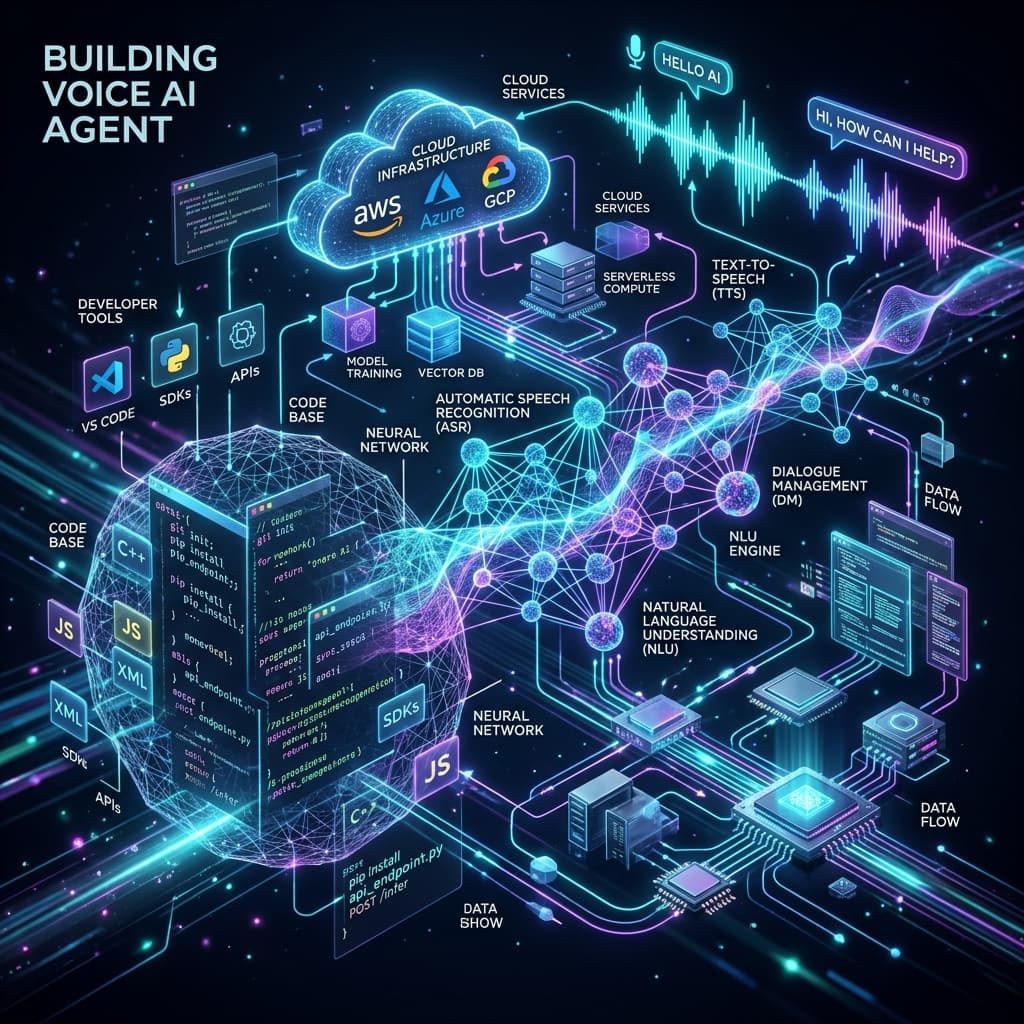
Build a production-ready AI voice agent from scratch in 2026. This step-by-step tutorial covers the complete stack: STT with Deepgram, LLM with GPT-4o, TTS with ElevenLabs, telephony with Twilio, and real-time orchestration with Pipecat — plus the no-code path if you want to skip the engineering.