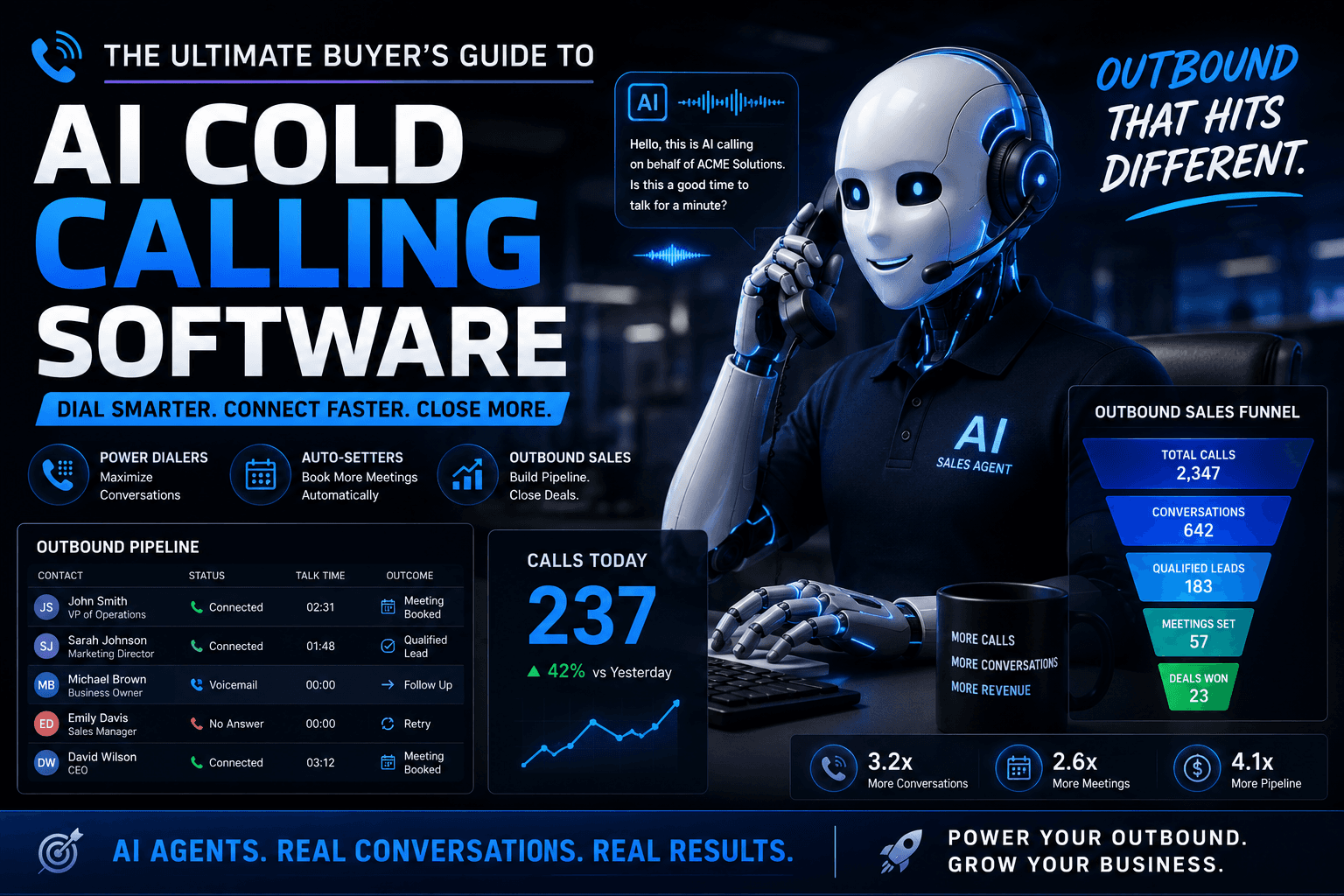
AI Cold Calling Software in 2026: The Complete Buyer's Guide
Dialers, auto-setters, objection scripts, TCPA rules, and outbound sales ROI math — everything you need to deploy AI cold calling at scale.
Utkarsh Mohan•May 23, 2026
AI voice agent for solar companies: instant lead qualification, site survey appointment setting, and TCPA-compliant outbound dialing to cut CAC by 40-60%.
Utkarsh Mohan
Published: Mar 31, 2026

The residential solar market in the United States continues to expand at more than 20% annually. With the average residential installation valued between $20,000 and $35,000 and the federal Investment Tax Credit locked at 30% through 2032, the commercial opportunity for solar installers has never been larger. Yet beneath that headline growth lies a quiet profitability crisis: customer acquisition costs that routinely run $2,000 to $5,000 per signed contract—and in highly competitive metro markets, considerably more. That pressure directly compresses margins on the most important metric in a solar business: cost per installed watt.
The cause is rarely a shortage of leads. Between paid digital advertising, purchased lists, door-to-door canvassing, utility partnership inquiries, and referral programs, most solar companies generate meaningful volume. The problem is what happens after the lead arrives—slow follow-up, inconsistent homeowner qualification, missed callbacks, scheduling friction, and no systematic re-engagement of aged pipeline prospects. Every one of those failure points is an operational problem, not a market problem. An AI voice agent for solar companies attacks each of them simultaneously: at scale, 24/7, and at a fraction of the cost of additional human sales development representatives. This guide explains exactly how—including the TCPA compliance rules your team must follow before dialing at scale.
The Solar Energy Industries Association and leading industry analysts consistently report that soft costs—sales, marketing, customer acquisition overhead, and permitting—now account for roughly 60-65% of the total installed cost of a residential solar system. Hardware costs have fallen dramatically over the past decade due to manufacturing scale and global supply chain efficiency. But all-in homeowner prices have not fallen proportionally, primarily because the labor-intensive customer acquisition process has failed to modernize at the same pace.
The funnel math is revealing. A solar company spends $150–$300 per lead through Google Ads, Facebook, or third-party aggregators like EnergySage or SolarReviews. Of those leads, only 30–40% answer the first call. Of those reached, 50–60% pass basic qualification. Of those qualified, 40–50% agree to a site survey. Of those scheduled, 70–75% actually show up. Of those who receive a proposal, 20–30% sign. The compounding effect of these conversion losses means a company may need 25–50 raw leads to close a single installation. Solar lead qualification AI attacks every stage of that funnel simultaneously.
| Funnel Stage | Typical Conversion Rate | Primary Failure Point | AI Voice Agent Impact |
|---|---|---|---|
| Raw Lead to Contact | 30–40% | Delayed follow-up; leads go cold within minutes | 95%+ contact rate within 60 seconds of form submission |
| Contact to Qualified | 50–60% | Inconsistent questioning; key criteria skipped | Standardized 7-point qualification on every single call |
| Qualified to Appointment Set | 40–50% | Scheduling friction; no available slots offered live | Real-time calendar access; instant booking during the call |
| Appointment Set to Completed | 70–75% | No-shows from weak confirmation cadence | Multi-channel reminders at 48 hr, 24 hr, and 2 hr before |
| Proposal to Signed Contract | 20–30% | Slow follow-up; no urgency framing; reps move on | Automated follow-up sequences with incentive deadline framing |
| Overall Lead-to-Close | 2–4% | Cumulative losses across every stage of the funnel | 8–12% with full AI pipeline automation across all stages |
Solar sales funnel: typical human-driven conversion rates versus AI-augmented pipeline results at each stage
The irony is that a substantial share of this leakage is entirely preventable. Leads that go uncontacted for hours, qualified homeowners who never receive a follow-up call, appointments that are scheduled inefficiently or confirmed inadequately—these are operational failures. Solar sales call automation through an AI voice agent corrects all of them simultaneously without adding headcount, without burnout, and without the inconsistency that comes from a rotating cast of SDRs with varying skill levels and energy.
The single most well-documented principle in lead conversion is speed-to-lead: the faster you contact a prospect after they express interest, the higher the probability of converting them. Research from InsideSales.com, Harvard Business Review, and numerous solar-specific studies align on this finding. In the residential solar market, where homeowners frequently submit inquiry forms to multiple installers simultaneously through comparison portals, speed-to-lead is not merely important—it is often the entire competitive differentiator. The first company to call frequently wins the appointment, regardless of panel brand, warranty, or financing terms.
Yet the operational reality at most solar companies stands in stark contrast. Sales development reps are juggling existing pipeline calls, attending team meetings, driving between site surveys, or simply off the clock when new leads arrive. The industry average first-contact time ranges from 2 to 24 hours. A prospect who submits a form at 8:47 PM on a Tuesday night and receives a call at 10:15 AM Wednesday has, in most cases, already committed to a competitor who called at 8:49 PM. The emotional window for the solar decision—curiosity, motivation, openness to the conversation—is narrowest at the moment of inquiry and widens for competitors with every passing minute.
This is where an AI voice agent for solar companies delivers its most immediate, measurable return. The instant a lead form is submitted—from the company website, a Google Ads landing page, a Facebook lead ad, a third-party marketplace, or a utility program portal—the AI agent initiates an outbound call within seconds. The homeowner's phone rings while they are still at their computer, still thinking about solar, still emotionally engaged. The AI greets them by name, references their specific inquiry, and opens a qualification conversation before any competitor has even seen the lead notification in their CRM.
“Before we deployed our AI voice agent, our average speed-to-lead was over four hours. We were losing deals to competitors who simply called first. Within the first month of automation, our contact rate jumped from 32% to 89%, and our cost per acquisition dropped by 47%. The math was undeniable—we were paying less for better results.”
— Illustrative scenario based on reported AI deployment outcomes in the solar industry
Speed without structure produces noise, not pipeline. Solar sales are uniquely complex because multiple hard qualification criteria must be satisfied before a site survey investment is worthwhile. Dispatching a design engineer and sales consultant to a rental property, a north-facing roof covered in shade, or a home with a $55 monthly electricity bill wastes $200–$500 in direct labor and opportunity cost per failed visit. Solar lead qualification AI prevents this by applying a standardized 7-point homeowner screening framework to every single lead—conversationally, without the prospect feeling interrogated.
By working through these seven points conversationally, the AI voice agent for solar companies produces a structured qualification score and data packet for every lead. Hot leads—homeowners who own their property, have a sound roof, manageable shade, a meaningful electricity bill, no blocking HOA situation, near-term decision intent, and clarity on financing—are immediately routed into the appointment-booking flow. Warm leads with one or two unresolved criteria are tagged for human follow-up with specific context notes. Cold leads—renters, very low bill amounts, or properties with insurmountable shade—are politely thanked and removed from active pipeline, preserving sales team bandwidth for prospects with genuine conversion potential.
Book a demo and watch Ringlyn AI qualify a real solar lead in under 3 minutes — including homeownership, roof age, shade, bill size, HOA status, timeline, and financing intent.
Once a lead is qualified, the next critical conversion point is scheduling the on-site survey—the in-person visit where a consultant or design engineer evaluates the property, takes measurements, assesses the electrical panel, and presents a customized proposal. Every friction point in the scheduling process represents lost revenue. Traditional methods require an SDR to check technician availability, call the homeowner back with proposed times, negotiate conflicts, and manually enter the appointment into the CRM. This introduces delays of 24–72 hours between qualification and scheduling—and every hour of delay reduces the probability the homeowner will keep the appointment.
Solar appointment setting automation through an AI voice agent removes this friction entirely. With real-time integration into the company's scheduling platform, the AI sees every available slot across all technicians and territories. It offers the homeowner two or three convenient options—'I have openings this Thursday at 2 PM or Saturday morning at 10 AM. Which works better for your schedule?'—and confirms the booking immediately. The homeowner gets a confirmation via SMS and email within seconds. The assigned technician gets a notification with the property address, full qualification notes, and driving directions. The CRM record is created automatically with complete structured data—no manual entry, no delay, no gaps.
Also read: AI Cold Calling Software in 2026: The Complete Buyer's Guide — Dialers, Scripts, TCPA Rules, and ROI
The residential solar industry has been one of the most heavily scrutinized sectors for TCPA (Telephone Consumer Protection Act) violations. The FCC and class-action plaintiffs' attorneys have targeted solar lead generators and installers alike for consent practices that tied a single lead-form submission to calls from dozens of unrelated sellers. Before deploying AI cold calling for solar at any meaningful scale, every solar company must understand what the TCPA requires—and what it prohibits—for automated and AI-driven outreach.
The core TCPA requirement for outbound automated or AI-driven calls to cell phones is prior express written consent. 'Written' in the TCPA context means the homeowner must have affirmatively agreed—in writing, which includes digital signatures and web-form checkboxes—to receive autodialed or artificial-voice calls from your specific company, for the specific purpose of solar sales. A lead purchased from an aggregator, or generated through a comparison site where the homeowner's consent was collected for 'multiple solar companies,' does not satisfy the one-to-one consent requirement that the FCC has been enforcing since 2024. The consent must name your company as the calling entity.
Beyond the consent framework, solar companies running outbound AI dialing campaigns must adhere to several additional rules. Calling hours are restricted to 8 AM–9 PM in the homeowner's local time zone—not the company's—making time-zone-aware scheduling essential when running national campaigns. The National Do Not Call Registry must be scrubbed at least every 31 days, and company-specific internal DNC lists must be honored immediately upon request. Predictive dialers that abandon calls before connecting to a live agent or AI must keep the abandoned call rate below 3% averaged over a 30-day period. And in two-party consent states—including California, Florida, Illinois, Maryland, Massachusetts, Michigan, Oregon, Pennsylvania, and Washington—calls must be disclosed as recorded at the start of the conversation.
Ringlyn AI's platform includes built-in TCPA compliance tooling: DNC list scrubbing integrations, time-zone-aware call scheduling, configurable call-recording disclosure prompts, abandoned call rate monitoring, and audit-ready call logs. For AI for solar installers operating in multiple states, the platform can apply state-specific compliance rules to individual numbers based on area code or verified address, ensuring your outbound campaigns remain defensible without requiring manual per-state configuration.
While inbound lead response and qualification deliver the highest immediate ROI, the full strategic potential of AI cold calling for solar extends far beyond reactive engagement. Three outbound campaign types are particularly valuable for solar companies and were previously impossible to execute at scale with a human-only SDR team: neighborhood saturation, referral program activation, and aged-lead reactivation.
When a solar installation is completed on a residential street, a powerful social proof effect activates. Neighbors notice the panels, ask questions at the mailbox, and become measurably more receptive to solar conversations. An AI voice agent for solar companies converts this into an automated, data-driven outbound campaign. Using geographic data, the system identifies every residential property within a defined radius of a completed installation—typically 0.25 to 1 mile—and initiates outbound calls to those homeowners with a personalized, consent-compliant message that references the nearby installation as social proof. The AI qualifies interested homeowners on the spot and books site surveys for those with genuine intent. Cost per lead from these campaigns is typically 60–80% lower than paid digital advertising because the targeting is geographically precise and the social proof accelerates conversion.
Most solar companies offer referral bonuses of $500–$1,000 per successful referred installation, but systematically activating satisfied customers to provide referrals is operationally difficult when sales reps are focused on closing new deals. The solar sales AI phone agent solves this by conducting post-installation satisfaction calls that naturally transition into referral requests. After confirming the customer is satisfied and addressing any minor questions, the AI asks: 'We offer a $750 referral bonus for any friend, family member, or neighbor who goes solar with us. Is there anyone in your network who has mentioned rising utility bills or interest in solar?' When the customer provides names, the AI immediately notes them for consent-compliant outreach—one of the highest-converting lead sources in the residential solar industry.
The most overlooked revenue source in most solar companies is the existing pipeline of leads that went cold—homeowners who expressed interest 3, 6, or 12 months ago but never converted. Sales reps naturally prioritize fresh leads, and systematic re-engagement of aged prospects is the first thing that gets sacrificed when workload increases. Yet industry data consistently shows that many of these homeowners are still interested—they simply got distracted, were not ready to commit financially, or were waiting for the right trigger. A rate increase notice from the utility, a neighbor who just went solar, a conversation at a barbecue—any of these can reignite buying intent in a prospect your team has long since stopped contacting.
| Capability | AI Voice Agent | Traditional Solar Sales Team |
|---|---|---|
| Speed-to-lead on new inquiries | Under 60 seconds, 24/7/365 including evenings and weekends | 2–24 hours average; varies by time of day, rep availability, and staffing gaps |
| Lead qualification consistency | 100% adherence to 7-point homeowner screening framework on every call | Varies by rep experience and energy level; key criteria frequently skipped under workload pressure |
| Appointment scheduling speed | Real-time booking during the live qualification call; instant multi-channel confirmation | Requires callback or manual calendar check; 24–72 hour delay between qualification and booking |
| Follow-up sequence execution | Automated multi-touch sequences executed precisely on schedule; no leads forgotten | Inconsistent; reps prioritize freshest leads and aged pipeline prospects drop from active follow-up |
| Outbound dialing capacity | Thousands of TCPA-compliant personalized calls per day with consistent quality | 50–80 dials per rep per day with quality degrading as volume increases |
| Evening and weekend coverage | Full coverage with identical performance quality at no incremental cost | Limited or nonexistent without significant overtime premiums or dedicated after-hours staffing |
| TCPA compliance controls | Built-in DNC scrubbing, time-zone scheduling, recording disclosure, abandoned call monitoring | Dependent on rep training and manual process adherence; hard to audit at scale |
| Cost per qualified appointment | $40–$100 including AI platform cost and lead cost | $150–$400 including fully loaded labor, overhead, benefits, and lead cost |
A standalone voice agent that cannot read from and write to the systems the solar company already operates on is fundamentally limited in value. The true power of a solar sales AI phone agent emerges when it is deeply integrated with the company's existing technology stack—particularly the solar-specific CRM platforms and design tools that are central to the daily sales workflow. These integrations transform the AI agent from a phone-answering automation into an intelligent hub within the company's operational infrastructure.
Aurora Solar is the leading solar design and sales platform used by thousands of installers to create accurate system designs, generate shade analyses from satellite imagery, and produce customer-facing proposals. When the AI voice agent is integrated with Aurora, it can pull preliminary design data—estimated system size, projected annual production, estimated first-year savings—into the qualification conversation with the homeowner. After an appointment is booked, the system automatically generates a preliminary Aurora project file with the homeowner's address, utility provider, and electricity consumption data, giving the design team a significant head start on proposal preparation before the technician's wheels even hit the driveway.
Enerflo, along with platforms like SolarNexus, Salesforce, and Zoho CRM, serves as the operational backbone for solar companies managing pipeline, project milestones, and customer communications. The AI voice agent for solar companies integrates bidirectionally with these systems. On the inbound side: the AI pulls lead data, appointment history, proposal status, and prior conversation logs to deliver a fully contextualized call experience—so a homeowner who was contacted three months ago hears their name and a reference to their previous conversation, not a cold opening. On the outbound side: every call outcome, qualification score, appointment booking, and full conversation transcript syncs to the CRM record in real time, ensuring every team member has complete, current information about every prospect.
This integration also powers workflow automation. When the AI qualifies a lead and books an appointment, the CRM can automatically generate a project folder, notify the assigned technician, queue up a pre-visit information packet for the homeowner, and schedule a post-survey follow-up call—all without a single manual action from an office coordinator. The result is a seamless, automated pipeline from initial inquiry to signed contract, with human expertise applied precisely where it adds the most value: consultative sales conversations and proposal negotiations.
| Integration Point | Data Flow | Key Functionality | Business Impact |
|---|---|---|---|
| Aurora Solar | Bidirectional | Satellite shade analysis, preliminary system sizing, proposal generation triggers | Design data ready before site visit; faster proposal turnaround and better-informed technicians |
| Enerflo / SolarNexus | Bidirectional | Lead management, pipeline tracking, milestone automation, rep assignment | Zero manual data entry; complete audit trail for every prospect at every pipeline stage |
| Google Calendar / Outlook | Bidirectional | Technician availability, appointment scheduling, pre-appointment reminder triggers | Optimized survey scheduling density; reduced technician drive time between properties |
| Twilio / Telephony | Outbound | AI call initiation, SMS confirmations, voicemail detection and drop | Instant multi-channel communication on every lead event, 24/7 |
| Utility Rate Databases | Inbound read | Current rate structures, time-of-use schedules, net metering and net billing policies | Accurate, location-specific savings estimates during every qualification call |
| Incentive Program APIs | Inbound read | Federal ITC status, state rebates, SREC pricing, utility-specific performance incentives | Real-time incentive information creates legitimate urgency and proposal accuracy |
Solar AI voice agent integration ecosystem: data flows, functionality, and measurable business impact across the core technology stack
Solar carries reputational baggage that most industries do not. Aggressive door-knocking, high-pressure closes, and a decade of misleading savings claims mean a meaningful share of homeowners answer the phone already suspicious. Automation amplifies whatever approach you already have — if your script is pushy, an AI runs the pushy script perfectly, thousands of times, and your brand pays for it. These are the failure modes worth engineering out before launch.
There is a commercial argument here as well as a compliance one. Solar customer acquisition cost is high enough that a burned neighbourhood is expensive, and referrals are one of the cheapest channels available to an installer. An agent that qualifies honestly and disqualifies quickly protects the referral pool that makes the next hundred sales cheaper.
Not all AI voice platforms are built for the complexity that residential solar sales demands. The homeowner who is considering a $25,000–$35,000 decision on their home expects a conversation that feels knowledgeable, empathetic, and responsive—not robotic. Solar-specific qualification criteria, incentive-dependent financial narratives, multi-state compliance requirements, and deep CRM integration needs mean that a generic voice bot will underperform significantly compared to a platform purpose-built for high-stakes, consultative sales environments. Ringlyn AI delivers precisely this.
Ringlyn AI's AI for solar installers features sub-second response latency that eliminates the pauses that destroy caller trust. Conversation flows adapt dynamically based on homeowner responses—if a homeowner mentions battery storage interest, the AI pivots naturally to discuss backup power, time-of-use rate optimization, and the NEM 3.0 economics in California without missing a beat. Built-in TCPA compliance controls include DNC list scrubbing, time-zone-aware scheduling, consent verification workflows, call-recording disclosure automation, and per-state compliance rule application—ensuring every outbound campaign is legally defensible from day one.
Ringlyn AI provides comprehensive analytics dashboards giving solar leadership complete pipeline visibility: calls initiated, contacts made, qualification outcomes by criteria, appointments booked, no-show rates, follow-up sequence performance, and outbound campaign conversion by neighborhood or list source. Every call is recorded and transcribed, creating a searchable knowledge base that informs both sales strategy and rep training. For solar sales call automation that scales with the business rather than constraining it, the platform handles seasonal volume spikes—the annual surge in solar inquiries during spring and summer—without degradation in response time or call quality. Going from 500 leads per month to 5,000 requires no additional headcount on the AI side, only infrastructure that is already priced into the platform.
“We went from processing 400 leads a month with six SDRs to handling 1,800 leads a month with two SDRs and our AI voice agent. Cost per qualified appointment dropped from $280 to $85. Our appointment-to-close ratio actually improved because qualification was more consistent, and our two remaining SDRs focus exclusively on high-value consultative selling. It completely changed our unit economics.”
— Illustrative scenario based on reported outcomes from solar companies deploying AI voice agent platforms
See how Ringlyn AI qualifies solar leads in under 3 minutes, books site surveys instantly, runs TCPA-compliant neighborhood campaigns, and reactivates your aged pipeline — all without adding SDR headcount.
Also read: AI Phone Agents for Home Services Dispatch
An AI voice agent for solar companies is an automated phone agent that handles outbound and inbound calls across the entire solar sales pipeline—contacting new leads within seconds of form submission, running a structured homeowner qualification conversation, booking site survey appointments in real time, and executing follow-up sequences on a programmatic schedule. The AI uses natural language processing to conduct fluid phone conversations, captures structured qualification data directly into the solar CRM, and escalates to a human rep whenever the conversation requires consultative expertise or the homeowner requests to speak with a person.
Yes, but compliance requires careful configuration. TCPA requires prior express written consent naming your specific company before making any autodialed or AI-generated call to a cell phone. Purchased lead lists or aggregator-generated consent do not satisfy the FCC's one-to-one consent standard enforced since 2024. Solar companies must also scrub outbound lists against the National DNC Registry at least every 31 days, restrict calls to 8 AM–9 PM in the recipient's local time zone, disclose call recording in all-party consent states, and keep abandoned call rates below 3%. Ringlyn AI's platform includes built-in TCPA compliance tooling—DNC scrubbing, time-zone-aware scheduling, recording disclosure automation, and audit-ready call logs—to make compliant outbound campaigns operationally practical.
Ringlyn AI's solar lead qualification framework evaluates homeowners across seven criteria during the initial call: property ownership, roof age and condition, shade and orientation, monthly electricity consumption, HOA or deed restrictions, decision timeline and buying motivation, and financing readiness. Each criterion is captured through conversational questions that feel natural rather than interrogative. The AI produces a qualification score and structured data packet for every lead. Hot leads are immediately routed to the appointment-booking flow. Warm leads with one or two unresolved criteria are tagged for human follow-up with specific context notes. Cold leads are politely removed from active pipeline with a clear disposition recorded in the CRM.
Ringlyn AI books site survey appointments during the live qualification call—while the homeowner is still on the phone, while their motivation is at its peak. The AI accesses the company's calendar in real time, offers two or three available time slots, and confirms the booking immediately upon the homeowner's choice. The homeowner receives an SMS and email confirmation within seconds. The assigned technician receives a notification with the full qualification data and property address. The average time from 'yes, I'm interested' to confirmed appointment on the calendar is under three minutes—compared to the 24–72-hour delay typical when scheduling requires a separate callback.
Aged solar leads respond best to contextually relevant re-engagement rather than generic callbacks. Ringlyn AI's follow-up sequences use CRM data to craft personalized outreach: referencing the original conversation date, noting specific objections previously raised, and introducing a new trigger such as a recent utility rate increase, a completed solar installation nearby, or an improved financing offer. The most effective reactivation sequences run at days 5, 21, and 60 after the lead goes cold, then quarterly thereafter. The post-no-show recovery automation—calling within 30 minutes of a missed appointment—is a particularly high-ROI automation, recovering 30–40% of no-show appointments that would otherwise be permanently lost.
Ringlyn AI integrates bidirectionally with Aurora Solar, Enerflo, SolarNexus, Salesforce, Zoho CRM, and other major solar industry platforms. Lead data, qualification scores, appointment bookings, call recordings, and full conversation transcripts sync automatically in real time. When the AI books an appointment, the integration can automatically generate a preliminary Aurora project file, create the CRM opportunity record, assign the appropriate technician, and trigger downstream workflow automations including homeowner pre-visit emails and post-survey follow-up call scheduling. All data flow is configured during the onboarding process, typically completed within 2–3 weeks of deployment start.
Yes. Ringlyn AI's solar conversation flows include extensive objection-handling coverage for the most common homeowner concerns: upfront cost and payback period concerns, roof damage fears, aesthetics and HOA restrictions, long-term commitment hesitation, moving before the system pays off, NEM 3.0 changes in California, skepticism about electricity savings projections, and general 'it's not right for me' dismissals. The AI responds with empathetic, data-supported answers. For complex objections that require nuanced human expertise—such as detailed structural engineering questions or unusual utility tariff situations—the AI performs a warm transfer to a live solar consultant with a real-time context whisper, so the homeowner never has to repeat themselves.
Neighborhood saturation campaigns use the social proof created by completed solar installations in a geographic area. When a system is commissioned, Ringlyn AI can automatically identify all residential properties within a defined radius—typically 0.25 to 1 mile—and initiate TCPA-compliant outbound calls to those homeowners referencing the nearby installation: 'We recently completed a solar installation for a neighbor on [Street Name], and I wanted to let you know about a special neighborhood program.' The AI qualifies interested homeowners on the spot and books site surveys directly. Campaign lists are scrubbed against the National DNC Registry and only include numbers for which the company holds appropriate consent documentation. Cost per lead from these campaigns is typically 60–80% lower than comparable digital advertising spend.
Solar companies typically see measurable ROI across five dimensions within the first 90 days: a 50–70% reduction in cost per qualified appointment versus a fully loaded human SDR; a doubling or tripling of contact rate from sub-60-second speed-to-lead automation; a 15–25% reduction in appointment no-show rates from automated multi-channel confirmation sequences; a 10–20% increase in appointments generated from existing aged pipeline through systematic follow-up; and the capacity to run outbound campaigns—neighborhood saturation, referral activation, re-engagement—that were simply impossible at scale with a human-only team. For a solar company spending $50,000 per month on lead generation, even a 30% CAC reduction saves $15,000 monthly, delivering $180,000 in annual savings while simultaneously increasing installed capacity and total revenue.
Dialers, auto-setters, objection scripts, TCPA rules, and outbound sales ROI math — everything you need to deploy AI cold calling at scale.
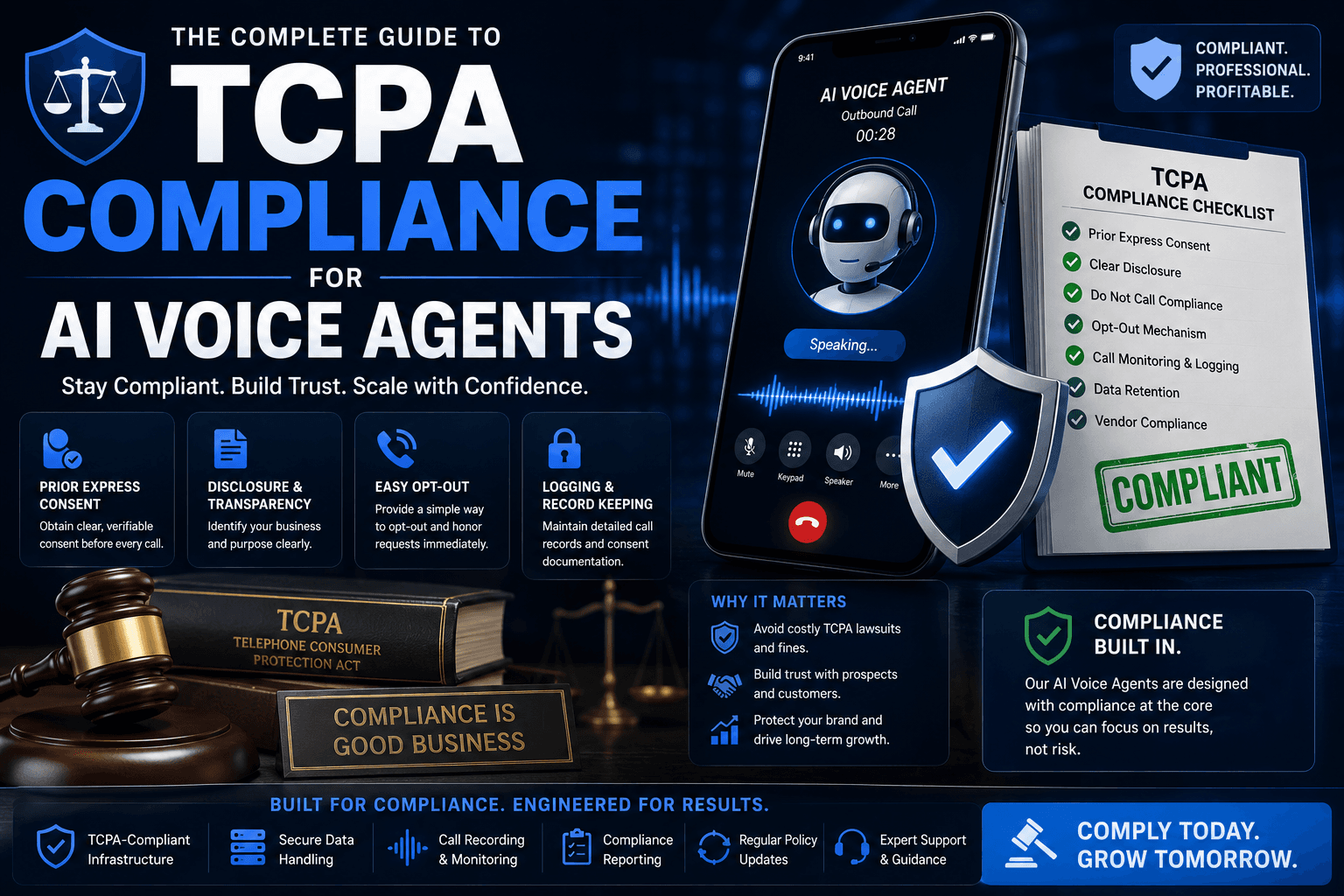
What TCPA actually requires for AI-driven calls, the FCC's one-to-one consent enforcement, Texas SB 140, recording rules, and branded caller ID.

The complete playbook for deploying outbound AI voice agents to automate cold calling, qualify leads at scale, and accelerate pipeline velocity.