Updated June 2026 with Q2 2026 personalization performance benchmarks. Every enterprise has invested in customer data: CRM systems loaded with purchase history, CDPs tracking behavioral signals, propensity models scoring churn and upsell likelihood. But when a high-value customer calls, the AI picks up and says: 'Welcome. How can I help you today?'
That gap between the data you hold and the experience you deliver is the enterprise personalization gap — and it is the most expensive, most addressable performance hole in enterprise customer communications today. Organizations running generic AI calls are leaving 3.7× their current conversion rate on the table. Those building AI call personalization at scale are pulling ahead of competitors who have not closed this gap yet.
This guide covers everything an enterprise voice AI team needs to close the gap: what genuine AI call personalization requires technically, how to evaluate AI call personalization software, how the five-layer architecture works, Q2 2026 benchmark data across five verticals, compliance requirements, and a six-stage implementation roadmap.
See AI call personalization in action for your enterprise
Ringlyn AI's platform demonstration shows exactly how we personalize at scale — book a live walkthrough with our enterprise team
What Is AI Call Personalization?
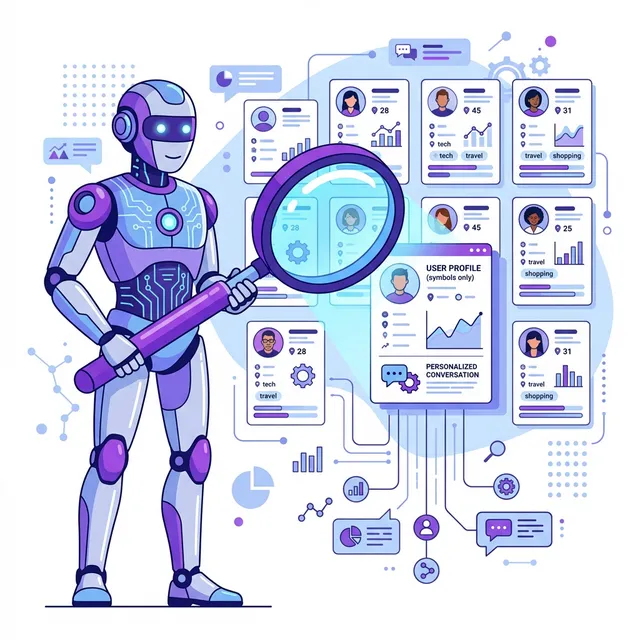
AI call personalization is the practice of dynamically adapting a voice AI agent's conversation — its opening, content, tone, pace, and objectives — based on the specific identity, history, preferences, and predicted needs of each individual caller, in real time. It is not the same as scripted variable insertion ('Hi [Name]'). That is template population. Genuine AI call personalization is a multi-dimensional adaptive system that changes what the agent says, how it says it, and what outcomes it pursues — calibrated to every caller, every time.
Enterprise-grade AI call personalization operates across five dimensions simultaneously:
- Identity Personalization: The agent knows who is calling before the first word is spoken — name, account tier, relationship tenure, and value status shape every subsequent decision in the conversation.
- Situational Personalization: The agent understands the caller's current context — open service tickets, recent purchases, pending renewals, prior commitments — and addresses it proactively, eliminating repetitive customer effort.
- Behavioral Personalization: The agent reads and adapts to real-time conversation signals — speech pace, response latency, vocabulary complexity, expressed emotion — matching the caller's communication style dynamically throughout the call.
- Preferential Personalization: The agent applies known customer preferences — language choice, communication formality, channel opt-ins, prior interaction feedback — to customize the structure and register of the conversation.
- Predictive Personalization: The agent uses propensity models and behavioral AI to anticipate what the caller is likely to need or want and surfaces it proactively, before the customer explicitly asks.
Why Personalized AI Voice Calls Outperform Generic Scripts
The performance gap between personalized AI voice calls and generic automated outreach is not incremental — it is structural. When a caller is greeted with specific, contextually accurate acknowledgment of who they are and what their situation is, three things happen simultaneously: (1) resistance drops because the call is clearly relevant; (2) engagement duration rises because the content is worth hearing; (3) conversion probability increases because the offer or resolution is calibrated to the individual's actual need.
Contrast this with a generic AI call: a scripted greeting, a one-size-fits-all value proposition, no acknowledgment of whether the customer is a decade-long high-value account or a first-time prospect. The generic call demands maximum cognitive buy-in from the customer in exchange for minimum demonstrated relevance. The result is high hang-up rates, low conversion, and brand damage from an experience that communicates we don't know you.
Voice interactions carry an average intent-to-transact signal 3.8× stronger than equivalent digital channel interactions. When AI call personalization engages that signal with contextually calibrated conversations, the performance arithmetic is transformational — not marginal. And critically, the performance gap between personalized and generic deployments is widening in 2026 as enterprise customers raise their expectations of every call they receive.
AI Call Personalization Software: The Enterprise Evaluation Checklist
Not all AI call personalization software delivers genuine personalization. Many platforms offer surface-level customization — name insertion, basic CRM lookup — marketed as personalization. Enterprise buyers evaluating AI call personalization software should use the following capability checklist to distinguish real personalization infrastructure from marketing language.
- Real-Time CRM API Integration (sub-200ms latency): The platform must pull live customer data at call initiation, not from a stale cache. Native integrations with Salesforce, HubSpot, Microsoft Dynamics, and Zoho are baseline requirements; custom API support is essential for proprietary systems.
- Multi-Source Context Assembly: Personalization that relies on CRM data alone is limited. Enterprise-grade platforms assemble context from CRM, order management, support ticketing, product entitlements, and behavioral data simultaneously at call initiation.
- Real-Time Sentiment Detection and Adaptive Dialogue: The platform must detect caller sentiment and communication register dynamically during the call and adjust the agent's response strategy in real time — not just the content, but the tone, pacing, and escalation threshold.
- Predictive Action Engine: Advanced platforms incorporate propensity models and behavioral AI to anticipate caller needs and proactively surface the right offer, resolution, or information — before the customer asks.
- Built-In Compliance Controls (GDPR, CCPA, HIPAA, TCPA): Personalization that uses personal data must be backed by consent verification, data minimization controls, AI disclosure mechanisms, and auditable interaction logging baked into the platform architecture.
- Continuous Learning Architecture: Static personalization logic degrades quickly. The platform must refine conversation logic, update propensity models, and improve personalization quality with every interaction — at scale.
- Enterprise Scalability Without Personalization Degradation: Personalization must be consistent whether the platform handles 1,000 calls per day or 1,000,000. Architecture must support burst load without quality compromise.
The Five-Layer Architecture Powering Enterprise AI Call Personalization
Delivering all five personalization dimensions in real time — across millions of calls — requires a structured technical architecture. Ringlyn AI's enterprise platform uses the following five-layer model, processing and applying all layers in under 800 milliseconds before the first word of each conversation begins.
| Architecture Layer | Function | Enterprise Technology Components | Personalization Outcome |
|---|
| Layer 1: Caller Identification | Identify caller before conversation begins | ANI/DNIS lookup, CRM real-time API, customer data platform integration | Agent greets by name, sees account tier, relationship tenure, and lifetime value status |
| Layer 2: Context Assembly | Build comprehensive caller context from all data sources simultaneously | CRM webhook, order management API, support ticket system, account data, interaction history | Agent is fully briefed on open tickets, recent purchases, pending renewals, and prior commitments |
| Layer 3: Conversation Architecture Selection | Select the appropriate conversation flow for this specific caller | Interaction scoring, segment logic, customer journey stage mapping, churn propensity scoring | High-value callers receive expedited resolution; at-risk callers receive retention-focused dialogue |
| Layer 4: Real-Time Adaptive Dialogue | Modify tone, content, and pacing based on live conversation signals | NLP sentiment analysis, speech pattern detection, real-time intent classification | Agent mirrors caller communication register, adjusts for frustration signals, activates escalation readiness |
| Layer 5: Predictive Action Engine | Anticipate caller needs and surface relevant solutions proactively | Propensity models, behavioral AI, product recommendation engine, churn scoring | Agent surfaces the right offer or resolution before the customer explicitly requests it |
Ringlyn AI Five-Layer Enterprise AI Call Personalization Architecture — all five layers execute in under 800ms at call initiation
The critical engineering constraint here is latency. If personalization processing introduces perceptible delay at call initiation, the caller experience degrades before personalization can deliver its value. Ringlyn AI's architecture maintains sub-800ms total processing time across all five layers — including live CRM API calls — so the personalized experience begins with the first word, not after a detectable pause.
AI Phone Call Personalization in Practice: A Live-Call Walkthrough
Understanding how AI phone call personalization works in a live interaction clarifies the gap between architectural theory and customer experience reality. The following scenario illustrates a real-world outbound call powered by Ringlyn AI's five-layer personalization stack.
The context: A financial services enterprise is running an outbound renewal campaign. Next in the call queue: David Chen, a seven-year customer in the Premium tier, with a support ticket opened 12 days ago for a billing discrepancy, whose renewal is 23 days away, and whose churn propensity score is elevated due to the unresolved ticket. Before the call connects, all five layers have executed: Layer 1 identifies David; Layer 2 assembles his complete context including the open ticket; Layer 3 selects the retention-focused conversation architecture; Layer 4 primes for concise, empathetic communication; Layer 5 queues a loyalty retention discount with a high acceptance rate for his behavioral segment.
The call: The AI agent opens with: 'Hi David, this is Ringlyn calling about your renewal coming up on the 22nd. Before we get to that, I wanted to confirm the billing question you raised earlier this month has been resolved — did you receive the account credit?' This opening demonstrates knowledge, removes the most likely objection proactively, and builds trust before the primary ask. A generic AI agent on the identical call would open with the renewal pitch immediately — and face the unresolved ticket as a conversation-derailing objection.
As the call proceeds, Layer 4 detects that David's speech pace is fast and his tone mildly impatient. The agent responds by shortening its turns, skipping the standard feature summary, and moving directly to the offer. Layer 5's predictive engine surfaces the loyalty discount at the optimal conversational moment. David renews. Total call duration: 3.2 minutes. Conversion rate for personalized calls in this segment: 23.7%. Conversion rate for generic calls attempting the same objective: 8.3%.
Enterprise AI Call Personalization ROI: Q2 2026 Benchmarks
The performance differential between personalized and generic AI voice deployments is substantial across every key metric. The following benchmark data is drawn from Ringlyn AI enterprise customer performance across financial services, healthcare, telecommunications, e-commerce, and professional services verticals, refreshed through Q2 2026.
| Performance Metric | Generic AI Call | Personalized AI Call (Ringlyn AI) | Uplift |
|---|
| Call completion rate | 54% | 81% | +50% |
| Average call duration | 2.1 minutes | 3.8 minutes | +81% |
| Outbound conversion rate | 8.3% | 23.7% | +186% |
| First-contact resolution rate | 71% | 91% | +28% |
| Customer satisfaction score (CSAT) | 3.4 / 5.0 | 4.4 / 5.0 | +29% |
| Outbound hang-up rate | 41% | 14% | −66% |
| Upsell / cross-sell conversion | 3.1% | 12.9% | +316% |
| Inbound escalation to human rate | 24% | 9% | −63% |
Personalized vs. Generic AI Call Performance — Ringlyn AI Enterprise Platform Benchmark Data, Q2 2026
“The performance gap between personalized and generic AI voice agents is not marginal — it is transformational. For enterprises deploying at significant call volume, AI call personalization is the single highest-leverage optimization available in 2026.”
— Ringlyn AI Enterprise Analytics Team
The revenue translation of these metrics is significant. For an enterprise running 100,000 outbound calls per month with a $250 average conversion value: improving conversion from 8.3% to 23.7% represents approximately $4.7M in incremental monthly revenue — against a marginal personalization technology cost of under $50,000 per month for an enterprise deployment of this scale. No other optimization in the enterprise voice stack approaches this return profile.
Industry Playbooks: Personalized AI Voice Calls by Vertical
AI call personalization strategy differs meaningfully across industry verticals. The data signals available, the regulatory constraints applicable, and the conversation objectives vary by sector. The following playbook table summarizes the highest-impact personalization levers and key performance outcomes for five major verticals based on Ringlyn AI enterprise deployment data.
| Industry | Primary Personalization Signals | High-Impact Personalization Moves | Key Performance Outcome |
|---|
| Financial Services | Account value, life stage, product holdings, risk profile, recent transactions | Surface relevant products based on life events; proactively address transaction anomalies; adapt compliance disclosures to customer segment | +210% loan conversion uplift; −55% inbound escalation rate |
| Healthcare | Patient history, appointment cadence, condition category, care gap status | Remind patients of care gaps before they escalate; personalize scheduling to stated preferences; adapt for health literacy level | +67% appointment adherence; −42% no-show rate |
| Telecommunications | Tenure, plan tier, data usage patterns, device history, churn risk score | Proactively offer upgrade when usage approaches plan limits; personalize retention offers using tenure and loyalty data; acknowledge recent service incidents | +189% retention offer acceptance; −49% churn for high-risk segment |
| E-commerce / Retail | Purchase history, browse behavior, cart abandonment, loyalty tier, return frequency | Open with contextually relevant product recommendations; recover abandoned carts with personalized urgency framing; reward loyalty tier with exclusive offers | +245% outbound cart recovery conversion; +3.1× repeat purchase rate |
| Professional Services / SaaS | Contract value, product usage depth, renewal date, stakeholder map, support history | Acknowledge open issues before renewal discussion; position upsell on underutilized features; tailor conversation to buyer role and seniority | +173% renewal rate for at-risk accounts; +94% upsell conversion |
AI Call Personalization Playbooks by Industry — Ringlyn AI Enterprise Customer Data, Q2 2026
Data, Integration, and Compliance for AI Call Personalization
AI call personalization quality is directly proportional to the quality, recency, and accessibility of the data informing it. Enterprise organizations typically have the data — the implementation challenge is making it available to AI agents in real time, in a structured format, at call initiation. The following requirements define the data infrastructure floor for enterprise AI call personalization.
- Real-Time CRM API Integration: Customer record data must be retrievable via live API at call initiation — under 200ms. Cached or batch-synced CRM data introduces accuracy risk and defeats real-time personalization. Ringlyn AI integrates natively with Salesforce, HubSpot, Microsoft Dynamics, and Zoho, with a custom API framework for proprietary systems.
- Unified Interaction History: All prior voice, chat, email, and digital interactions must be accessible in a single repository the AI agent can reference — eliminating redundant customer effort and enabling acknowledgment of prior commitments.
- Live Product and Account Data: For service and sales interactions, real-time access to account status, subscription data, order history, and product entitlements enables accurate, relevant agent responses without lookup delays or stale-data risk.
- Behavioral and Propensity Data: Predictive personalization (Layer 5) requires access to churn propensity scores, upsell likelihood models, and engagement trend outputs — enabling the agent to calibrate the interaction objective to the customer's predicted current state.
- Consent and Compliance Records: Personalized AI calls must verify in real time that communication consent is active, AI disclosure requirements are met for the applicable jurisdiction, and data processing is within the lawful basis on record for this customer.
On the regulatory side, enterprise AI call personalization operates across multiple compliance frameworks simultaneously. GDPR and CCPA govern data use and consent; TCPA applies to outbound calling; HIPAA applies to healthcare; the EU AI Act and state-level AI disclosure laws (California, Colorado, Illinois) require AI identification. Ringlyn AI's platform is SOC 2 Type II certified with configurable GDPR, CCPA, and HIPAA compliance controls, pre-built AI disclosure mechanisms, and audit-ready interaction logging for every call.
Implementation Roadmap: 6 Stages From Generic to Personalized AI Calls
Moving from a generic AI call deployment to a fully personalized enterprise program follows a structured six-stage implementation path. The following framework reflects the approach Ringlyn AI uses with large-scale enterprise customers across all major verticals.
- Stage 1 — Personalization Audit and Data Assessment (Weeks 1–2): Map existing customer data assets, API availability, and data quality gaps. Identify which personalization layers are immediately achievable and which require data enrichment or infrastructure changes. Define the personalization data model for AI agent integration.
- Stage 2 — Integration Architecture Design (Weeks 2–4): Design the CRM, CDP, and external data source integration architecture. Define real-time API call structure, fallback logic for data unavailability, refresh cadences, and caching strategy where appropriate.
- Stage 3 — Conversation Design and Personalization Logic (Weeks 3–6): Build personalized conversation architectures for each interaction type. Define context-dependent branches, personalization variable logic, adaptive response frameworks, emotional intelligence triggers, and dynamic objection-handling paths.
- Stage 4 — Compliance Review and Configuration (Weeks 4–6): Complete regulatory compliance review for all applicable jurisdictions. Configure AI disclosure mechanisms, consent verification workflows, data processing controls, and interaction logging infrastructure.
- Stage 5 — Pilot Deployment and Performance Calibration (Weeks 6–10): Deploy personalized agents to a defined call subset with full performance monitoring. Calibrate personalization logic on observed performance data. Validate compliance controls in a live environment before full-scale rollout.
- Stage 6 — Full-Scale Rollout and Continuous Optimization (Weeks 10+): Scale personalized agent deployment to full call volume. Activate the continuous optimization loop: performance analytics feed conversation logic refinements, propensity model retraining, and personalization architecture updates — creating a compounding performance improvement curve that generic deployments cannot generate.
The highest-performing enterprise AI call personalization programs are continuously learning systems, not static deployments. Every call generates performance data that refines conversation logic, updates predictive models, and improves future interaction quality — a compounding advantage over competitors still running generic scripts.
Q2 2026 Update: What Shifted in AI Call Personalization Performance
Q2 2026 platform data sharpens several benchmarks from earlier in 2026. The headline conversion uplift between generic and fully personalized AI calls has moved from 3.4× to 3.7×. The improvement is driven primarily by advances in real-time sentiment adaptation in the Q2 2026 model generation — better communication register matching (Layer 4) and faster predictive action triggering (Layer 5) are the primary contributors.
Two additional Q2 2026 shifts are worth flagging for enterprise teams reviewing their personalization investment case. First, the outbound hang-up rate for personalized calls has improved further — now 14% versus 41% for generic, compared to 17% versus 41% in early 2026. Second, upsell and cross-sell conversion uplift has moved from +281% to approximately +316% as predictive personalization (Layer 5) compounds with improved propensity model accuracy. For a 100,000-call/month program at a $250 conversion value, the personalization gap is now worth approximately $4.7M in incremental monthly revenue — up from $3.85M in early 2026. The technology cost to close the gap is essentially unchanged at under $50K/month for enterprise scale. The ROI case has only strengthened.
Move from generic AI calls to personalization that drives measurable results
Ringlyn AI's enterprise team will design your personalization architecture and show projected performance outcomes before you commit