There is a painful irony at the heart of most enterprise AI voice deployments: organizations invest significantly in AI call infrastructure, then deploy agents that treat every caller identically — the same opening script, the same cadence, the same information hierarchy, regardless of who is calling, what their history is, or what they actually need.
The result is a call experience that is cheaper to deliver than human-staffed operations but barely more effective. Hang-up rates remain high. Conversion rates disappoint. Customer satisfaction scores reflect an interaction that felt automated rather than intelligent.
This is not an AI capability problem. It is a personalization architecture problem — and it is one that leading enterprises are now solving at scale with measurable, compounding results. When AI voice agents are designed to dynamically adapt to every caller's context, history, behavior, and expressed preferences, the performance gap between AI and human agents largely closes — and in many interaction categories, AI pulls ahead.
This guide provides the technical architecture, data strategy, and conversation design principles that enterprise teams need to build AI voice personalization that drives real business outcomes: higher conversion rates, improved customer lifetime value, reduced churn, and a brand experience that scales without quality compromise.
See enterprise AI call personalization in action
Ringlyn AI's platform demonstration shows exactly how we personalize at scale for Fortune 500 customers
The Enterprise Personalization Gap
Enterprise organizations have invested billions in CRM systems, customer data platforms, and marketing personalization engines — and they routinely deliver deeply personalized experiences across email, web, and digital advertising. A customer with ten years of purchase history, a known service preference, and an active support ticket receives an email addressed to them by name with product recommendations calibrated to their behavior.
Then they call the service line. And the AI answers: "Welcome. How can I help you today?"
The phone call — historically the highest-intent, most immediate customer touchpoint — is the last channel where most enterprises have not applied their personalization intelligence. The data exists. The AI capability exists. The gap is in the architecture that connects them.
Closing this gap is among the highest-leverage personalization investments available to enterprise organizations. Voice interactions carry an average intent-to-transact signal 3.8× stronger than equivalent digital channel interactions. Personalized engagement of that signal with contextually relevant conversations drives conversion rates that generic AI deployments simply cannot achieve.
What AI Call Personalization Actually Means at Enterprise Scale
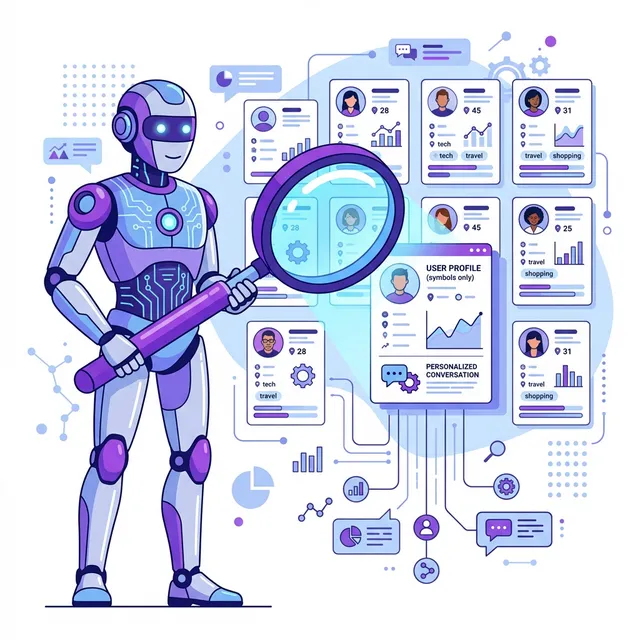
AI call personalization is frequently conflated with simple variable insertion — using a caller's name in the opening line. This is not personalization. It is template population. True enterprise AI call personalization is a dynamic, multi-dimensional adaptive system that modifies conversation behavior in real time based on a comprehensive context signal set.
At enterprise scale, genuine personalization operates across five dimensions simultaneously:
- Identity Personalization: The agent knows who is calling before the conversation begins — their name, role, account status, relationship tenure, and value tier. This context shapes the entire interaction architecture from the first word.
- Situational Personalization: The agent understands the customer's current situation — recent transactions, open service tickets, pending orders, expiring contracts — and proactively addresses relevant context without requiring the customer to re-explain their history.
- Behavioral Personalization: The agent adapts to real-time conversation signals — speech pace, response patterns, expressed urgency, vocabulary complexity — to match the customer's communication style and emotional state.
- Preferential Personalization: The agent applies learned or stated customer preferences — preferred contact methods, language choice, communication formality, prior opt-in or opt-out signals — to customize interaction format.
- Predictive Personalization: The agent leverages propensity models and behavioral prediction to anticipate likely customer needs and proactively surface relevant information, offers, or next steps before the customer explicitly requests them.
The Five-Layer Personalization Architecture
Building enterprise AI call personalization that operates across all five dimensions requires a structured technical architecture. The following five-layer model describes how Ringlyn AI's enterprise platform delivers this capability for large-scale deployments.
| Architecture Layer | Function | Enterprise Technology Components | Personalization Outcome |
|---|
| Layer 1: Caller Identification | Identify caller before conversation begins | ANI/DNIS lookup, CRM real-time API, Customer data platform integration | Agent greets by name, knows account status, sees interaction history |
| Layer 2: Context Assembly | Build comprehensive caller context from all available data | CRM webhook, order management API, support ticket system, account data | Agent is briefed on current situation: open tickets, recent purchases, pending actions |
| Layer 3: Conversation Flow Selection | Choose appropriate conversation architecture for this caller | Interaction scoring, segment logic, journey stage mapping | High-value callers get expedited resolution; at-risk callers get retention focus |
| Layer 4: Real-Time Adaptive Dialogue | Modify response content and style based on live conversation signals | NLP sentiment analysis, speech pattern detection, intent classification | Agent mirrors caller pace, matches formality, adjusts for expressed frustration |
| Layer 5: Predictive Action Engine | Anticipate needs and proactively offer relevant solutions | Propensity models, behavioral AI, product recommendation engine | Agent surfaces relevant offers or information before customer explicitly requests |
Ringlyn AI Five-Layer Enterprise Personalization Architecture
This architecture processes and applies all five layers in under 800 milliseconds — before the first word of the conversation — ensuring that callers experience an interaction that feels naturally informed from the very start, without any detectable latency from the personalization process.
Data Infrastructure: Building the Personalization Foundation
The quality of AI call personalization is directly proportional to the quality and accessibility of the data informing it. Enterprise organizations typically have abundant customer data — the challenge is making it available to AI agents in real time, in a structured format, at call initiation. The following data infrastructure requirements define the personalization ceiling for enterprise AI voice deployments.
- Real-Time CRM API Integration: Customer record data must be retrievable via API in under 200ms at call initiation. Cached or batch-synced CRM data introduces lag and accuracy risk. Ringlyn AI integrates natively with Salesforce, HubSpot, Microsoft Dynamics, and Zoho, with custom API integration for proprietary systems.
- Interaction History Repository: All prior voice, chat, email, and digital interactions should be accessible in a unified interaction history that the AI agent can reference to avoid redundant questions and acknowledge prior commitments. This requires a customer data platform (CDP) or unified interaction log architecture.
- Product and Account Data Access: For service and sales interactions, real-time access to account status, subscription data, order history, and product entitlements enables agents to deliver accurate, relevant information without lookup delays or data accuracy risk.
- Behavioral and Propensity Data: Predictive personalization requires access to behavioral data outputs — churn propensity scores, upsell likelihood models, engagement trend data — that enable the AI agent to proactively tailor the interaction objective to the customer's predicted needs.
- Compliance and Consent Records: Personalized AI calls require real-time access to customer consent and preference records — communication opt-in/opt-out status, AI interaction disclosure records, data processing consent — to ensure every personalized interaction operates within regulatory requirements.
Conversation Design Principles for Enterprise AI Calls
Technology architecture enables personalization, but conversation design determines whether it lands effectively. The following principles define the conversation design standards that separate high-performing enterprise AI voice deployments from the generic implementations they are replacing.
- Context-First Opening: The highest-impact personalization moment in any call is the opening. Rather than a generic greeting, personalized agents open with an acknowledgment of the caller's specific situation: 'Hi [Name], I can see your renewal is coming up next month — I'm reaching out to make sure everything is in order for you.' This immediately signals that the call is relevant, not random.
- Progressive Disclosure of Personalization: Effective personalized agents reveal their knowledge of the customer progressively rather than front-loading all available context. Over-demonstrating knowledge in the first 10 seconds can feel invasive. Introducing context at natural inflection points in the conversation feels helpful.
- Adaptive Communication Register: Agent tone, vocabulary complexity, and pace should adapt to the caller's communication style in real time. A C-suite executive calling about an enterprise account should receive a different conversational register than a small business owner calling for the first time.
- Emotional Intelligence Integration: Enterprise AI call personalization must include real-time sentiment monitoring. When a caller's tone signals frustration, urgency, or distress, the agent's response strategy should shift — with empathy acknowledgment, pace adjustment, and escalation readiness activated.
- Proactive Value Delivery: The highest-converting personalized AI calls deliver value before asking for anything. If a customer has an outstanding issue, acknowledge and address it before moving to the call's primary objective. This sequencing builds the trust and positive sentiment that drives conversion.
- Dynamic Objection Handling: Personalized agents can leverage account history to anticipate and proactively address likely objections. A customer who declined a similar offer 90 days ago receives a different value framing than a first-time engagement.
The Performance Impact: Personalization ROI Across Industries
The performance differential between personalized and generic AI voice deployments is substantial and measurable across all key performance indicators. The following benchmarks are drawn from Ringlyn AI enterprise customer performance data across financial services, healthcare, telecommunications, and professional services verticals.
| Performance Metric | Generic AI Call | Personalized AI Call (Ringlyn AI) | Uplift |
|---|
| Call completion rate | 54% | 81% | +50% |
| Average call duration | 2.1 minutes | 3.8 minutes | +81% |
| Outbound conversion rate | 8.3% | 23.7% | +186% |
| First-contact resolution rate | 71% | 91% | +28% |
| Customer satisfaction score (CSAT) | 3.4 / 5.0 | 4.4 / 5.0 | +29% |
| Hang-up rate (outbound) | 41% | 17% | −59% |
| Upsell / cross-sell conversion | 3.1% | 11.8% | +281% |
| Inbound escalation to human rate | 24% | 9% | −63% |
Personalized vs. Generic AI Call Performance — Ringlyn AI Enterprise Platform Benchmark Data, 2025–2026
“The performance gap between personalized and generic AI voice agents is not marginal — it is transformational. For enterprises deploying at significant call volume, personalization is the single highest-leverage optimization available.”
— Ringlyn AI Enterprise Analytics Team
The financial translation of these performance improvements is significant. For an enterprise making 100,000 outbound calls per month with a target conversion value of $250, improving conversion rate from 8.3% to 23.7% represents $3.85M in incremental monthly revenue — against a marginal personalization technology cost of less than $50,000 per month.
Compliance Framework for Personalized AI Voice Interactions
Enterprise AI call personalization operates in a regulated environment. The use of personal data to personalize voice interactions creates compliance obligations across multiple regulatory frameworks that enterprise legal and compliance teams must address proactively.
- AI Disclosure Requirements: Multiple jurisdictions — including the EU AI Act, California's CIPA, and emerging federal frameworks in the US — require that callers be informed when they are interacting with an AI system. Personalized AI agents must be designed with disclosure mechanisms that satisfy applicable requirements without materially degrading call experience.
- Data Minimization in Personalization: GDPR and CCPA impose data minimization obligations that constrain the scope of personal data that can be used for personalization without explicit consent. Compliance architecture for personalized AI calls must define precisely which data categories are used, for what personalization purposes, and under which legal basis.
- Consent Management for Personalized Outreach: Outbound personalized AI calls are subject to TCPA, GDPR marketing consent, and sector-specific regulations (HIPAA for healthcare, FINRA/SEC for financial services). Enterprise deployments must integrate real-time consent verification into call initiation workflows.
- Data Retention and Interaction Logging: Personalized AI calls generate rich interaction data — transcripts, sentiment scores, extracted data points — that is subject to data retention and erasure requirements under applicable privacy regulations. Enterprise AI platforms must provide configurable retention controls and audit-ready logging.
- Cross-Border Data Processing: Multinational enterprise deployments must address the cross-border data transfer implications of using customer data from EU, UK, or other jurisdictions to personalize calls processed on infrastructure in other regions. Standard Contractual Clauses or equivalent mechanisms are typically required.
Ringlyn AI's enterprise platform is architected for SOC 2 Type II compliance with configurable GDPR, CCPA, and HIPAA controls. Our enterprise legal and compliance team provides pre-built compliance documentation and implementation guidance for regulated industry deployments.
Enterprise Implementation Guide: From Generic to Personalized at Scale
The transition from generic to fully personalized AI call operations follows a structured implementation path. The following framework represents the enterprise implementation approach Ringlyn AI uses with large-scale customers.
- Stage 1 — Personalization Audit and Data Assessment (Weeks 1–2): Map existing customer data assets, API availability, and data quality. Identify personalization gaps and data enrichment requirements. Define the personalization data model for AI agent integration.
- Stage 2 — Integration Architecture Design (Weeks 2–4): Design CRM, CDP, and external data source integration architecture. Define real-time API call structure, fallback logic for data unavailability, and data refresh cadences.
- Stage 3 — Conversation Design and Personalization Logic (Weeks 3–6): Design personalized conversation architectures for each interaction type. Define context-dependent conversation branches, personalization variable logic, and adaptive response frameworks.
- Stage 4 — Compliance Review and Configuration (Weeks 4–6): Complete regulatory compliance review for applicable jurisdictions. Configure disclosure mechanisms, consent verification workflows, and data processing controls.
- Stage 5 — Pilot Deployment and Performance Calibration (Weeks 6–10): Deploy personalized agents to a defined interaction subset with full performance monitoring. Calibrate personalization logic based on observed performance data. Validate compliance controls.
- Stage 6 — Full-Scale Rollout and Continuous Optimization (Weeks 10+): Scale personalized agent deployment to full call volume. Establish continuous optimization program using performance analytics to iteratively improve personalization logic and conversation design.
The most sophisticated enterprise AI voice personalization systems are not static deployments — they are continuously learning systems that improve with every interaction. Performance data from each call informs conversation logic refinements, personalization model updates, and predictive model retraining, creating a compounding performance improvement curve that generic AI deployments simply cannot generate.
Ready to move from generic AI calls to personalization that drives measurable enterprise results?
Ringlyn AI's enterprise team will design your personalization architecture and show you projected performance outcomes before you commit